It’s 8:37 PM, the night before your latest UWorld block. You’re not even on Step 1 yet, but you’re already replaying the same horror reel in your head: you’re sitting in the Prometric center, the clock is running, and you’re staring at a question about… insulin. Or aspirin. Or basic physiology you’ve known since M1. And your brain? Static. Absolutely blank.
Not on some obscure lysosomal storage disease. On something your tutor would call "low-hanging fruit."
You can almost feel the panic in your chest right now. Because if you blank on simple stuff on practice questions, what happens when it’s the real exam? What if you panic so hard you forget everything? What if Step 1 becomes the day your brain decides to just… nope out?
Let’s walk through this. Because your anxiety is not totally irrational, but the catastrophe you’re picturing absolutely is.
Why You’re So Scared of “Easy” Questions
The fear isn’t just, “What if I miss questions?”
It’s deeper and way uglier:
- “If I miss easy questions, it proves I’m not actually smart.”
- “If I blank under pressure, it means I don’t belong here.”
- “If I freeze on real test day, I can’t fix it—my whole career is screwed.”
You’re not scared of difficult, obscure questions. Everyone expects to miss those. You’re scared of those questions where you read it and think, “Wait… I know this… why can’t I get to the answer?”
Here’s the part people gloss over: blanking on “simple” questions under pressure is normal human brain behavior, not a personal defect. I’ve watched absurdly smart people do this:
- Person with 255-level NBMEs: completely blanked on “What enzyme does warfarin inhibit?” for a full minute.
- Classmate who knew renal cold: forgot which side of the nephron loop was water permeable because they panicked about the clock.
- Someone I tutored: could explain RAAS beautifully but froze on a question asking what happens to renin after ACE inhibitor therapy.
And you know what? They still scored well. Because Step 1 isn’t a flawless-performance-or-you’re-dead exam. It’s a “you’ll mess up and still be okay” exam.
The Ugly Truth: You Will Blank On Test Day (And It Won’t Kill Your Score)
Let me be blunt: yes, you will blank on test day. On something simple. Probably more than once.
The question is not, “Can I prevent blanking altogether?”
The real question is, “What happens after I blank?”
Your anxiety is imagining this chain:
Blank → Panic → More blanking → Full meltdown → Total failure
Reality looks more like:
Blank → Mild panic → Use system → Make reasonable guess → Move on → Brain recovers
The difference is whether you’ve trained that “use system → move on” part.
Here’s the math nobody talks about:
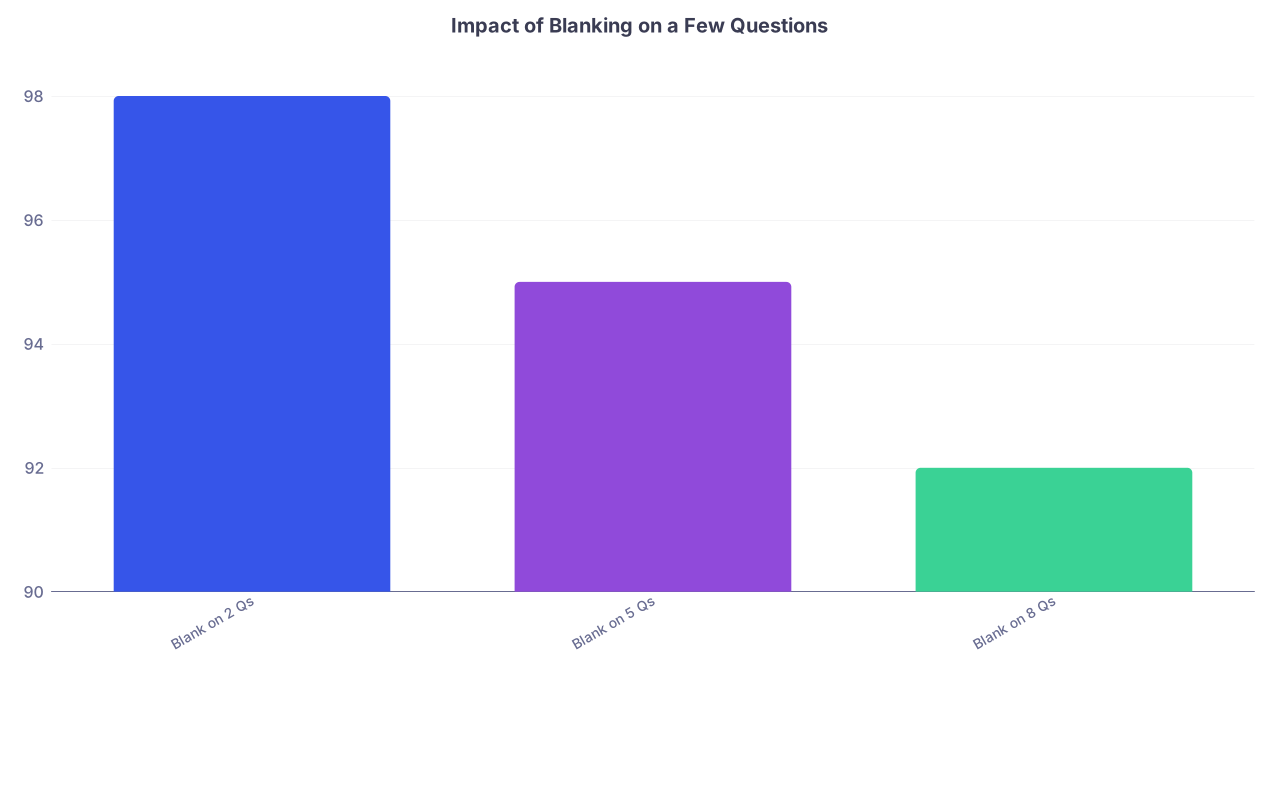
| Category | Value |
|---|---|
| Blank on 2 Qs | 98 |
| Blank on 5 Qs | 95 |
| Blank on 8 Qs | 92 |
That’s roughly what happens to your percent correct if you completely torch a handful of questions out of ~280. It moves your score. It doesn’t destroy your life.
You’re acting like blanking on 3 easy questions is the difference between “doctor” and “failed out of medicine.” It’s not. Not even close.
What “Blanking” Actually Is (It’s Not You Being Stupid)
Blanking feels like: “I know nothing.”
But what’s really going on is a mix of:
Acute stress response
Heart rate up, cortisol up, frontal lobe a little fried. You know the content; you just can’t access it cleanly.Cognitive overload
On Step 1, you’ve been reading dense questions for hours. Your working memory is tired and starts dropping stuff on the floor.Perfectionism + time pressure
You’re not just trying to get it right. You’re trying to get it right fast. That pressure alone can jam your recall.
This isn’t a character flaw. It’s physiology plus unrealistic expectations.
The “simple” question feels like a trap because your brain attaches massive meaning to it. Miss a zebra? Sure, fine. Miss “which side of the heart is systemic”? Your brain screams, “Fraud.”
That’s what spikes your panic. Not the question. The story you attach to it.
The Only Thing That Actually Saves You On Test Day: A Script
You cannot stop your brain from occasionally blanking. You can decide what you’ll do next.
You need a script. Not vibes. Not “I’ll just try to stay calm.” That’s useless when your amygdala is screaming.
Here’s a simple, brutal, test-proof script you can practice:
You read the question. Your mind blanks.
Thought appears: “Oh no, I should know this.”
Your job: do not argue with that thought. Just tag it: “Panic brain.”Ask: Is this recall or reasoning?
- Pure recall (“What enzyme…?”, “What nerve…”)?
- Or can you reason it out from path/phys/pharm?
If it’s recall and you still can’t pull it in 10–15 seconds:
- Eliminate the obviously wrong choices.
- Pick the best remaining answer.
- Mark it if you really must.
- Move on.
If it’s reasoning:
- Talk yourself through the path: “Okay, this is nephrotic, not nephritic. Protein loss → low oncotic pressure → edema…”
- Even if you’re unsure, narrow to 2 choices. Pick. Move on.
Yes, this sounds basic. It’s supposed to. The only things that work when you’re panicking are things so simple you could do them half-asleep.
You’re not going to invent brilliant new coping strategies mid-block at Prometric.
You need to train this script now:
- The next time you blank on a UWorld “easy” question, pretend it’s Step 1.
- Start the script. Time yourself.
- Practice walking away from the question when it’s not coming back.
Because the part that hurts your score isn’t the one blank. It’s the 4 questions after it that you rush because you lost a full minute arguing with yourself in your head.
“But What If I Spiral and The Whole Exam Falls Apart?”
That’s the worst-case scenario your brain keeps feeding you, right? One blank → full-blown meltdown → exam torched.
Let me say this very clearly: the exam is designed assuming you will not feel in control the whole time. Almost no one walks out feeling good. People walk out and say things like:
- “I barely recognized half the stuff.”
- “I guessed on so many questions.”
- “I for sure failed.”
And most of them… pass. Often with solid scores.
What kills you is not feeling miserable on test day. What kills you is letting that misery control your behavior.
So instead of fantasizing about a perfect, confident test day, prepare for the messy one:
You will have at least one block where you feel like you got stomped.
Plan for it. “If Block 2 sucks, I’ll reset during the break: snack, bathroom, 5 slow breaths, then block 3 starts fresh.”You will feel behind time on at least one block.
Plan for that too. “If I’m behind at question 20, I’ll prioritize speed over perfection and accept more educated guesses.”You will see questions where you know you used to know this but can’t summon it.
Plan the response. “I will choose the best available option, mark if I must, and protect the rest of the block.”
There’s a difference between anxiety that says, “I need to prepare for reality” and anxiety that says, “I must prevent all bad feelings.” The second one will destroy you.
Concrete Things You Can Do Now to Reduce Test-Day Blankouts
You want something practical, not just “stay calm.”
Fine. Here’s what actually moves the needle.
1. Simulate misery, not comfort
Don’t just do question blocks at 2 PM, fully caffeinated, with your favorite snack nearby. Do this:
- One or two full 7-block practice days (NBME + UWorld mixed)
- Wake up at test-day time. Same breakfast. Same clothes.
- No checking your phone during breaks. No long rests.
- Treat it like the real thing: timed, no pausing.
Then watch what your brain does when it’s tired in blocks 5–7. That’s your real Step 1 brain. Practice managing that version of you.
2. Track process errors, not just content errors
When you review and you see a “simple” question you missed, ask:
- Did I actually not know it?
- Or did I know it but:
- Panic?
- Rush?
- Misread?
- Change from right to wrong?
Those are different problems. Memorizing more won’t fix a panic habit. For those “knew it but choked” questions, literally write down:
“How I want to respond next time I feel this panic” in a notebook.
Yes, it’s tedious. But you’re retraining your nervous system, not just your memory.
3. Use a stupidly simple grounding routine during blocks
You don’t have time for a 5-minute mindfulness session mid-question. But you do have time for:
“Feet–Seat–Breath” (takes maybe 5 seconds):
- Notice your feet on the floor.
- Notice your body in the chair.
- One slow inhale, one slow exhale.
- Back to the question.
Do that once every 10 questions or whenever you feel that “oh no” jolt. Doesn’t have to be deep. Just enough to keep your brain from flipping fully into fight-or-flight.
4. Pre-commit to your “disaster rules”
Write these down somewhere before test day:
- “If I blank on something easy, I will give it 15–20 seconds, eliminate what I can, answer, and move on.”
- “If I’m stuck between 2, I won’t spend more than 30 seconds debating. I’ll pick and move on.”
- “If I finish a block early, I will only change an answer if I missed a keyword or misread, not because I feel vague discomfort.”
Your test-day brain will be too fried to make good rules on the fly. Give it a script.
You Don’t Have to Trust Yourself Fully to Still Perform
Here’s the real root fear: you don’t trust your own brain under pressure.
You’ve seen yourself:
- Freeze during cold calls in small groups
- Miss easy questions on practice blocks
- Forget basic facts you knew cold the day before
So your brain goes, “If I can’t even trust myself during UWorld, how the hell am I supposed to trust myself on Step 1?”
Answer: you don’t have to “trust yourself” in some spiritual sense. You just have to trust the systems you build around you:
- Your pacing rules
- Your break schedule
- Your “blanking” script
- Your practice with full-length testing days
You’re not relying on “I will be calm and confident and perfect.” You’re relying on “I will probably freak out, but I have a plan for what to do when that happens.”
That’s enough.

| Step | Description |
|---|---|
| Step 1 | Read question |
| Step 2 | Answer and move on |
| Step 3 | 10-15 sec recall attempt |
| Step 4 | Talk through path/phys |
| Step 5 | Eliminate, guess, mark, move on |
| Step 6 | Pick best of 2-3 choices |
| Step 7 | Know it immediately? |
| Step 8 | Recall or Reasoning? |
| Step 9 | Still blank? |

| Scenario | Likely Real Impact |
|---|---|
| Blank on 3 easy questions | Mild hit, still pass/solid |
| Panic one block, others okay | Overall score largely preserved |
| Feel like you guessed on 40–50 Qs | Very normal, still often pass |
| Forget a “basic” fact you knew cold | Emotionally jarring, numerically minor |
| Change right→wrong on a few Qs | Slight drop, not a catastrophe |
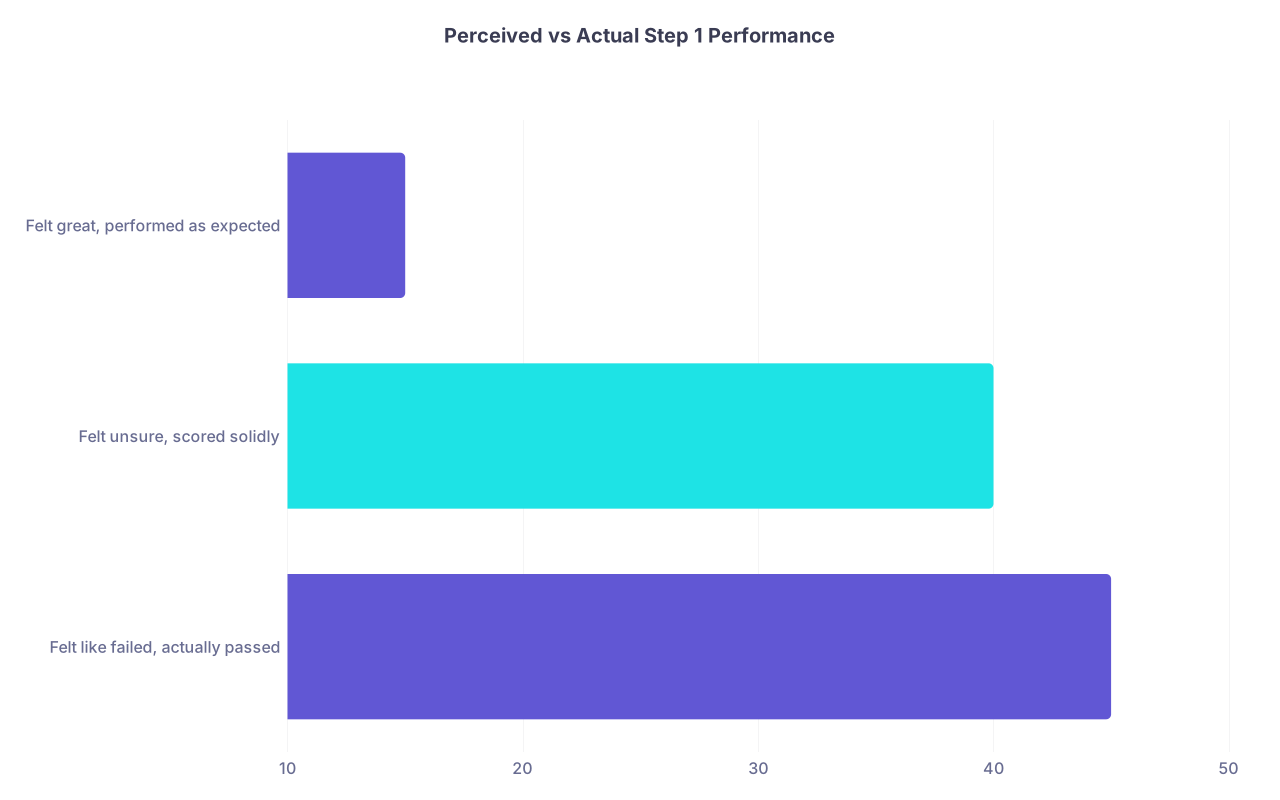
| Category | Value |
|---|---|
| Felt like failed, actually passed | 45 |
| Felt unsure, scored solidly | 40 |
| Felt great, performed as expected | 15 |
FAQ: The Six Questions You’re Probably Too Embarrassed to Ask Out Loud
1. What if I blank on the first question of the exam and it ruins everything?
Then it’s a rough start. Not a ruined day.
If question 1 feels like a brick wall, do this: grounding breath, best guess, move on. Your brain usually catches up by question 5–10 once it realizes, “Oh, we’re doing UWorld again, just with a nicer interface.”
One bad question at the start is emotionally loud, not statistically important.
2. What if I literally can’t remember anything once I sit down?
I’ve never seen that happen without some underlying medical issue (like severe sleep deprivation, intoxication, or a real neurological problem). What actually happens is:
You sit. You’re overwhelmed. The first block feels foreign. Then your brain slowly shifts from “panic” to “pattern recognition.”
Your recall won’t be perfect. But “forgetting everything” is a story your anxiety made up, not a real phenomenon for someone who actually studied.
3. Should I postpone my exam if I’m still blanking on easy practice questions?
Not automatically.
Ask:
- Is the blanking happening less than before?
- Am I scoring roughly in the passing/target range on NBMEs?
- When I review, do I usually know the material but just misfire under pressure?
If yes, the answer is not always “delay.” The answer is “work on test-taking and anxiety, not just content.” Delaying without changing your process just gives you more time to spiral.
4. Is it better to spend extra time to “force” recall on simple questions?
No. Forcing recall on a single “easy” question at the cost of rushing the last 10–15 questions in a block is a terrible trade.
If it won’t come in 15–20 seconds and it’s pure recall, you’re done. Cut your losses. Half the battle of Step 1 is knowing when to walk away from a question that’s turning into a time sink.
5. What if I cry mid-exam or feel like I’m having a panic attack?
That happens. People have stepped out to the bathroom, splashed water on their face, taken 1–2 minutes of unscheduled break (the clock runs, yes), and still passed.
If you feel yourself tipping into that zone:
- Take your hand off the mouse.
- Look away from the screen.
- Do 3 slow breaths in through your nose, out through your mouth.
- Remind yourself: “I don’t have to feel okay to choose an answer.”
Then answer the question in front of you. You’re not aiming for emotionally comfortable. You’re aiming for functional.
6. Will residency programs somehow “know” I froze and blanked during Step 1?
No. They see a score (or P/F). They don’t see your internal meltdown about forgetting which immunoglobulin crosses the placenta.
There’s no secret column that says, “Blanked on heparin mechanism, likely incompetent.” Programs care about the final score and the rest of your application, not the 30 seconds you had a minor episode on question 17 of block 3.
Key Takeaways (So You Can Stop Reading and Go Live Your Life)
- You will blank on some “simple” questions. That doesn’t doom your score.
- The damage comes from the spiral after blanking, not the blank itself—have a script and process for what you’ll do next.
- You don’t need a perfect, calm test day to pass (or even do well). You just need systems that still work when you’re anxious and tired.
You’re not the only one terrified of your brain betraying you on Step 1. The fear is loud. The catastrophe it predicts is not real.