
The most dangerous Step 1 mistake isn’t a low NBME score. It’s taking the exam anyway because you’re scared to delay.
You’re not crazy for thinking, “What if I just… never get a passing NBME? What if I’m that person?” I’ve heard that exact sentence whispered in libraries, stairwells, and outside prometric centers. More than once.
Let’s walk through this like someone who’s actually losing sleep over it. Because you’re not asking, “How do I raise my score?” You’re asking, “Am I about to destroy my career if I delay… or if I don’t delay?”
You’re stuck between two bad-feeling options:
- Sit for Step 1 with NBMEs that keep saying “fail”
- Delay and feel like you’re falling behind everyone else
So which one is actually worse?
The blunt truth: your NBMEs matter more than your feelings
You can feel “kind of ready” and still fail Step 1.
NBMEs are not perfect, but they’re still the best crystal ball you’ve got. When people ignore them, that’s when the horror stories happen.
Here’s the piece everyone secretly wants to know:
If your recent NBMEs are clearly below passing range and not trending up, you should seriously consider delaying. Even if:
- Your school says your date is “fine”
- Your friends “felt the same” and passed
- You’re just sick of studying and want it over with
Step 1 is now Pass/Fail. That doesn’t mean it’s low-stakes. A fail still shows up. Programs still see it. Some doors quietly close.
So your decision isn’t: “Do I want a great score?”
It’s: “What strategy gives me the highest chance to pass on the first attempt?”
Because that’s the real game now.
What NBME scores actually mean (and when “almost passing” is still too risky)
Let’s put some structure to the dread.
The passing Step 1 score is 196 (check the current value with FSMB/USMLE because it can change). NBMEs now report a 3-digit score that roughly correlates with that scale.
Here’s the non-sugarcoated breakdown of what your most recent NBME scores usually mean for risk:
| Recent NBME Range | Rough Pass Chance | Risk Level |
|---|---|---|
| 205+ | High | Low |
| 200–204 | Moderate–High | Moderate |
| 195–199 | 50/50 territory | High |
| 190–194 | Low | Very High |
| <190 | Very low | Extremely High |
Is this exact? No. But I’ve seen similar numbers play out over and over.
Now add this ugly but honest twist:
If your trend is flat or dropping, even a 195–200 should make you nervous.
If your trend is clearly rising, a 195–200 a week or two before the exam might be okay, especially if:
- You’ve improved steadily over multiple NBMEs
- That score is with minimal memorized questions
- You’re not burning out or guessing blind on half the test
But there’s a reason that 205+ right before the test is the comfort zone. Not because you “need” that to pass. Because life happens. Bad sleep happens. Weird test forms happen.
Having a buffer is how you sleep the night before.
The nightmare loop: when you keep failing practice NBMEs
Let’s name the situation you’re probably in:
- You’ve taken multiple NBMEs
- They’re consistently below passing
- You convince yourself each one is a fluke
- You promise to do “one more NBME” before deciding
- That one is also low
- Now you’re closer to your test date and even more trapped
I’ve watched people ride this NBME roller coaster:
- NBME 25: 182
- Panic, grind UWorld 10 hours a day, no strategy shift
- NBME 26 two weeks later: 186
- “Okay but I felt better… maybe?”
- NBME 28 a week before exam: 188
- “If I postpone now, I wasted all this time…”
That’s the trap. The sunk-cost brain trap.
Here’s the harsh reality:
If you’ve taken 3+ NBMEs in the 180s–low 190s with no real upward movement, you don’t have a “bad test-taking day” problem. You have a knowledge and/or strategy gap big enough to absolutely justify delaying.
Not failing. Delaying. Very different things.
A simple decision rule: when you should strongly consider delaying
Here’s the version I wish someone had shoved in my face when I was spiraling:
If you’re:
- Within 2–3 weeks of your exam date
AND - Your last two NBMEs are:
- Below 195
- Or 195–199 but flat/no clear upward trend
You should actively plan for a delay. Not as an emotional reaction, but as a strategic move.
Flip it around:
You’re probably okay to sit (not guaranteed, but reasonable) if:
- Your last two NBMEs are:
- 200+
- Within 7–10 days of the exam
- Done under honest conditions (no pausing, no peeking, no extended untimed mode)
And the trend across your last 3–4 NBMEs looks like this:
- 187 → 196 → 201 → 206
vs - 196 → 193 → 195 → 197 (this second one should make you uneasy)
But won’t delaying ruin everything? (Reality check)
This is the part your anxiety is chewing on:
“If I delay:
- Will I fall behind my class?
- Will I mess up rotations, graduation, residency?
- Will programs think I’m weak?”
Let’s separate fear from fact.
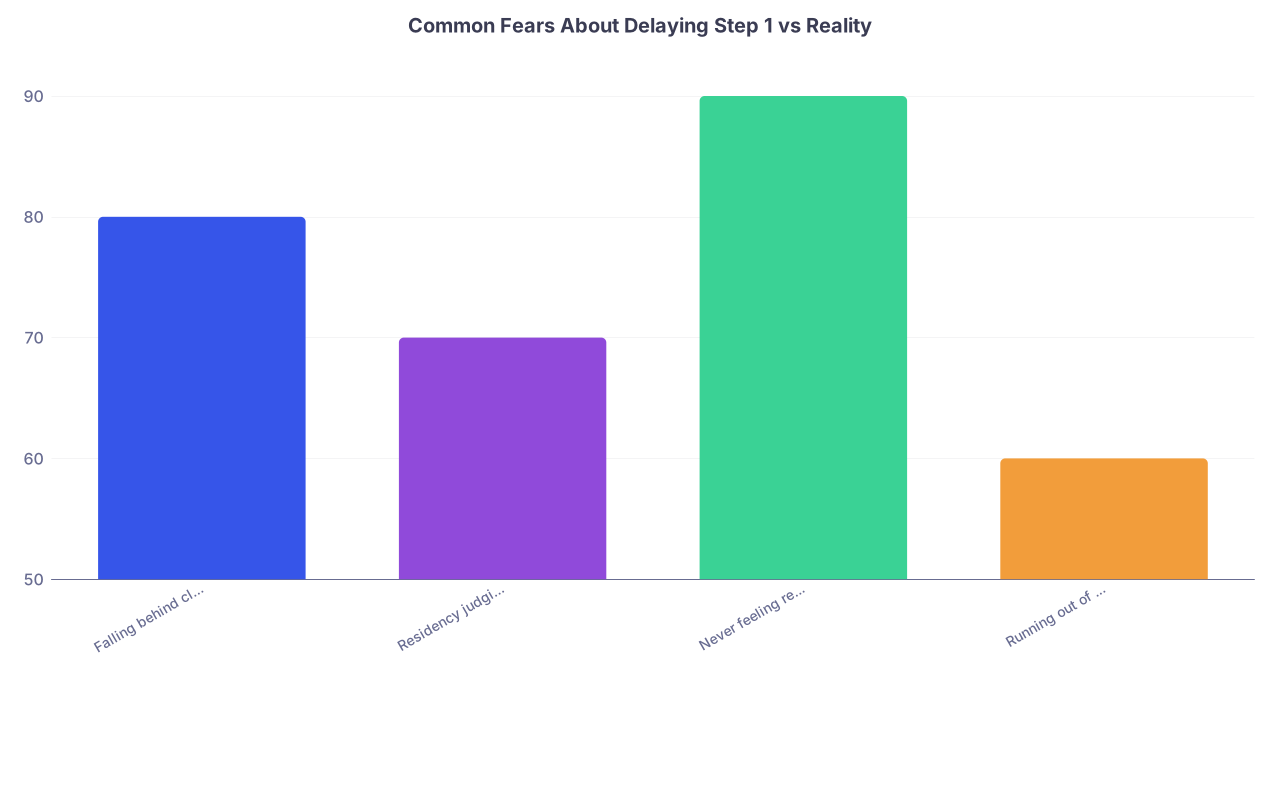
| Category | Value |
|---|---|
| Falling behind class | 80 |
| Residency judging delay | 70 |
| Never feeling ready | 90 |
| Running out of motivation | 60 |
(Figures here are just a way of saying: these fears are common. Especially the “never feeling ready” one.)
What usually happens if you delay with a plan:
- Your school is mildly annoyed about paperwork
- Your rotation schedule sometimes shifts, but schools are used to this
- You end up graduating on time or close to it
- No one in residency interviews asks, “Why did you move your test by 4–8 weeks?”
What actually haunts applications?
- A failed Step 1 attempt
- Then a re-take that barely passes
- And now you’re competing in residency with that red flag on ERAS
Given those two outcomes—
A) Passed Step 1 on first try after a delay
B) Failed once, passed second time, “on time” originally
B is worse. Every time.
So yeah, delaying messes up your ideal timeline. Failing messes with your record.
How to decide in 7 days (step-by-step, not vibes-based)
Here’s the “I can’t sleep, just tell me what to do” framework.

| Step | Description |
|---|---|
| Step 1 | Take NBME under real conditions |
| Step 2 | Strongly consider delay |
| Step 3 | Reasonable to sit |
| Step 4 | Repeat NBME in 5-7 days |
| Step 5 | Plan targeted extra study + reschedule date |
| Step 6 | Score >= 200? |
| Step 7 | Last 2 NBMEs >= 200? |
| Step 8 | Improved & >= 200? |
Real conditions means:
- Timed blocks
- No pausing or stopping mid-block
- No checking answers during the test
- Quiet environment similar-ish to Prometric
Within a 7–10 day window, look at:
- Your latest NBME
- The trend of the last 3–4
- Whether you’re guessing wildly a lot or just missing content you can fix
If you’re consistently below passing or in barely-passing range with no momentum, waiting “to magically feel different” by test day is just superstition.
What to do after you decide to delay (so it actually helps)
Delaying buys time. It does not, by itself, raise your score.
You need an actual plan that looks different from “keep doing what hasn’t worked.”
A lot of people delay, then:
- Keep doing only UWorld, mindlessly
- Don’t fix their weak systems
- Don’t review incorrects deeply
- Take another NBME 3 weeks later and… same score
That’s the scenario that really breaks people. Because then you don’t just feel behind. You feel broken.
Instead, use the extra time like this (rough sketch):
Week 1:
- Full NBME to set a baseline
- Make a brutally honest list of your weak subjects (not just “I hate neuro,” but “I’m missing endocrinology, renal phys, immunology basics”)
- Cut platforms you’re not fully using. Too many resources is the silent killer.
Weeks 2–3:
- Rotate through 1–2 weakest systems at a time
- Targeted content review (Boards & Beyond, Sketchy, or your main resource)
- UWorld questions ONLY in those systems, timed, with deep review and notes
Week 3–4:
- Mixed-block UWorld to rebuild test-taking stamina
- Another NBME under honest conditions
- Adjust plan based on the new weak spots, not vibes
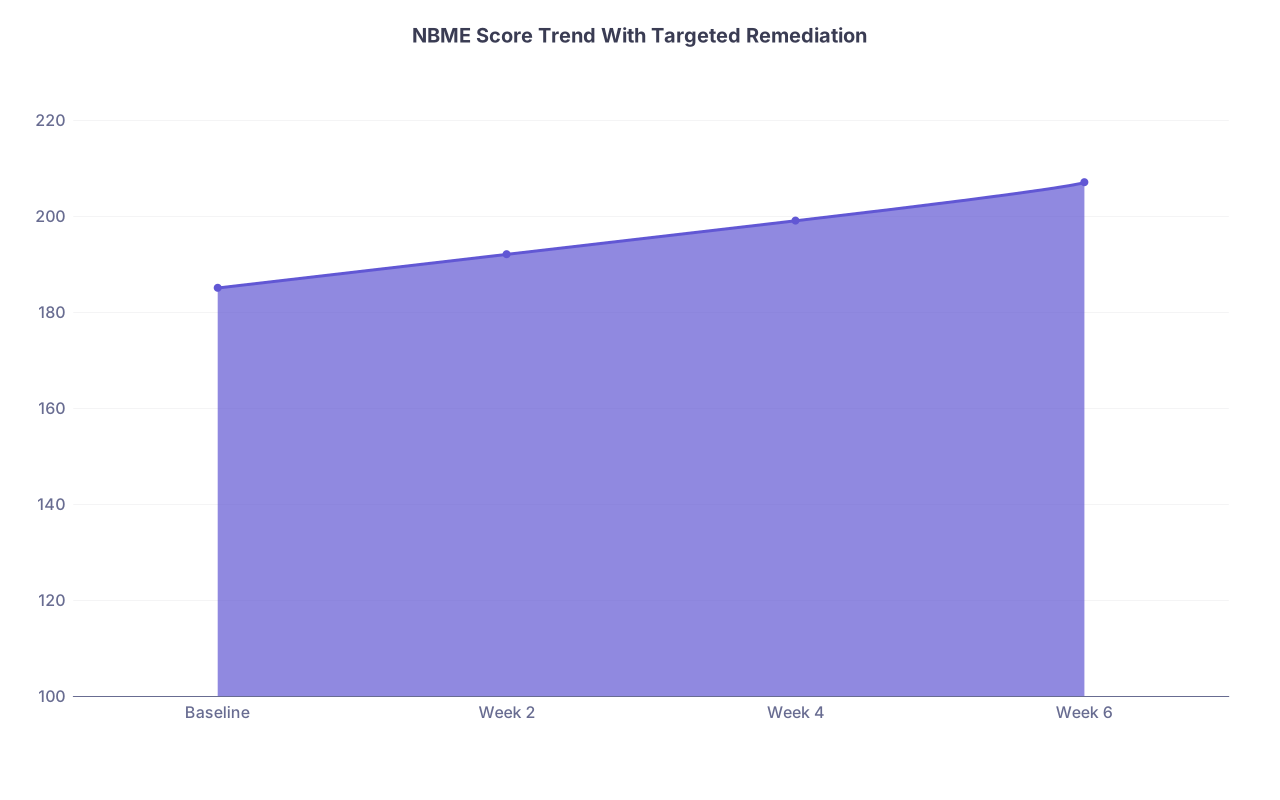
| Category | Value |
|---|---|
| Baseline | 185 |
| Week 2 | 192 |
| Week 4 | 199 |
| Week 6 | 207 |
Is that guaranteed? No. But this kind of focused delay changes trajectories. The “I just need more time” delay without changing strategy usually doesn’t.
Dealing with the mental spiral while your friends seem to be cruising
This part sucks more than the content.
You’re watching:
- Classmates post “Done with Step 1! Bye forever UWorld!”
- Group chats go silent because everyone’s in rotations
- People casually drop their NBME 230s and 240s like that’s normal
And you’re over here bargaining with the universe for a 196.
Here’s what usually gets missed in that comparison game:
- People lie. Or “round up” their scores. A lot.
- Some classmates had stronger preclinical foundations than you. That’s not a moral failing.
- Some are walking into Step 1 with 215+ NBMEs and are stressed about not hitting 240. Totally different problem from yours. Different rules.
Your goal is singular: pass safely, on the first try.
You’re not behind. You’re playing a different level of the same game.
And honestly? The people who had to grind hard for Step 1 usually do very well on Step 2, because they already know how to dig out of a hole.
The one scenario where you probably shouldn’t delay
There’s only one situation where I get nervous about people endlessly pushing their test:
- You’re scoring in the low 200s
- Trend is generally upward
- But you “don’t feel ready” and keep moving your exam every time you feel anxious
This is not a score problem. It’s an anxiety problem dressed up as perfectionism.
You’re not asking, “Am I likely to pass?” You’re asking, “Will I feel 100% safe?” and the answer to that is no, not really, not for anyone.
So here’s the dividing line:
- If your numbers say “high chance of passing” but your brain says “but what if…” → you probably need to sit.
- If your numbers say “real risk of failing” and your brain is screaming → listen to the numbers.
Don’t punish yourself for being scared. But don’t let fear become your study strategy either.
Quick reality check: what you can do today
Don’t try to solve your entire Step 1 destiny in your head.
Do this instead:
- Schedule an NBME in the next 48 hours under real testing conditions.
- Commit in advance to what threshold will trigger a delay (for example: “If I’m under 195, I delay. If I’m 195–200, I’ll re-test NBME in a week. If I’m 200+, I keep my date.”).
- Write that rule down. On paper. Not in your head where you can negotiate with it at 2 a.m.
Then follow it. Even if you’re scared. Especially if you’re scared.
FAQ (exactly 4 questions)
1. What if my NBMEs are all between 190–195 — should I still take Step 1?
If your last two NBMEs are in the 190–195 range, you’re in the danger zone. Could you pass? Yes. People do. But the risk of failing is very real. I’d only consider sitting with scores in that band if:
- You’ve had a clear upward trajectory (e.g., 175 → 184 → 191 → 195)
- You still have 2+ weeks and a concrete, targeted plan
Even then, I’d want one NBME at or above ~200 right before the exam to feel like you’re not flipping a coin on your career.
2. How many NBMEs should I take before deciding to delay?
At least 3 real NBMEs, spaced out enough to reflect actual learning (5–7 days minimum between them, with real studying in between). One bad NBME doesn’t define you. Three low or flat ones start to tell a story. The pattern matters more than any single score. But taking 7–8 NBMEs in a panic, back-to-back, just burns forms and hurts your confidence without giving better data.
3. Can I ever be “ready” if I keep feeling dumb after every NBME?
Feeling dumb after NBMEs is universal. People scoring 240+ feel like idiots half the time. The question isn’t “Do I feel smart?” It’s:
- Are my scores trending upward?
- Do I understand why I’m missing questions?
- Am I seeing fewer “I have no idea what this is” moments and more “I narrowed to 2 and picked wrong”?
Those shifts matter more than how smart you feel. Confidence usually lags behind performance by a few weeks.
4. What if I delay and my score still doesn’t improve much? Did I just waste time for nothing?
That’s the scariest what-if. I’ve seen it happen when people delay but don’t actually change how they study. If you delay and your score barely moves, at least you’ve learned something crucial about your weak areas and study habits before a real fail lands on your record. But in most cases, when someone:
- Cuts extra resources
- Fixes fundamentals in their worst systems
- Does focused, timed practice with deep review
their NBME does move. Maybe not to some fantasy number, but often enough to clear passing with a cushion. A “wasted” delay is usually a sign of a “copied-and-pasted” study plan, not proof that you’re incapable.
Open your latest NBME score report right now and write, in one sentence, what your actual trend has been over the last 3–4 tests. Not what you wish it was. That single sentence will tell you more about whether to delay than another week of anxious Googling ever will.