
The worst Step 1 advice you’ll hear is “just don’t run out of time.” You might run out of time. Now what?
Let’s talk about the nightmare scenario you probably keep replaying in your head: you’re in a Step 1 block, the clock is red, there are like 8 questions left, your heart is racing, and you’re stuck between “do I randomly click C for everything or leave them blank and at least not make a stupid mistake?”
You’re not crazy for worrying about this. But some of the panic you’re feeling is based on half-truths and rumors, not how the exam actually works.
We’re going to be really blunt about two things:
- What actually happens if you don’t finish the block.
- Whether guessing or skipping is “better” when the clock is dying.
And yes, I’m going to lean into the anxiety a bit—because pretending we’re all chill about this exam is useless.
First: How Bad Is It If I Don’t Finish a Block?
Here’s the ugly part: unanswered questions are treated as wrong. There’s no mercy rule, no “partial credit because you tried really hard on the other 32 questions.”
If you leave questions blank, they’re incorrect. Same as if you chose the worst possible answer on purpose.
So when you’re staring at the clock with 1 minute and 10 unanswered questions left, the baseline you’re starting from is: those 10 are currently guaranteed wrong. The only direction you can go is up.
That alone already answers the “guess vs skip” question logically: skipping is literally the same as getting it wrong. Guessing might give you some right.
But I know your brain doesn’t work on pure logic when you’re stressed. You’re probably thinking things like:
- “What if guessing messes up my score calculation somehow?”
- “What if the algorithm thinks I’m random-clicking and punishes me?”
- “What if I rush and miss questions I could have gotten right?”
Let’s tackle these fears one by one.
The Scoring Reality: Why Skipping Is Never Better Than Guessing
Let me say this as clearly as I can:
There is no penalty for guessing on Step 1.
No “negative points.” No secret deduction if you miss too many. Wrong is just… wrong. Same as blank. Same as timing out on that question.
So imagine this:
You’ve got 10 questions left and 30 seconds. Options:
- You leave them all blank → 0/10 right.
- You randomly guess on all 10 → on average, with 5 options, you’ll get about 2 right.
You cannot make it worse by guessing. You can only:
- Keep it the same (if you get them all wrong anyway), or
- Make it better (if you get any right).
There is no scenario where skipping gives a higher score than guessing. None.
To make this super concrete:
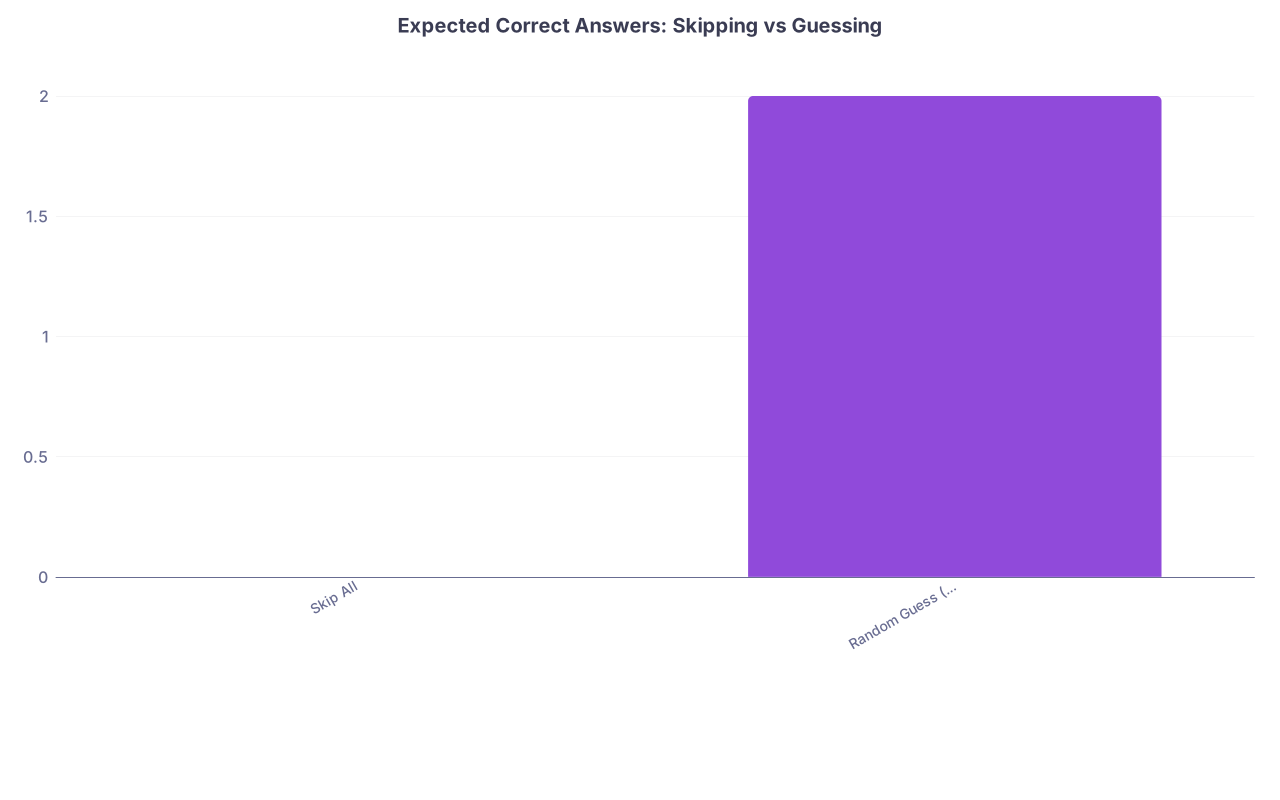
| Category | Value |
|---|---|
| Skip All | 0 |
| Random Guess (5 options) | 2 |
That’s the math. But I get it—that’s not what you’re really afraid of. You’re afraid of being the person who “ran out of time” and tanked their exam.
“What If I Run Out of Time Every Block and Destroy My Score?”
Yeah, this is the deeper fear. Not just “I might have to guess a few at the end,” but:
- “What if I’m naturally slow and I just can’t finish?”
- “What if I keep reading and re-reading and freeze?”
- “What if my real test feels way slower than my practice?”
Here’s the uncomfortable truth: if you’re routinely finishing NBME/UWorld blocks with 0–1 minute left or timing out, that’s not a guessing problem. That’s a pacing and behavior problem. And that will hurt your score if you don’t fix it.
But here’s the part people don’t say out loud:
Most people who “run out of time” on the real test don’t suddenly fail because of it. They lose some points. It stings. But the exam doesn’t blow up.
Think of it this way:
- If you miss 5–8 questions in one block because you guessed at the end, that sucks…
- …but Step 1 has around 280 questions total. That’s like 2–3% of the exam.
- Annoying? Yes. Fatal? Almost never, unless you were already right on the edge.
The real disaster scenario isn’t one rushed block. It’s:
- Being behind time every single block
- Overthinking early questions so badly that you permanently live in “I’m 6 behind” mode
- Panicking, then spiraling into worse decisions
So you don’t need to be perfect. You do need a strategy.
When the Clock Is Dying: What To Do in the Last 2–3 Minutes
This is the part nobody trains you for. They just say “practice pacing” and leave it at that.
Here’s exactly what to do when the block is slipping away and your chest is tight.
1. Stop fully reading new stems once you hit a personal “panic threshold”
This is huge. You need a rule like:
- “If there are 5 minutes left and more than 6 questions left, I switch modes.”
Normal mode = full reading, maybe a little review.
Panic mode = survival.
Panic mode means:
- Go straight to each question, scroll just enough to see key info.
- Pick the most reasonable answer with whatever you see.
- Move on. No revisits. No ego. No “but I could probably reason this out.” You can’t. The clock says no.
2. If it’s under 60 seconds and you still have multiple questions, abandon nuance
This sounds harsh, but when it’s under a minute and you’ve got 4+ questions left, you have one job:
Make sure every single one has a bubble filled.
At that point, you’re not taking a test. You’re doing damage control.
Rapid-fire plan:
- Click through each question
- Pick one answer (more on strategy in a second)
- Don’t scroll unless an answer choice is literally cut off
- Save and move
If you somehow finish with 10–15 seconds left, then you can go back to the current question and try to read a little more. But you start by securing guesses on every remaining item.
Should I Guess the Same Letter for All the Remaining Questions?
This is the classic urban legend: “Always pick C,” “Choose B for biochem,” etc.
Let’s be honest—there’s no magical letter the NBME favors. But there is some logic here.
If you are completely blind guessing (no time to read the stem, no time to eliminate anything):
- Picking the same letter for all of them is totally fine.
- Over a ton of questions, it doesn’t change the expected average (still ~20% on a 5-choice question), but it simplifies your life and lowers the chance of misclicks.
If you have a tiny bit of time:
- Glance quickly at choices. If one looks insane (“take your patient off insulin entirely”) and you can eliminate it in under 2 seconds, do it. Then guess among the remaining.
- But don’t start truly reasoning. This is not the time for Pathoma-style logic. This is survival mode.
Here’s how the math looks, roughly:
| Strategy | Expected Correct |
|---|---|
| Skip all 10 | 0 |
| Random guess individually | ~2 |
| Same letter for all | ~2 |
So if your brain loves structure under stress, “I always pick C when I’m completely blind guessing” is a perfectly reasonable rule. Just don’t romanticize it. It’s not a cheat code. It’s a coping mechanism.
The Fear of “What If I Rush and Miss Questions I Could’ve Gotten Right?”
This one is real. And it’s not dumb.
Because yes, you can hurt yourself by panicking too early and cutting corners on questions you could have answered correctly with 10 more seconds of thought.
So here’s the hard line I recommend:
- For the first 30 minutes of the block: do normal, solid reasoning. Aim for ~1.1–1.2 minutes per question on average. That gives you buffer.
- If you notice you’re 5+ questions behind halfway through the block, start trimming your overthinking. One extra reread? Fine. Five slow rereads? No.
- Only go into true panic mode when there’s a clear mathematical problem:
- Under 10 minutes, more than ~10 questions left
- Under 5 minutes, more than ~6–7 questions left
- Under 1 minute, anything more than ~2–3 questions left
You’re not supposed to be in crisis mode the whole exam. That’s how you burn yourself out by block 3. You’re building a last-ditch rule set, not a permanent state.
How to Train for This So the Real Thing Doesn’t Blindside You
The worst time to figure out your “oh crap” protocol is during your real Step 1.
You need to practice being behind on time on purpose during UWorld and NBME blocks. Not just hope it doesn’t happen.
Try this:
On a few practice blocks, cap yourself at 60 minutes instead of 64.
- Force yourself to adapt.
- Notice when your brain starts panicking.
- Practice flipping into “guess quickly” mode intentionally.
At the start of every block (practice or real), mentally set:
- “If I hit X minutes left with more than Y questions, I switch strategies.”
Also, pay attention to your personal traps:
- Do you stare at long stems too long because they feel “high-yield”?
- Do you obsess over pharm tables and lose 4–5 minutes there?
- Do you reread every question twice by default?
Those behaviors are what cause the “I didn’t finish” nightmare. The end-of-block guessing is just the symptom we’re trying to treat.
Quick Reality Check: How Often Do People Actually Time Out?
You’re not the only one terrified of this. Every dedicated period, someone in the library whispers, “My friend literally had to randomly guess on 15 questions in a block and still passed.”
Anecdotally, here’s what actually happens on test day for most people I’ve seen or heard from:
- 1–3 blocks: finish with 5–10 minutes left → review marked questions
- 2–3 blocks: finish with 2–4 minutes left → maybe peek at a couple marked
- 1–2 blocks: finish with under a minute left or time out with 1–3 unanswered → forced quick guesses
The truly catastrophic “I left 10 blank because time ran out and I froze” situation? Rare. But it happens.
The difference between disaster and “ugh, that sucked but I’ll live” is having an auto-pilot plan for the last two minutes.
The Bottom Line: Guessing vs Skipping
Let’s stop dancing around it and say it straight:
- Skipping = definitely wrong.
- Guessing = maybe right, maybe wrong.
- There is no scoring penalty, no secret algorithm punishment, no NBME cop that flags you for “guessing too much.”
If your fear is:
- “What if guessing tanks my score?” → It doesn’t. Skipping already tanked it.
- “What if I look dumb to the NBME?” → Nobody is watching your clicks in real time. They only see right/wrong.
- “What if I panic and lose everything I studied?” → One rushed block won’t erase months of prep.
Your brain is going to scream at you in those final minutes:
“You’re screwing this up. You should have worked faster. You’re not ready.”
You answer it with something boring and mechanical like:
- “Under a minute. I’m guessing C on everything left.”
- Click. Move. Don’t emotionally engage.
Key Takeaways
- Never leave questions blank on Step 1. Blank = wrong. Guessing can only help or break even, never hurt.
- Have a pre-decided panic plan (when X minutes left with Y questions, switch to fast-guess mode and make sure every question gets an answer).
- Train this in practice, not on game day—simulate time pressure, notice when you overthink, and get comfortable switching into “survival mode” when the clock demands it.
You’re allowed to be scared of running out of time. But you don’t have to be unprepared for it.