
The fastest way to ruin your Step 1 prep is to obsess over everyone else’s timeline.
Let me guess what’s happening.
You were just trying to get through systems. Maybe you’d planned to “start serious Step studying” after this block. Then suddenly:
- One friend casually says they’re on their second pass of UWorld.
- Another just finished their third NBME.
- Someone in your group chat posts a 245 practice score “kinda low but I’ll take it for now lol.”
And you’re sitting there thinking:
“I’m dead. I already failed and I haven’t even taken the exam yet.”
Let’s pull that apart before your brain convinces you your career is over.
The ugly truth about Step 1 comparison
Most people are not being fully honest about where they’re “at.”
I’ve watched this exact movie with multiple classes:
Someone says, “Yeah I’m mostly done with UWorld.”
What they mean is:
They did 30% of the bank in tutor mode, looked at some explanations, half-guessed half the questions, and now they’re bored so they started another resource. But what you hear is:
“They did 100% of UWorld, reviewed every explanation, Anki’d all of it, and are scoring 80s on NBMEs.”
Same conversation, two completely different realities.
Here’s the worst part: the people who are actually behind rarely talk about it. They just go silent. You’re only hearing from the loud ones — the ones flexing or spiraling publicly. That’s a heavily biased sample.
So you build this mental chart in your head where everyone else is a month ahead, scoring higher, using more resources, and somehow still sleeping 8 hours.
Reality? The distribution looks more like this:
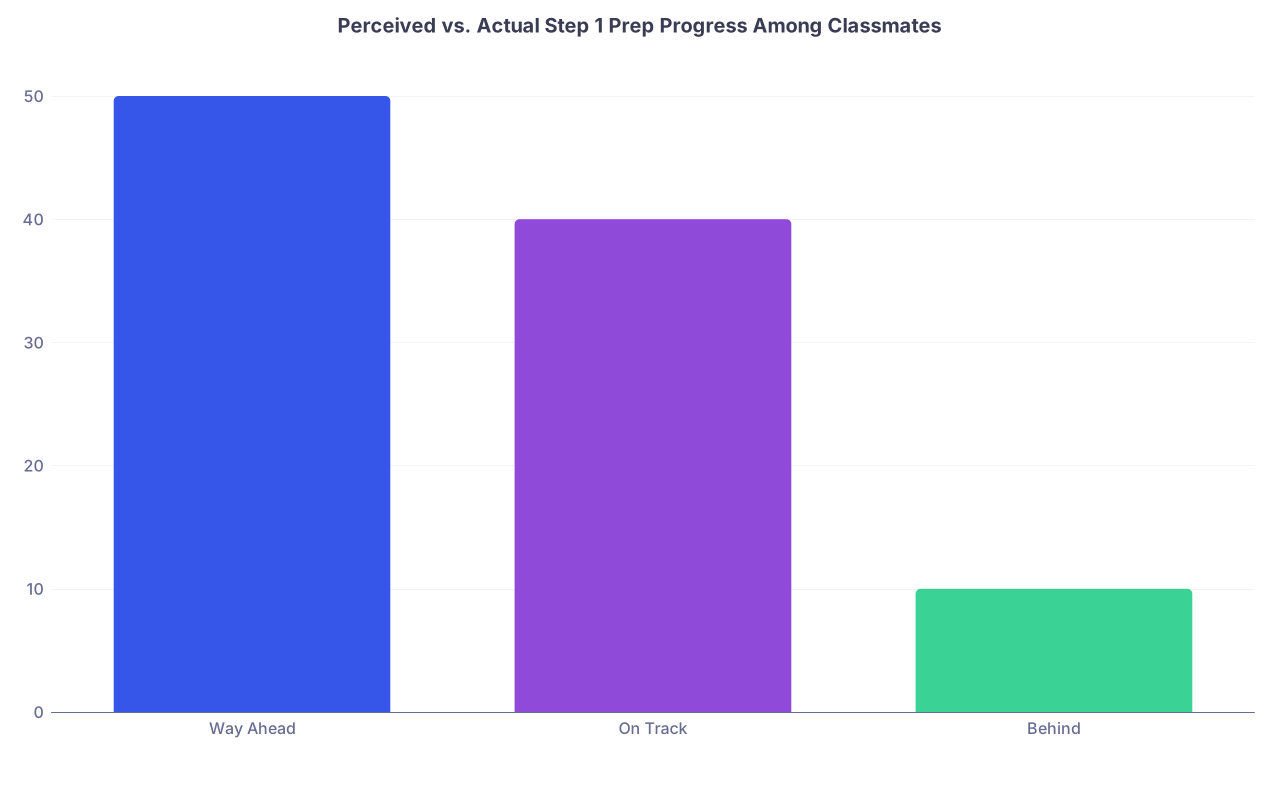
| Category | Value |
|---|---|
| Way Ahead | 50 |
| On Track | 40 |
| Behind | 10 |
You perceive that 50% are way ahead and you’re in the behind group.
More often, what I actually see is most people are clustered in the “messy but basically on track” zone — and almost everyone feels behind.
You’re not uniquely failing. You’re just getting a close-up view of your own chaos and a curated view of everyone else’s.
The “I already lost the race” spiral
Let me say this clearly:
Step 1 prep is not a race that starts in January and ends in June where early runners automatically win.
What actually matters:
- Your baseline knowledge
- The quality of your final 6–8 weeks
- How effectively you close gaps, not how early you started
I’ve seen all of these happen in real life:
- Person A starts UWorld 8 months early, does it scattered and unfocused, burns out, starts ignoring explanations.
- Person B starts 3 months before, but is brutal about review, tracks weak areas, sticks to a simple plan.
- Person B ends up with the better score. Over and over again.
But you and I both know the voice in your head doesn’t care about logic. It’s saying things like:
- “If they’re already at 220 on practice and I’m at 190, I’ll never catch up.”
- “If I’m starting UWorld now and they’re almost done, my curve is permanently shifted down.”
- “If I don’t keep up, I’ll end up in a specialty I hate, in a place I hate.”
I’ve heard versions of this from so many students that I can practically script it. And what actually happens?
That kid sitting at 190 six weeks out, once they finally stop freaking out about everyone else and just hammer their weak areas, jumps 20–30+ points by test day.
Is that guaranteed? No. But it’s common. Very common. The growth curve in the last few weeks can be steep if you stop scattering your energy on comparison and channel it into:
- Focused practice
- Ruthless review
- Sleep that’s not completely wrecked by panic
The hidden cost of constant comparison
Here’s the part no one really talks about: comparison isn’t just annoying. It’s performance‑harming.
When you’re obsessing over what your friends are doing, a few things happen:
You change your plan every 3 days
You hear “I’m doing Boards & Beyond + Sketchy + UWorld random timed + Anki 800/day,” and suddenly your reasonable plan looks “too light.” So you cram in another resource, drop your review, and your prep turns into chaos.You study from fear, not strategy
You open a Qbank not thinking “What can I learn?” but “If I don’t get 70% I’m doomed.” That state absolutely wrecks retention and problem-solving.You burn out earlier
You sprint because everyone else seems to be sprinting. Three weeks later, your brain feels like wet cardboard and you still have a month to go.
I’ve seen students with totally salvageable starting points crash themselves just from emotional exhaustion created by comparison. They didn’t run out of time. They ran out of bandwidth.
You can’t afford to keep paying that cost.
What “being behind” usually actually means
Let’s be really concrete. When people tell me “I’m behind,” it usually ends up meaning one of these:
- “I haven’t finished content review before starting questions.”
- “My classmates are on their 2nd/3rd pass of UWorld; I’m just starting.”
- “My practice scores are low and theirs are higher.”
- “They have a beautiful spreadsheet and color-coded schedule and I’m using a sticky note.”
Here’s the unpleasant truth: none of those, by themselves, guarantee failure.
What actually matters over the next stretch of time is:
| Actually Matters | You Obsess Over |
|---|---|
| Your baseline and trajectory | Exact number of Qs your friends did |
| How you review missed questions | How many resources they use |
| Sleep, nutrition, basic function | Their NBME screenshots |
| Filling your weakest gaps | Who “started earlier” |
The exam doesn’t care if you started UWorld in December or March. It cares whether, by test day, you’ve seen a lot of clinical-style questions and understood why you got them wrong.
How to handle it when your friends are way ahead
You don’t need a motivational poster. You need a tactical way to not lose your mind.
Here’s the minimum viable survival plan.
1. Shrink your comparison circle
You don’t have to announce it. Just quietly:
- Mute the group chat that only posts scores, percentiles, and memes about grinding.
- When someone starts flexing: “I’m already on my 2nd UWorld pass,” change the subject or say “Nice” and mentally file it under “not relevant to my life.”
- If one particular person always makes you spiral, stop asking them about their prep. At all.
You’re not being rude. You’re protecting your ability to function.
2. Anchor to your data, not their bragging
You need hard numbers from you, not vibes from other people. That means:
- Take one baseline assessment (NBME or UWSA or school CBSE — whatever is available).
- Accept that the score might punch you in the face. That’s better than your imagination, which is probably even worse.
Then you switch from “Everyone’s ahead” to a different question:
“Given where I am right now, what’s the most high-yield way to spend the next 4–8 weeks?”
That’s a solvable problem. “Everyone else is ahead” is not.
3. Build a simple, not perfect, plan
People behind love to respond by overcompensating with insane plans. Don’t.
Something like this is usually enough structure:
- 40–80 UWorld questions/day (or your qbank of choice), in 1–2 blocks
- Serious review of every question — right and wrong
- Targeted review of the weakest 1–2 systems/topics each day based on those questions
- A small dose of flashcards / recall (not 1000+ cards/day unless you’re already that person)
- One practice test every 1–2 weeks to track trend
That’s it. Not 10 resources. Not copying your friend’s entire notion board.
If you’re already behind, complexity is the enemy. It gives you more ways to procrastinate and more reasons to feel like you’re “failing the plan.”
The fear of “falling behind = bad residency”
Let’s address the nightmare scenario in your head.
You’re probably thinking something like:
“If I mess this up because I started later than my friends, I’ll limit my entire career. My future specialty. Where I live. Everything.”
Here’s where the worst-case thinking goes off the rails:
- Step 1 is now pass/fail at many schools (or at least de-emphasized). Even where it still matters numerically, it’s just one part of your application.
- Programs care just as much — sometimes more — about Step 2, clinical evals, letters, and evidence you’re not a disaster to work with at 3 a.m.
- A less-than-perfect Step 1 doesn’t automatically shut every door. I’ve watched people rescue their trajectory with strong Step 2 scores, solid clinical years, and smart planning.
Do some doors narrow with a weaker board performance? Yes. I won’t sugarcoat it.
Does that mean “it’s derm or misery forever”? No. That thinking is just your anxiety turning one exam into a life sentence.
You’re not choosing your entire future specialty right now. You’re just trying to give your future self as many options as possible.
A quick reality reset
Let’s reset against some actual data-like logic rather than group chat panic.
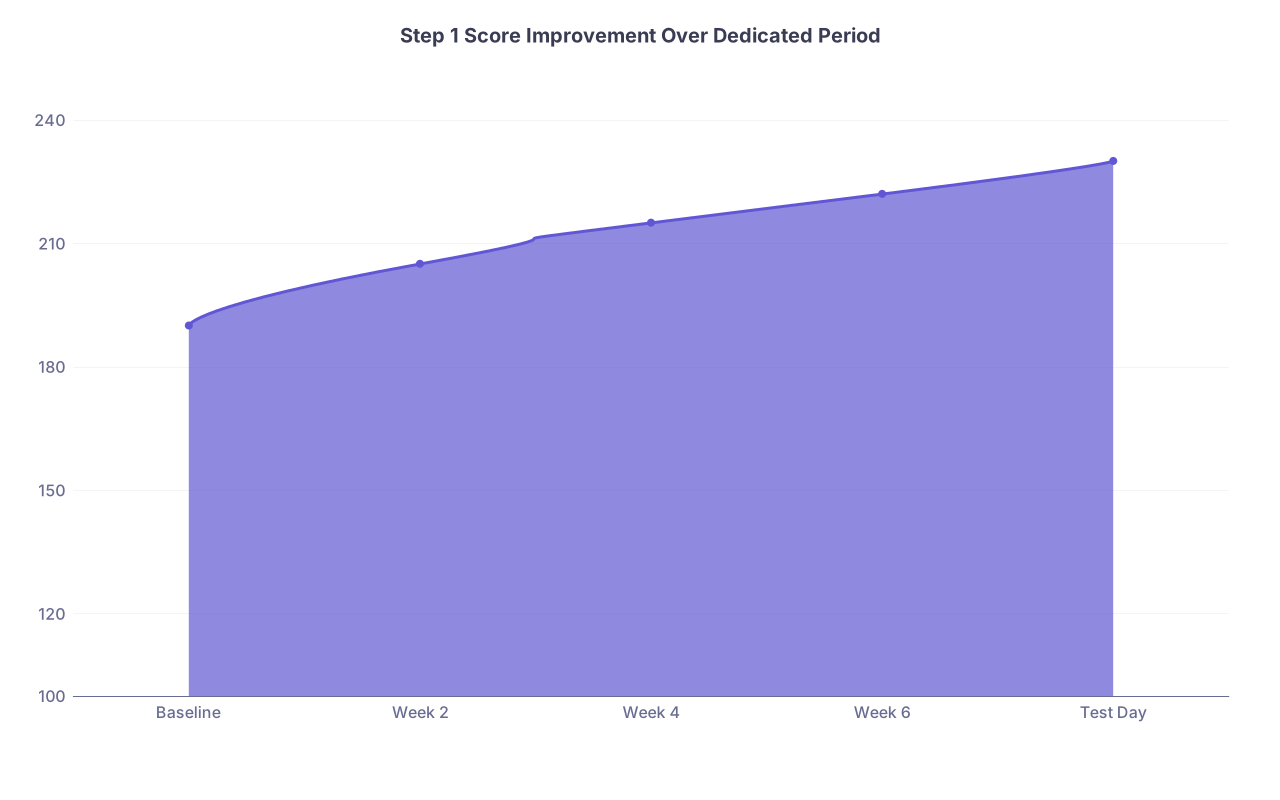
| Category | Value |
|---|---|
| Baseline | 190 |
| Week 2 | 205 |
| Week 4 | 215 |
| Week 6 | 222 |
| Test Day | 230 |
That kind of trajectory? Very common when:
- The student stops changing their plan every 48 hours
- They accept where they’re starting
- They keep showing up for questions and review even when scores sting
The main difference between people who end up okay and people who crash isn’t usually intelligence. It’s emotional bleeding from constant comparison.
Your brain has limited RAM. You can either spend it on:
- Tracking everyone else’s progress, or
- Tracking your own weak points and fixing them
You don’t get both for free.
How to respond in the moment when comparison hits
The next time someone casually says, “Yeah I just hit 75% correct on my second UWorld pass,” and your stomach drops, try this tiny script in your head:
- “Their timeline is not my timeline.”
- “The test will not ask how early I started. It will ask if I know the material.”
- “What’s one concrete thing I can do in the next 2 hours to move myself forward?”
Then actually do that one thing. One block. One review. One tiny ugly Anki session.
You can’t stop your brain from freaking out. But you can stop letting the freak‑out decide your actions.