Why 12-Hour Study Days Rarely Improve Step 1 Outcomes
What if the thing you’re proudest of in your Step 1 prep—those “grind” 12-hour study days—is actually the reason your scores are stuck?
The culture around Step 1 loves extremes. “I did UWorld twice.” “I did 1,000 Anki cards per day.” “I studied 12–14 hours every day for two months.” People say this like it’s a badge of honor. Then a decent chunk of them end up with very average scores. Or worse, barely passing.
Let me be blunt: for most students, 12-hour study days are not a power move. They’re a compensation strategy. And not a very good one.
The data from sleep research, cognitive performance, and spaced repetition all point in the same direction: more isn’t better after a point. It’s just more.
Let’s break the myth.
What the Data Actually Shows About Hours vs Performance
There’s this unspoken belief: “If I just study more hours, my score has to go up.” That’s emotionally satisfying. It’s also wrong.
Most students I’ve seen with strong Step 1 performances had something like 6–9 real hours of focused work per day, not 12–14. The high-hour people? Mixed bag. A lot of 220–235s. Occasionally higher, sometimes lower. The hours themselves weren’t predictive.
There isn’t a giant RCT that randomizes students to 6 vs 12-hour study blocks for Step 1, but we have enough from adjacent fields to see the pattern.
From cognitive and learning research:
- Working memory and attention tank after about 50–90 minutes of continuous, high-intensity focus.
- Performance on complex tasks declines sharply with prolonged wakefulness and mental load.
- Sleep deprivation, even “modest” (like 6 hours per night), significantly reduces learning and recall efficiency.
Then layer on what we actually know about med students:
- Studies show that average medical student sleep is already suboptimal in exam periods.
- Burnout and depressive symptoms correlate with worse exam performance and worse long-term retention.
You can pretend you’re the exception. Most people are not.
The hidden issue: when people say “I studied 12 hours,” they rarely mean 12 hours of high-quality encoding and retrieval practice. They mean 12 hours sitting in front of material, oscillating between focus, fatigue, distraction, and panic.
So the question is not: “Do 12-hour days work?”
The question is: “How much actual learning are you getting per hour after hour 6, 7, 8?”
And the honest answer, for most, is: not much.
Cognitive Limits: Your Brain Is Not a QBank Machine
You can brute force flashcards. You cannot brute force synapse formation.
High-stakes exams like Step 1 rely heavily on:
- Long-term memory consolidation
- Complex problem solving
- Pattern recognition
- Clinical reasoning under pressure
All of those depend on two things you absolutely trash with 12-hour grind days: sleep quality and cognitive freshness.
Sleep research is merciless here. Memory consolidation (especially for the kind of integrated basic science Step 1 hits) happens primarily during slow-wave and REM sleep. If you’re studying 12 hours a day, you’re probably:
- Cutting sleep
- Sleeping later
- Sleeping worse (stressed, wired, scrolling your phone until 1 a.m.)
Then you wake up, proud of your 7 a.m. start, and repeat the same broken cycle.
Over a couple of days? You get away with it.
Over 4–8 weeks of dedicated? Your learning efficiency drops off a cliff.
There’s robust data that after even one night of short sleep, hippocampal function (aka learning center) is impaired. After several nights of 6 hours instead of 8, your performance is similar to someone legally intoxicated—except you’re trying to memorize glycolysis regulation and interpret nephron physiology curves.
And no, that third coffee does not fix this. It just lets you sit in front of your materials longer without falling asleep. Totally different thing.
Study Efficiency vs Study Volume: The Ugly Truth
Let’s get specific. Here’s what I’ve seen repeatedly in real students:
Student A:
- “Studies” 12 hours/day.
- Does 60–80 UWorld questions, but checks their phone constantly, half-reads explanations, and doesn’t review thoroughly.
- Tries to blast through 800–1,000 Anki cards but keeps hitting “Good” just to survive the pile.
- Sleeps 5–6 hours, feels constantly behind, adds more hours to “catch up.”
Student B:
- Studies 7–8 hours/day.
- Does 40–60 UWorld questions with full review. Actually writes down missed concepts and re-teaches them.
- Does 300–400 focused Anki reviews, suspends garbage cards, actively edits decks.
- Sleeps 7.5–8.5 hours, takes one half-day off per week.
On paper, Student A is “working harder.”
On test day, Student B is the one hitting a higher score.
Not because they’re smarter. Because they’re learning efficiently.
Here’s what the difference looks like when you stop romanticizing time and look at learning mechanics:
| Feature | 12-Hour Grind Day | 8-Hour Efficient Day |
|---|---|---|
| Focused UWorld review | Low | High |
| Anki quality | Rushed | Deliberate |
| Sleep | 5–6 hours | 7–9 hours |
| Burnout risk | High | Moderate–Low |
| Score per hour gained | Low | Higher |
Those extra 3–5 hours you’re so proud of? They’re usually your lowest-yield hours of the day. High fatigue, low retention, high anxiety.
Which means your score per hour in that window is garbage.
The Myth of “Dedicated = Monastic Suffering”
Somewhere along the way, “dedicated period” got rebranded as “monastic self-destruction.”
People talk like if you aren’t cancelling your entire life, isolating from friends, and studying 12–14 hours a day, you’re not taking Step seriously. That’s not discipline. That’s insecurity in disguise.
Here’s what usually happens when someone tries to sustain 12-hour days for more than a week:
- Week 1: Adrenaline-fueled sprint. They hit close to 10–12 hours of semi-productive work. Lots of fear-driven intensity.
- Week 2–3: They start dreading their desk. Procrastination creeps in. “12 hours” on their schedule becomes 7–8 real hours and 4–5 hours of YouTube, texting, and staring at the wall.
- Week 4+: They’re so fried that even when they’re technically studying, none of it sticks. They start forgetting easy questions, panic, and double down on adding more hours, which makes everything worse.
Notice the toxic loop: fatigue → worse learning → panic → more hours → more fatigue.
I talked to a student who proudly told me, “I did 14-hour days for six weeks.” Her baseline NBME? 215. Her last NBME before test day? 224. That’s it. Nine points. She didn’t have a learning problem. She had an efficiency and recovery problem.
Meanwhile, I’ve watched another student go from a 205 NBME to a 245 in 5 weeks. Longest days? 9 hours. Most days? 7–8 hours. But every block was tight, intentional, and followed by sleep.
The difference was not willpower. It was strategy and respect for biology.
What Actually Drives Step 1 Score Increases
Strip away the Instagram flexing and neurotic scheduling. Score improvement comes from a handful of concrete behaviors—none of which require 12-hour days.
The big drivers:
Consistent, active retrieval practice
That means questions and spaced repetition, not just re-reading First Aid like it’s a holy book.High-quality QBank review
Getting 44/60 vs 39/60 on UWorld is marginal. Understanding why you missed those 16, and preventing those misses in the future? That moves scores.Spaced repetition done sanely
Anki works if you treat it as a curated, active recall tool—not a masochistic “1,000 reviews a day or I’m failing” challenge.Integrated concepts, not brute memorization
Step 1 punishes shallow memorization and rewards pattern-based reasoning. That type of learning is sleep- and rest-dependent.NBME calibration and adjustment
Doing NBMEs, analyzing patterns of weakness, and then deliberately fixing those—rather than mindlessly adding more hours while repeating the same mistakes.
None of those tasks become magically more effective at hour 11 of your day.
What actually improves them? Showing up consistently at 80–90% mental capacity, every day, for several weeks. That requires sustainable pacing, not theatrics.
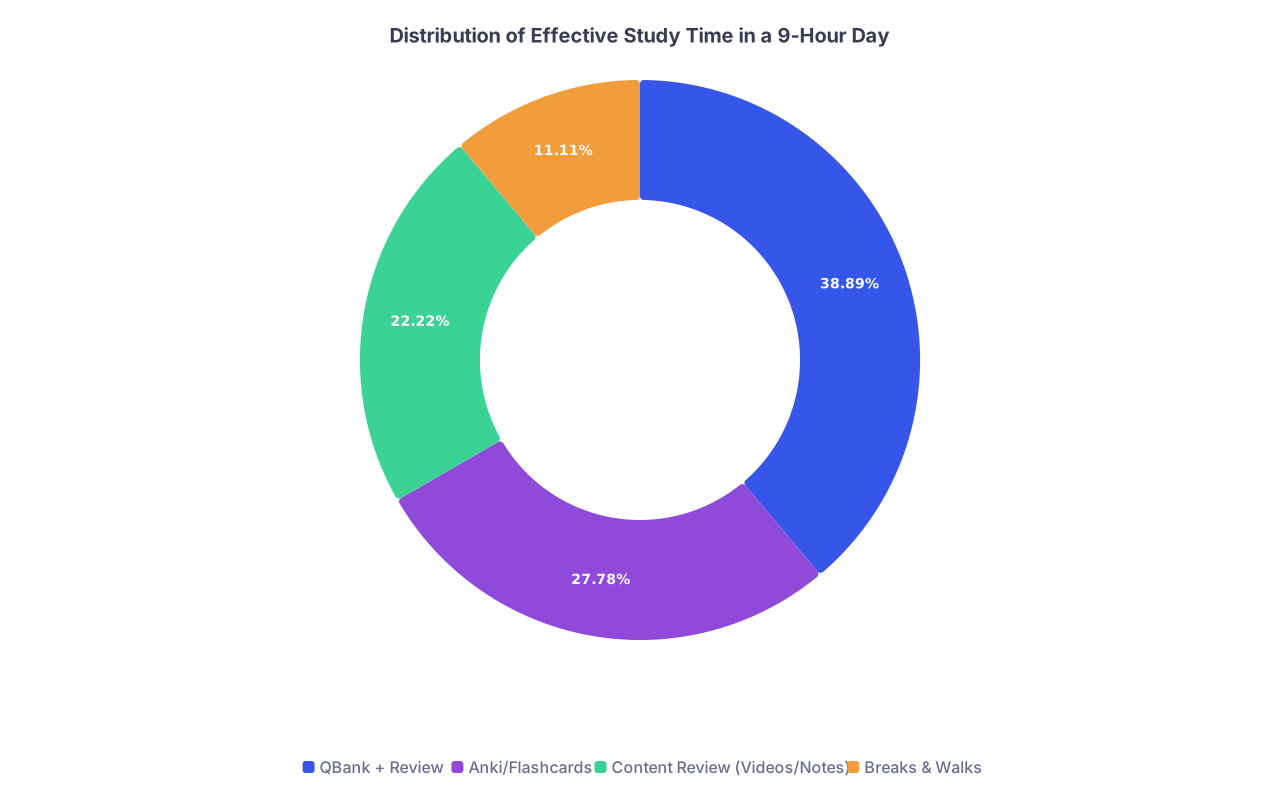
Here’s what a realistic, high-yield day often looks like for students who end up scoring well:
| Category | Value |
|---|---|
| QBank + Review | 210 |
| Anki/Flashcards | 150 |
| Content Review (Videos/Notes) | 120 |
| Breaks & Walks | 60 |
That’s about:
- 3.5 hours on QBank and review
- 2.5 hours on Anki
- 2 hours on targeted content
- 1 hour of real breaks
You can’t cram that into 4 hours. But you also don’t need 12.
The Cost of 12-Hour Days: Hidden Damage You Don’t See on a Schedule
Let’s talk about what those marathon days actually do to you.
First: motivation erosion.
You can white-knuckle motivation for a week. Maybe two. After that, your brain starts associating Step 1 with unending misery. So every morning, you’re fighting not just the content, but your own aversion to starting.
Second: anxiety amplification.
The more hours you “should” be studying, the easier it is to feel behind. You tell yourself: “If I don’t hit 12 hours, today is a failure.” Great way to guarantee you feel like a failure most days. Chronic underachieving your own insane targets doesn’t make you work harder. It makes you quit internally.
Third: decision fatigue.
After 8–9 hours of studying, your executive function is shot. That’s when you start making dumb choices: skipping review, changing your exam date impulsively, rewriting your schedule at 1 a.m., looking for “new” resources because your brain wants an escape.
All of that noise directly eats into the limited energy you should be spending on actual learning.
A More Honest Model: Diminishing Returns
If you want a mental model that actually matches reality, use this: diminishing returns.
For most med students:
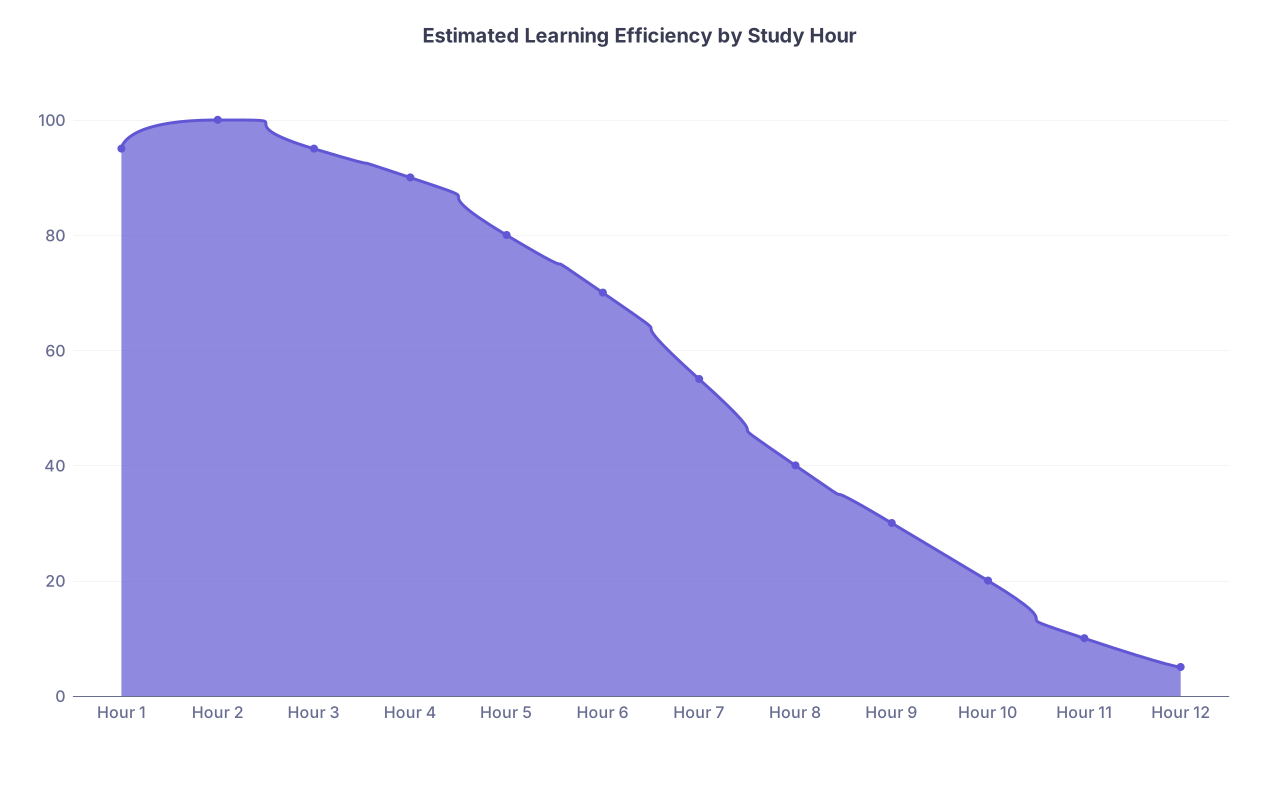
- Hours 1–4: High yield, high focus, strongest encoding.
- Hours 5–7: Moderate yield, still valuable if broken into focused blocks with real breaks.
- Hours 8–9: Steep drop-off. Some useful work if you’re disciplined, but quality is fragile.
- Hours 10–12: Mostly theater. You’re performing the role of “hardworking student” but your brain checked out an hour ago.
Now add this: as you sleep less and fatigue accumulates, those thresholds shift left. Your “high-yield” window shrinks. That’s how people get worse over dedicated, even while “studying more.”
If you plotted true learning over time, it would not be a line. It would look more like this:
| Category | Value |
|---|---|
| Hour 1 | 95 |
| Hour 2 | 100 |
| Hour 3 | 95 |
| Hour 4 | 90 |
| Hour 5 | 80 |
| Hour 6 | 70 |
| Hour 7 | 55 |
| Hour 8 | 40 |
| Hour 9 | 30 |
| Hour 10 | 20 |
| Hour 11 | 10 |
| Hour 12 | 5 |
Those last four hours? They feel productive because they’re exhausting. But effort and learning are not the same metric.
So What Should You Do Instead?
Let’s be clear: I’m not arguing for “chill” Step 1 prep. I’m arguing for ruthless efficiency.
A few concrete shifts:
- Cap your real focused work around 7–9 hours per day for most of dedicated. If you’re truly fresh and can sustain 10 once in a while, fine. But that’s the ceiling, not the target.
- Protect sleep like it’s part of your study schedule. Because it is. A sleep-deprived brain doing 12 hours is less effective than a rested brain doing 8.
- Judge your days by completed tasks with real cognitive work (e.g., 60 QBank questions + full review, 300 well-done Anki cards), not by hours “in the chair.”
- Plan at least one half-day off per week. Not as a luxury. As brain maintenance.
If you’re already in the 12-hour trap and fried, this isn’t hypothetical. You’re feeling it. Your NBMEs might even be flat or sliding. You do not fix that by adding more hours. You fix it by improving the quality of the ones you keep.
The Bottom Line
Let me end this without sugarcoating.
Twelve-hour study days are usually a symptom of anxiety and poor strategy, not dedication. They rarely produce proportional score gains and often sabotage sleep, mood, and learning efficiency.
Step 1 rewards consistent, high-quality, well-rested work—questions, spaced repetition, targeted review—not maximal time in the chair. For most students, 7–9 focused hours beat 12 scattered, exhausted ones.
If your prep plan’s main flex is “I’ll just study 12 hours a day,” you do not have a strong plan. You have a fantasy.