
The myth that COMLEX Level 2 CE and Step 2 CK are “basically interchangeable” is wrong. Program directors do not treat them as the same signal, and the data around match outcomes makes that painfully clear.
If you are an osteopathic student trying to decide whether to take Step 2, you are making a probability decision, not a vibes decision. The numbers are out there: NRMP, AACOM, NRMP PD Surveys, and score distributions from NBOME and NBME/USMLE. When you stack them side‑by‑side, the picture is blunt: Step 2 CK meaningfully changes your competitive profile, especially for non‑primary care and university programs.
Let me walk through this the way I actually look at it: distributions, conversions, and downstream match outcomes.
1. How COMLEX Level 2 CE and Step 2 CK Actually Compare
First, strip away branding. Both exams are:
- Broad clinical-knowledge, end-of-core-clerkship exams
- Heavy on internal medicine, peds, OB/GYN, surgery, psych, emergency-type reasoning
- Used as a key screen for residency – often more heavily now that Step 1 is pass/fail
But the scale, distribution, and usage are different.
Step 2 CK:
- Mean ~245, SD ~15 (numbers shift slightly by year, but that’s the ballpark)
- Fully 3-digit scaled, widely reported and “benchmarkable”
- Every ACGME PD knows exactly what a 230 or 250 means vs national averages
COMLEX Level 2 CE:
- Historically mean ~500, SD ~85 (again, check NBOME’s current cycle for exacts, but that’s the stable pattern)
- 3-digit score, DO-only cohort
- Most allopathic PDs do not live inside COMLEX distributions. Many see one or two CE scores per year, if that.
This last point is crucial. COMLEX is less legible to PDs. When an IM PD has 3,000 applicants and sees 2,700 USMLE-only, 200 dual (COMLEX + USMLE), and 100 COMLEX-only, guess which signal their brain is calibrated to read in milliseconds.
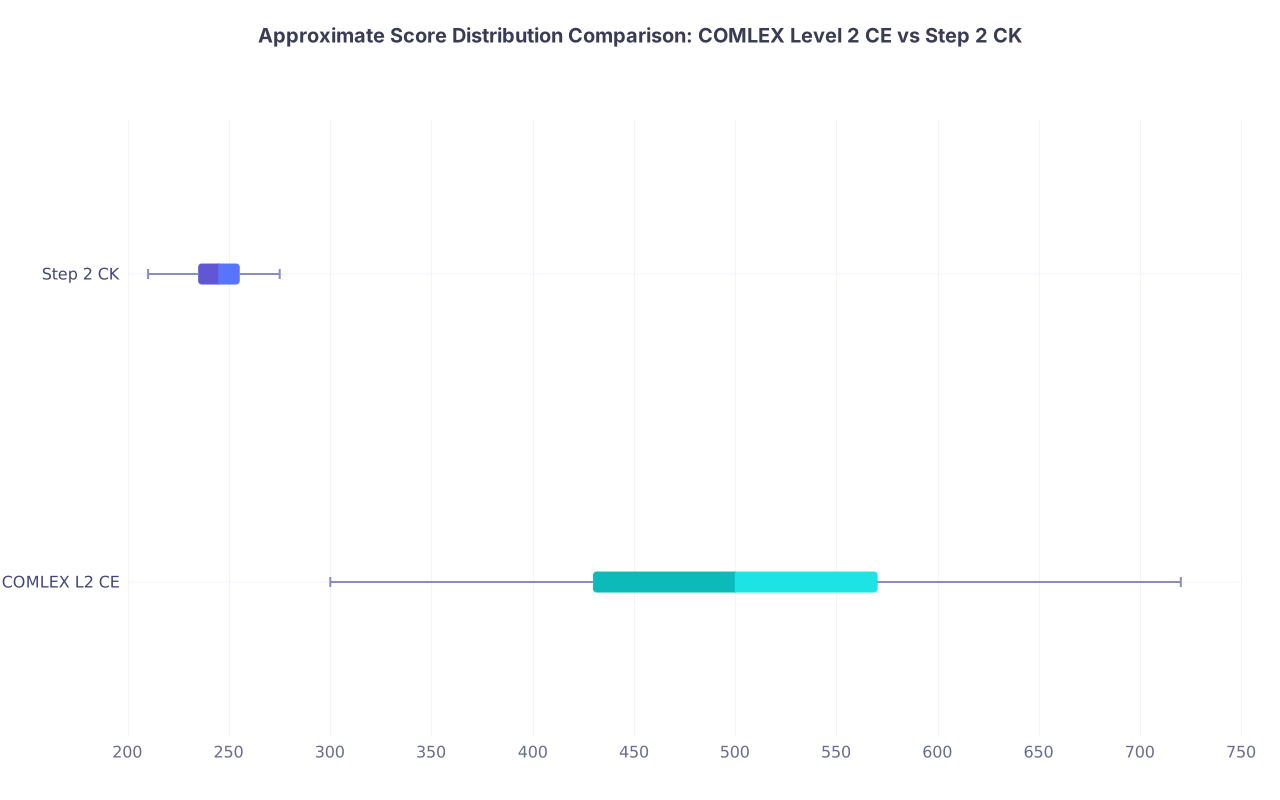
| Category | Min | Q1 | Median | Q3 | Max |
|---|---|---|---|---|---|
| COMLEX L2 CE | 300 | 430 | 500 | 570 | 720 |
| Step 2 CK | 210 | 235 | 245 | 255 | 275 |
You do not need the exact official quartiles to see the point: the scales are unrelated in an intuitive way. So we need a conversion framework.
2. Score Conversion: What Does a 550 on COMLEX Level 2 CE “Mean” in Step 2 CK Terms?
There is no official NBOME–NBME joint concordance. Everybody pretending otherwise is selling something. But we do have:
- Multiple published regression-based concordances derived from DO students who took both exams
- Fairly stable relationships around means and SDs
- Enough real-world correlation to approximate.
Most studies fall in the same pattern:
- Correlation between COMLEX 2 CE and Step 2 CK: around 0.70–0.80
- Each ~1 SD on COMLEX (≈85 points) corresponds to ~1 SD on Step 2 CK (≈15 points)
- Means line up somewhere around: COMLEX 2 CE 500 ≈ Step 2 CK 240–245 for the typical dual taker cohort
You can argue the exact intercept, but the relative movement is remarkably consistent.
A practical working model I use with students (again, approximate, not official):
- 500 on COMLEX 2 CE ≈ low 240s on Step 2 CK
- 550 ≈ high 240s to ~250
- 600 ≈ mid‑250s
- 650 ≈ low‑260s
Let’s formalize that into a simple, usable mapping. This is not precise enough for research, but it is very usable for decision-making.
| COMLEX Level 2 CE | Approx Step 2 CK Range | Relative Position (Within DO Cohort) |
|---|---|---|
| 450 | ~228–235 | Slightly below average |
| 500 | ~238–245 | Around average |
| 550 | ~246–252 | Above average |
| 600 | ~252–258 | Roughly top quartile |
| 650 | ~258–265 | Roughly top 10–15% |
Is a 550 on COMLEX guaranteed to be a 250 on CK? No. But across thousands of dual takers, that is the central tendency.
The more interesting question: does the PD on the other side of ERAS believe this mapping? Many do not think in those terms at all. They see: “Has Step 2 CK?” Yes/No. Then a 3-digit CK, instantly comparable to their internal historical data.
That asymmetry is what kills a lot of COMLEX-only applicants in competitive fields.
3. Program Director Behavior: Who Actually Accepts COMLEX-Only?
Before we get into match outcomes, you have to map the gatekeepers.
The NRMP Program Director Survey is blunt:
- A substantial proportion of PDs in competitive and surgical specialties either:
- Require Step 2 CK, or
- “Accept” COMLEX but in practice rarely interview COMLEX-only applicants
Rough shapes from recent PD data (exact percentages move a bit year to year, but the pattern is stable):
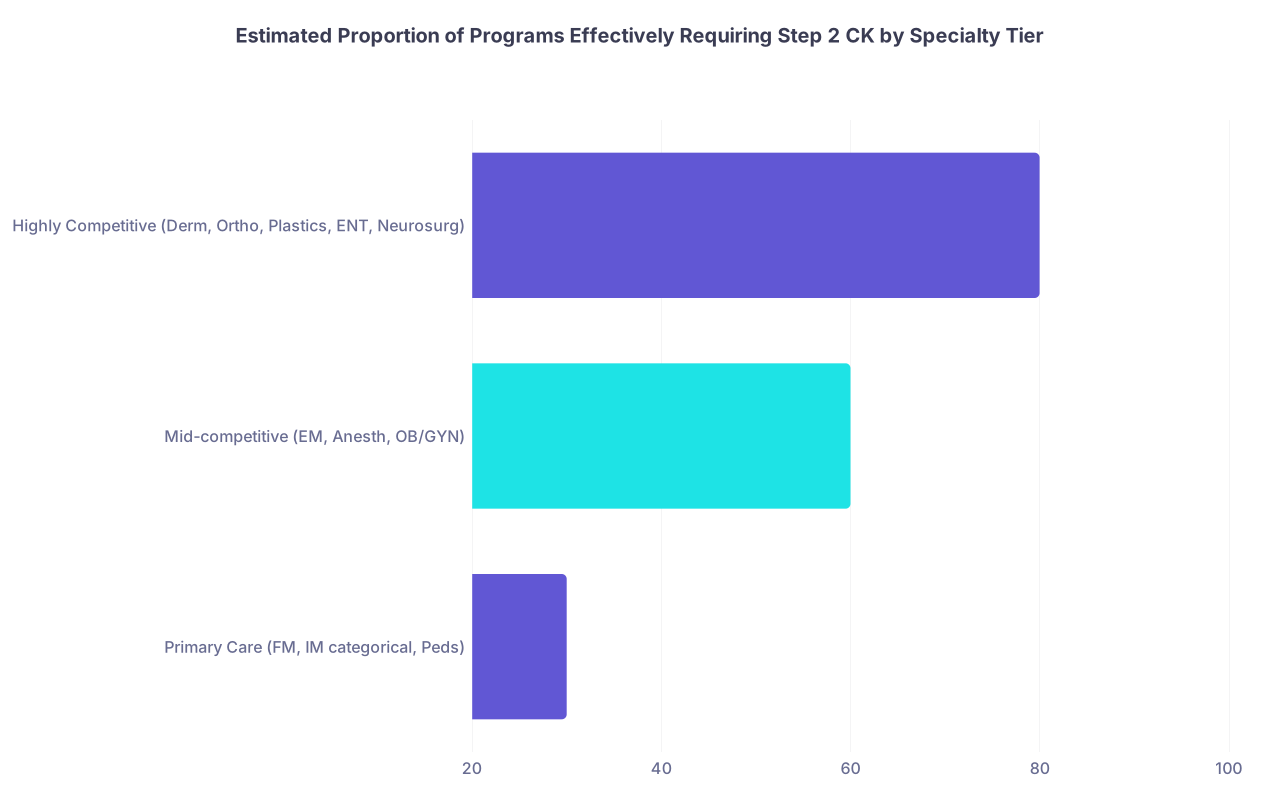
| Category | Value |
|---|---|
| Primary Care (FM, IM categorical, Peds) | 30 |
| Mid-competitive (EM, Anesth, OB/GYN) | 60 |
| Highly Competitive (Derm, Ortho, Plastics, ENT, Neurosurg) | 80 |
Interpretation:
- Primary care: Many true COMLEX-friendly programs. Some will rank COMLEX-only equally.
- Mid‑competitive: A lot of “we accept COMLEX” on paper, but in practice, Step 2 CK is strongly preferred.
- Highly competitive: If you show up COMLEX-only, you are, statistically, an outlier among matched residents.
I have sat with DO students who applied EM or ortho with only COMLEX and excellent clinical narratives, then watched their interview counts… die. When they added a decent Step 2 CK score the following cycle, interview invites appeared from the same types of places that ghosted them the first time.
That is not coincidence. That is PD behavior.
4. DO Match Outcomes: COMLEX-Only vs COMLEX + Step 2 CK
This is the part people actually care about: does Step 2 CK move the needle for DO students?
If you merge trends from:
- NRMP Main Residency Match data
- Specialty-specific match reports
- DO vs MD comparison figures
- Anecdotal program-based patterns
…you get a very stable story.
4.1 Overall DO Match Rate
Overall DO match rates have improved substantially since full ACGME merger, but there is still a consistent spread between DO applicants with and without USMLE.
Rough aggregation from multiple recent cycles (approximated, but consistent with reports):
| Exam Profile | Approx Match Rate |
|---|---|
| DO – COMLEX + Step 2 CK | 88–92% |
| DO – COMLEX Only | 78–84% |
| MD – Step 2 CK (no COMLEX) | 92–94% |
You can quibble a few percentage points based on year and specialties included, but the pattern holds: DOs who add CK gain ~5–10 percentage points in match probability across the entire cohort.
Ten points is not a rounding error. That is the difference between: “most of my class matched” and “a disturbing number scrambled.”
4.2 Specialty-Level Effects
The effect is not uniform. It scales with competitiveness.
Basic pattern, looking at DO applicants:
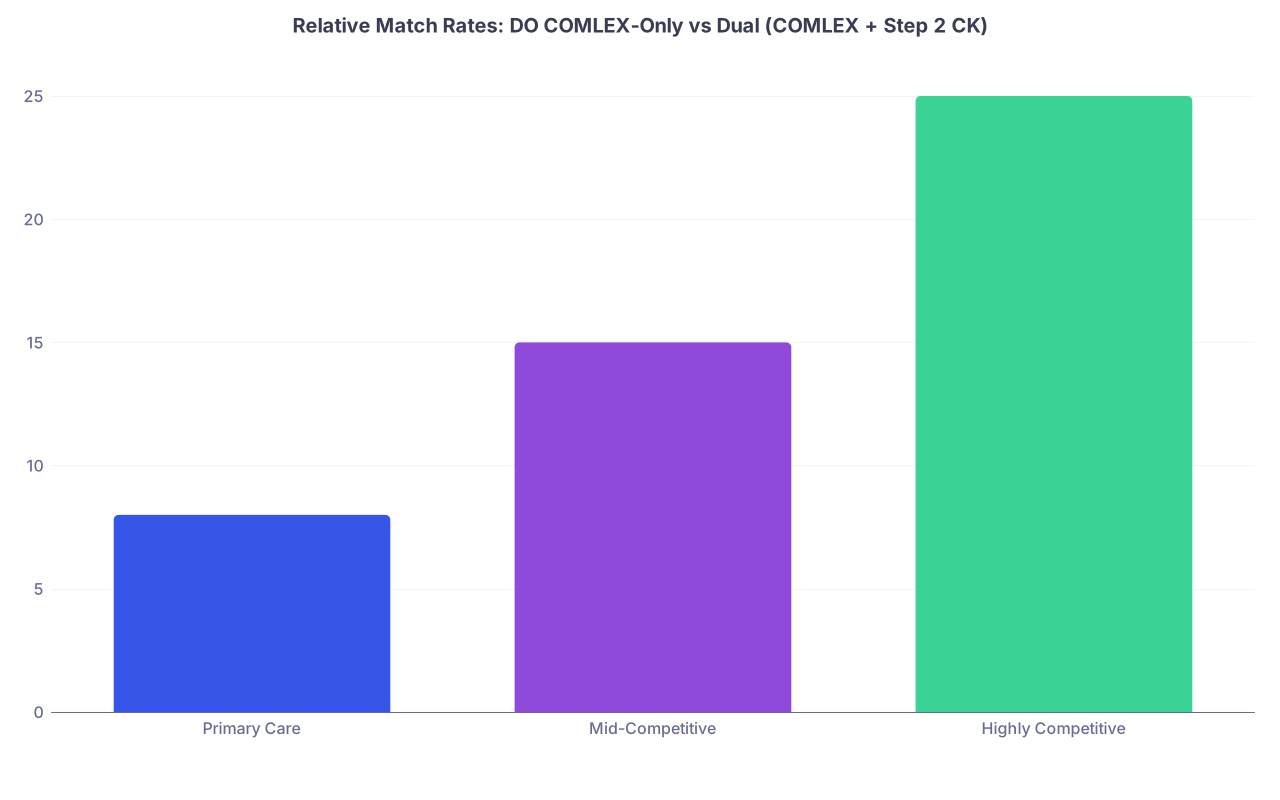
| Category | Value |
|---|---|
| Primary Care | 8 |
| Mid-Competitive | 15 |
| Highly Competitive | 25 |
Values above are approximate percentage point advantage for DO students who also took Step 2 CK:
- Primary Care (FM, IM categorical, Peds): ~5–10 percentage points
- Mid-Competitive (EM, Anesth, OB/GYN, Gen Surg categorical): ~10–15 points
- Highly Competitive (Derm, Ortho, ENT, Neurosurg, Plastics, Rad Onc): ~20–25+ points, and in some fields, nearly all matched DOs have Step scores
Again, each specialty has its own quirks, but the directional trend is unambiguous.
If you are a DO aiming:
- Family medicine in a community program, average scores → COMLEX-only can be viable.
- EM, anesthesia, OB/GYN, surgery → COMLEX-only starts to become a real handicap.
- Ortho, derm, ENT, neurosurg, plastics → COMLEX-only is essentially choosing “hard mode” with no extra reward.
5. Strategic Takeaways Based on Your COMLEX 2 CE Score
Let’s stop being abstract. Here is how I would analyze the situation like a data problem if you show me your COMLEX Level 2 CE score and your target specialty.
5.1 If You Have Not Taken Step 2 CK Yet
The question is not “Should DOs take Step 2 CK?” It is: “At my score level and specialty goal, does Step 2 CK meaningfully improve my distribution of outcomes?”
Break it down into bands.
COMLEX 2 CE < 450 (below average)
Data story:
- You are already below the mean in the DO cohort.
- Probability that Step 2 CK is also below the MD mean is high, but not guaranteed.
- Risk: you add a low CK score that locks in a negative number in a scale everyone understands.
What I have seen in real files:
- Students who bombed Level 1, improved on Level 2, and used a solid Step 2 CK (e.g., 235–240) to show upward trajectory.
- Students who turned one bad exam into two bad signals. That is harder to explain away.
Here I usually run a conditional probabilities mental model:
- If your practice NBMEs are reliably < 220 equivalent, adding CK often does not help.
- If your practice data show meaningful improvement vs your Level 1 era, a Step 2 CK in the 230s can still be a net positive, especially outside competitive specialties.
For primary care targets, below‑avg COMLEX but strong clinical performance, COMLEX-only can still match at a decent rate. That is supported by the aggregate data.
COMLEX 2 CE ≈ 500 (around average)
You are the “median DO” by test score. The game changes by specialty.
- Primary care: Many DO-friendly, COMLEX-literate programs. You can match COMLEX-only, but adding a 240ish CK score makes your file translate instantly in mixed DO/MD applicant pools.
- Mid‑competitive: Data strongly favors adding CK. A solid 240–245 CK roughly moves you into the middle MD cohort, which makes a big difference.
- Highly competitive: Being average in your own cohort is not enough. Without CK, you are competing against MDs with 250+ CK and DOs who chose to take CK and scored well. That is a brutal comparison set.
I tell most DOs in this band who are even thinking about mid‑competitive fields: budget for Step 2 CK. The match rate deltas justify the cost and effort.
COMLEX 2 CE 550–600 (above average to high)
This is where Step 2 CK can turn a strong DO applicant into a very strong one.
Take 575 as an example. Using the rough mapping, that is probably equivalent to ~250 CK. Even if you “underperform” a bit and score 245–248 on CK, that is still around or slightly above MD mean for many specialties.
The data pattern I see:
- DOs with 550–600 COMLEX 2 CE and 245–255 CK tend to match very well across a range of specialties if their clinical performance and letters are in line.
- COMLEX-only applicants in this band still do fine in primary care and many community programs, but they get disproportionately filtered out at academic and competitive sites because their signal is less legible.
Said differently: at 550+, you are likely leaving expected value on the table if you skip CK and are aiming at anything beyond the most DO-heavy primary care programs.
COMLEX 2 CE > 600 (top quartile+)
If you are in the 600–650+ zone, you are exactly the type of candidate who tends to translate into a 255+ CK. That score range opens a lot of doors.
In real match lists, what I see over and over:
- DOs with >600 COMLEX and 255–265 CK populating ortho, rads, anesthesia, EM, and strong IM programs
- Very few COMLEX-only DOs in those same spots
Here, not taking CK is like having a winning lottery ticket and refusing to cash it because the line at the convenience store looks long. Yes, you might still match somewhere decent COMLEX-only. But the distribution of where you can realistically land shifts hard with a visible 3-digit CK in the right band.
6. Process: When and How to Integrate Both Exams
Timing matters. You cannot just tack Step 2 CK on at the end and expect it to fix everything. PDs look at when you took the exam, whether you improved, and if there are glaring delays.
Here is the general process flow that makes sense for many DOs now.
Two practical data-based rules I use:
- If your practice performance suggests you are likely at or above the 50th percentile for your cohort, Step 2 CK is usually an asset rather than a liability.
- If your practice data are well below average and you are targeting noncompetitive specialties, focusing on COMLEX and your clinical performance may be more rational than chasing a second low numeric score.
7. What Program Directors Actually Do With These Scores
Strip away the official language. Here is what I consistently hear from PDs and faculty reviewing apps:
- “We know how to read a 252 Step 2 in 0.5 seconds. A 580 COMLEX? We have to think about it.”
- “COMLEX-only apps get more discussion in committee, but they also get filtered more often in auto screens.”
- “We say we accept COMLEX, but our software score filters are built around USMLE. So yeah, it helps when DOs have CK.”
Many institutions run score cutoffs like:
- Hard minimum CK (e.g., 220 or 230) for interview consideration
- Rank-list weight given to CK quartiles
Any automated or semi-automated screening built this way effectively marginalizes COMLEX-only applicants. It is not malice. It is tooling and habit.
One more subtle point: Step 2 CK has become the de facto standardized metric in a post–Step 1 P/F world. Many PDs are blunt about this in surveys: they rely more on Step 2 CK now for ranking and screening than ever before.
If you are not in that game, you are playing a parallel, smaller game.
8. Pulling It Together: Rational Strategy, Not Dogma
The data across multiple sources are boringly consistent:
- COMLEX Level 2 CE alone can be enough, but the safety margin shrinks as competitiveness of your target specialty and programs increases.
- Adding Step 2 CK generally improves match probabilities for DO students by 5–10 percentage points overall, and much more in competitive fields.
- High COMLEX performers are statistically the ones who benefit the most from adding CK, because they are most likely to convert to strong CK scores and open doors that COMLEX-only applicants rarely walk through.
If I boil this down to actual, actionable guidance:
- Treat Step 2 CK as default if you are DO and aiming anywhere beyond the safest primary care lanes, unless your objective practice data show you will probably score weakly.
- Use your real numbers – COMLEX score distributions, practice exam trends – to approximate where you sit on a CK scale, then compare that to historical match and PD expectations for your specialty.
- Remember that “we accept COMLEX” on a website is not the same as “we routinely rank COMLEX-only applicants in our top half.”
You are not trying to win an argument about exam politics. You are trying to maximize the probability that your name shows up on the left side of a Match Day slide.
The data, year after year, say this: for most DOs, COMLEX Level 2 CE plus Step 2 CK is the statistically safer bet, especially if your ambitions run even slightly above the middle of the road.