
The reflex to buy an expensive Step 2 CS course is usually wrong.
You do not automatically need a dedicated Step 2 CS course. Most students can pass comfortably with free or cheap resources if they prepare deliberately and practice out loud with a partner. Courses help a very specific group of people. For everyone else, they’re just a $1,000 anxiety tax.
Let’s go through this cleanly so you can decide which side you’re on.
Step 2 CS (or equivalent) – What Actually Matters
Even though the original Step 2 CS has been discontinued, many schools and some licensing bodies still use a CS-style OSCE or mock exam that looks and feels similar. The same logic applies whether you’re dealing with:
- A school clinical skills exam / OSCE
- A standardized patient (SP) exam for graduation
- An “in-house Step 2 CS replacement”
The structure is the same at its core:
Multiple standardized patient encounters. You’re scored on:
- History and physical (can you get the right info and examine appropriately?)
- Communication and professionalism (are you empathetic, organized, and clear?)
- Documentation / clinical reasoning (can you put it into a coherent note or plan?)
You don’t pass or fail because you didn’t buy a course. You pass or fail because of:
- Repeatedly missing key history elements
- Chaotic or incomplete physical exams
- Poor time management
- Weak or disorganized notes
- Robotic, rushed, or culturally insensitive communication
Now ask the real question:
Do you need to pay a company to fix those things, or can you fix them with structured practice and free material?
Free vs Paid: What Actually Changes?
Here’s the honest comparison.
| Aspect | Free / Cheap Resources | Paid CS Course |
|---|---|---|
| Cost | $0–$100 | $600–$2000+ |
| Content | Cases, checklists, videos | Same, plus live coaching |
| Practice Partners | Classmates/friends | Other test-takers |
| Feedback Quality | Variable but can be strong | Usually structured and consistent |
| Scheduling | Flexible, self-paced | Fixed dates, intensive |
| Best For | Average/good clinical skills | High-risk or repeated failures |
The course isn’t magic. It just forces you to:
- Show up
- Practice multiple cases under time pressure
- Get systematic feedback
You can recreate 80–90% of that yourself if you’re disciplined.
When Free Resources Are Enough (For Most People)
If you recognize yourself here, you don’t need a course. You need a plan.
You likely do not need a paid Step 2 CS course if:
- You’re passing your school OSCEs on the first try
- Attendings and residents usually say your presentations are “clear” or “solid”
- You can take a history in under 10 minutes without freezing
- You’re comfortable talking to patients about tough topics (sexual history, substance use, non-adherence)
The students I see do just fine usually build a simple system:
Pick 1–2 solid free/cheap resources
Examples:- Old Step 2 CS case books (still incredibly useful for OSCE-type exams)
- Online checklists and SOAP note templates from your school or teaching hospitals
- YouTube videos of full standardized patient encounters
Practice 3–5 cases per week for 3–4 weeks
Not reading. Not highlighting.
Actual out-loud encounters with:- Timer on (15 minutes for encounter, 10 minutes for note or whatever your exam uses)
- A partner acting as the patient
- A checklist afterward
Use structured feedback
After each case, ask your partner:- Did I introduce myself and clarify your name and preferred form of address?
- Did you feel I listened or rushed you?
- What did I completely miss?
Write the note every single time
Students try to skip this. Then get steamrolled on test day.
You should be able to write a concise SOAP or equivalent note in the allowed time, without thinking. That happens after 15–20 reps, not 2.
If you do that consistently for a few weeks, a dedicated course adds very little.
When You Should Seriously Consider a Course
Here’s where I’m blunt: some people absolutely benefit from a formal course, and skipping it is a bad gamble.
You should strongly consider a dedicated Step 2 CS (or OSCE) course if:
You have a history of failing clinical skills exams
- Failed your school OSCE
- Needed remediation for communication or professionalism
If your school already flagged you, take that seriously. A course gives you targeted, supervised practice.
You’re an international medical graduate (IMG) with limited U.S.-style patient exposure
Especially if:- You rarely did full English patient interviews in your clinical years
- You’re still translating in your head a lot
A good course helps you: - Standardize your phrasing
- Learn the “expected” U.S. patient-friendly language
- Get used to U.S. documentation style
Serious language barriers or heavy accent + patient comprehension issues
I don’t mean your English isn’t perfect. I mean:- Patients often say, “Sorry, can you repeat that?”
- Attendings have commented that communication is an issue
In that case, structured coaching is worth money.
You have no reliable practice partners and you know you won’t self-police
If:- Your school doesn’t offer any decent mock OSCE
- Your classmates are scattered, disengaged, or unavailable
- You procrastinate unless you’ve paid for something
Then yes, a course may be the only way you’ll actually do 20–30 cases before test day.
You already failed a Step 2 CS-style exam once
At that point, doing “more of the same” with just free resources is naive.
You need structured feedback from someone who has seen hundreds of candidates and knows your recurring patterns.
What You Can Get For Free (Or Almost Free)
Let’s be concrete. Here’s what you should use if you’re staying out of the course lane.
1. Case Books and Question Banks
Old Step 2 CS prep books and school OSCE guides are gold mines. They give you:
- Chief complaints
- Sample histories
- Focused physical exam checklists
- Sample notes or write-ups
Treat each chapter as a mini-simulation. Don’t just read. Run it as a case with a partner.
2. Online Videos and Encounter Demos
Search for:
- “Standardized patient encounter full example”
- “OSCE history taking [chest pain/abdominal pain/headache/etc.]”
Watch with a pen in hand. Pause and list:
- How they introduce themselves
- Phrases they use to show empathy
- How they transition between topics (“Now I’d like to ask about…”)
Then copy the parts that feel natural and make them yours.
3. School Resources
Most schools now have:
- Clinical skills labs with SPs
- Recorded practice encounters
- Faculty-led mock OSCEs
If your school offers even one mock exam, treat it like the real thing. Show up prepared, review your performance, and fix the weaknesses immediately.
A Simple 3-Week DIY “Course” Plan
If you’re opting out of a paid course, don’t just say “I’ll practice a bit.” Build a minimum viable plan.
Week 1 – Foundation
- Watch 3–4 full encounter videos
- Practice 1–2 focused histories per day with a friend/classmate
- Build your own templates:
- Intro + verification of name
- ROS sequence
- Closing and counseling phrases
Week 2 – Full Cases
- 8–10 full encounters with:
- 15 minutes talking/exam
- Immediate 10-minute timed note
- After each:
- Partner tells you what felt rushed, what was unclear
- You compare note to checklists or case book
Week 3 – Polish and Pressure
- Focus on:
- Complaints you hate (vaginal discharge, back pain, psych, pediatric via parent, etc.)
- Scenarios with sensitive content
- Use 1–2 days as full mock exam:
- String together 4–6 cases back-to-back
- No phone. No checking your notes between cases.
This is the kind of thing people pay $800 for. You can recreate it yourself if you’re willing to be a little organized and a little uncomfortable.
If You Decide To Pay for a Course, Don’t Get Scammed
Some CS/OSCE prep outfits are solid. Some are glorified PowerPoints and panic marketing.
Here’s what a good course should give you:
- Multiple live standardized patient encounters
- Real-time feedback on:
- Structure of your history
- Appropriateness and efficiency of your physical exam
- Clarity and accuracy of your note
- Your communication style and nonverbal habits
- A clear report: what you’re already doing fine, what specifically you must fix
Red flags:
- The website leans heavily on fear: “Most IMGs FAIL without us”
- They won’t show you sample content or a real schedule before you pay
- No clear faculty credentials or their “faculty” are unnamed “US physicians”
Ask them direct questions:
- “How many cases will I personally do?”
- “Who gives feedback? Faculty? SPs? Residents?”
- “Do you provide written evaluations of performance by domain?”
If they give vague answers, skip it.
Common Myths About Step 2 CS Courses
Let’s kill a few bad ideas that float around group chats.
“Everyone in my class is taking a course.”
No they’re not. A loud subset of anxious people is. The quiet majority passes with school resources and peer practice.“Programs care if you took a course.”
They don’t. There’s no checkbox for “bought a commercial prep course.” They see pass/fail or your OSCE performance if your school reports it internally. That’s it.“Free resources don’t teach you the ‘tricks’.”
There are no real “tricks.” The so-called secrets are normal things:- Introduce yourself and wash your hands
- Sit down
- Summarize what you’ve heard
- Explain your plan and ask if they have questions
You can learn all of that from a 10-minute YouTube video.
“Courses are the safest option.”
No. The safest option is honest self-assessment and targeted practice. Paying money doesn’t fix poor habits if you don’t actually change them.
Quick Decision Checklist
You likely do not need a course if:
- You’re consistently passing clinical skills/OSCEs
- Supervisors say your communication is good or very good
- You’ve got at least one reliable partner willing to practice 10–20 cases
- You’re willing to stick to a 3-week plan like the one above
You should strongly consider a course if:
- You’ve failed or nearly failed prior OSCEs
- You’re an IMG with limited U.S.-style patient interaction
- Patients and attendings regularly struggle to understand your English
- You have no realistic way to simulate multiple full-length encounters without external help
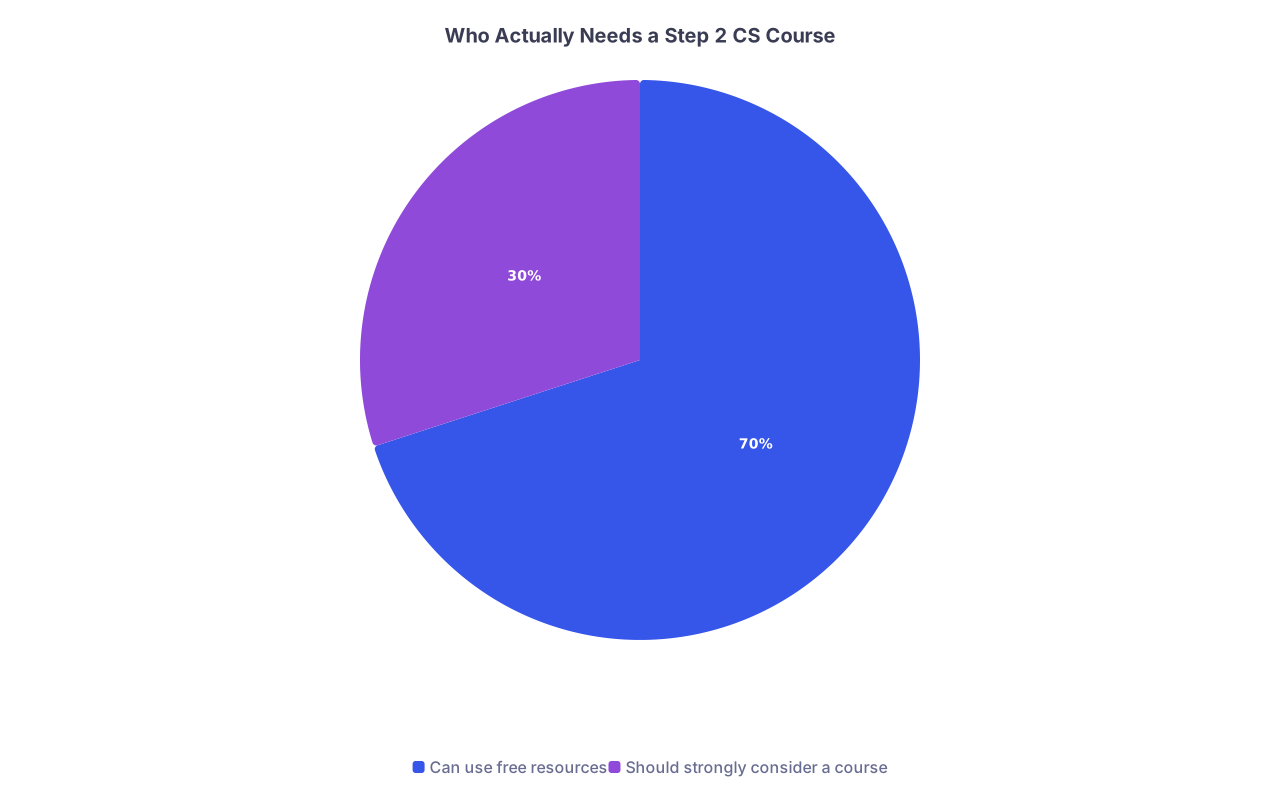
| Category | Value |
|---|---|
| Can use free resources | 70 |
| Should strongly consider a course | 30 |
That breakdown is roughly what I’ve seen: most students do fine with self-directed prep. A minority genuinely benefit from structured, paid instruction.
FAQs
1. How many practice cases do I need before a CS-style exam?
Aim for at least 15–20 full cases (history + focused exam + written note) before test day. I’ve seen good students feel comfortable around case 10–12, but performance keeps tightening after 20. Reading 50 printed cases isn’t the same as doing 15 live ones.
2. Can I practice Step 2 CS-style cases alone?
You can practice parts alone—like timing your note writing, rehearsing your intro and closing, or mentally running through ROS patterns—but you shouldn’t do all your prep solo. At minimum, you need another human for:
- 8–10 real encounters where you speak out loud
- Feedback on how you sound and how your pacing feels
That can be a classmate, partner, roommate, or even an online peer over Zoom.
3. Are old Step 2 CS resources still useful for modern OSCEs?
Yes. Hugely. The exam name changed, but the core skills didn’t. Old CS case books give you excellent chief complaints, structured histories, and sample notes that map very closely to current clinical skills exams and school OSCEs. You’ll just adapt minor format differences your institution requires.
4. What if my school doesn’t offer any mock OSCEs?
Then you build your own. Grab:
- A case book or online case bank
- One or two classmates
- A timer app
Run 4 cases in a row on a Saturday morning and treat it like your personal mock OSCE: no phones, strict timing, write every note. It’s not fancy, but it’s effective. This is essentially what many paid courses are selling you.
5. How do I know if my communication skills are “good enough” without a course?
Ask the people who’ve watched you work:
- “Do I ever come across as rushed or dismissive with patients?”
- “Are my explanations usually clear enough for patients to understand?”
- “Is there anything in my communication that might hurt me on a standardized exam?”
If multiple attendings, residents, or preceptors tell you you’re fine (or better than fine), believe them over marketing copy from a test-prep website.
Bottom line: Most students do not need a dedicated Step 2 CS course. If your clinical skills and communication are already decent, you’ll get more value from a focused 3–4 week self-directed plan using free and cheap resources. Save the course money for people with real risk factors: prior failures, serious language barriers, no practice infrastructure, or very limited clinical exposure.


