

The fantasy that “a good Step 2 score will solve everything” is dead the moment your score comes back borderline.
If that’s where you’re sitting right now—refreshing your email, staring at a number that’s not a disaster but definitely not what you wanted—this article is for you. Not theory. Not vibes. Actual moves you can make in the next 1–4 weeks to salvage this cycle or set up the next one.
We’re talking Plan B after a borderline Step 2 score: adjusting your residency strategy without self-destructing your career.
Step 1: Get brutally clear on what “borderline” means for you
“Borderline” is not a real category. Programs don’t have a dropdown that says “borderline candidate.” They have numbers, filters, and piles.
You need to translate your score into reality for your target specialties.
| Specialty Type | Competitive Example | Typical Step 2 Range for Solid Applicants | Where 'Borderline' Often Starts |
|---|---|---|---|
| Ultra-competitive | Derm, Ortho, ENT | 250+ | ~238–245 |
| Competitive | Anesthesia, EM, Rads | 240–250 | ~232–238 |
| Mid-competitive | IM, Gen Surg, OB | 235–245 | ~225–232 |
| Less competitive (categorical) | Peds, Psych, FM | 225–238 | ~215–225 |
These are rough. But they give you a working model.
If your Step 2 is:
- 10–15 points below the average for your dream specialty → you’re in true “borderline” territory.
- 20+ points below → you’re not borderline; you’re an outlier for that field, and you need a more aggressive Plan B.
- 5–7 points below → you’re uncomfortable but still in the running at some places if the rest of your app is strong.
Here’s what you do this week:
- Look up:
- NRMP Charting Outcomes for your specialty.
- Your school’s match list and typical Step 2 ranges for that field (ask your dean’s office or recent grads).
- Put your score in context:
- Compare to national matched averages.
- Compare to unmatched in that specialty.
You are not allowed to say “borderline” again until you actually know your position.
Step 2: Decide your real risk tolerance (before you blow up your rank list)
This is where people get reckless: they feel embarrassed, panic, and then either overcorrect (“I’m switching to Family from Ortho overnight”) or undercorrect (“I’ll just apply to Derm anyway, something will work out”).
You need to answer two blunt questions:
- Am I willing to risk going unmatched this year?
- Is this specialty truly worth delaying my career 1–2 years for, if necessary?
If your honest answer is:
- “I cannot afford a gap year financially/emotionally” → Your strategy shifts toward safer options, backups, and volume.
- “I want this specialty badly enough to risk SOAP or a reapplication” → You can tolerate a more aggressive main-list plan, but you must still have a safety net.
No one can answer this for you. Not me, not your advisor, not Reddit. But skipping this step and pretending you “just want to match somewhere” when you’d actually be devastated in some fields is how people end up miserable.
Write this down:
“I am willing / not willing to risk going unmatched for [specialty]. If I go unmatched, my backup plan is ____.”
If you can’t fill that blank, that’s your first problem.
Step 3: Rebuild your program list with your new reality in mind
Your Step 2 score just changed your target program tiers. That does not necessarily kill your specialty choice—but it absolutely changes where you should apply.
Here’s how to recalibrate:
1. Sort programs into tiers—for you, not for bragging rights
Use:
- Program websites (look at residents’ med schools, AOA, PhD, etc.).
- Doximity / NRMP data.
- Your own school’s match list: where people “like you” have matched.
Rough cut:
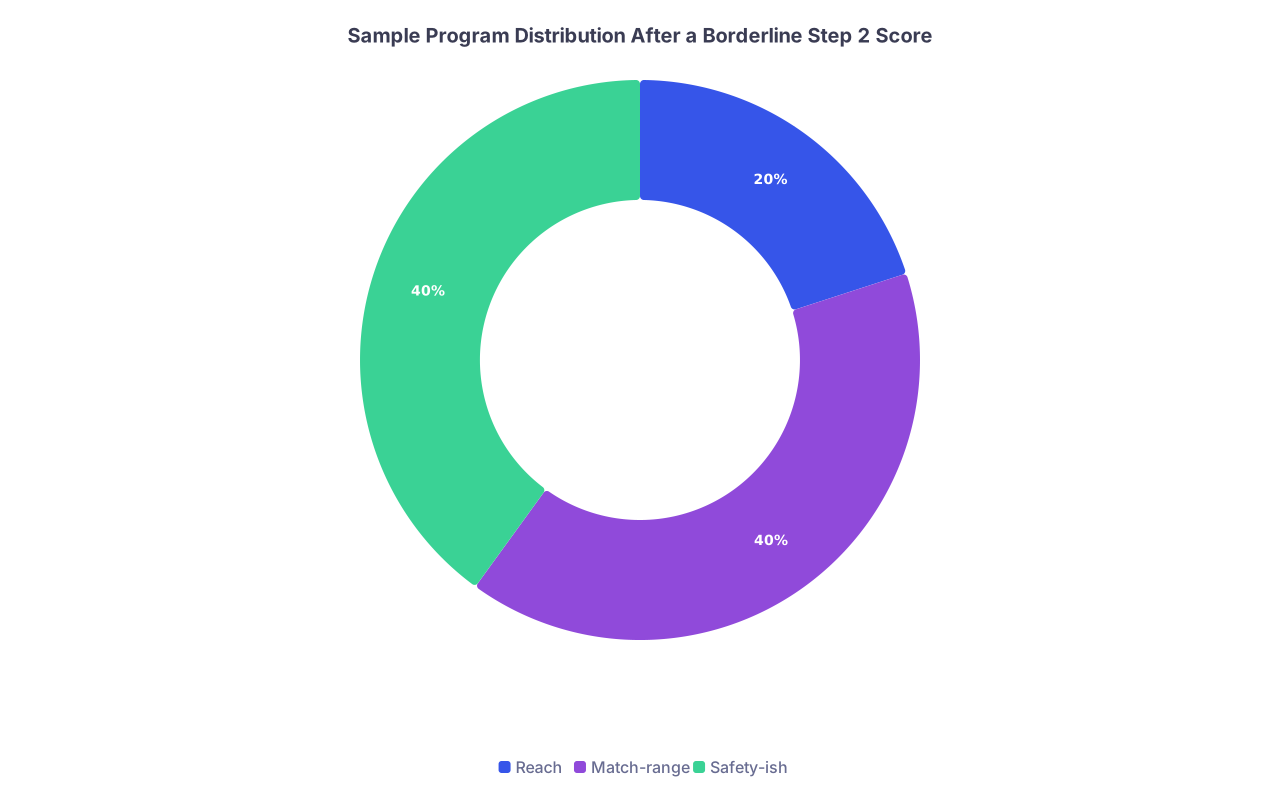
- Reach: You’re significantly below their usual Step 2 profile or academic heft.
- Match-range: You’re around their typical applicant range.
- Safety-ish: Historically take more IMGs, DOs, or lower scores; community programs; newer programs.
Then build your list with an honest distribution.
| Category | Value |
|---|---|
| Reach | 20 |
| Match-range | 40 |
| Safety-ish | 40 |
For a borderline score in a moderately competitive specialty, something like:
- 20% reach
- 40% realistic
- 40% safety-ish
If you’re going for ultra-competitive with a significantly low score, that might become:
- 10% reach (or fewer)
- 40% match-range
- 50% safety-ish or alternate specialty
2. Adjust for MD vs DO vs IMG
I’m going to be blunt.
- US MD with borderline score: You still have more wiggle room. Programs will look harder at the rest of your file.
- US DO with borderline score: You need volume and strategic targeting. Many “mid-tier” academic programs quietly filter DOs or rarely rank them high.
- IMG with borderline score: You can’t pretend you’re in the same pool. You must be fiercely realistic and add a lot more safety programs or consider less competitive specialties.
If you’re DO/IMG with a borderline score and aiming for competitive fields (rads, anesthesia, EM), Plan B is not optional. It’s mandatory.
Step 4: Decide whether to hold or pivot on specialty
This is the part nobody wants to say out loud: sometimes the right Plan B is changing fields.
Not always. But sometimes.
Here’s a simple sanity framework:
| Situation | Likely Move |
|---|---|
| Score mildly below average, strong clinical evals, good letters | Stay in specialty; adjust tiers and volume |
| Score 15–20+ below competitive specialty norms, weak research, no strong home support | Strongly consider pivot or dual-apply |
| IMG/DO + borderline + very competitive specialty + no connections | Pivot or dual-apply almost mandatory |
| You’d also genuinely like another, less competitive specialty | Dual-apply with serious intent |
“Dual-apply” is not a cute phrase. It is basically running two full applications:
- Two sets of letters (ideally).
- Two personal statements.
- Two narratives in interviews.
If you’re going to dual-apply, commit. That means:
- Actually doing away rotations or at least strong exposure in both.
- Being able to explain both interests without sounding like you panicked last-minute.
If you truly love your competitive specialty and there is no second choice that would make you reasonably happy, your Plan B might be:
- Apply more conservatively.
- Accept the risk of going unmatched.
- Prepare for a research year or prelim year + reapply.
That is a valid choice. Just do it consciously, not accidentally.
Step 5: Weaponize the non-score parts of your application
With a borderline Step 2, every other piece of your file moves from “nice to have” to “weapon.”
You can’t change the number. You can change everything else.
Clinical evaluations and narrative comments
Programs read these harder when scores aren’t impressive.
You want:
- Phrases like “top 10% of students I’ve worked with.”
- Comments about work ethic, ownership, communication.
- Consistency across rotations, not one superstar eval and three “fine” ones.
You can’t rewrite old evals, but you can:
- Crush current/future rotations in your target field.
- Ask attendings who saw you at your best to write strong letters now.
- Politely request that they address:
- Your clinical reasoning.
- Reliability.
- Ability to grow.
- How you compare to peers.
Letters of recommendation
For borderline scores, letters are your lifeline. Weak letters kill you faster than a bad score.
Priority:
- 1–2 letters from your specialty of choice where you worked directly with them and they actually know you.
- One department chair/PD letter if standard for your specialty.
- If dual-applying, make sure each specialty has at least 2 letters tailored to it.
If you’re unsure if an attending will write a strong letter, literally ask: “Do you feel you can write me a strong, supportive letter for [specialty] residency?”
If they hedge? Walk away. A lukewarm LOR is worse than no letter.
Step 6: Fix the narrative before it fixes you
Programs will notice your score. They might not say it out loud, but it’s there.
You’ve got two basic choices:
- Pretend it doesn’t exist and hope no one asks.
- Own it, explain it briefly, and redirect attention to your strengths.
If your Step 2 is:
- Slightly lower than expected but consistent with preclinical/Step 1 → You probably do not need to address it explicitly unless they ask.
- Significantly lower than your Step 1 or class performance → You should be ready with a concise explanation.
Bad explanations:
- “I’m actually a great test taker but had a bad day.”
- A long saga of personal drama that takes five minutes to tell.
- Blaming the exam, NBME, or “unfair” questions.
Better structure:
- One sentence: acknowledge the score without drama.
- One sentence: specific, non-dramatic contributor (if real).
- Two–three sentences: what you changed, how your recent performance reflects your true capability.
Example: “I recognize my Step 2 score isn’t as strong as many applicants in this field. I took the exam during a period when I overcommitted to rotations and didn’t leave enough time for structured review, which was a mistake. Since then, my performance on our in-house exams and on service has been much more consistent with my abilities, and my attendings can speak to how I function clinically. I’ve been very deliberate about my study habits and organization since then.”
Then stop talking. Move on to your strengths.
Step 7: If you haven’t taken Step 2 yet and you’re trending borderline—change course now
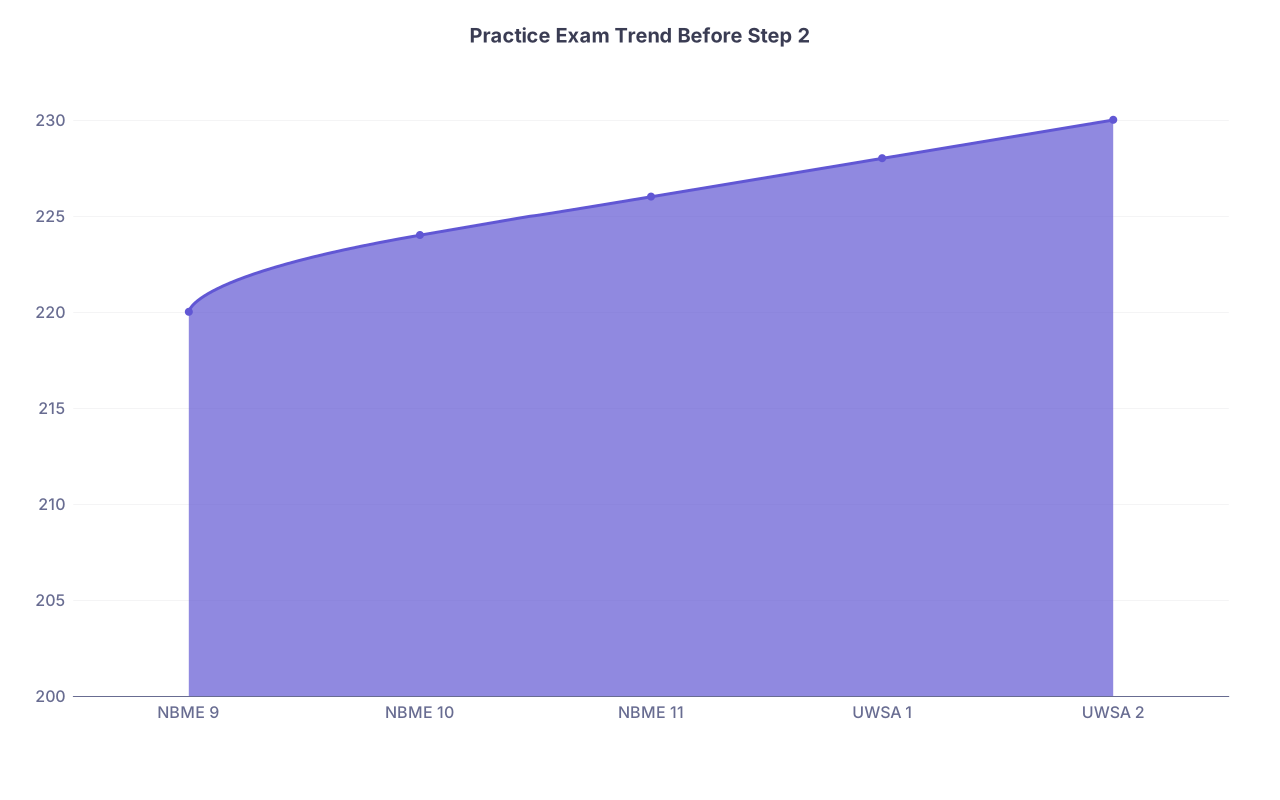
Some of you are reading this before your score, but you already know your practice tests are living in the low 220s and you’re aiming for a relatively competitive field.
Good. You still have levers.
| Category | Value |
|---|---|
| NBME 9 | 220 |
| NBME 10 | 224 |
| NBME 11 | 226 |
| UWSA 1 | 228 |
| UWSA 2 | 230 |
If your trajectory looks like that and your target is, say, anesthesia or EM, here’s what you do:
-
- You have at least 2–3 more weeks you can realistically use.
- You are still doing question blocks and can identify gaps you haven’t closed.
- Your school and application timeline allow it.
Do a brutally honest gap analysis:
- List the systems/topics where your % correct is low (from UWorld, AMBOSS, NBMEs).
- Spend 70–80% of your remaining study time on those, not on re-reviewing what you like.
Stop chasing perfection:
- If you’re sitting on a 229 UWSA 2 score, you are not jumping to 250 in 10 days.
- But you can move to a safer mid-230s range with focused work.
If you’re within 5 points of your minimum “acceptable” score for your goals and your practice tests have plateaued, you have a real decision:
- Take it and own the result.
- Delay and risk complicating the application timeline.
There is no universal right answer. But doing nothing and hoping for a miracle is not a strategy.
Step 8: Use your school and mentors strategically, not passively
Too many students treat advisors like weather apps: they check once and accept the forecast.
You need to drive these conversations.
Who to talk to:
- Your dean’s office / academic advisor.
- A faculty mentor in your target specialty.
- A recent grad who matched in that field with a similar or slightly better profile.
What to ask specifically:
- “With a Step 2 of X, what range of programs in [specialty] have taken students from our school in the past 5 years?”
- “If you were me, would you single-apply or dual-apply? To which backup?”
- “How many programs would you apply to realistically with this profile?”
- “Are there any PDs/alums you’d feel comfortable emailing on my behalf?”
And then: push back (respectfully) if the advice is vague. “I appreciate that—but I need more concrete guidance. Are you saying I have, say, a 10–20% chance vs 50%+ if I include [backup specialty]?”
You’re not a passive character in this story. Get numbers, ranges, examples.
Step 9: Prepare a SOAP and “unmatched” contingency plan now—not later
Hoping you won’t need a Plan C is fine. Not having one is foolish.
If you’re taking any meaningful risk (competitive specialty, low score, DO/IMG, weak research), outline a SOAP plan before Match Week:
- What fields would you be willing to SOAP into?
(Be honest. Don’t list options you’d never actually rank.) - Are you willing to take:
- A prelim year in medicine or surgery?
- A transitional year?
- A categorical spot in a different specialty?
- If you go unmatched completely, what would you do for 12–24 months?
- Research position in your specialty.
- Additional clinical experience, maybe abroad or via observerships (for IMGs).
- Teaching, MPH, or other degree (only if it actually strengthens your reapplication).

| Step | Description |
|---|---|
| Step 1 | Borderline Step 2 Score |
| Step 2 | Apply Broadly Within Specialty |
| Step 3 | Dual-Apply or Switch Specialty |
| Step 4 | Apply Aggressively to Specialty |
| Step 5 | Start Residency |
| Step 6 | SOAP Plan |
| Step 7 | Research/Prelim/Gap Year + Reapply |
| Step 8 | Competitive Specialty? |
| Step 9 | Risk Going Unmatched? |
| Step 10 | Matched? |
| Step 11 | SOAP Offer? |
If you never need this flowchart, great. But if Monday of Match Week comes and you see “Did Not Match,” you’ll be dealing with adrenaline, shame, and a 48–72 hour decision storm. Having a prewritten plan is the difference between strategic and desperate.
Step 10: Fix your daily life so you don’t burn out while adjusting strategy
This part is boring but non-negotiable.
Borderline scores wreck people not just because of the number, but because of the spiral:
- Shame.
- Overworking to “prove yourself.”
- Saying yes to everything on rotations.
- No sleep, no exercise, eating garbage, doomscrolling residency threads at 1 a.m.
You do not make good strategic decisions in that state.
For the next 4–6 weeks, set some hard minimums:
- Sleep: non-negotiable 6–7 hours on most nights, even on busy rotations.
- Applications: 30–60 minutes per day of real work (program research, personal statement, emailing mentors).
- Boundaries: one residency-free block per day (no ERAS, no Reddit, no obsessing).
You’re not a hero for killing yourself. You’re just tired, and tired people write bad personal statements and make panicked specialty switches.
What to do tonight
Do not just nod along and move on. This is exactly how people drift into disaster.
Tonight, do three concrete things:
- Write your Step 2 score and target specialty at the top of a page. Under it, make two columns: “If I stay in this specialty” and “If I pivot / dual-apply.” List 3 pros and 3 cons for each.
- Open a spreadsheet and build a rough program list with three columns: Reach, Match-Range, Safety-ish. Put at least 5 programs in each based on your current understanding.
- Email one advisor or mentor with a specific ask: “Can we discuss my residency strategy now that I have a Step 2 of X and am interested in [specialty]? I especially need help deciding between single-applying vs dual-applying and realistic program tiers.”
That’s it. No huge life decisions tonight. Just clarity, data, and one step toward a real Plan B.


