
It’s 11:47 p.m. You’ve refreshed the NBME page so many times your browser is begging for mercy. The Step 2 CK score is finally there. You click. You scan to the middle of the PDF. And your stomach just… drops.
Lower than Step 1. Not a disaster, but lower. And your brain instantly goes to: “That’s it. I’m done. Programs will think I peaked early. This kills my application. I should’ve delayed. I should’ve done more UWorld. I should’ve… I should’ve…”
You’re not thinking about “growth mindset” or “holistic review.” You’re thinking: is this the moment everything falls apart?
Let’s be brutally honest about what this actually means. Who it hurts. Who it doesn’t. What you can still do. And what’s just your anxiety talking.
First: How Bad Is “Lower Than Step 1” Really?
Let me cut through the noise: “lower than Step 1” is not a single scenario. There are very different worlds here.
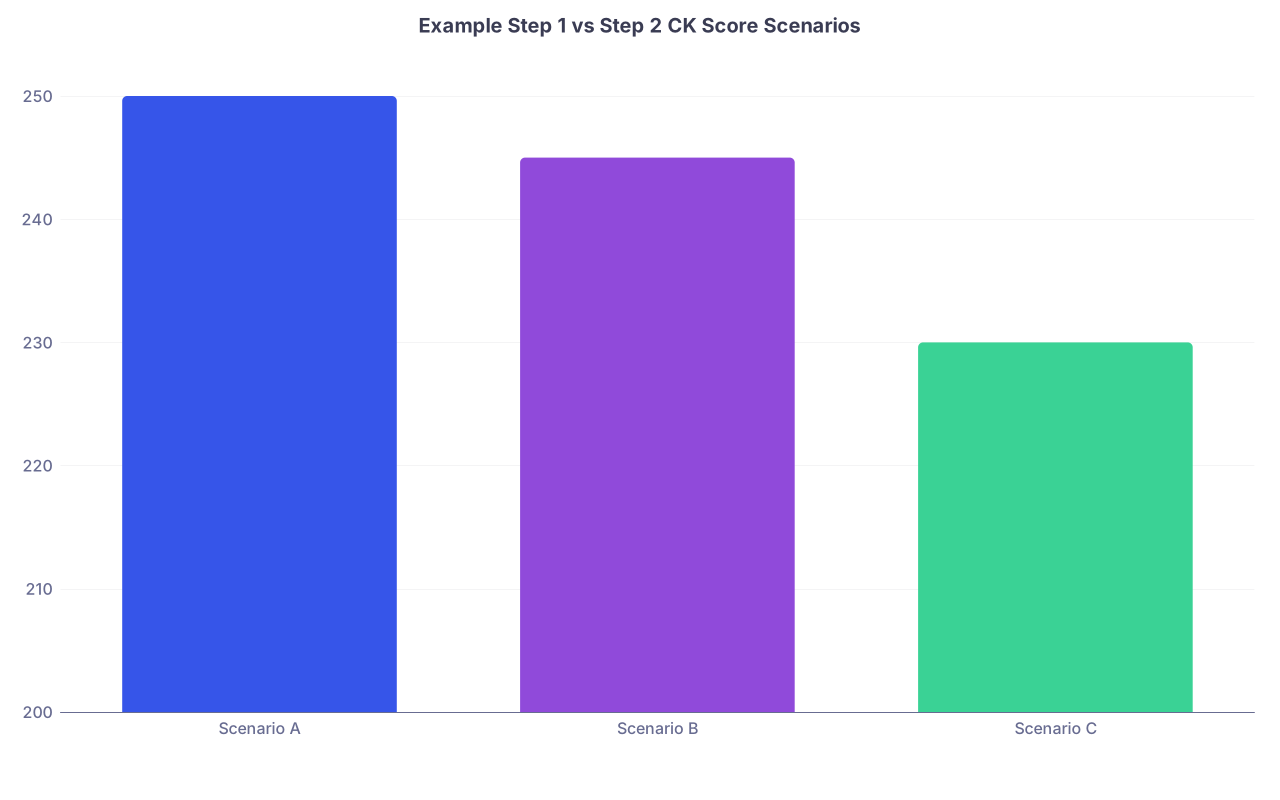
| Category | Value |
|---|---|
| Scenario A | 250 |
| Scenario B | 245 |
| Scenario C | 230 |
Let’s put some concrete numbers on it so we stop talking in vague panic.
Say:
- Step 1: 250
- Step 2: 244
That’s technically “lower.” But it’s still very strong. No sane PD is tossing that application in the trash.
Now compare:
- Step 1: 230
- Step 2: 214
Also lower. But this is a different conversation.
The real questions programs silently ask aren’t “Is Step 2 lower than Step 1?” but:
- Are both scores in a range that fits our usual applicants?
- Is there a pattern of concern? (downward trend, barely passing, multiple fails?)
- Does anything else in the app offset this? (research, letters, clinical grades, school reputation, etc.)
Direction matters less than your final Step 2 number and the story your whole application tells.
I’ve seen people lose their minds because their 255 Step 2 was “worse” than their 260 Step 1… and then go on to match derm. That’s not fake. That literally happens every year.
Where you’re in more danger is:
- Mid 220s → low 210s
- Borderline Step 1 → clearly weaker Step 2
- One or both scores hovering near pass
So before spiraling, you need to honestly label your situation.
How Programs Actually Look at Step 1 vs Step 2
Here’s the part that messes with your head: you’re obsessing about the direction (up vs down). They’re mostly obsessing about the level (strong / average / concerning).
Think like a PD for a second. You’ve got 1500 apps for 12 spots. You can’t sit there doing emotional forensics on each score trend. You’re doing quick reads:
- Strong / competitive scores → keep
- Solid but not amazing → look at rest of app
- Marginal / risky → scrutinize or screen out
For many programs, both scores get mentally grouped like this:
| Category | Rough Step 2 CK Range |
|---|---|
| Highly competitive | 250+ |
| Strong | 240–249 |
| Solid / average | 225–239 |
| Below average | 215–224 |
| Concerning | <215 |
This varies by specialty obviously, but you get the idea.
The vibe is: “Are you in the range where we feel safe ranking you?” not “Did you go up exactly 8 points from Step 1 to Step 2 or else you are trash?”
Here’s how the Step 1 → Step 2 relationship tends to be interpreted in real life:
High Step 1 + slightly lower but still strong Step 2
Programs: “Still a strong test taker. Fine.” End of story.Average Step 1 + higher Step 2
Programs: “Nice upward trend. Probably matured clinically.” Bonus.High Step 1 + significantly lower Step 2 into borderline territory
Programs: “Huh. What happened here?” They may dig into MSPE, clerkship comments, letters.Borderline Step 1 + borderline or lower Step 2
Programs: “Test-taking is a consistent concern.” This can be a problem, especially for competitive fields.
Your anxiety wants to treat any drop as a red flag. Their reality is more: “Does this applicant look like they’ll pass our in-training exams and boards without drama?”
Specialty-Specific Reality Check (How Screwed Am I?)
Let’s just be direct because this is what you’re actually worried about.
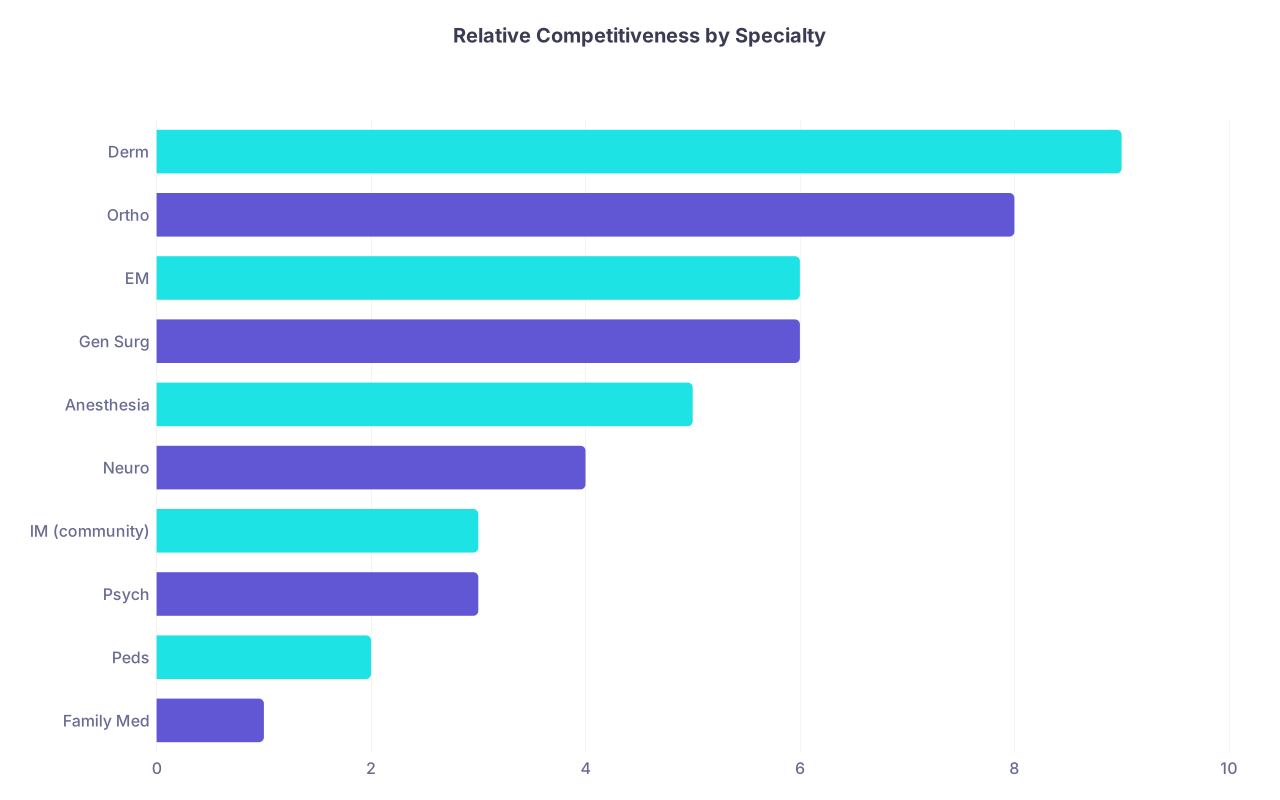
| Category | Value |
|---|---|
| Family Med | 1 |
| Peds | 2 |
| Psych | 3 |
| IM (community) | 3 |
| Neuro | 4 |
| Anesthesia | 5 |
| Gen Surg | 6 |
| EM | 6 |
| Ortho | 8 |
| Derm | 9 |
If you’re going for ultra-competitive (derm, ortho, plastics, ENT, rad onc, some neurosurg)
Here’s the part that stings: in those fields, people split hairs. They look at every detail because everyone applying is strong.
If you had:
- Step 1: 255
- Step 2: 240
Still not automatically dead. But if your research is light, your letters are just “fine,” and your school isn’t a big name, that drop can hurt because it drags you closer to (or below) their usual mean.
If you had:
- Step 1: 238
- Step 2: 225
You’re now on the weaker side for those specialties. The issue isn’t “lower” — it’s “below typical range.” Programs may wonder if you’ll struggle with in-training exams.
Can you still match? Yes, with:
- Strong research
- Really good letters from known people
- A realistic, broad list including less prestigious programs
But your margin for error shrinks.
If you’re going for moderately competitive (anesthesia, EM, rads, gas, some IM academic programs)
A moderate drop is usually not fatal, as long as you stay within a reasonable band.
- 245 → 238? Still fine at many places. They won’t love the trend, but they’ll live.
- 230 → 218? More mixed. Some will be okay if the rest is strong; others will pause.
Here, letters and clinical grades matter a ton. A “team player, hardworking, great clinical judgment” narrative can offset a flat or slightly downward score trend.
If you’re going for less competitive (FM, peds, psych, many community IM)
This is where your brain most overestimates the damage. For many of these programs, as long as you’re not in obvious trouble territory, a small drop won’t matter.
I’ve seen:
- Step 1: 227, Step 2: 221 → matched FM no problem.
- Step 1: 220, Step 2: 215 → matched peds with solid letters and solid clinical performance.
Where it gets dicey is if:
- You’re international, and both scores are low.
- You’ve failed an exam before.
- Your school doesn’t have strong connections to US programs.
Then every point matters more.
Red Flags vs “Annoying But Fine” Flags
You’re probably mentally labeling your entire life a red flag. Let’s separate the actual problems from the noise.
Real red flags:
- A fail on Step 1 or Step 2
- Step 2 significantly below 215–220 if you’re aiming for anything other than the very least competitive spots
- A big downward trend plus poor clerkship comments or remediation
- Score barely above passing as a US MD, especially for competitive fields
“Annoying but fine” flags:
- 260 → 252
- 245 → 238
- 230 → 226
These feel catastrophic because you built an identity around “I’m a high scorer.” Programs don’t care about your personal perfectionism; they care whether you’re in their safe zone.
If you’re in the “annoying but fine” group, the real challenge is psychological, not logistical. You’ll still get interviews. You just won’t feel as invincible as you thought.
Concrete Steps If Your Step 2 Is Lower
You can’t change the score. But you’re not powerless. There are things that move the needle.

| Step | Description |
|---|---|
| Step 1 | Step 2 CK lower than Step 1 |
| Step 2 | Focus on rest of app |
| Step 3 | Adjust specialty list |
| Step 4 | Get strong letters |
| Step 5 | Highlight clinical strengths |
| Step 6 | Discuss with advisor |
| Step 7 | Broaden program list |
| Step 8 | Score still in safe range? |
1. Get a brutally honest read from someone who knows your field
Not your class group chat. Not Reddit. An actual human in your specialty who’s seen match seasons.
Ask them:
- “With Step 1 X and Step 2 Y, aiming for [specialty], how realistic am I?”
- “Should I adjust my list or add a backup specialty?”
- “Does this change how many programs I need to apply to?”
Their answer might sting. But it’s better than building a fantasy and crashing in March.
2. Fix what you still can: the rest of your application
Programs don’t sit there staring only at your USMLE page. They look at:
- Clinical grades
- Narrative comments in your MSPE
- Letters of recommendation
- Research / projects (especially for academic fields)
- Personal statement and how coherent your story is
If your numbers are no longer flawless, everything else matters more.
So:
- Push for strong letters from people who actually know your work. Generic letters kill borderline applications.
- Make your personal statement specific and grounded. “I love surgery because I like working with my hands” is wallpaper.
- Clean up your ERAS: no typos, no lazy descriptions, show responsibility and continuity.
3. Adjust your program list like your life depends on it (because it kind of does)
This is where anxious people mess up. They cling to “dream” programs and under-apply to realistic ones.
If your Step 2 dropped you from “top of the pile” to “middle of the pile,” you may need:
- More mid-tier and community programs
- A wider geographic spread
- Fewer reach-only programs
If you slipped into weaker territory, you might need:
- A true backup specialty
- A more aggressive application strategy (more programs, more networking, signals used wisely if applicable)
This is not “giving up.” This is survival.
4. Be ready to briefly explain it… or not
If your drop is large and noticeable, you can:
- Have a short, honest explanation ready for interviews:
“I had a family situation that impacted my dedicated period, and my score doesn’t reflect my usual performance. Since then, I’ve done X/Y to show I can perform at a higher level.”
Don’t over-talk it. Don’t make your whole personality “explaining my Step 2.” One or two sentences, then pivot to your strengths.
If the drop is small, you don’t need to proactively bring it up at all. Most people won’t.
If Your Brain Is Still Screaming “I Ruined Everything”
Let’s talk about the ugly internal monologue for a second.
You’re probably thinking:
- “Other people went up 10–15 points. I went down. I’m clearly not as smart.”
- “Programs will compare me side-by-side and instantly toss me.”
- “I should’ve delayed the exam. I knew I wasn’t ready. Why did I do this?”
Most of that is hindsight plus perfectionism.
Here’s what I’ve actually seen over multiple cycles:
- People with upward trends but meh scores get fewer interviews than people with downward trends but higher final numbers. Level > direction.
- Applicants obsessing over 4–6 point drops that PDs do not care about at all.
- Someone with a “disappointing” Step 2 still matching their specialty because their mentors went to bat for them. Hard.
No one’s going to write in your MSPE: “This applicant scored 7 points lower on Step 2 than Step 1 and should be considered forever tainted.” That voice is only in your own head.
And honestly, some of you needed this ego hit. Being forced to rely on more than just a score can actually help you become a better colleague, not just a better test-taker.
Quick Reality Check Table (Where Do You Actually Fall?)
Just to ground this further, here’s a rough, overly simplified snapshot:
| Situation | Overall Impact |
|---|---|
| Step 1 250, Step 2 242, non-ortho/derm | Mild annoyance, usually fine |
| Step 1 235, Step 2 228, applying FM/peds/psych | Very likely okay with solid app |
| Step 1 240, Step 2 224, aiming EM/anesthesia | Needs strong app + broad list |
| Step 1 225, Step 2 212, competitive specialty | Serious problem; consider backup |
| Both scores <215, any specialty | High risk; needs careful strategy |
| Slight drop but both >250 | No real impact outside top-tier hair-splitting |
Is this simplistic? Yes. But it’s probably less dramatic than what your anxiety is telling you.
FAQ (Exactly 6 Questions)
1. Will programs automatically think I “got lazy” or “fell off” because Step 2 is lower?
No, not automatically. Most PDs don’t have the time or energy to invent psychological narratives about you. They see two scores, assess the level, maybe glance at the dates, and move on. If your Step 2 is still solid, they won’t dramatize a small drop the way you do.
2. Should I delay applying a year and try to improve something somehow?
Usually no, because you can’t retake Step 2 for a higher score if you passed. Taking a year off without a concrete plan (research year with strong mentorship, clear benefit for competitive specialties) can actually look worse. Most of the time, you’re better off applying smartly with the scores you have.
3. Will a strong Step 3 fix a lower Step 2?
It can slightly soften concerns, especially if programs worry about test-taking ability. But Step 3 doesn’t carry the same weight as Step 2. It’s more like: “Okay, they can pass another big exam.” Nice, but not game-changing. Don’t count on Step 3 as your main rescue.
4. I’m an IMG with a lower Step 2 than Step 1. Am I doomed?
You’re not doomed, but the bar is higher for you. Programs often lean heavily on scores for IMGs. If both scores are still competitive (especially Step 2), you’re okay. If they’re borderline or low, you’ll need a broader list, possibly less competitive specialties, strong US clinical experience, and excellent letters. It’s harder, not impossible.
5. Should I address the lower Step 2 score in my personal statement?
Only if there’s a real story and it’s a significant drop. And even then, keep it short and don’t turn the whole statement into a defense brief. Something like one sentence acknowledging a challenge, then pivoting to what you’ve done since. If the drop is small, leave it alone. Don’t spotlight what they might’ve skimmed past.
6. Everyone I know seems to have gone way up on Step 2. Does that mean I’m way below average?
No. You’re seeing a biased sample. People who improve brag. People who drop or stay the same quietly disappear from those conversations. On top of that, the people who talk the loudest often already started high. Your brain compares your reality to their highlight reel and concludes disaster. That’s not data. That’s social media plus med school insecurity.
Key takeaways:
First, “lower than Step 1” is not inherently fatal; the actual Step 2 number and your overall application matter far more than the direction of change. Second, if your score truly dropped into a weaker range, you’re not done—you just need a more strategic, maybe humbler, application plan with honest mentorship and a broader list.