
The biggest mistake people make with COMLEX Level 3 is pretending all topics are worth the same points. They are not. The blueprint data is brutally asymmetric.
If you treat ethics, OMM, and biostats like side dishes, you are literally throwing away double‑digit percentage points.
Let me lay this out the way it actually looks in the numbers—not how people “feel” the exam should be.
The Real Shape of COMLEX Level 3: Big Buckets, Not 20 Equal Topics
NBOME gives you a public blueprint with domain frequencies. Most people glance at it, say “oh cool,” then go back to doing random questions.
Here is the high‑level distribution you are actually facing (rounded from NBOME published ranges and real score reports feedback):
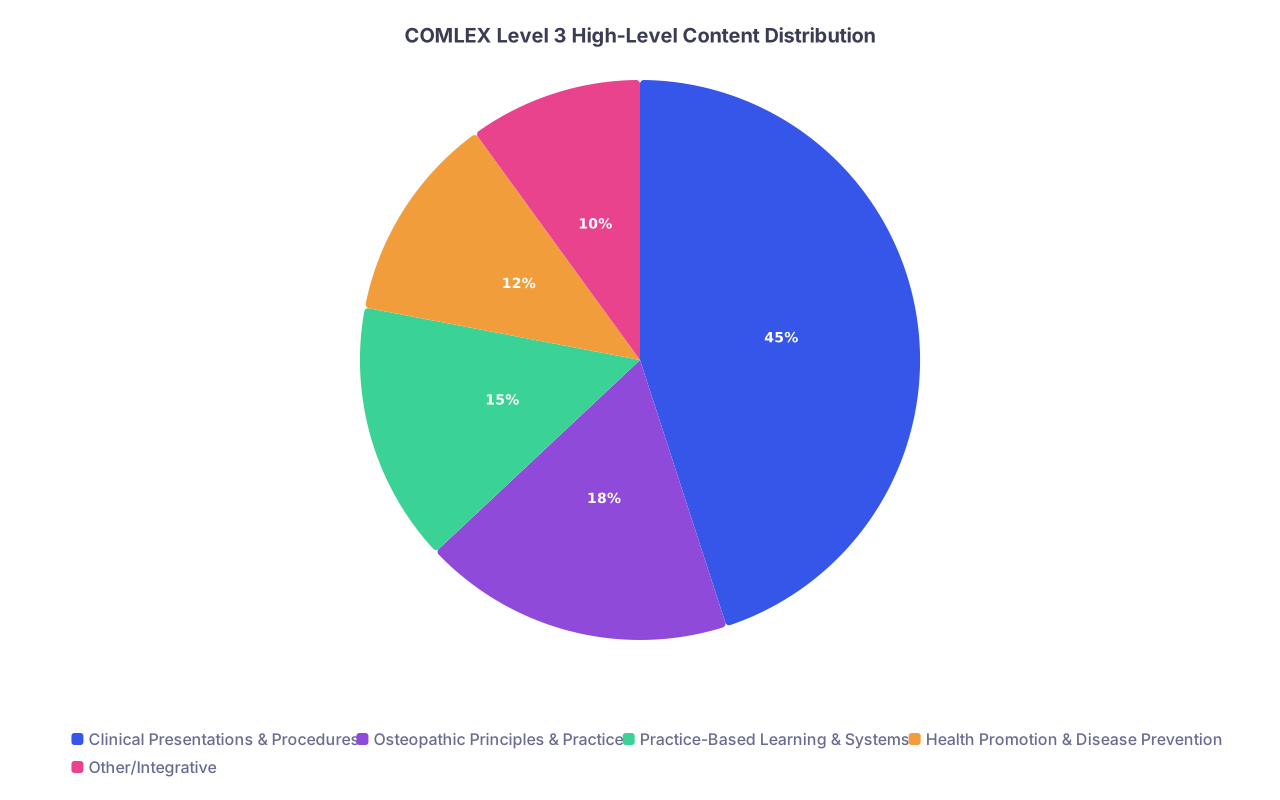
| Category | Value |
|---|---|
| Clinical Presentations & Procedures | 45 |
| Osteopathic Principles & Practice | 18 |
| Practice-Based Learning & Systems | 15 |
| Health Promotion & Disease Prevention | 12 |
| Other/Integrative | 10 |
If you want to think like a data analyst, your first conclusion should be obvious:
- Almost half of your score lives in bread‑and‑butter clinical medicine.
- Nearly one‑fifth is osteopathic principles and OMT.
- The rest is not “fluff.” Systems-based practice, ethics, patient safety, prevention, and public health collectively equal another ~35–40%.
So no, COMLEX Level 3 is not “just Level 2 again.” It is more management-heavy, system‑heavy, and ethics‑heavy, with OMM permanently turned on in the background.
Clinical Medicine: Where Almost Half the Exam Lives
“Clinical Presentations & Procedures” is the single largest bucket, roughly 40–50% of questions. But that still hides how skewed it is.
Think in organ systems and settings.
By organ system
NBOME divides this into areas like cardiovascular, respiratory, musculoskeletal, neurology, GI, etc. Based on blueprint weights and question bank distributions, a realistic breakdown looks like this:
| System / Area | Approx. Weight of Total Exam |
|---|---|
| Cardiovascular | 8–10% |
| Musculoskeletal (non-OMM) | 7–9% |
| Neurologic | 7–9% |
| Respiratory | 6–8% |
| Endocrine | 4–6% |
| GI & Hepatobiliary | 4–6% |
| Renal/Genitourinary | 4–6% |
| OB/GYN | 4–6% |
| Pediatrics | 4–6% |
| Psych/Behavioral | 4–6% |
If you sum the top four (CV + MSK + Neuro + Pulm), you are looking at roughly 28–35% of the entire exam.
That means a depressing but useful truth: you can be mediocre in several low‑yield subspecialty areas and still pass comfortably if you are rock‑solid in:
- Chest pain, dyspnea, heart failure, arrhythmias
- Stroke, seizure, headache, back pain with neuro findings
- Pneumonia, COPD/asthma, PE, ARDS
- Fractures, joint injuries, osteoarthritis, low back pain
This is also where most of the management‑heavy, “what is the next best step?” questions live. NBOME leans heavily on:
- Appropriate diagnostic workup (which test, in what order)
- Risk stratification (high vs low risk, admit vs discharge)
- Initial management vs escalation (fluids, antibiotics, anticoagulation, imaging, consults)
By setting: outpatient vs inpatient vs urgent/emergent
Level 3 is more “day in the life of a resident” than a pure fact‑recall test. Rough proportions based on blueprint + examinee reports:
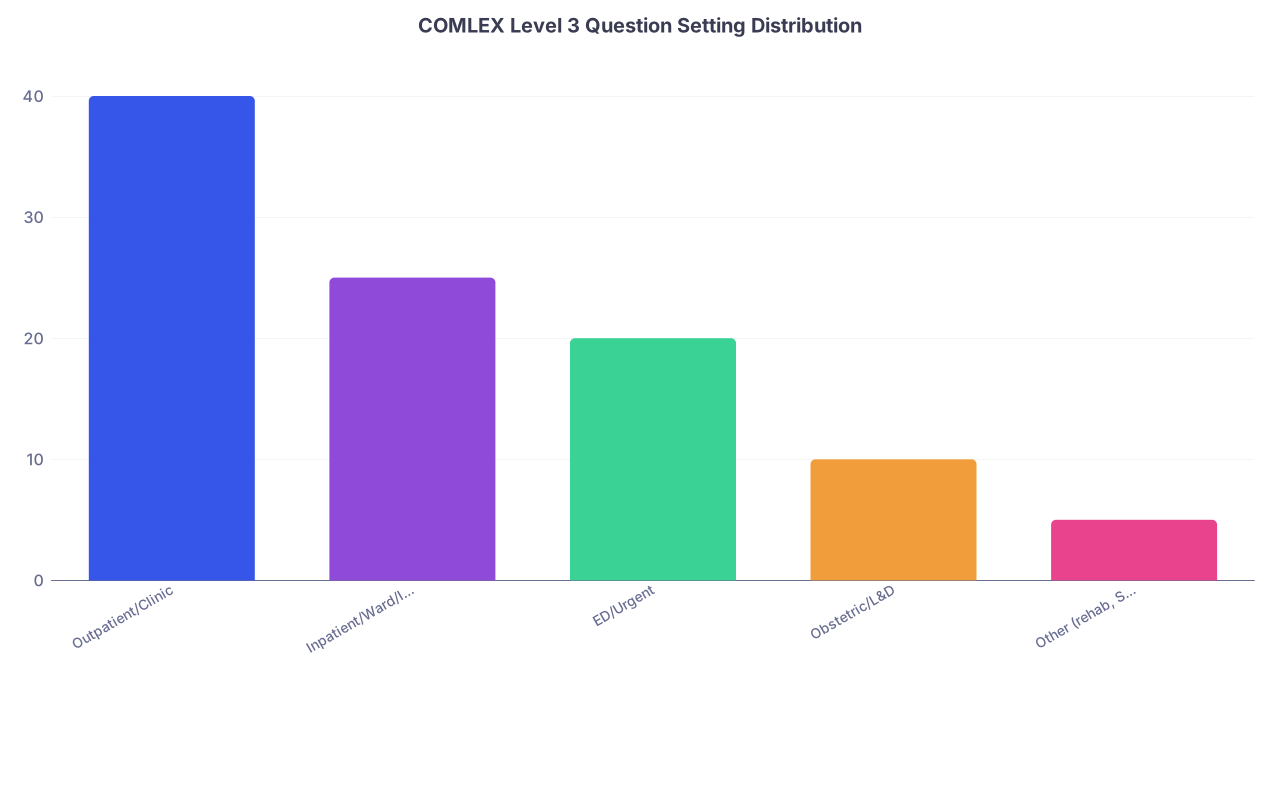
| Category | Value |
|---|---|
| Outpatient/Clinic | 40 |
| Inpatient/Ward/ICU | 25 |
| ED/Urgent | 20 |
| Obstetric/L&D | 10 |
| Other (rehab, SNF, etc.) | 5 |
You are punished if you study like it is all ICU medicine. It is not.
The data suggests:
- Roughly 40%: primary care style encounters (HTN, DM, lipid management, chronic pain, preventive care, follow‑up decisions).
- 20–25%: inpatient/ICU (sepsis, GI bleed, acute CHF, post‑op issues).
- 15–20%: urgent/ED (minor trauma, acute infections, acute neuro, OB triage).
- The rest scattered across rehab, nursing home, post‑op clinic, etc.
So if your “studying” is mostly high‑drama emergency algorithms and almost no bread‑and‑butter chronic disease management or screening schedules, you are misallocated.
Osteopathic Principles & OMM: You Cannot Ignore Nearly 20%
This is where DOs sabotage themselves. Many residents think: “I never do OMT on the wards. I’ll just guess.” That is how you take an otherwise passable performance and drop it below the line.
The blueprint generally puts Osteopathic Principles and Practice (OPP) at approximately 15–20% of the exam. That is not a rounding error. That is equal or greater than entire organ systems.
Break it down further.
OPP subcomponents
Reasonable approximate distribution from blueprint:
| OPP Area | Approx. Portion of OPP Section |
|---|---|
| Somatic dysfunction diagnosis | 30–35% |
| Treatment techniques & choices | 25–30% |
| Osteopathic philosophy & models | 20–25% |
| Safety/contraindications | 15–20% |
Translate that into the whole exam:
- Diagnosing somatic dysfunction: ~5–7% of total exam.
- Selecting the correct OMT technique: another ~4–6%.
- Knowing basic osteopathic philosophy and models (biomechanical, respiratory‑circulatory, etc.): ~3–5%.
- Recognizing contraindications and integrating OMM into hospital/clinic care: ~3–4%.
Those are not single questions. Those are dozens of questions.
The “silent killer” in scoring: missed easy OMM
OMM questions are pattern‑based and often binary:
- You either recognize an L5 rotated left, sidebent right, and pick the matching sacral diagnosis.
- Or you stare at the options and guess.
The gap between a student scoring 60% vs 85% in OPP often swings total score by 10–15 scaled points. That is the difference between borderline and solid.
If you want a data‑driven tactic: a focused 7–10 day OMM refresh on:
- Spinal mechanics (Fryette’s principles, especially lumbar/sacral).
- Common techniques (HVLA, ME, counterstrain, FPR, BLT, Still, myofascial).
- Absolute vs relative contraindications.
- Hospital‑appropriate OMT use cases.
…will almost always yield more net points per hour than trying to become an expert in rare rheumatologic syndromes.
Systems, Safety, and Practice Management: The Underrated 25–30%
Here is where people roll their eyes and then get wrecked by vignettes.
NBOME lumps a massive amount of “doctoring” into domains like:
- Practice‑based learning and improvement
- Systems‑based practice
- Professionalism
- Patient safety
- Interpersonal and communication skills
Collectively, you are talking about roughly 20–30% of the exam once you account for overlap with clinical vignettes. This is not fringe content.
Let’s put numbers on the main components.
Practice-based & systems content
| Domain | Approx. Weight of Total Exam |
|---|---|
| Professionalism & Ethics | 7–10% |
| Patient Safety & Quality Improvement | 6–9% |
| Systems-based Practice / Health Systems | 5–8% |
| Interpersonal & Communication Skills | 4–7% |
Stack those top three and you get about 18–27% of the exam anchored in:
- What is the right thing to do ethically and legally?
- How do you respond to error, near‑miss, or safety issues?
- How should care be coordinated across teams and settings?
These questions are usually low‑calculation, high‑reading‑comprehension. The trap is cognitive laziness: people skim the stem and pick what “feels nice” instead of what matches patient autonomy, justice, or institutional policy.
Common patterns you keep seeing
I keep seeing the same themes in question banks and recall discussions:
- Informed consent nuance (capacity vs competence, surrogate decision‑making, minors, emergencies).
- Handling medical errors: disclose vs conceal, how much detail, who to involve.
- Reporting duties: suspected abuse, impaired colleagues, communicable diseases.
- End‑of‑life: advance directives, DNR/DNI, when the family’s request conflicts with the patient’s documented wishes.
- Systems problems: discharges without follow‑up, medication reconciliation errors, unsafe staffing, handoff failures.
These are not random “fluffy” questions. They are strongly blueprint‑driven and repeat across forms.
If your prep on this content is just your vague memory of MS2 ethics lectures, you are underprepared. A 1–2 day dedicated ethics/systems review is very high yield per hour.
Health Promotion & Disease Prevention: Small Category, Big Volume of Easy Points
Health promotion and disease prevention usually sits in the 10–15% range of the total exam. This overlaps with outpatient questions and chronic disease visits.
Think:
- Screening guidelines (ages, intervals, modalities).
- Vaccinations across the life span.
- Counseling on lifestyle, risk reduction, and adherence.
- Pre‑op eval and perioperative risk stratification.
| Category | Value |
|---|---|
| Clinical Presentations & Procedures | 45 |
| Osteopathic Principles & Practice | 18 |
| Practice-Based Learning & Systems | 15 |
| Health Promotion & Disease Prevention | 12 |
| Other/Integrative | 10 |
Most of this is binary right vs wrong. You either know:
- When to start and stop colon CA screening.
- When lung CA screening is indicated.
- Who gets which pneumococcal vaccine and when.
- Appropriate Pap/HPV testing schedules.
Or you do not.
What the data suggests from question bank analytics: these topics have very high discrimination indices. Strong candidates nearly always get them right; weaker candidates often miss them. That means these questions disproportionately separate passes from fails.
Translation: memorize the tables. The yield is absurd.
CCS / Clinical Decision-Making Cases: Low Count, Massive Weight Per Item
On COMLEX Level 3, the “clinical decision-making” (CDM) or case-based sections have fewer total items than the multiple-choice blocks but a higher point density per case. NBOME does not publish exact per-case weights, but using analogs from Step 3 and score modeling, a reasonable approximation:
- CDM/interactive cases: roughly 20–25% of the total score.
- Individual cases carry multiple scoring nodes (ordering correct tests, choosing correct management, avoiding harmful actions).
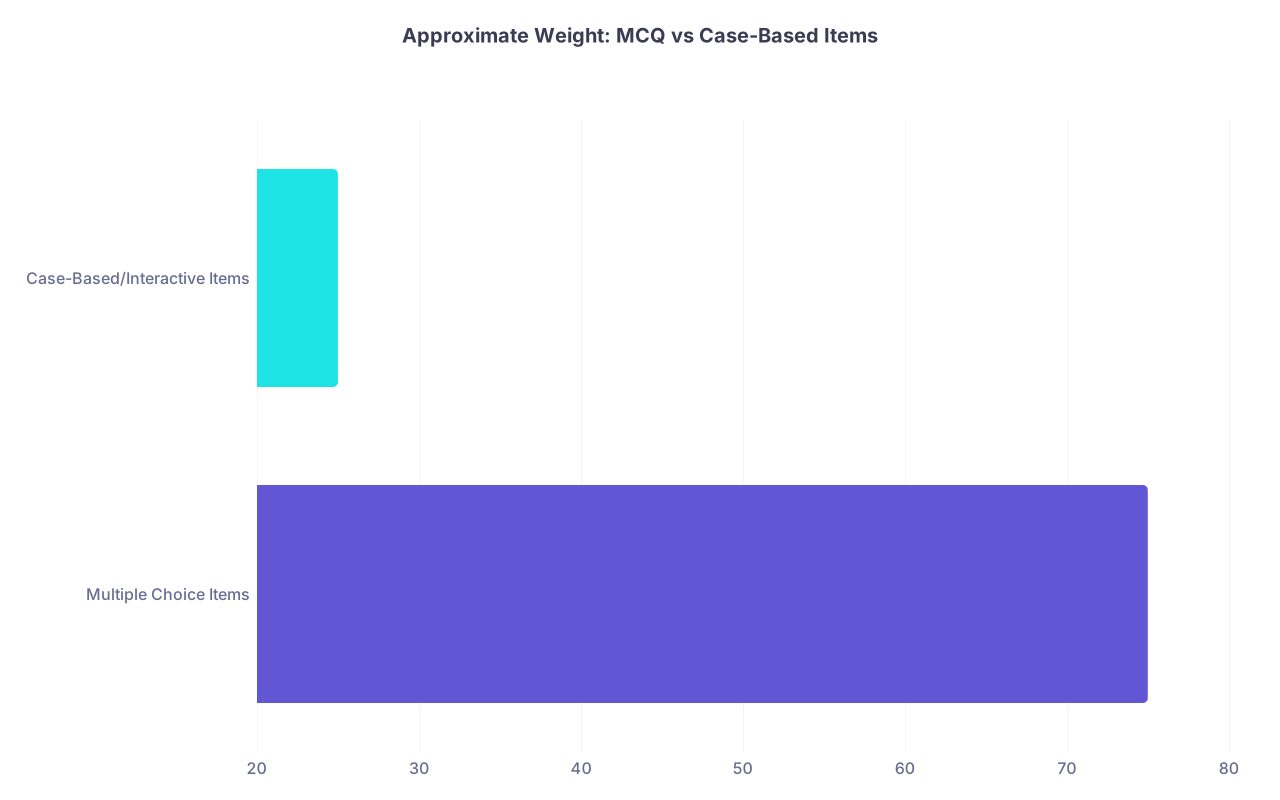
| Category | Value |
|---|---|
| Multiple Choice Items | 75 |
| Case-Based/Interactive Items | 25 |
A single poorly handled case can cost you the equivalent of several MCQs. That changes how you should practice:
- You do not just need knowledge; you need sequencing. What you do first matters.
- Overordering low‑yield, expensive, or contraindicated studies often loses explicit points.
- Missing key safety actions (like checking pregnancy status, allergies, or hemodynamic stability) is disproportionately punished.
If you are only doing MCQ practice and never simulating timed, stepwise CDM cases, you are leaving a quarter of the exam uncalibrated.
Time Allocation: Where Your Study Hours Should Actually Go
You can argue all day about resources. You cannot argue with the basic math.
Here is a reasonable, data-consistent way to allocate a finite 6‑week prep period of ~200 focused hours if your goal is a solid pass with buffer:
| Domain | Approx. % of Study Time | Hours (out of 200) |
|---|---|---|
| Core Clinical Medicine (MCQ) | 45–50% | 90–100 |
| OPP / OMM | 15–18% | 30–35 |
| Ethics, Systems, Safety, Communication | 12–15% | 25–30 |
| Prevention / Screening / Public Health | 8–10% | 15–20 |
| Case-Based / CDM Practice | 15–20% | 30–40 |
Notice three things:
- OMM plus ethics/systems together should realistically be 55–65 hours. Most residents give them <20. That mismatch explains many near‑fails.
- CDM/cases: 30–40 hours is not optional. You need repetition to get the “next step” sequencing right.
- Core medicine is still the largest slice, but not 80–90%. Diminishing returns kick in if you keep hammering cardiology questions while ignoring your obvious vulnerabilities.
If you are short on time (for example, a brutal inpatient month), you compress proportionally but do not zero out any of these categories. Cutting OMM or ethics to zero is like deciding you are fine giving away 20–30% of the test.
A Concrete Weekly Structure (So This Is Not Just Theory)
To make this actionable, here is what a 3‑week focused push (already in residency, limited capacity) could look like in structure, not just percentages:
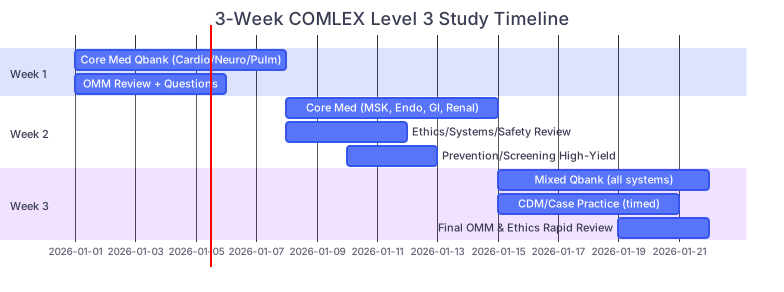
| Task | Details |
|---|---|
| Week 1: Core Med Qbank (Cardio/Neuro/Pulm) | a1, 2026-01-01, 7d |
| Week 1: OMM Review + Questions | a2, 2026-01-01, 5d |
| Week 2: Core Med (MSK, Endo, GI, Renal) | b1, 2026-01-08, 7d |
| Week 2: Ethics/Systems/Safety Review | b2, 2026-01-08, 4d |
| Week 2: Prevention/Screening High-Yield | b3, 2026-01-10, 3d |
| Week 3: Mixed Qbank (all systems) | c1, 2026-01-15, 7d |
| Week 3: CDM/Case Practice (timed) | c2, 2026-01-15, 6d |
| Week 3: Final OMM & Ethics Rapid Review | c3, 2026-01-19, 3d |
This is not perfect. But it respects the blueprint frequencies and avoids the common pattern of “I did thousands of random questions and barely touched OMM or ethics.”
What the Data-Driven Strategy Really Boils Down To
Strip all the noise away and you are left with a few blunt realities.
The points are concentrated. Roughly 70–80% of your score will come from: core clinical medicine (especially cardio/neuro/pulm/MSK), OMM, ethics/systems/safety, and case-based decision making. If your study plan does not clearly emphasize those, it is misaligned with the exam.
OMM and ethics are not side quests. Together they often account for a quarter or more of the exam. A focused, structured refresh in these areas is one of the highest ROI moves you can make, particularly if you have been clinically strong but exam‑borderline in the past.
CDM cases are leveraged. A relatively small number of cases contribute a large chunk of your score. Practicing the process—prioritization, safety checks, and sequencing—matters as much as knowing individual guidelines.
If you treat COMLEX Level 3 like a vague “comprehensive test” and study everything equally, you are wasting time. If you treat it like a weighted dataset and allocate your time to match the blueprint frequencies, you are playing the right game.