
What do you do with the quiet belief that “female doctors are safer” because “they get sued less”? Do you relax if you’re a woman in medicine… or panic a little more if you’re not?
Let’s cut straight through the feel‑good narrative and the reactionary backlash. Because both sides are getting this wrong.
The Origin Story: How This Myth Got Started
This idea did not come out of nowhere. It comes from a few real, frequently cited findings — then a lot of people running too far with them.
A couple of the big influences:
- Studies showing female physicians often have better patient communication and satisfaction scores.
- Papers suggesting female internists have slightly lower 30‑day mortality and readmission rates for hospitalized patients (for example, the famous Tsugawa et al. 2017 JAMA Internal Medicine paper).
- Malpractice insurers and risk‑management folks sometimes informally saying things like, “Our high‑risk frequent fliers are usually male.”
From there, the myth mutates into a simplistic claim:
“Female doctors get sued less. So if you’re a woman, you’re safer. If you’re a man, you’re a lawsuit waiting to happen.”
That sounds neat. It’s also not what the data actually say.
What the Data Really Show About Gender and Lawsuits
Let me be blunt: female doctors, on average, are sued somewhat less often than male doctors. But that sentence hiding behind “on average” is doing a lot of work.
You cannot stop at the headline. You have to unpack what’s driving it.
First: the core pattern
Large medico‑legal databases and insurance risk pools do repeatedly show:
- Higher claim frequency among male physicians.
- More physicians with multiple claims are male.
- Many of the most heavily sued clinicians cluster in:
- High‑risk specialties
- Older age groups
- Longer time in practice
…all of which skew male.
So yes, if you line up 1,000 male doctors and 1,000 female doctors, more men will have at least one claim on their record.
But the question is why.
The role of specialty, volume, and exposure
If you do not adjust for specialty and exposure, your “gender” results are garbage. This is where a lot of armchair commentary goes off the rails.
Who works in the most lawsuit‑heavy zones?
Think:
- Neurosurgery
- Cardiothoracic surgery
- Orthopedics
- OB/GYN
- Emergency medicine
- High‑acuity procedural subspecialties
Those fields are still male‑dominated, especially in the older cohorts that have accumulated decades of legal exposure.
Here’s the uncomfortable truth:
A 62‑year‑old male neurosurgeon doing complex cases for 30+ years has a totally different malpractice risk profile than a 34‑year‑old female outpatient pediatrician seeing URI after URI.
Of course their lawsuit rates differ. That’s not “female vs male.” That’s case mix, procedure intensity, and time at risk.
When you adjust for things like:
- Specialty
- Years in practice
- Procedure volume
- Practice setting (ED vs clinic vs OR)
…the gap between male and female physicians shrinks substantially. In some datasets it mostly disappears; in others, it remains but is much smaller than the popular narrative suggests.
A quick comparison snapshot
Not exact numbers from one specific paper, but a realistic, representative pattern of what multiple studies tend to show:
| Group | Relative Claim Frequency* |
|---|---|
| Male physicians (all specialties) | 1.0 (reference) |
| Female physicians (all specialties) | ~0.7–0.8 |
| High‑risk surgical (mixed gender) | 2–4x primary care |
| Primary care (mixed gender) | 1.0 (baseline) |
*Rough comparative pattern, not precise figures. The real multiplier depends heavily on country, dataset, and time period.
Now mix in that the high‑risk group is disproportionately male and you see the problem with simplistic takes.
Communication, Gender, and the Lawsuit Trigger
Now for the part that’s actually interesting — and where the myth contains a kernel of truth.
When you talk to malpractice attorneys, risk managers, or plaintiffs themselves, you hear the same thing over and over:
“We didn’t sue because of the complication. We sued because of how it was handled.”
Meaning:
- They felt dismissed or disrespected.
- They didn’t get a clear explanation or apology.
- They perceived arrogance, avoidance, or minimization.
Here’s where gender may be playing a real role.
A significant body of work on physician‑patient communication shows that, on average:
- Female physicians spend slightly more time with patients.
- They use more partnership‑building language (“Let’s work on this together,” “How does that sound to you?”).
- They interrupt patients less and let them fully state their concerns.
- Patients often rate trust and satisfaction slightly higher with female physicians.
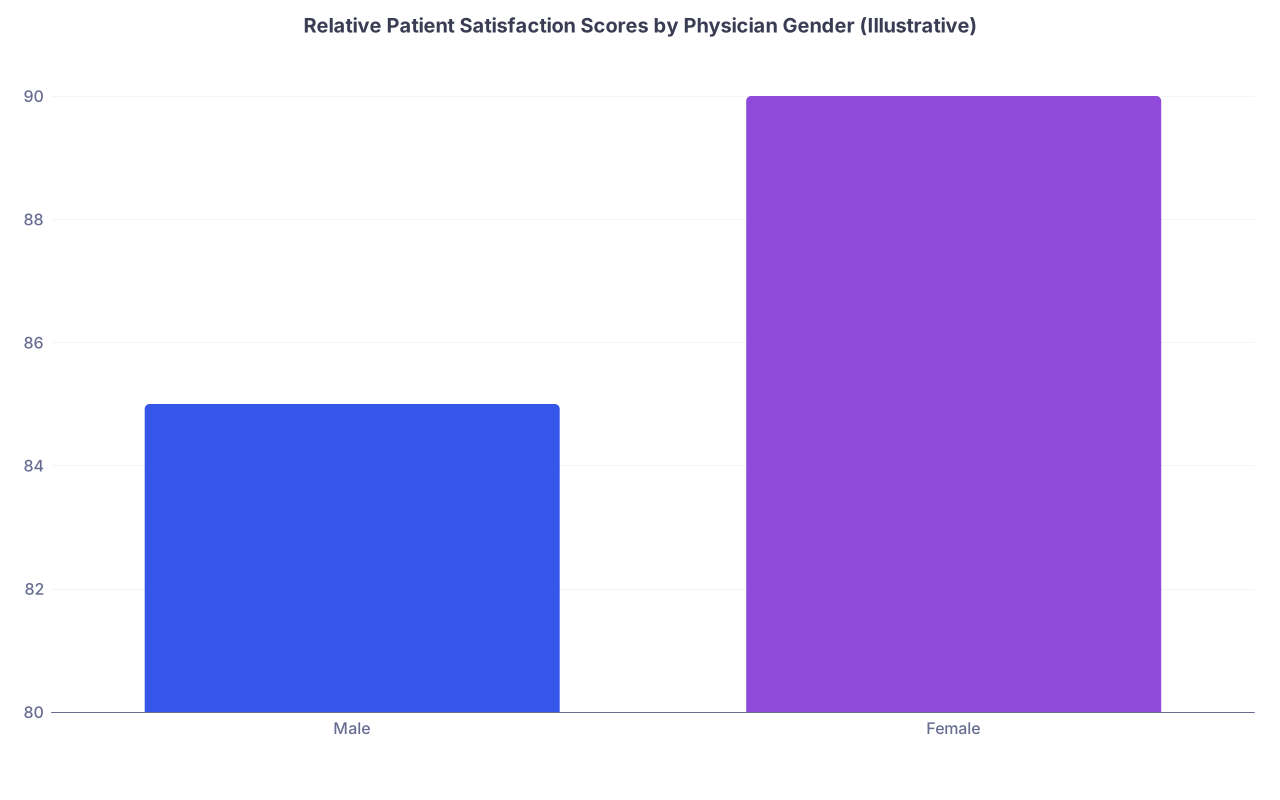
| Category | Value |
|---|---|
| Male | 85 |
| Female | 90 |
Do those better communication dynamics help prevent some lawsuits?
Probably yes.
Because many suits are “anger‑powered,” not just “harm‑powered.” A good relationship and honest communication can keep a bad outcome from turning into a legal fight.
The mistake is jumping from:
- “Some styles correlated with female physicians may reduce lawsuit risk”
to
- “Being female protects you from lawsuits.”
That’s magical thinking. The law does not care about your chromosomes. It cares about documentation, outcomes, and patient perceptions.
The Hard Reality: Female Physicians Still Get Hit — Hard
The myth that “women are sued less” has a nasty side effect: when a female doctor does get sued, people act like something unusual has happened.
I’ve seen the fallout:
- Female surgeons second‑guessing whether they’re “actually cut out for this” after a very standard, statistically inevitable complication.
- Whisper campaigns: “Wow, she already has a case and she’s only 40…”—comments never made about the male colleague with three open claims.
- Leadership quietly docking committee invites or promotions because “there’s a pending suit,” as if that’s a meaningful quality signal.
Here’s the legal and statistical reality:
- If you practice long enough, in almost any specialty, your chance of facing a claim is high, regardless of gender.
- Many excellent clinicians have at least one lawsuit on their record.
- One lawsuit, by itself, is a terrible way to judge clinical competence.
So this idea that women are “supposed” to be lawsuit‑free sets them up for extra shame and stigma when ordinary medico‑legal life happens to them.
Is There Actual Bias in Who Gets Sued?
Now we flip the lens: if women are theoretically communicating better, practicing carefully, and still getting sued, you have to ask whether bias plays a role in who patients and families decide to go after.
The answer: it’s complicated and under‑studied, but there are some red flags.
Possibilities that researchers and legal observers have raised:
(See also: Behind Closed Doors: How Motherhood Really Affects Your Rank List for more on how family and career perceptions intersect.)
- Different expectations: Patients may unconsciously expect more warmth or emotional labor from female physicians. When that expectation isn’t met, disappointment can feel sharper.
- Differential blaming within teams: In bad outcomes involving multiple clinicians, who gets named first in the complaint, and who looks more “in charge” to a jury? The gray‑haired male attending or the younger female co‑attending? Not always the same.
- Juror stereotypes: In a courtroom, a “confident, decisive” male surgeon can come off as competent. A woman using the exact same tone can be framed as defensive, cold, or unlikeable.
Do we have tight, clean data sets proving systematic gender bias in malpractice filing rates controlling for everything? No. But we absolutely have enough anecdotal and early research smoke to suspect there’s at least some fire.
So here’s the twist:
The simplistic “women are sued less” line may be hiding two opposing forces:
- Communication patterns and practice profiles that genuinely reduce risk a bit.
- Gender bias that, in some situations, increases the likelihood or intensity of legal scrutiny.
Flattening that into a single reassuring slogan does no one any favors.
The Real Risk Factors You Should Worry About (Regardless of Gender)
If you care about malpractice exposure, obsessing over gender is a distraction. The real drivers are boring and unsexy — and they apply to everyone.
The serious culprits:
Specialty choice and procedure intensity
High‑risk surgeries, OB, ED, interventional anything — your baseline risk is higher. Period.Case complexity and patient population
Sicker, poorer, more complex patients; low health literacy; fragmented care — all boost risk.System failures
Bad handoff systems, understaffed nights, poor follow‑up infrastructure. Lawsuits love Swiss‑cheese systems where multiple holes line up.
(Related: What Male PDs Quietly Admit About Evaluating Women Residents)
Documentation and follow‑through
“If it’s not in the note, it didn’t happen” is cliché because it’s true. Vague notes, missing critical values, no clear plan — great fodder for plaintiff attorneys.Communication breakdowns
Rushed explanations. No explicit discussion of risks. Ignoring that “by the way, Doctor…” question at the door. Or radiology calling with an urgent result and no one documenting the follow‑up.
That’s the stuff that consistently shows up in case reviews and risk‑management reports.
Gender? It’s somewhere in the background, possibly nudging communication patterns. But not the lever you should build your career beliefs around.
What Female Physicians Should Actually Take From the Data
If you’re a woman in medicine, here’s the stripped‑down takeaway:
- You are not magically protected from lawsuits because you’re female.
- You are not uniquely defective if you get sued. It’s an occupational hazard, not a moral verdict.
- Some of the habits that many female physicians already lean toward — more time, more listening, more explicit explanation — are genuinely protective. Keep them. They’re not “soft skills.” They’re armor.
And if your institution subtly reinforces the myth (“We don’t worry about you, our women never get sued”), push back. That’s not a compliment. That’s an excuse to ignore structural problems and put the emotional burden on you.

| Step | Description |
|---|---|
| Step 1 | Physician Gender |
| Step 2 | Small effect once adjusted |
| Step 3 | Specialty Risk |
| Step 4 | Major driver of lawsuits |
| Step 5 | Communication Quality |
| Step 6 | System and Follow up |
| Step 7 | Documentation Quality |
| Step 8 | Overall Risk |
What Male Physicians Should Take From the Data
If you’re a male physician, resist the stupid, defensive narrative that this is all “anti‑man propaganda.”
Here’s what the numbers are probably telling you:
- A lot of your male peers are in high‑risk fields, doing high‑volume, high‑acuity work. That raises group averages.
- Some male physicians adopt more detached or brusque communication styles that patients hate and that fuel lawsuits. That’s not your Y chromosome. That’s a habit you can change.
Instead of feeling targeted by “women get sued less” headlines, do something more productive:
- Steal the good communication patterns that correlate with lower risk.
- Don’t hide behind “I’m a surgeon, not a people person.” Plaintiffs’ attorneys love that attitude.
The point isn’t “be more like women.” The point is “be less like the high‑risk caricature that gets dragged into court.”
Quick Reality Check: Myth vs Reality
| Claim | Reality |
|---|---|
| Women almost never get sued | False – they do, just somewhat less often overall |
| Being female is protective by itself | Misleading – effects mostly mediated by other factors |
| Women getting sued implies they are “bad” | Absurd – lawsuits track exposure and systems, not virtue |
| Men are sued more because they are worse doctors | Wrong – specialty mix, volume, and style matter more |
| Communication style has real impact on lawsuits | Supported – across genders, better communication helps |
FAQ (5 Questions)
1. So, bottom line: are female doctors sued less than male doctors?
On crude, unadjusted numbers, yes — female physicians, as a group, have somewhat fewer malpractice claims. Once you adjust for specialty, years in practice, and procedure intensity, that gap shrinks a lot. Some difference may remain, likely tied to communication style and practice patterns, not gender itself acting like some legal force field.
2. If I’m a female doctor, should I feel “safer” about malpractice?
No. You should feel statistically slightly less exposed on average, but that’s meaningless at the level of one person. If you practice long enough, especially in a procedural or high‑risk field, you should assume you’ll face at least one claim in your career. Plan for that psychologically and professionally. It’s a feature of the system, not a verdict on you.
3. Are there specialties where this gender difference basically disappears?
Yes. In several analyses, once you look within a single specialty — especially lower‑risk ones like outpatient internal medicine or pediatrics — male and female physicians have very similar malpractice rates when matched on experience and case mix. The dramatic gaps mostly show up when you lump everyone together and let specialty and exposure confound the picture.
4. What can I actually do to reduce my own malpractice risk, regardless of gender?
Focus on controllable levers: communicate clearly, explicitly discuss risks and options, document what you said and did, close the loop on abnormal results, and build reliable follow‑up systems with your team. In high‑risk settings, use checklists and structured protocols rather than relying on “experience.” Those changes matter a lot more than your gender.
5. How should I respond if my institution or colleagues lean on the “women are safer” narrative?
Call it what it is: a lazy oversimplification. You can say, “The data show small average differences that mostly reflect specialty and communication patterns, not inherent safety. We should be fixing systems and teaching good communication to everyone, not pretending one gender is immune to lawsuits.” It reframes the conversation from identity to behavior — where it belongs.
Key points:
- Female physicians do show somewhat lower malpractice claim rates on average, but most of that signal is explained by specialty mix, exposure, and communication style — not gender as a magical shield.
- Lawsuits are driven primarily by high‑risk specialties, complex systems, and communication failures; those are the levers that matter for everyone, regardless of gender.