
The way most women in medicine use social media is far more dangerous to their careers than they realize.
Not because you are doing anything outrageous. Because the bar for “problematic” is lower for you than for your male colleagues—and what’s forgiven in them is quietly documented and held against you.
Let me be blunt: the screenshots live longer than your explanations.
You’re in a field where professionalism, patient trust, and institutional reputation are currency. Social media can amplify you—or quietly sabotage the promotion file that already has enough hurdles for women.
Let’s walk through the traps I see smart women fall into again and again, and how to avoid becoming a cautionary tale in your own department.
1. Thinking “Personal Account” Means “Private Life”
The most common and most expensive mistake: believing that “This is my personal account” is some kind of shield.
It isn’t.
You can put “Views my own” in your bio, lock your Instagram, and use a cute handle. It does not matter. If someone can connect that account to you as Dr. X at Hospital Y, then your posts are professional data points. For hiring committees. For credentialing. For lawyers.
Here’s how people get burned:
- A resident nurses a private Instagram with 1,200 followers, mostly friends and med folks. She posts a boomerang shot in scrubs on a COVID floor: “Another 80-hour week, let’s gooo.” No faces visible. No names. She thinks it’s harmless. Her PD gets a screenshot from risk management: “Is this how your residents portray working conditions at our hospital?”
- A medical student tweets a sarcastic “Can’t wait to do more free labor for entitled patients” after a rough shift. It gets 20 likes. One classmate she barely knows reports it during a professionalism evaluation. It’s in her dean’s letter now.
The mistake is assuming scale equals safety. “I only have 300 followers” doesn’t save you. You’re one retweet or one angry colleague away from your post sitting in a dean’s inbox with the subject line: “FYI – concerning behavior?”
If you’re in medicine, especially as a woman, assume:
- Any post can be shown to your department chair out of context.
- Any private account can be screenshotted.
- Any “joke” can be treated as literal evidence of your attitude.
That doesn’t mean never post. It means you never post anything you’d be unwilling to see in an email thread with your name in the subject line.
2. Underestimating How Gender Bias Shapes “Professionalism”
What gets men described as “outspoken” gets women labeled “unprofessional,” “emotional,” or “disruptive.”
I’ve watched this play out in real time:
- A male resident posts a rant about hospital admin: “Leadership doesn’t care about us, they only care about the bottom line.” People nod. “He’s passionate.”
- A woman resident posts a similar critique, even with more nuance. Later: “She seems angry. Is she going to be difficult to work with? Will she be a liability?”
Is that fair? Of course not. But pretending it’s not happening is naïve.
Some specific ways bias bites women harder online:
Tone Policing
Strong language from you is judged more harshly. Sarcasm, profanity, even heavy cynicism—what’s “relatable” in a male surgeon’s tweet becomes “unprofessional” in a female internist’s.Appearance Scrutiny
A bikini photo from a male EM doc? “Ha, work hard play hard.”
Same photo from a female EM doc? I’ve literally heard: “She wants to be an influencer more than a physician.”“Too Much Social Media” Narrative
When a male cardiologist is active online: “He’s building a brand.”
When a woman is: “Does she have time for patients?” Or whispered: “She’s very into attention.”
You cannot single‑handedly fix the double standard. But you can stop pretending it isn’t there and adjust accordingly.
Filter each post through this lens:
- Could this be misread as bitter, unstable, or attention-seeking if someone already had a bias against me?
- If a promotion committee chair who barely knows me saw only this account, what personality would they infer?
You do not have to be bland. You do have to be strategic.
3. Posting Patient-Adjacent Content That Feels “Harmless”
This is where careers die quietly.
You don’t need a name or a face to violate confidentiality. You just need enough detail that someone, somewhere, could recognize the situation. Or that an ethics committee thinks they could.
I’ve seen posts like:
- “Delivered a baby in the parking lot because mom didn’t make it inside. Wild night in L&D.”
- “Middle-aged guy with chest pain refuses workup because he ‘Googled it’ and it’s probably gas. Sir, what.”
- “That moment when your 26-year-old patient says he doesn’t need insulin because TikTok said cinnamon cures diabetes.”
You think you’re venting or educating. Risk management sees: patient details + mocking tone + location inference = problem.
Red flags:
- Any time, age, or situation specific enough that the patient (or their family) would recognize themselves.
- Any wording that could be construed as mocking, shaming, or contemptuous.
- Complaint posts about “this patient population” that slide into stereotypes.
And remember: rural or specialty settings make re-identification easier. “We only had one 16-year-old trauma last weekend” can be enough.
The “but everyone does it” defense won’t protect you when legal gets involved. And as a woman, you’re already fighting stereotypes about being “too emotional” or “loose with boundaries.” A single thoughtless post can be used to confirm all the biases stacked against you.
Safer alternative: de-identify beyond recognition and add clear educational context—or better yet, share a composite or fully fictionalized case and label it clearly as such.
If there is even a 5% chance a patient could read your tweet and say, “Oh god, that’s me” and feel exposed—you’re too close to the line.
4. Mixing Justified Anger With Screenshots and Names
You will encounter harassment, sexism, racism, discrimination. Some of it will be from colleagues or patients. None of this is hypothetical.
Social media can feel like the only place where you have a voice. I get why women post:
- Creepy DMs from patients.
- Sexist emails from attendings.
- Racist comments from staff.
- “This attending said X to me today” with identifying details.
Here’s the problem: once you publish those screenshots or descriptions with enough specificity to identify someone, you’ve entered a minefield—defamation, confidentiality, institutional policy violations.
You might be absolutely right about the behavior. You might be morally justified. The institution might actually be protecting the bad actor. All true. And yet, you’re still the one whose “judgment” and “professionalism” will be questioned.
Again: double standard. A male attending hero-calling out another doctor online might be seen as a “whistleblower.” You, as a junior woman? “She’s reckless with sensitive information.”
Better approach:
- Document everything privately: email, secure apps, personal log.
- Use internal reporting channels (yes, they’re imperfect, but use them).
- When you post publicly, talk about the pattern, not the identifiable person. “Here’s a composite of things said to me as a woman in residency,” not “Yesterday Dr. X in Cardiology said…”
I’m not telling you to be silent. I’m telling you not to hand the institution an easy way to make you the problem instead of the behavior.
5. Letting the “Medfluencer” Trap Hijack Your Career
There’s a specific trap for women in medicine right now: being rewarded online for content that your actual career gatekeepers quietly disrespect.
I’ve seen residents with 50k followers doing:
- Transition reels from scrubs to clubwear.
- “Day in the life of a hot doctor” style content.
- Sponsored posts for beauty products mixed with medical content.
Again, is it wrong in a moral sense? No. Is it used against women in hiring and promotion conversations? Yes.
You might hear:
- “Is she serious about academic medicine or more about Instagram?”
- “Her content seems more lifestyle than clinical.”
- “Patients might not feel comfortable with this persona.”
Men are not immune, but the judgment hits women faster and harder. Because people already sexualize you, question your seriousness, and assume you’re there for status.
A useful way to think about it:
- Is the persona you’re building online aligned with the professional identity you want gatekeepers to see?
- If your promotion committee watched your 20 most-watched videos, would they see depth, professionalism, and judgment—or mainly aesthetics and attention?
You can absolutely use social media creatively. Just don’t optimize for likes that move you further from the way you want to be trusted professionally.
If you want to be known as a sharp, ethical, competent physician-leader, your online presence has to support that narrative, not fight it.
6. Over-Sharing Mental Health Struggles Without Boundaries
Another gendered trap: women are culturally pushed to be “vulnerable,” “authentic,” and “open.” Social media loves this. Medicine… selectively tolerates it.
Posts like:
- “My anxiety is so bad I cried between every case today.”
- “Post-call depression is crushing me. I don’t know how much longer I can do this.”
- “I dissociated through that entire shift.”
I believe you. And I want you to get real help and real support. But your PD, credentialing office, and malpractice insurer may read something very different: “Is she safe? Is her judgment intact? Is she impaired?”
Men posting similar things often get a “bro, same” response and then everyone moves on. Women get flagged as fragile, unstable, or “a risk.”
The solution is not to pretend you’re fine. It’s to choose the right audience and format.
Better options:
- Share in closed, trusted groups—not searchable public posts.
- Work with a therapist or coach offline.
- If you post publicly, frame it in a more structured, reflective way: “A few years ago I was struggling with burnout. Here’s what helped and what I wish I’d known.”
You’re not a robot. But you are in a profession where people weaponize vulnerability against women. Protect yourself.
7. Blurring Boundaries With Patients and Trainees
One more subtle way careers go sideways: being too accessible online.
Women physicians get more boundary-pushing from patients. More DMs. More personal questions. More “friendly” interactions that drift toward inappropriate.
Common mistakes:
- Accepting patient or family friend requests on personal accounts.
- Responding to medical questions in DMs with actual advice, not clear redirection.
- Letting trainees follow your unfiltered personal account, then venting about work, attending behavior, or your relationship.
The risk isn’t theoretical:
- Patient screenshots your DM where you casually said “Sounds like a virus, you’ll probably be fine”—then has a bad outcome.
- Trainee who resents you prints out your sarcastic tweet about “entitled med students” and shows it to an associate dean.
- Patient spouse finds your Instagram bikini photos and complains that you’re “unprofessional” after a bad encounter in clinic.
The standard for “unprofessional” again? Lower for you.
Create clean boundaries:
- Separate professional and personal accounts—and actually treat the personal one as truly private, with people you’d invite into your home. Not 2,000 “mutuals.”
- Never give individualized medical advice in DMs. Ever. “I can’t give medical advice here—please call the office or urgent care.”
- Be cautious about letting trainees into your unfiltered online world until your power differential with them is gone.
8. Underestimating Searchability and Digital Permanence
You might think you’re safe because:
- The post was deleted.
- It was on Stories, “so it disappeared.”
- It was on a different platform under an old username.
- It was from pre-med days. “Who cares?”
Assume someone will care. And that someone might be:
- A fellowship director who looks up every applicant.
- An opposing attorney in a malpractice case.
- A journalist doing a background check.
- A disgruntled colleague.
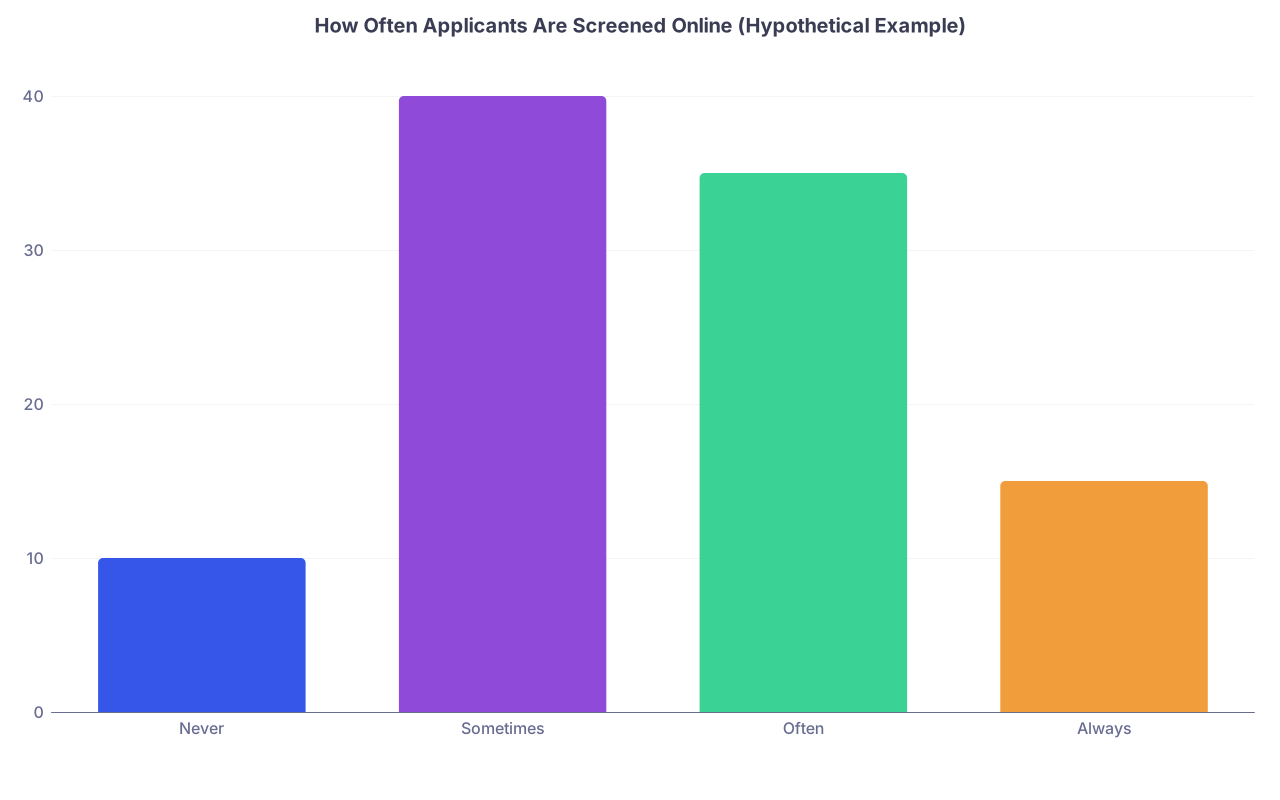
| Category | Value |
|---|---|
| Never | 10 |
| Sometimes | 40 |
| Often | 35 |
| Always | 15 |
Even if those exact numbers are hypothetical, the pattern isn’t. I’ve sat in rooms where faculty googled finalists during a 10-minute break and passed phones around with: “Look what came up when I searched her name.”
The mistake is pretending your accounts are separate from your CV. They are now part of it. Informally, but powerfully.
Do a reality check:
- Google your full name + MD / DO / medical school / hospital.
- Search your most-used handles.
- Check image search.
If something would be devastating to see pulled up in front of a credentials committee, you have cleanup work to do.
Cleanup isn’t perfect, but it’s better than denial.
9. Posting in Anger or Exhaustion (You Will Regret It)
There’s a predictable pattern:
- You have a brutal shift.
- Someone says something sexist, unsafe, or just plain stupid.
- You’re exhausted, dysregulated, and your impulse control is gone.
- You open Twitter/Instagram and type furiously.
- You hit post. Instant relief.
- Screenshot. Circulation. Fallout.
Social media rewards heat, not nuance. The problem is, medical careers are built on the exact opposite.
You need a gap between emotion and publication.
A simple, non-negotiable rule that has saved a lot of people:
- If you’re angry, humiliated, or exhausted—type it in your Notes app first. Sleep on it. If it still seems smart and aligned with your long-term goals 12–24 hours later, then consider posting a revised version.
Your future self will almost always thank you for not live-tweeting your worst shift.
10. Forgetting You Can Use Social Media Well—But Only If You Play Long Game
Social media doesn’t have to be a liability. It can absolutely help women in medicine:
- Showcase expertise in a niche.
- Build networks beyond your institution.
- Share research in plain language.
- Mentor students who never see women who look like them in leadership.
The mistake is treating it like entertainment only, when your profile says “MD” or “MS4” or “R2 Pediatrics.”
You’re building a public narrative about who you are. That narrative will be consulted by people who hold power over your career, whether you like it or not.
Before you post, ask three questions:
- Does this align with the physician I want to be known as in 5–10 years?
- Could this be screenshotted and read in the worst possible light?
- If my harshest critic in the department showed this to the chair, what story would they tell about me from it?
If the answers scare you, don’t post it. Put it in a journal. Text a friend. Yell into a pillow. But don’t gift your detractors ammunition.
| Scenario Type | Safer Choice | Risky Choice |
|---|---|---|
| Venting about work | Private group chat or journaling | Public tweet naming service or unit |
| Patient stories | Composite, fully de-identified | Specific age, time, or unique details |
| Showing personality | Hobbies, interests, advocacy | Sexualized or shock-value content |
| Professional opinions | Thoughtful, sourced threads | Angry rants posted post-call |
| Mental health | Past-tense reflection, resources | Real-time crisis posts with details |

| Step | Description |
|---|---|
| Step 1 | Write Post |
| Step 2 | Save to drafts and wait |
| Step 3 | Reassess later |
| Step 4 | Remove identifiers or do not post |
| Step 5 | Do not post |
| Step 6 | Post |
| Step 7 | Am I angry or exhausted |
| Step 8 | Mentions patients or coworkers |
| Step 9 | Helps my long term goals |


Your Next Move
Do not just nod and move on.
Today—right now—pick one platform you use the most. Open your profile and scroll through your last 30 posts or stories.
For each one, ask: “Would I be okay with this on a screen behind me during my promotion or fellowship interview?”
If the answer is no, delete it. Then adjust what you post tomorrow.
That tiny audit is how you stop your social media from quietly working against you while you’re busy taking care of everyone else.