
The year before promotion review makes or breaks careers—especially for women faculty in medicine.
You don’t “get ready” the month your chair asks for your CV. By then, most of the real decisions have already been made in meeting rooms you weren’t in. The leverage point is the 12 months before your file hits the committee.
Here’s a brutally practical, time‑stamped checklist for that year. Month by month, then quarter by quarter, then week by week at the end. You’ll see exactly what to do and when.
12 Months Before Review: Reality Check and Strategy
At this point you should stop guessing and get clinical about your promotion plan.
1. Confirm the actual review timeline
Do not wait for someone to “tell” you. You ask.
By 12 months out you should:
- Email your department administrator and chair:
- “When will my promotion dossier be due to the department?”
- “What is the timeline for departmental, school, and university-level review?”
- Clarify the promotion date vs file due date. They’re often 6–12 months apart.
| Milestone | Common Timing Before Official Promotion |
|---|---|
| Candidate dossier due | 9–12 months |
| Department review | 7–10 months |
| School-wide committee | 4–7 months |
| Dean/Provost decision | 1–3 months |
| Promotion takes effect | Start of next academic year |
If you thought you had “a year,” you may actually have nine months or less. Adjust accordingly.
2. Audit the written criteria—not the folklore
Every department has two sets of rules: the official ones and the whispered ones. You need both, but you start with the written.
By 12 months out you should:
- Download:
- School-wide promotion and tenure guidelines
- Department‑specific expectations by track (clinical educator, clinician‑scholar, research, etc.)
- Highlight:
- Required titles (assistant → associate; associate → full)
- Minimum years in rank
- Requirements in:
- Teaching
- Clinical work
- Scholarship
- Service/leadership
- Regional/national recognition
Now compare what’s written to your CV. Ruthlessly.
Create three columns:
- Clearly meets
- Could argue
- Not close
The “could argue” group is where women often get crushed—because committees are more generous with “borderline” for men than for women. Your job this year is to move as many things as possible from “could argue” into “clearly meets.”
3. Identify your actual track and dominant identity
I’ve seen too many women faculty “kind of be” everything: clinician + teacher + admin + some research. That’s a recipe for getting labeled “solid citizen” instead of “leader in X.”
By 12 months out you should:
- Decide what you want to be known for in your letter writers’ heads in one sentence:
“She is a regional leader in equity-focused medical education,” or
“She is a national expert in asthma care implementation science.” - Confirm with your chair:
- Your official track
- Your dominant area (education, research, clinical, leadership)
If your chair’s sentence about you doesn’t match yours, that’s the first problem to solve.
9–10 Months Before Review: Positioning and Gap Closure
At this point you should stop hoarding accomplishments and start engineering your narrative.
4. Map your “promotion story”
Promotion is not a list. It’s a story backed by evidence.
By 9–10 months out you should:
- Draft a one‑page narrative describing:
- Your main focus (education, research, etc.)
- The problem you’ve been working on
- Your unique contribution
- Evidence of impact (curriculum adopted, guidelines changed, improved outcomes, national roles)
- Read it through the “external letter writer” lens:
- Can someone who doesn’t know you repeat in 2–3 sentences what you’re known for?
If your story is “she does a lot and is very nice,” you’re in trouble. That’s how women get described, and it kills promotion cases.
5. Fill the most fixable gaps
You don’t have time to reinvent your career. You do have time to tighten the obvious holes.
Pick 2–3 gaps maximum that you can fix in under a year. For example:
- Teaching:
- Missing formal teaching evaluations? Start collecting systematically.
- No formal role? Seek an official course/clerkship/rotation title you already functionally do.
- Scholarship:
- Manuscripts languishing? Lock in deadlines, coauthor responsibilities, writing sessions.
- No first/last authorship? Pick the one paper you can push to that role.
- Leadership:
- Lots of work, no titles? Get your actual role named (e.g., “Director, X Initiative,” not “informal lead”).
- National visibility:
- Lots of local work, nothing national? Submit:
- 1–2 invited workshops
- 1 multi‑institutional panel
- 1 society working group or committee
- Lots of local work, nothing national? Submit:
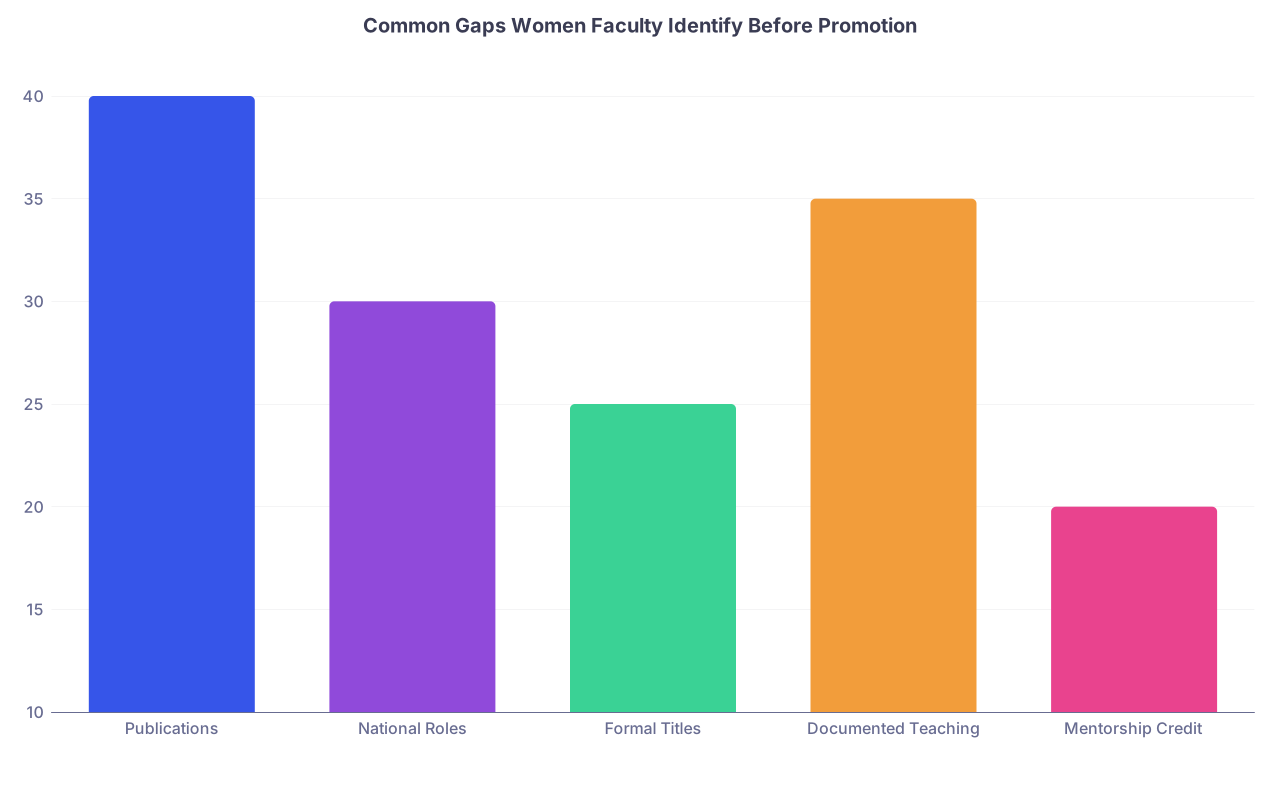
| Category | Value |
|---|---|
| Publications | 40 |
| National Roles | 30 |
| Formal Titles | 25 |
| Documented Teaching | 35 |
| Mentorship Credit | 20 |
Be honest. You cannot fix all five. You choose the ones that move the needle most for your track.
6. Secure a candid meeting with your chair
Not the perfunctory annual review. A focused “am I promotable next cycle?” conversation.
By 9 months out you should:
- Send your chair:
- Updated CV
- Draft personal statement or narrative
- Your own gap assessment (bullet‑pointed, not a six‑page essay)
- Ask directly:
- “If my file went forward as of today, would you support my promotion without reservation?”
- “What specifically would a skeptical committee member criticize?”
- “What would you need to see in the next 6–9 months to feel fully comfortable advocating for me?”
Write down their answers word‑for‑word. Chairs often waffle. Don’t let vague praise substitute for concrete commitment.
If they say you’re “borderline” or “maybe the following year”—this is when you decide whether to push anyway, and you may want a senior woman mentor outside your department to weigh in.
6–8 Months Before Review: Evidence Collection and Visibility
At this point you should treat your career like a clinical trial: collect data, not vibes.
7. Systematically capture teaching and mentoring
Women do a ton of “invisible” educational work that never makes it into the file.
By 8 months out you should:
- Start a simple log (spreadsheet is fine) for:
- Lectures, small groups, simulations, bedside teaching
- Guest teaching at other institutions
- AD HOC advising, mentoring, career coaching (especially of women, URiM, trainees)
- For each:
- Date
- Audience
- Title/role
- Hours
- Any evaluations or feedback quotes
Ask for formal evaluation links when missing. If your school doesn’t give teaching scores for certain roles, get at least 3–5 short written testimonials you can use (with permission).
8. Clean and strengthen your CV
Your CV is not a diary. It’s a legal exhibit.
By 7–8 months out you should:
- Align formatting to your institution’s standard. No creative layouts.
- Distinguish clearly:
- Peer‑reviewed publications
- Non–peer‑reviewed pieces
- Abstracts vs posters vs invited talks
- Push things to completion:
- Turn “in preparation” into “submitted” or delete them
- Convert “submitted” into “accepted” when possible
- Flag accomplishments that show:
- Leadership (chair of committee, director roles)
- Innovation (new curriculum, clinic model, program)
- Impact (outcomes changes, policy changes, adoption elsewhere)

If you don’t know where to put something (e.g., DEI panel work), ask a recently promoted woman in your department who “got it to count.” The category label matters.
9. Plan your external referee strategy (even if you don’t choose them)
Most institutions don’t let you officially pick your external reviewers. But you can strongly shape who is in the pool.
By 6–7 months out you should:
- Make a list of 10–15 potential external evaluators who:
- Are at or above the rank you’re seeking
- Are at peer or aspirational institutions
- Know your work, but aren’t close collaborators
- Ask yourself for each:
- Have they seen my work in action? (talk, workshop, committee, paper)
- Can they speak to impact beyond my institution?
Then, work backward:
- Present at one national meeting where 1–2 of them will be
- Join or contribute visibly to one national committee/project they’re on
- Share your recent work with them in a non‑needy way (“Thought you might be interested in this paper/program given your work on X”)
You’re not lobbying for a letter. You’re making sure that if their name is floated, they can say something more useful than “I’ve never heard of her.”
3–5 Months Before Review: Documentation and Ethics
Now you’re entering the “everything counts” window. At this point you should be in documentation mode and very clear about ethical lines.
10. Draft your personal statement / narrative
This is where a lot of women undersell themselves into oblivion.
By 4–5 months out you should:
- Write 2–3 focused pages that:
- State your primary identity and track clearly in the first paragraph
- Describe your contributions in teaching, clinical care, scholarship, leadership
- Emphasize outcomes, not effort:
- “I led the development of X curriculum, now used by Y institutions”
- “I implemented Z clinic model, reducing no‑show rates by 20%”
- Explicitly name your role:
- “As founding director…”
- “As senior author…”
- Avoid the trap of:
- Over‑justifying career interruptions with apology language
- Buried, quiet statements like “I played a role in…”
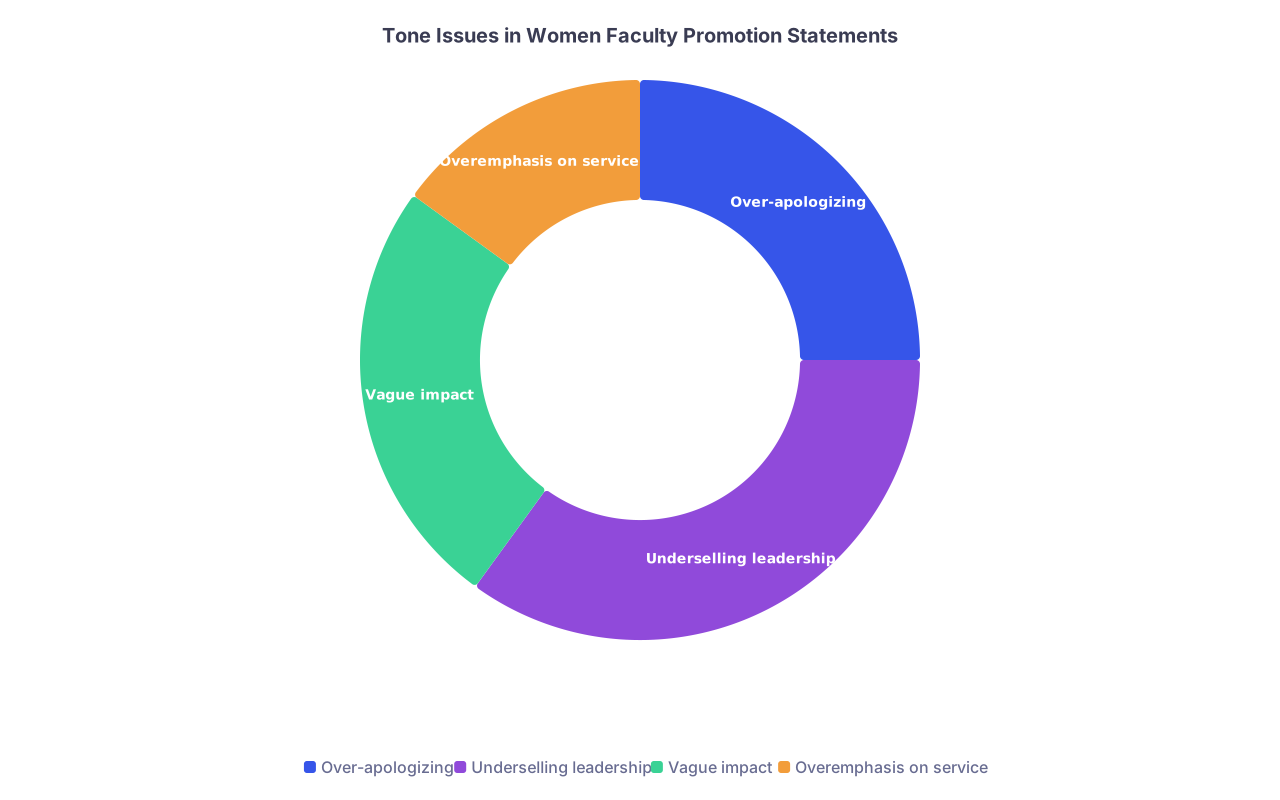
| Category | Value |
|---|---|
| Over-apologizing | 25 |
| Underselling leadership | 35 |
| Vague impact | 25 |
| Overemphasis on service | 15 |
If you took parental leave, had health challenges, or carried disproportionate family responsibilities during COVID, state that factually. No self‑flagellation.
11. Decide how to frame gender and equity issues
You’re in “Women in Medicine” territory here—personal development and ethics overlap.
By 3–4 months out you should decide:
- What you want to say about:
- Structural barriers you’ve faced (pay inequity, bias, exclusion from networks)
- Extra invisible labor you’ve done (mentoring women and URiM trainees, DEI work)
- How to frame it:
- As context, not complaint
- As leadership, not charity
Example language:
- “I have consistently mentored women and URiM trainees, which has led to X outcomes (publications, awards, leadership positions).”
- “During the pandemic, I assumed unplanned caregiving responsibilities, which temporarily slowed my publications but accelerated my work in telehealth education, now adopted by…”
This isn’t whining. It’s accurate documentation of environment and ethics.
12. Tighten boundaries and say no—strategically
By 3–4 months out you cannot keep accepting every “can you just…” request. Every extra task has an opportunity cost for your file.
At this point you should:
- Make a short list of:
- Things you will do because they strengthen your promotion case
- Things you will defer or decline until after the review
- Use default language:
- “I’m in the middle of a promotion year and need to protect writing time; I can’t take this on fully but can suggest X or Y.”
- “I’d be glad to consider this after my promotion review cycle.”
It feels selfish. It isn’t. It’s aligning your labor with your stated goals—exactly what male colleagues have been allowed to do for decades.
2 Months Before Department Deadline: Final Assembly
Now you’re in the red zone. At this point you should stop generating new things and focus on assembling and polishing.
13. Build your teaching and service portfolios
If your institution allows (or requires) supplemental documentation, use it.
By 8 weeks out you should:
- Create teaching portfolio:
- Representative syllabi
- Sample evaluations (with quantitative data if available)
- Evidence of innovation (new methods, curricula)
- Create service/leadership portfolio:
- Selected committees with outcomes
- Programs you started, outcomes you can quantify
- DEI work and its measurable impact (recruitment, retention, climate changes)
Do not drown reviewers in 200 pages. Curate.
14. Run an informal mock review
You want at least one senior woman and one senior man (outside your line of reporting) to sanity‑check your dossier.
By 6 weeks out you should:
- Send them:
- CV
- Personal statement
- Summary of teaching, clinical, scholarship, leadership
- Ask for:
- “If you were on the committee, what would you flag as weaknesses they might latch onto?”
- “Is the narrative consistent with the evidence?”
- “Where do you see me relative to others who’ve been promoted here?”
Do not argue. Listen, adjust, and decide which feedback to incorporate.

Final 4 Weeks Before File Submission: Precision and Presence
At this point you should be in execution mode.
15. Week‑by‑week micro‑checklist
4 weeks out
- Lock your CV. No more formatting changes.
- Confirm with administrator:
- All required forms are complete
- Deadlines for uploads
- Process for updating “in press” items later
- Update your chair on any last‑minute wins (grants, papers, awards).
3 weeks out
- Final polish of personal statement:
- Remove hedging language (“I was fortunate to be asked…” → “I was selected to…”)
- Make sure every major contribution is clearly yours
- Double‑check:
- Names, dates, titles
- Consistency between CV, statement, and portfolios
2 weeks out
- Submit draft dossier to your chair if that’s the norm.
- Ask explicitly:
- “Is there anything in this file that you think will be questioned?”
- Request to see (or at least be told) the department letter framing, if your culture allows.
1 week out
- Submit final dossier calmly, not at 11:58 PM.
- Document:
- Exact date/time submitted
- Confirmation from admin
And then—protect your energy. You’re going to wait months for the outcome. Don’t spend that entire time re‑litigating your file in your head.

Ethical and Personal Development Checkpoints
Sprinkled through all of this, there are ethics and personal development questions you should be asking yourself:
- Are you taking proper credit for your work—or letting colleagues (often men) claim it?
- Are you mentoring women and trainees in a sustainable way, or bleeding yourself dry?
- Are you aligning your values (equity, patient care, teaching excellence) with how you’re evaluated—or letting the system define value for you?
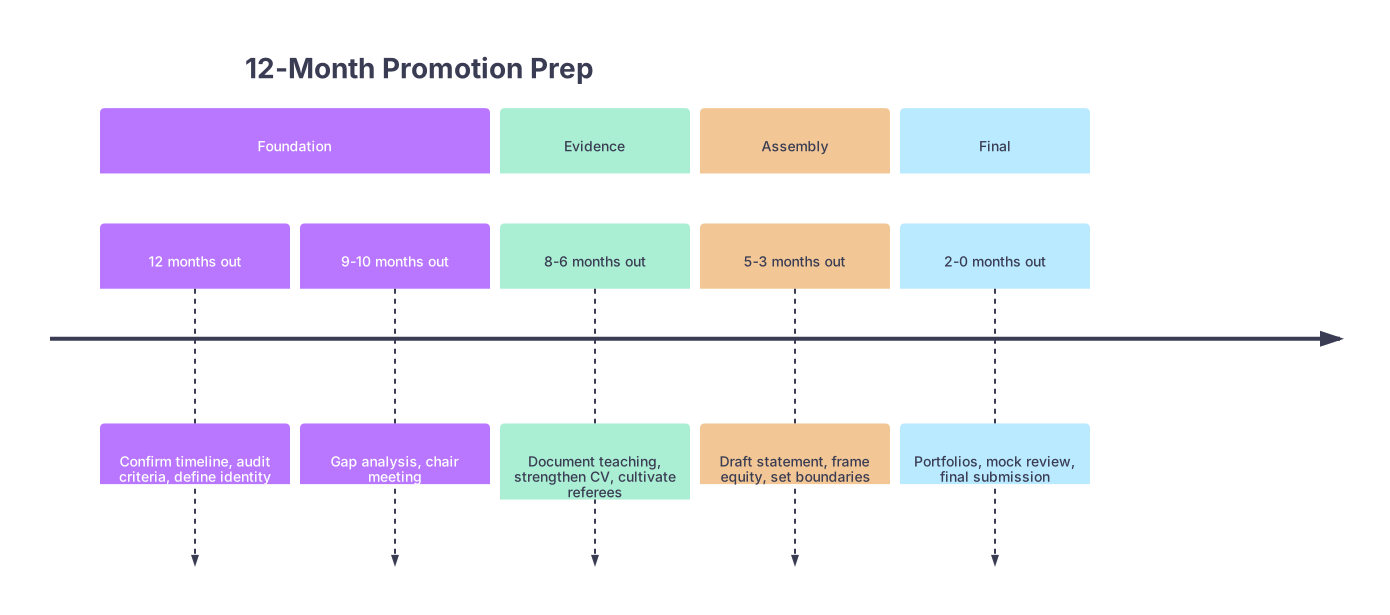
| Period | Event |
|---|---|
| Foundation - 12 months out | Confirm timeline, audit criteria, define identity |
| Foundation - 9-10 months out | Gap analysis, chair meeting |
| Evidence - 8-6 months out | Document teaching, strengthen CV, cultivate referees |
| Assembly - 5-3 months out | Draft statement, frame equity, set boundaries |
| Final - 2-0 months out | Portfolios, mock review, final submission |
You’re not just checking boxes. You’re deciding, deliberately, what kind of academic physician you’re becoming—and insisting the system recognize that work accurately.
FAQ (Exactly 3 Questions)
1. What if my chair tells me to “wait one more year” for promotion?
You push for specifics. “Wait” is not a plan. Ask: “What concrete accomplishments, in which domains, would make you a strong advocate next year?” Then decide whether that’s realistic and aligned with your goals. Sometimes “wait” is code for “I don’t want to spend political capital on you.” In that case, talk to trusted senior women outside your department and your faculty affairs office to assess whether applying anyway is strategically wise.
2. Should I explicitly discuss gender bias or inequity in my promotion materials?
You should discuss facts and impact, not abstract complaints. If bias has shaped your opportunities or timeline, frame it as context and as motivation for your work (e.g., your leadership in equity initiatives). Tie it to concrete outcomes—programs, policies, curricula—not just personal suffering. Keep the tone professional and grounded in evidence. Committees respond better to data and leadership than to generalized grievance language.
3. How much does national visibility really matter for promotion?
For associate and especially full professor, it often matters a lot. Committees want to see that people outside your building care about what you do. But “national visibility” doesn’t only mean R01‑level grants or keynote talks. It can be multi‑institutional curricula, society committee roles, guidelines contributions, widely adopted QI projects, or major educational resources. In your year before promotion, your job is to make at least 1–2 of those clearly visible and well documented in your file.
Key points: Start a full year before your dossier is due, not when someone emails the deadline. Turn your messy, overextended reality into a sharp, evidence‑backed story about who you are professionally. And stop waiting for the system to “notice” you—engineer the file that forces them to.