

Compassion fatigue in oncology and ICU is not a personal weakness. It is an occupational injury that most people miss until it has already done damage.
Let me break this down specifically, because airy wellness talk is useless on a ward where three bad conversations can hit you before 10 a.m.
Oncology and ICU are compassion-intensive environments. You are expected to absorb fear, anger, grief, and uncertainty all day, while still being precise, efficient, and “professional.” If you do not recognize the early warning signs of compassion fatigue, two things usually happen:
- Your care quality slips in subtle but very real ways.
- You slowly become a person you do not recognize—irritable, numb, disconnected from why you went into medicine.
We will stay tightly focused on early warning signs and how they actually present in oncology and ICU work, not generic burnout platitudes.
1. What Compassion Fatigue Actually Is (and Is Not)
Compassion fatigue gets thrown around as a buzzword. Most people mix it up with burnout, depression, or just “being tired.” That confusion is part of the problem.
Compassion fatigue vs burnout vs depression
Here is the clean distinction I use when I teach residents:
| Feature | Compassion Fatigue | Burnout | Major Depression |
|---|---|---|---|
| Core issue | Secondary trauma from caring for others | Chronic work stress and overload | Global mood disorder |
| Onset | Often sudden or situation-linked | Gradual over months to years | Variable, often weeks to months |
| Trigger | Patient suffering, death, trauma | Systems, workload, lack of control | Multifactorial (bio-psycho-social) |
| Where it shows first | Attitude toward patients and families | Attitude toward job and institution | Entire life, not only at work |
| Response to rest/vacation | Improves partly but returns with caseload | Improves somewhat with time off | Usually persists despite time off |
Compassion fatigue is basically “empathic strain.” Chronic, repeated exposure to suffering, tragedy, ethical gray zones, and families in crisis wears down your capacity to emotionally engage without cost.
In oncology and ICU, the mechanism is obvious:
- Constant proximity to death and dying.
- Recurrent delivery of bad news.
- Long-term relationships with patients who decline.
- Moral distress (continuing treatments that feel futile, resource constraints, conflicting goals of care).
You might still love medicine. You might not feel “burned out” about documentation or bureaucracy. But you find yourself unable to care the way you used to. That is compassion fatigue.
2. Why Oncology and ICU Are High-Risk Environments
Compassion fatigue can happen anywhere. But oncology and ICU clinicians are particularly exposed. And the early signs look a bit different in these settings.
The risk profile: why these two are brutal
Oncology:
- Longitudinal relationships. You follow patients for months or years, watch remissions and relapses, celebrate and then watch everything crash.
- Anticipatory grief. You and the patient both know where this is heading, even if nobody says it out loud.
- Repetitive bad news. “The scan shows progression.” “This line of therapy has failed.” You say some version of this dozens, maybe hundreds of times.
- Young deaths. Nothing scrambles your emotional wiring like watching a 32-year-old with two kids die after fourth-line therapy.
ICU:
- Sudden catastrophe. Families meet you on the worst day of their lives, and they expect clarity that you often do not fully have.
- High stakes, high acuity. Every decision feels like it might move someone toward life or death within hours.
- Moral distress about proportionality. Full codes on clearly dying, frail patients. Prolonged ventilation when the odds are terrible. Conflicts between teams and families.
- Rotating anonymity. You may not know these patients long, but you are submerged in raw, undigested emotion from families.
Now combine that with the modern reality:
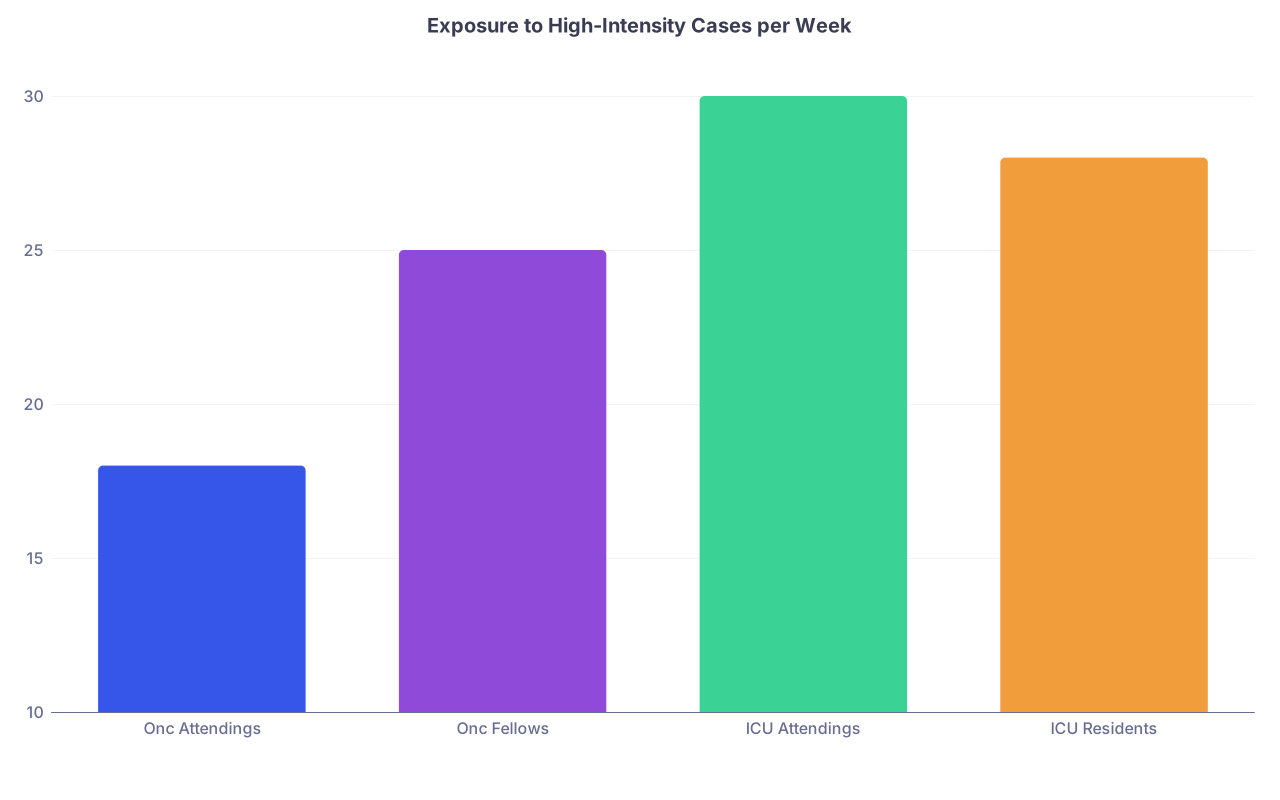
| Category | Value |
|---|---|
| Onc Attendings | 18 |
| Onc Fellows | 25 |
| ICU Attendings | 30 |
| ICU Residents | 28 |
That is a placeholder number chart, but you know the feeling: a relentless queue of high-intensity cases with no decompression.
3. Early Emotional Warning Signs You Should Not Dismiss
Most people look for the late-stage stuff: total numbness, explosive anger, obvious depersonalization. That is like waiting for ST elevation before you treat ischemia.
The emotional early warning signs are quieter and easier to rationalize away.
3.1 Subtle shift from empathy to irritation
You notice a change in how you feel when you see:
- The “difficult” family on the schedule.
- Another consult for “goals of care discussion.”
- The frequent flyer dying of metastatic disease who “still wants everything done.”
Old you: “This is going to be heavy, need to show up fully.”
Compassion-fatigued you: “Not them again. I do not have the bandwidth for this.”
Watch for these thoughts:
- “I just need them to stop talking so I can get out of the room.”
- “Why are they crying again? We have already gone over this.”
- “They should have accepted this weeks ago. Now they are wasting everyone’s time.”
You will not say it out loud. You might not even clearly articulate it to yourself. But if you catch that internal eye roll when you open the chart—flag it.
3.2 Dread attached to specific patient types
This is very common in hem-onc and ICU:
- Young patients with poor prognosis.
- Families demanding maximal intervention in clearly terminal situations.
- Patients with substance use or complex psychosocial situations.
- “Train wreck” admissions and re-admissions.
Dread is different from reasonable anticipatory concern. Dread feels heavy, almost like somatic resistance. You see their name and feel a little drop in your stomach. You stall. You round on them last. You mentally bargain with co-residents about who takes which room.
Repeated, targeted dread = early compassion fatigue.
3.3 Emotional blunting outside of work (not just at work)
One underrated sign: you stop reacting emotionally in your life, especially to “small good things.”
- You used to cry occasionally at movies. Now you do not feel much.
- Your partner tells you good news, and you intellectually know it is good, but there is no internal spark.
- Activities that once felt replenishing now feel like chores.
Burnout often starts at work and bleeds outward. Compassion fatigue frequently shows as a numbness that started from overexposure to others’ pain and slowly dampens your emotional range in general.
You are not “chill.” You are partially shut down.
4. Behavioral Early Warning Signs in Oncology and ICU
Feelings are one layer. Behavior gives you more objective data. Watch how you move through your day. It tells on you.
4.1 Micro-avoidance of patient and family interaction
This is probably the most consistent early marker I see in oncology fellows and ICU residents.
The pattern:
- You spend more time in front of the EMR and less time in the room.
- You delegate communication: “Can palliative care talk to them?” not because it is indicated, but because you want out.
- You round in the room for 60 seconds, then talk about all the actual decisions outside, in the hallway or workroom.
- You suddenly become “incredibly busy” when the family arrives, mysteriously pulled into “urgent tasks.”
On paper, your notes look fine. Orders are appropriate. But the relational aspect of care is shrinking.
In oncology clinic, it can look like:
- Shortened visits with complex patients.
- “Let’s just see how the next scan looks” instead of going deeper into prognosis conversations you know are needed.
- Less checking in with nurses or social workers about how the family is coping.
4.2 Shifts in language: cynical, detached, or overly technical
Language reveals mindset. You will catch it in sign-out, in the physician workroom, on pager messages.
In ICU:
- Referring to patients primarily by bed number or diagnosis even when you actually know their names.
- “He is a train wreck” instead of describing complexity.
- “Family is unrealistic” rather than “family is struggling to accept prognosis.”
- “We are just flogging” as shorthand for complex end-of-life frustration.
In oncology:
- “We can offer them third-line therapy” said with an internal subtext of futility, but no real conversation with the patient about goals.
- “I do not think they get it” instead of “I am not sure we actually aligned expectations.”
You are not a villain for thinking or saying these things once in a while. But when this language becomes your dominant mode, it signals emotional distancing as self-protection.
4.3 Productivity obsession as avoidance
Another sneaky behavioral sign: over-focusing on “efficiency” and “throughput” as a way to avoid the emotional parts of the work.
Example patterns:
- In clinic, you start triaging your time more by RVUs and less by clinical/emotional complexity. The sickest, neediest patients get the shortest visits because they are “always so draining.”
- On ICU rounds, you push for speed—“let's keep this moving”—and become irritated when bedside nurses or families raise emotional concerns that slow the team down.
- You volunteer for tasks that involve procedures, numbers, and data and avoid those involving family meetings and discussions.
Work becomes a shield. You look like a hardworking machine. Underneath, you are hiding from what hurts.
5. Cognitive Warning Signs: How Your Thinking Warps
Compassion fatigue does not just affect feelings and behavior. It changes how you think about patients, families, and even yourself.
5.1 All-or-nothing thinking about “good” and “bad” patients
You know you are sliding when your brain sorts people into crude buckets:
- Good patients: grateful, compliant, “reasonable.”
- Bad patients: “demanding,” “needy,” “noncompliant,” “angry.”
In oncology:
- The grieving but appreciative family? “Good.”
- The angry spouse who thinks you are “giving up” by suggesting hospice? “Bad.”
In ICU:
- The quiet family that nods along with your recommendations? “Good.”
- The family that pushes back, wants every test, asks daily for second opinions? “Difficult.”
This binary categorization is a red flag. It usually means your capacity for nuance is collapsing under strain.
5.2 Moral fatigue and “what is the point?” thinking
This is common in advanced cancer or long-stay ICU cases.
You catch thoughts like:
- “We do all this, and half of them die anyway.”
- “I am not sure anything I am doing actually matters long term.”
- “Even when we ‘win,’ there is always another problem.”
These are not philosophical reflections. They feel heavy, hopeless, and draining. They erode your sense of meaning in the work. Once that goes, compassion follows.
5.3 Self-criticism dialed to maximum
Oddly, compassion fatigue often coexists with harsh self-judgment.
Patterns:
- Ruminating after conversations: “I said that wrong, no wonder they are upset.”
- Taking total responsibility for every bad outcome, even when it was inevitable.
- Feeling like an imposter because you cannot save everyone.
The combination of relentless exposure to suffering + internal perfectionism is gasoline on the compassion fatigue fire.
6. Physical and Lifestyle Clues You Are Ignoring
You might think these are just residency or call problems. Sometimes they are. But in oncology and ICU clinicians with high emotional exposure, these are often part of the same syndrome.
6.1 Sleep that is technically long but not restorative
Typical descriptions I hear:
- “I crash as soon as I get home, but I wake up feeling like I did not sleep.”
- “I wake up at 3 a.m. replaying the family conference.”
- “On my days off, I sleep 12 hours and still feel wrecked.”
You are not just “tired.” Your nervous system is being chronically activated by others’ trauma and grief.
6.2 Increased reliance on numbing rituals
Watch for escalation in:
- Alcohol use “to unwind after a shift,” now almost mandatory.
- Mindless scrolling, gaming, or streaming late into the night to avoid thinking.
- Compulsive exercise or, conversely, total abandonment of movement.
On their own, these behaviors can be benign. When they become your primary way to not feel what work is bringing up, they are early warning signs.
6.3 Social withdrawal from people who are not in medicine
Common line: “They do not get it, so why bother?”
So you:
- Stop explaining what you do to family and friends.
- Avoid social contact because small talk feels intolerable.
- Prefer hanging out only with colleagues who “understand”—but even there, you default to gallows humor as your main communication style.
Yes, the work is hard to explain. But if you notice growing contempt or impatience with anyone outside medicine, be careful. That is usually not “they are all shallow”; it is you being emotionally overdrawn.
7. Oncology- and ICU-Specific Red Flags You Should Take Seriously
Let me get more granular. These are niche, very specific patterns I have seen repeatedly in oncology and ICU when compassion fatigue is brewing.
7.1 Oncology: the “automatic chemo reflex”
You are compassion-fatigued if you notice:
- You are offering next-line chemotherapy more by default than by genuine conviction that it aligns with the patient’s goals.
- You delay honest prognosis conversations because you dread the emotional fallout, so you “just try another regimen” instead.
- You feel annoyed when palliative care surfaces values or hospice conversations “too early,” because it triggers more emotional work for you with the patient.
Essentially, chemo becomes your emotional buffer: keep treating, and you can avoid saying out loud what everyone already half-knows.
7.2 Oncology: emotional disengagement from long-term patients
Another pattern:
- A patient you have known for years finally relapses terminally. Instead of feeling intense sadness, you feel… nothing. Or mild irritation at the timing (“right before my vacation”).
- You delay calling them with scan results because you do not want to “deal with it today.”
- You avoid their room longer than usual when they are admitted nearing end-of-life.
You will tell yourself you are just “busy.” Look harder.
7.3 ICU: emotional automation in family meetings
In the ICU, early compassion fatigue often shows in how you run family conversations.
Signs:
- Your script becomes rigid and impersonal. You use the same phrases with every family, in the same order, with minimal adaptation.
- You do not ask about who the patient is as a person anymore. You stick to data, ventilator settings, and mortality percentages.
- You feel relieved if the family defers all decisions to “whatever you think is best,” not because it is clinically ideal, but because it saves you the emotional labor of exploring values.
You are still technically competent. But the relational, human core of your job is getting hollowed out.
7.4 ICU: anger at families who “won’t let go”
This one is nearly universal at some point, but frequency and intensity matter.
You might notice:
- Deep resentment toward families insisting on full code in clearly futile scenarios.
- Fantasies about telling them, “You are torturing your loved one,” or “You are making us do things we know are wrong.”
- A sense of personal offense—like they are doing this to you, not just struggling with grief and denial.
When this anger becomes your default response instead of occasional frustration, your empathic bandwidth is probably shot.
8. Simple Self-Screen: A 60-Second Check-In
You want something concrete. Fine. Ask yourself these questions once a week for a month. Yes, actually answer them, not in your head while scrolling.
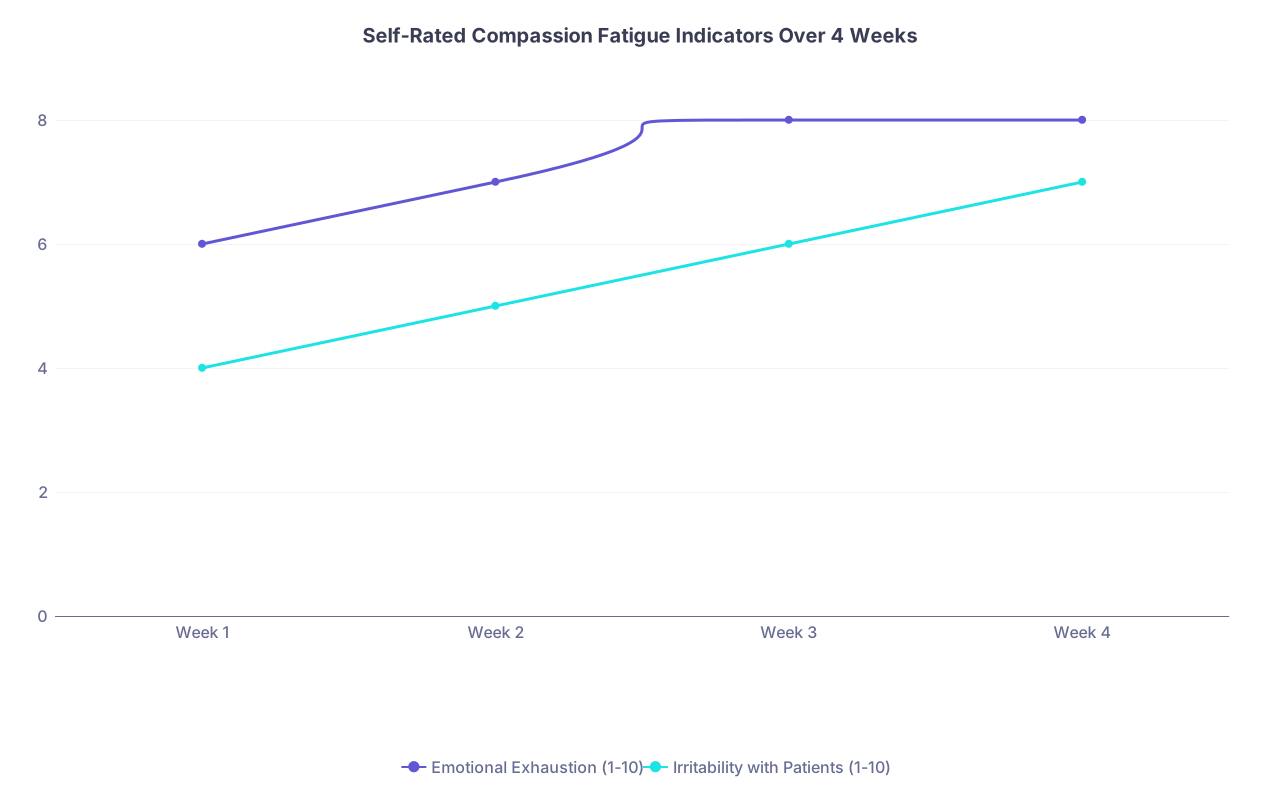
| Category | Emotional Exhaustion (1-10) | Irritability with Patients (1-10) |
|---|---|---|
| Week 1 | 6 | 4 |
| Week 2 | 7 | 5 |
| Week 3 | 8 | 6 |
| Week 4 | 8 | 7 |
(Use your own numbers if you want to track.)
Ask:
- Over the last week, how often did I feel irritated or impatient with patients or families who were scared, angry, or grieving?
- How often did I avoid or shorten emotionally heavy conversations even when they were clinically needed?
- Did I feel less emotionally present with at least one patient I used to feel close to?
- Did I use alcohol, food, screens, or work to avoid thinking about specific patients or cases?
- Outside of work, did I feel more numb than usual to good things in my life?
If your honest answers show a pattern of “often” or “very often” for more than 2–3 items, you are not just “tired.” You are absorbing more emotional trauma than you are processing.
9. What To Do When You See These Signs (Without Quitting Medicine)
You are not going to fix this with a scented candle and another “resilience” webinar. You also do not have the luxury of a six-month sabbatical mid-fellowship.
So what is actually realistic in oncology and ICU?
9.1 Name it explicitly
Sounds trivial. It is not.
You are not “weak.” You are not “bad at boundaries.” You are experiencing compassion fatigue secondary to high emotional load.
Literally say to yourself:
- “I am having signs of compassion fatigue. This is an injury, not a character flaw.”
That simple reframe changes whether you respond with shame (which makes it worse) or with actual problem-solving.
9.2 One structural boundary at work, not ten
Most people overcorrect: they try eight new wellness habits and keep none.
Pick one small, structural, non-negotiable boundary, for example:
- In ICU: after every family meeting, take three minutes alone in a quiet space. No pager, no EMR. Just breathing, noticing what you feel, letting it pass through instead of carrying it into the next room.
- In oncology: build in an extra five-minute buffer in the schedule for known high-emotion visits (scan result discussions, first progression). Use that time to center yourself before and to actually sit for 60 seconds after, not to catch up on notes.
These micro-pauses are not “luxuries.” They are decompression valves.
9.3 Debrief with the right people, not everyone
Talking helps, but not if you are only venting in a cesspool of shared cynicism.
Find:
- One attending, fellow, or senior nurse who still seems to care and is not completely jaded.
- Tell them directly: “I find myself getting more irritated and numb with patients. I think I am burning out on the emotional side.”
If they respond with pure gallows humor and dismissal only, they are not your person. You want someone who can say, “Yes, I have been there, here is how I noticed and what I did.”
Peer debriefing after particularly heavy cases or deaths should not be optional in these fields. Push for it if your unit does not have it.
9.4 Professional help is not “for when you break”
You do not wait for septic shock to give fluids. Do not wait for a full breakdown to get therapy or counseling, especially if:
- You are replaying specific cases at night.
- You have a history of trauma yourself.
- You notice persistent numbness or hopelessness.
Therapists who understand healthcare workers and vicarious trauma exist. Use them. This is ethics, not just wellness: your patients are safer when you are not emotionally shredded.
10. How This Ties Back to Medical Ethics and Work–Life Balance
This is labeled under WORK LIFE BALANCE and PERSONAL DEVELOPMENT AND MEDICAL ETHICS for a reason. Compassion fatigue is not a purely personal problem. It is an ethical and systems problem.
Ethical dimension
When compassion fatigue progresses, it directly affects:
- Informed consent: rushed, incomplete conversations because you cannot bear to sit with distress.
- Respect for persons: subtle contempt for “difficult” patients erodes genuine respect.
- Non-maleficence: offering or continuing interventions driven more by your avoidance than the patient’s best interest.
If your internal state is warping your decisions, that is an ethics issue.
Work–life balance reality check
True balance here is not spa days. It is:
- Having parts of your life that are not colonized by others’ suffering.
- Being able to be fully present at work without using your personal life as a dumping ground for unprocessed emotions.
- Protecting time and space where you are not the caregiver, not the explainer, not the “strong one.”
That is not selfishness. That is professional maintenance.

| Step | Description |
|---|---|
| Step 1 | High exposure to suffering |
| Step 2 | Emotional overextension |
| Step 3 | Subtle irritability and dread |
| Step 4 | Avoidance of emotional work |
| Step 5 | Increased numbness and cynicism |
| Step 6 | Ethical risk and reduced care quality |
| Step 7 | Personal distress and possible collapse |
| Step 8 | Early recognition and support |
| Step 9 | Boundary setting and reflection |
| Step 10 | Partial recovery and resilience |
FAQs
1. How do I know if what I’m feeling is normal sadness versus compassion fatigue?
Normal sadness is episodic and proportional. You feel sad after a rough case, maybe tearful, but you recover, and your baseline empathy returns. Compassion fatigue is more pervasive: you notice a chronic shift toward irritability, numbness, or dread with many patients, not just one or two, and it does not fully reset even after rest days.
2. Can early compassion fatigue actually affect my clinical decisions?
Yes. I have seen clinicians delay hard conversations, default to “just one more chemo,” or push families toward or away from aggressive care based more on their own emotional exhaustion than the patient’s values. The changes are subtle, but they accumulate: rushed family meetings, minimized options, or avoidance of ethically complex discussions.
3. Is it realistic to address compassion fatigue during residency or fellowship with our schedules?
You are not going to reengineer your entire life in training, but you can make targeted moves: micro-pauses after hard encounters, choosing one person for real debriefing, recognizing and labeling what is happening, and getting therapy if you are replaying cases at night. These are small interventions, but they interrupt the slide early, which is the whole point.
4. What if my whole team is cynical—does that mean we are all compassion-fatigued?
Possibly, but not automatically. A certain amount of dark humor is normal. The distinction: if cynicism is the only emotional tone (no genuine tenderness, no moments of sadness or pride), and you routinely dehumanize patients in your language, that is more consistent with group-level compassion fatigue. It becomes a culture issue, not just an individual one.
5. Does switching specialties fix compassion fatigue?
Switching away from oncology or ICU can reduce exposure to high-intensity suffering, so it may help some people. But if you never address how you process others’ pain, you may carry the same patterns into any patient-facing role. I have seen people leave ICU for outpatient medicine and reproduce the same detachment and avoidance there. Fix the internal patterns, not just the job description.
6. How can leaders in oncology or ICU help reduce compassion fatigue in their teams?
Leaders need to stop pretending this is purely an individual resilience problem. Practical steps: normalize debriefs after deaths or traumatic cases, visibly use those debriefs yourself; protect small buffer times in schedules for high-emotion encounters; watch for behavioral red flags in trainees; and frame seeking psychological support as a professional strength aligned with patient safety, not as a private weakness.
Key points, without the fluff:
- Compassion fatigue in oncology and ICU is an occupational injury that shows early as subtle irritability, dread, avoidance, and emotional blunting—long before total burnout.
- Those early signs alter how you talk to, think about, and decide for patients and families; that makes this an ethics and care quality issue, not just a wellness concern.
- Catch it early, name it, set one or two structural boundaries, and get real support—peer and professional—before the numbness becomes your new personality.


