

What if that sick, sinking feeling of “I think I made a mistake choosing medicine” isn’t a temporary funk… but proof you actually chose the wrong life?
Let’s say it out loud because you probably already have, alone, at 2 a.m.:
“I don’t know if I actually want this.”
You’re supposed to be “grateful” to be here. People in your life brag about you. Your aunt tells everyone at Thanksgiving, “She’s in medical school!” Meanwhile, you’re in the bathroom scrolling residency horror threads and wondering how to blow up your life without disappointing everyone.
And then the real fear kicks in:
If I feel this way now, what does that mean for 30 years of this?
Let me be blunt: you are not the only one thinking this. Not even close.
Why So Many People Secretly Regret Medicine (At Least Sometimes)
You think you’re uniquely weak or ungrateful. You’re not. You’re just honest enough to not gaslight yourself 24/7.
Here are the patterns I keep seeing and hearing:
- The MS2 who whispers on a study break: “If I’d really understood what this was, I don’t know if I would’ve applied.”
- The PGY-1 in internal medicine who DMs: “I love my patients but I hate my life. Is this just what being a doctor is?”
- The premed on a gap year who already feels trapped by the idea of the sunk cost, before even starting.
A lot of people regret medicine some days because:
- The job is routinely sold as “helping people” and “intellectual challenge” and rarely as: “long-term sleep deprivation, constant emotional weight, liability, endless documentation, and a system that often fights you.”
- The path is insanely long. By the time you’re allowed to say “this doesn’t feel like my life,” you’ve got years of sunk cost, loans, and an identity built around “future doctor.”
- The culture normalizes self-sacrifice and pain. If you complain, you’re “not dedicated enough.”
So yes, it is normal.
No, that doesn’t automatically mean you picked the wrong career.
But that distinction—“this is objectively hard” vs “this is fundamentally wrong for me”—is the part that gnaws at your brain.
What Your Regret Might Actually Be Telling You
Regret isn’t always “I chose the wrong path.” Sometimes it’s:
- “I chose the right field for the wrong reasons.”
- “I chose the right field but the wrong environment.”
- “I chose the right long-term job, but this phase really doesn’t fit me.”
You need to figure out what you’re regretting. Vague dread will eat you alive.
Here’s a brutally honest breakdown.
| Type of Regret | What It Feels Like | What It Might Mean |
|---|---|---|
| Path Regret | “I don’t want to be a doctor at all” | Possible mismatch with core values/personality |
| Phase Regret | “I hate this step of training” | Training structure is the problem, not the final job |
| Environment Regret | “I hate this hospital/school/city” | Wrong setting, not necessarily wrong career |
| Identity Regret | “I only did this for prestige/parents” | Motivation conflict more than actual hatred of medicine |
A few concrete examples:
- Path regret: You’re in M3 and even on the “good” rotations, when attendings are nice and hours are tolerable, you feel nothing but “I want out.” Even imagining the best version of being a physician doesn’t feel right.
- Phase regret: You’re an intern doing Q4 overnight calls, you’re exhausted, but when you picture a stable attending job in your specialty with reasonable hours, it actually looks… okay. Even appealing. You just hate this year.
- Environment regret: Your surgery rotation is abusive, but when you rotated at a different site or did a subspecialty elective with normal humans, you suddenly felt way more alive.
- Identity regret: You notice you mostly like telling people “I’m in medicine,” but the day-to-day work doesn’t really spark curiosity or meaning, and you feel hollow when you’re honest with yourself.
Your job right now is not “decide forever.” It’s “figure out what category my regret belongs in.”
How to Process These Feelings Without Panicking Yourself into a Corner
You can’t process regret when you’re constantly in survival mode. You just shove it into some mental closet and hope it stops rattling.
Spoiler: it doesn’t.
Here’s a structure that actually works better than endless spiraling.
1. Separate the acute from the chronic
Ask yourself two separate questions:
- How much of my regret is tied to this exact week? (Exam, rotation, specific attending, night float, family drama)
- How much is present even on a good day?
If your answer is:
- “On good days, I still feel 60–70% sure I don’t want this at all” → that’s bigger than burnout. That’s data.
- “On good days, I actually feel kind of okay or even good about it; it’s the bad weeks that make me want to run” → that’s more consistent with stress, fatigue, or phase-specific misery.
Be honest. Don’t grade yourself on how you should feel.
2. Run the “Best Realistic Version” thought experiment
Not fantasy medicine. Not Grey’s Anatomy nonsense. The best realistic version of your future as a doctor.
Imagine:
- A specialty that fits your personality pretty well
- A reasonable hospital/group or outpatient setting
- A schedule on the sane side for your field (maybe 4 days a week clinic, or a hospitalist 7-on-7-off with good support)
- Colleagues that are decent humans
Now ask: If that were my life, would I feel okay? Not “ecstatic,” just okay and not trapped.
- If your gut answer is still “No, I’d feel like I wasted my life” → that’s serious.
- If your gut answer is “Honestly, I might be okay with that” → your issue is probably more about right now than the whole path.
This one question is better than 50 pros-and-cons lists.
3. Name the exact things you hate
Vague hatred feels infinite. Specific hatred is at least manageable.
Write this out somewhere private:
“I regret medicine because…”
And then get stupidly concrete, like:
- “…I never see daylight on IM ward months.”
- “…I’m always anxious about making a mistake because the system is understaffed.”
- “…I feel like my whole identity is ‘future doctor’ and I don’t know who I am outside of that.”
- “…I wanted time for art/family/hobbies, and right now that feels impossible.”
- “…I didn’t actually choose this; I slide into it because I was ‘good at science.’”
Once you see the specifics, you can ask:
- Are these fixable with a different specialty?
- Different practice setting?
- Time boundary changes?
- Leaving entirely?
Right now, you might not know. That’s fine. The goal is clarity, not instant solutions.
Work–Life Balance Reality Check (That No One Gives You Up Front)
Let’s talk about the part under your regret that you might feel guilty admitting:
“I don’t want work to be my whole life.”
You’re allowed to want that. A lot of medicine’s older culture acts like that’s moral failure. It’s not.
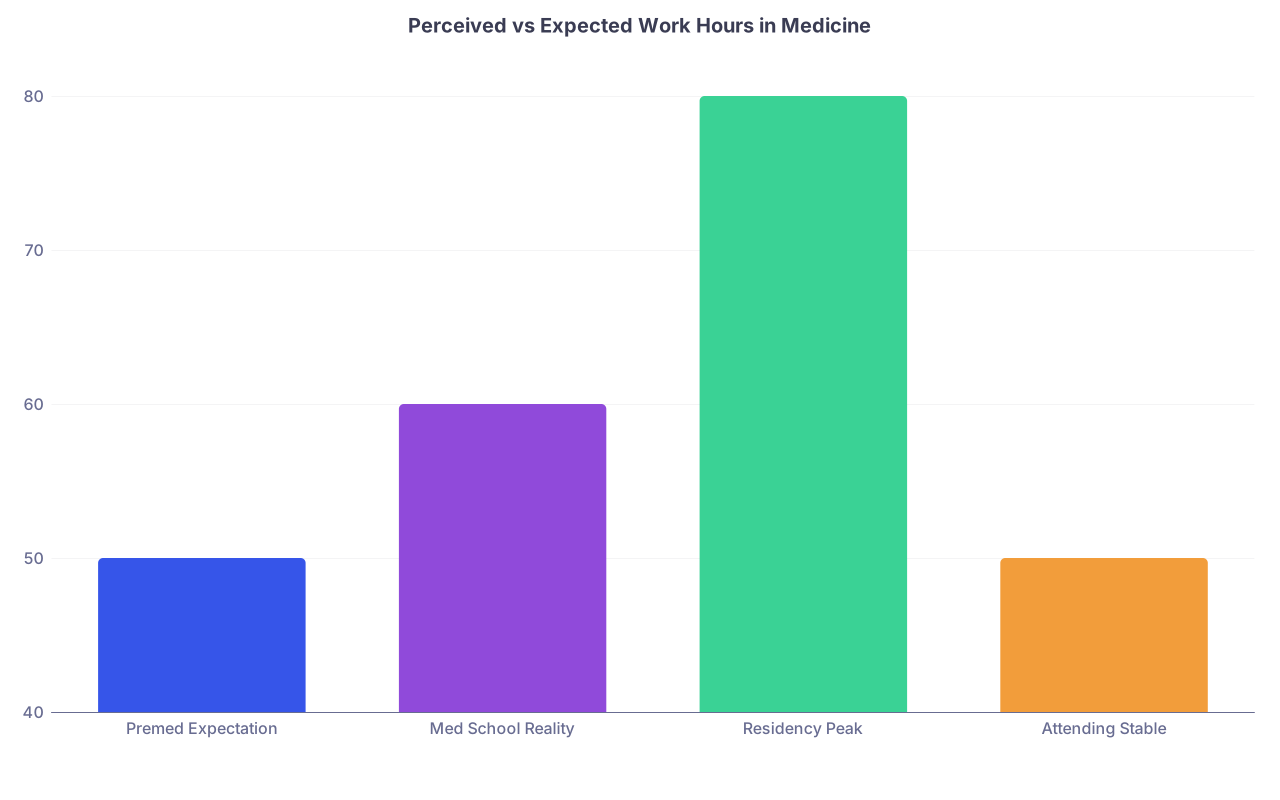
| Category | Value |
|---|---|
| Premed Expectation | 50 |
| Med School Reality | 60 |
| Residency Peak | 80 |
| Attending Stable | 50 |
This is the shock:
- As a premed, you picture 40–50 hours of meaningful work, stable life.
- In reality, med school + residency are often 60–80+ hours of work/study, sleep debt, and constant evaluation.
- Even as an attending, the hours and emotional weight can be heavy, depending on specialty and setting.
A few harsh truths:
- Medicine will take more of your life than many other careers, especially during training.
- That doesn’t mean every doctor is miserable. Some have genuinely balanced lives, but usually because they fought for it and made specific choices.
- If work–life balance is a high priority for you, you’re not “weak.” You just have different values than the martyrdom culture you’re surrounded by.
You’re not wrong for wanting:
- Evenings that aren’t destroyed by charting
- A hobby that isn’t “recovering from work”
- To see your kids actually awake
- To have a partner who doesn’t feel like a side quest
The ethical layer here: You can’t give good care long term if you’re hollowed out and resentful. So your desire for balance isn’t selfish—it’s actually necessary if you plan to stay in this profession without becoming bitter.
How to Decide: Stay, Adjust, or Leave?
This is the nightmare scenario your brain keeps throwing at you:
“What if I stay and waste my life?”
“What if I leave and regret it forever?”
And then you’re paralyzed and do nothing except suffer.
Here’s a more honest way to approach it.
Step 1: Test adjustments before you nuke your life
Before you decide you chose the wrong field entirely, experiment:
- Different rotations or electives: See if certain patient populations or paces feel less soul-crushing.
- Talk to attendings in different settings: Academic vs community vs outpatient vs concierge vs locums.
- Micro-boundaries:
- No studying after 10 p.m.
- Protected half day once a week, even if it means being “less perfect.”
- Say no to 1 optional thing that’s costing you sanity.
If even with these adjustments, your baseline feeling is still, “this is fundamentally not my life,” that’s information.
Step 2: Have at least one brutally honest conversation
Not with:
- Your proud parent
- Your friend who worships medicine
- The advisor who sees you as a “success statistic”
Talk to:
- A resident or attending who has actually considered quitting or changing—someone who isn’t drinking the Kool-Aid.
- A therapist who works with medical students/residents. (Yes, it’s awkward to start. Do it anyway.)
Say the real sentence:
“I’m scared I made a mistake going into medicine.”
Watch how many of them say, “I’ve thought that too.”
Step 3: Consider the ethics of staying vs leaving
You’re in the “Personal Development and Medical Ethics” zone whether you like it or not.
Ethically, you’re balancing:
- Obligation to patients and the profession
- Obligation to your own mental health and safety
- Obligation (or perceived obligation) to family, loans, expectations
Here’s the part people rarely say out loud:
Staying in medicine out of guilt while slowly breaking is not morally superior to leaving.
A burned-out, resentful, depressed physician is not a gift to patients, colleagues, or anyone. You don’t earn extra moral points for self-destruction.
At the same time, if there’s a version of this path that could work for you with some serious boundaries and adjustments, it’s worth at least exploring before you torch the whole thing.
You are allowed to:
- Pivot specialties
- Choose a lower-paying but more humane job
- Go part-time later
- Leave medicine entirely if you realize this really isn’t your life
None of those automatically make you “a failure” or a bad person. They make you someone who chose not to live a life they hate.
A Few Grounding Questions for When You’re Spiraling at 1 a.m.
If your brain is ping-ponging between “quit everything” and “just push through,” try these:
If I had zero loans and zero family expectations, what would I do?
Not as a fantasy. As a gut-level direction. Stay? Change specialty? Leave?What part of the day do I like least—and is that “medicine,” or is that “this specific system/rotation”?
Can I name one moment in the last month that felt meaningful or aligned?
If the answer is honestly “no,” that’s worth listening to.If my best friend described my life to me, what advice would I give them?
You’re usually kinder and clearer when it’s not “you.”
You don’t need total clarity tonight. Just a little more honesty than yesterday.

| Step | Description |
|---|---|
| Step 1 | Feel regret about medicine |
| Step 2 | Consider burnout or phase issue |
| Step 3 | Possible deeper misfit |
| Step 4 | Adjust schedule, supports, specialty exploration |
| Step 5 | Talk to therapist or trusted mentor |
| Step 6 | Stay with modified plan |
| Step 7 | Explore serious pivot or exit options |
| Step 8 | Is it only during worst weeks? |
| Step 9 | Any improvement over months? |
Bottom Line: Is It Normal to Regret Choosing Medicine Some Days?
Yes. It’s normal. It’s common. It’s not a sign you’re broken.
But here’s the sharper truth: you’re responsible for listening to that regret, not just numbing it.
You don’t have to decide your entire future this week. You don’t have to martyr yourself either. You’re allowed to ask:
- “What if medicine isn’t my forever plan?”
- “What if it is, but in a very different form than I was sold?”
- “What if my mental health actually matters more than my title?”
You’re not the only one lying awake wondering if you made the wrong choice. You’re just one of the few being honest enough to say it.


