
The stigma around switching specialties for lifestyle reasons is outdated—and often harmful.
You’re not a martyr-in-training. You’re a professional making a 30+ year career decision. And yes, switching specialties because you want a better life outside the hospital can be a legitimate, ethical, and smart choice.
Let me break down when it is, when it isn’t, and how to think about it like a grown-up clinician, not a guilty trainee.
The Core Question: Is It Legitimate?
Short answer: Yes, switching specialties for lifestyle reasons is legitimate—if three conditions are met:
- You can still provide excellent care in the new specialty.
- You’re honest with yourself about your motivations and fit.
- You don’t abandon core professional responsibilities in the process.
Lifestyle isn’t a dirty word. What people call “lifestyle” usually boils down to:
- Predictable hours
- Less overnight/holiday call
- Better compatibility with family or health needs
- Lower cognitive/administrative overload
- Emotional sustainability (less chronic trauma exposure)
Those are not trivial preferences. They determine whether you burn out at 42, get divorced twice, and hate your job—or whether you’re still a functional, decent human at 60.
Where this becomes problematic is when:
- You’re running from discomfort rather than choosing a better fit.
- You haven’t actually engaged with the realities of the new field (and are chasing a fantasy).
- You’re trying to dodge hard work entirely.
So the question isn’t “Is it OK to switch for lifestyle?”
The question is “Am I making a thoughtful, informed, patient-safe decision?”
How to Decide: A Simple 4-Step Framework
Use this like a decision consult on yourself.

| Step | Description |
|---|---|
| Step 1 | Unhappy in current specialty |
| Step 2 | Clarify reasons |
| Step 3 | Wait and reassess |
| Step 4 | Evaluate other specialties |
| Step 5 | Fix current situation first |
| Step 6 | Shadow and talk to attendings |
| Step 7 | Plan transition |
| Step 8 | Reconsider options |
| Step 9 | Is it persistent? |
| Step 10 | Lifestyle main driver? |
| Step 11 | Still better fit? |
Step 1: Distinguish Acute Pain from Chronic Misfit
Ask yourself:
- Is this a bad rotation, a toxic attending, or the entire specialty?
- How long have you felt this way—weeks, months, years?
- Do your co-residents feel similarly burned out, or does it seem worse for you?
If you’re an intern three months into surgery and hating life, that’s data—but not destiny. Everyone is miserable at some point in intern year.
If you’re PGY-3 in IM, have tried different rotations, different hospitals, maybe even therapy—and you still feel like you’re cosplaying as a doctor every day? Different situation.
Lifestyle is easier to judge once you know the baseline misery of training vs. the structural realities of a field.
Step 2: Name Your Real Reason(s)
Be brutally specific. “Lifestyle” is too vague. Try questions like:
- What exact moments make me think, “I can’t do this for 30 years”?
- Is it night call? Procedures? Constant crises? Endless documentation? Patient population?
- Do I hate the work itself—or just the way training is structured?
Typical examples:
- EM resident: “I can’t handle nights until age 65. My sleep is wrecked. I feel unsafe driving home.”
- Surgery resident: “I love the OR but the culture and hours are killing my relationship and my health.”
- IM resident: “I am drowning in chronic disease management documentation and 20 patients per day. I need more focus or defined episodes of care.”
Once your reason is clear, you can decide if it’s:
- Fixable within your field (different job, setting, FTE reduction).
- Or structural to the specialty (e.g., shift nights forever in EM, q4 call in some surgical fields).
Step 3: Reality-Check the “Lifestyle” of Other Specialties
This is where most people screw up. They chase stereotypes.
- “Derm is chill.”
- “Radiology is 9–5 in a dark room with no people.”
- “Psych is just talking.”
Stop. Every specialty has its own brand of pain.
Use actual data + conversations, not gossip.
| Specialty | Typical Schedule | Nights/Weekends | Common Stressor |
|---|---|---|---|
| EM | Shift-based | Frequent | Circadian disruption |
| Anesthesia | OR-day aligned | Variable call | High-stakes acute care |
| Psych | Clinic-based | Limited | Emotional burden |
| Radiology | Day blocks | Some call | Volume and isolation |
| FM/Primary Care | Clinic-based | Limited | Time pressure, admin |
Then you:
- Shadow attendings in the fields you’re considering (not just residents).
- Ask about their actual week: “What did last week look like for you?”
- Ask about downsides directly: “What sucks about this job nobody talks about?”
Lifestyle depends as much on job type and setting as on specialty:
- Outpatient GI vs inpatient-only GI.
- Community EM vs academic trauma center.
- Outpatient psych vs CL psych with call.
- Teleradiology vs in-hospital overnight.
Do not switch specialties until you’ve seen the “mid-career attending reality” of the new field.
The Ethics Question: Are You Letting Patients Down?
Here’s the guilt voice: “If I leave [insert shortage specialty] for something cushier, I’m abandoning patients who need me.”
The ethical reality is more nuanced:
A burned-out, resentful physician is not a gift to any patient population.
You’re not doing underserved communities a favor by being chronically exhausted and miserable in their clinic or OR.You owe patients competence and presence, not perpetual self-sacrifice.
The profession is not a vow of suffering. It’s a commitment to apply your skills responsibly and sustainably.System problems are not yours to solve alone.
Yes, primary care is short-staffed. Rural EM is on fire. But solving national workforce crises by sacrificing your own health is not a rational or sustainable plan.
The ethically wrong version of a lifestyle switch looks like this:
- You abandon a program mid-year with zero notice and no attempt to minimize harm.
- You ignore contractual obligations entirely and leave colleagues in unsafe staffing.
- You choose a new specialty you are clearly not suited for, just because it “pays well and is chill,” with no regard for your competence or interest.
The ethically defensible version looks like:
- You complete your current responsibilities as safely as possible.
- You work with your PD, GME, and future program to transition in an organized way.
- You choose a specialty where you can genuinely do good work over a long career.
Lifestyle vs Avoidance: The Hard Conversation With Yourself
Sometimes “lifestyle” is code for “I don’t want to be uncomfortable.”
You need to sort this out honestly:
Examples of avoidance:
- “I don’t like being bad at procedures, so I’ll switch to something where I never have to do them.”
- “I hate sick patients and hard conversations, so I’m looking for a field with ‘easy’ patients.”
- “I don’t want to study or read, so I’ll pick a ‘lighter’ specialty.”
Examples of legitimate limits:
- “I’ve had two close calls driving home post-call. My body doesn’t tolerate chronic sleep deprivation.”
- “My own mental health history makes daily exposure to trauma (EM, ICU) genuinely destabilizing.”
- “I need a job where I can actually see my kids more than one day a week.”
The difference is whether you’re running away from growth or recognizing a serious misfit with your physiology, psychology, or life goals.
If you’re not sure which one applies, that’s what a good therapist, mentor, or coach is for.
Practical Steps If You’re Considering Switching
Don’t just stew. Move methodically.
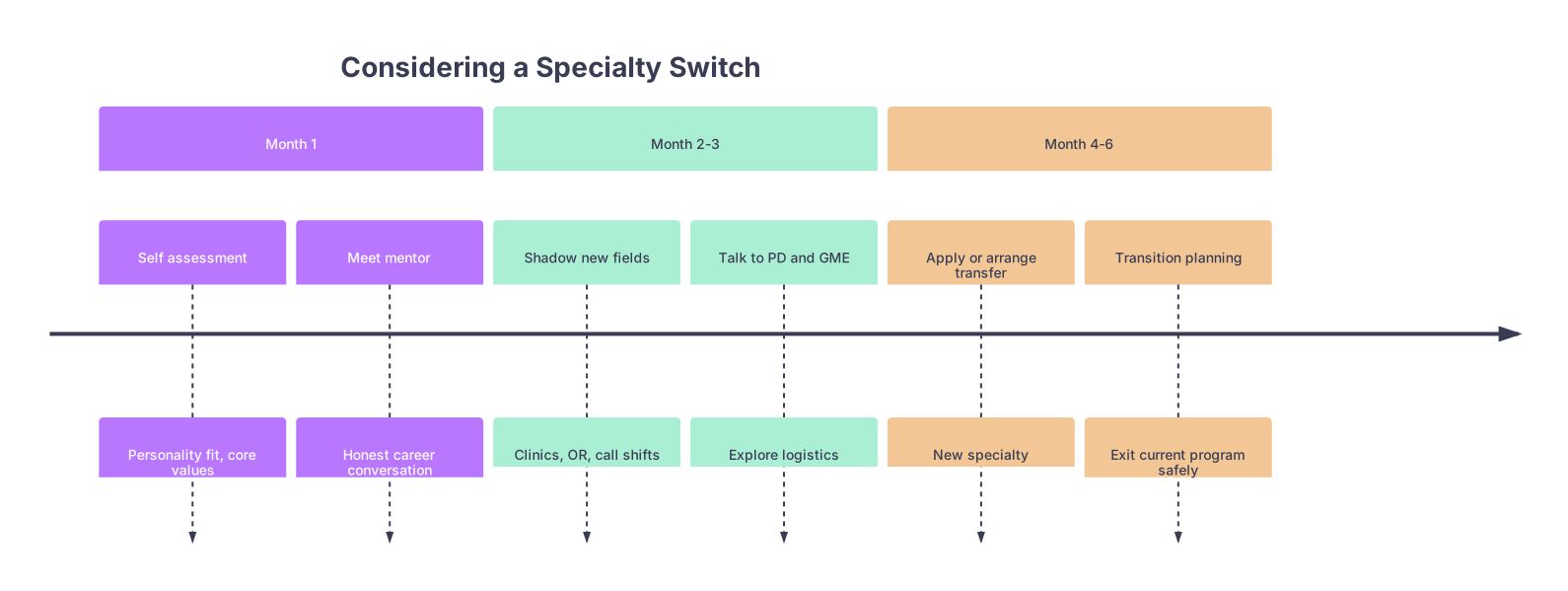
| Period | Event |
|---|---|
| Month 1 - Self assessment | Personality fit, core values |
| Month 1 - Meet mentor | Honest career conversation |
| Month 2-3 - Shadow new fields | Clinics, OR, call shifts |
| Month 2-3 - Talk to PD and GME | Explore logistics |
| Month 4-6 - Apply or arrange transfer | New specialty |
| Month 4-6 - Transition planning | Exit current program safely |
1. Do a brutally honest self-inventory
Write down:
- What do I actually enjoy on a typical day in my current field?
- What parts of medicine energize me (diagnostics, procedures, continuity, acute care, counseling, tech, etc.)?
- Non-negotiables: maximum nights, maximum weekends, geographic constraints, family needs.
2. Have three separate conversations
With:
- A trusted attending who actually knows you as a clinician.
- Someone in the specialty you’re considering who seems sane and balanced.
- Your own PD or APD, sooner than you want to.
You’re not the first resident or fellow to consider switching. Most PDs have seen it before. The good ones would rather help you move than keep someone who doesn’t want to be there.
3. Shadow like it’s your job (because it is)
Do at least:
- 2–3 full clinic days or OR days
- 1–2 call shifts or evenings/weekends in the new field
- A follow-up day to see what “aftermath” work looks like (notes, follow-up, coordination)
And then ask yourself: “On my worst day here, would I still choose this over my current worst day?”
4. Understand the logistics and costs
Switching comes with consequences:
- Possible extra years of training
- Loan interest ticking up
- Delayed attending income
- Visa issues (for IMGs)
- Contractual issues if you’ve already signed something
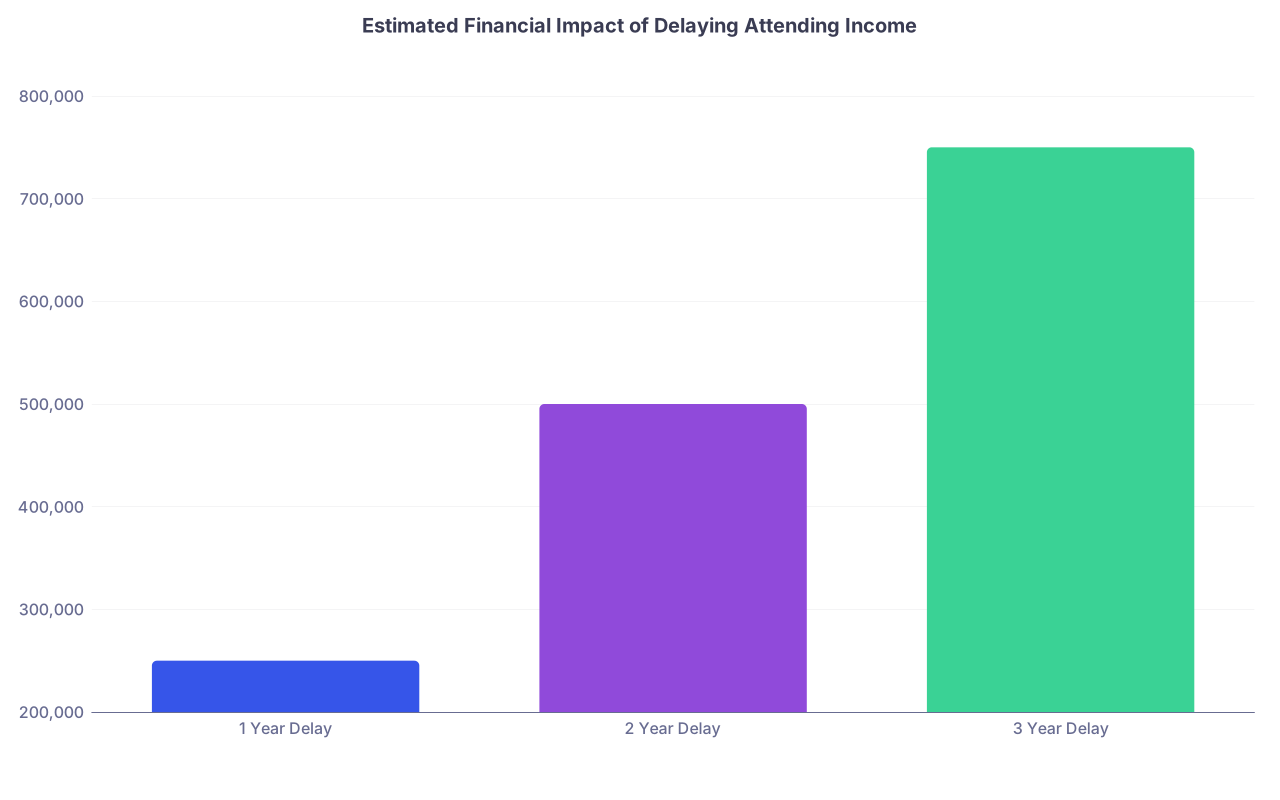
| Category | Value |
|---|---|
| 1 Year Delay | 250000 |
| 2 Year Delay | 500000 |
| 3 Year Delay | 750000 |
These are not reasons not to switch. They’re inputs into a rational decision.
Common Scenarios Where Switching Does Make Sense
Let me be concrete.
EM resident to Anesthesia or Radiology
Reason: Chronic night shifts wrecking health, desire for procedural or diagnostic focus, still comfortable with acute care but need more predictability.Surgery to Anesthesia/IM/Hospitalist
Reason: Loves OR/team environment/patient care but not willing to accept 80-hour weeks and 24-hour call for decades.IM to Psych
Reason: More energized by conversations, differential-thinking, and long-term narratives than by managing 15 problems in 20 minutes.Critical Care to Outpatient Specialty (e.g., Pulm-only, Sleep)
Reason: Burned out on death/ICU high stakes, wants to stay in same intellectual domain with less emotional trauma.
These are not cop-outs. I’ve seen people in all of these scenarios become far better physicians after switching because they were finally in a field that matched their temperament and tolerance.
When You Probably Should Not Switch (Yet)
- You’re in your first 6 months of intern year and hate everything. That’s standard. Get more data.
- Your program is toxic, but the specialty itself might still fit. Try a different environment first.
- You’ve done virtually no serious exploration of the target field. You’re in love with the fantasy version.
If you’re just tired and demoralized, start with:
- A real break (actual vacation, not “research time”).
- Therapy or counseling.
- Adjusting where/how you train (electives elsewhere, different clinical sites).
Only after that should you assume it’s a specialty problem, not a context problem.
The Bottom Line
Switching specialties for lifestyle reasons can be:
- Ethically sound
- Professionally wise
- Personally life-saving
…if you:
- Are honest about why you’re switching
- Do the work to truly understand the new field
- Transition responsibly, with patients and colleagues in mind
You do not owe your entire life to a specialty you picked at 26 after a few third-year rotations and some glossy brochures. You do owe your patients a version of you that’s competent, present, and not permanently running on fumes.
The next step:
Block off 45 minutes today, sit down with a blank page, and write two lists—“What I cannot keep doing for 30 years” and “What I want my actual life to look like at 45.” That’s your starting map for whether a lifestyle-driven switch is a smart move or just an escape fantasy.
FAQ: Switching Specialties for Lifestyle Reasons
1. Will switching specialties ruin my career or reputation?
Usually not, if handled professionally. Programs and attendings care more about whether you’re safe, reliable, and honest than whether you changed your mind. Many PDs quietly respect someone who recognizes a bad fit early rather than grinding through and burning out. Where reputations get damaged is when people disappear, break contracts without communication, or bad-mouth their old specialty publicly. If you’re transparent, give appropriate notice, and keep doing good work during the transition, you’ll be fine long term.
2. How early is “too early” to decide I picked the wrong specialty?
If you’re still in the first 6–9 months of intern year, assume at least 50% of your misery is “being new” rather than “wrong specialty.” That doesn’t mean your feelings are invalid. It means you should see more settings, more attendings, and more rotations before calling it. If by PGY-2 or beyond you’ve rotated through different environments and the core work still feels wrong, it’s much more likely you have a true misfit, not just an adjustment problem.
3. Is it better to finish my current residency then retrain, or switch mid-residency?
Depends on your situation. Finishing gives you a board-eligible skill set and earning potential, but costs extra years if you then start a new residency. Switching earlier can shorten total training time but may mean starting over without a fallback. Financially, many people benefit from finishing if they’re close to the end; psychologically, some cannot tolerate that and need out sooner. This is where a frank conversation with your PD and a financial advisor actually helps.
4. How do I talk to my program director about wanting to switch?
Be direct and prepared. Go in with: clear reasons that go beyond “I’m tired,” evidence that you’ve seriously explored alternatives (shadowing, conversations), and a collaborative tone: “I want to make sure I can have a sustainable career, and I’d like your help thinking through whether another specialty is a better fit.” Most PDs would rather help you land somewhere appropriate than keep an unhappy trainee. Do not make it a blame session about the program; focus on fit.
5. Are “lifestyle specialties” actually less stressful?
They’re different, not magically easy. Derm, radiology, psych, and some outpatient specialties tend to offer more predictable hours and fewer nights, but they come with their own pressures: productivity metrics, RVU demands, emotional fatigue, isolation, or high expectations from patients paying out of pocket. Some physicians find the chronic low-level grind of outpatient work more draining than acute high-intensity fields. That is why first-hand exposure beats assumptions.
6. How do I know I’m not just avoiding hard work?
Ask yourself: Am I okay working hard at something that fits me, or am I trying to minimize effort everywhere? If you’re willing to work very hard in other domains of your life (research, advocacy, teaching, family) but the specific grind of your current specialty feels incompatible, that points to misfit, not laziness. Also, check with people who know you well and are willing to be honest. If multiple mentors who respect you say, “This sounds like a mismatch, not a cop-out,” listen.