

Last week I watched a resident sit in the call room at 3 a.m., scrolling Zillow for non‑medical careers. He wasn’t joking. He said, “I’m scared I’m going to wake up at 45 and hate everything I sacrificed for this.”
If you’re even reading an article with this title, you probably already feel a smaller version of that fear in your chest. Same. Honestly, same.
The fear under the fear: “What if I build a life I can’t stand?”
The real terror isn’t just burnout. It’s the idea of getting everything you’re working for—MD, white coat, decent paycheck—and realizing: I don’t want this. I resent this. I resent me for choosing this.
Let’s say that out loud: yes, some doctors deeply resent medicine. I’ve met them. You probably have too. The bitter attending who says, “If I could do it again, I’d sell insurance.” The resident who counts down not to the end of call, but to the end of their career. That’s your nightmare scenario.
You’re not crazy for wanting to avoid that.
But here’s the part people don’t tell you: the difference between “I’m tired and stretched” and “I deeply resent my career” usually isn’t random. There are warning signs. There are choices. And there are questions you can ask now that change the long‑term story.
Not perfect protection. But a hell of a lot better than marching forward blind.
Question 1: Do I actually want medicine, or do I just want a stable, prestigious identity?
This is the ugly one.
Strip away:
- The status (“doctor” on your Starbucks cup)
- The external validation (parents, culture, Instagram)
- The “I’m doing something important” storyline you tell yourself
What’s left?
Would you still choose this path if:
- It paid like a high‑school teacher?
- Nobody outside the hospital cared you were a doctor?
- You had to introduce yourself simply as “[First name], I work in healthcare”?
If the honest answer is “I don’t know” or even “maybe not,” don’t panic. That doesn’t mean you’re doomed. It means you need to be brutally specific about what part of “being a doctor” you actually care about.
Try this:
Imagine medicine without the shine. The EMR that crashes. The 14‑minute new patient visits. The family yelling at you because they waited 4 hours in the ED. The 2 a.m. codes. The Q2 call. Now ask:
- When I picture real medicine—not TV medicine—what parts still pull me in?
- Is it thinking through diagnoses? Hands‑on procedures? Long‑term relationships? Systems‑level change? Teaching?
- Or is it mostly the idea of being someone impressive who “made it”?
Because here’s the pattern I’ve seen: the people who resent medicine most are often the ones who were more in love with the identity than the day‑to‑day work. When the identity gets normalized (no one claps when you walk into clinic), there’s nothing left to sustain them.
You don’t need some grand noble reason. But you do need at least one concrete part of the work that feels energizing, not just the label.
If you can’t name that, don’t ignore it. That’s not anxiety. That’s data.
Question 2: What kind of suffering am I willing to tolerate—and what kind will destroy me?
Medicine will cost you something. Time. Sleep. Emotional bandwidth. You can’t minimize that away with “self‑care” and a latte.
The question isn’t “Can I avoid suffering?” It’s “Which suffering can I live with without hating my life?”
For example:
- Some people can tolerate chronic sleep deprivation surprisingly well, but not emotional chaos. They’d rather be on a procedural specialty with brutal hours than outpatient psych with long, emotionally heavy days.
- Others are okay being emotionally wrung out if they can sleep at home and have predictable weekends.
- Some can accept missing holidays if they get high‑intensity, high‑adrenaline work. Others will deeply resent anything that regularly steals birthdays and anniversaries.
Ask yourself:
- If I imagine myself in my 30s, what would I resent more:
- Missing my kid’s school play, or
- Not being challenged intellectually at work?
- Which is worse to me long term:
- Being financially tight but having time, or
- Being financially comfortable but constantly exhausted?
You’re not choosing “suffering or no suffering.” You’re choosing your flavor of pain.
Resentment often comes from picking the wrong flavor for your personality and values—and hoping it “won’t be that bad.” It’s usually exactly that bad.
Question 3: How do I handle loss of control?
Here’s the cruel joke: a ton of people who go into medicine are type A control freaks… who then enter a system where they control almost nothing for a decade.
Your schedule. Your calls. Your rotations. What state you match in. Even what specialty you end up in if things go sideways.
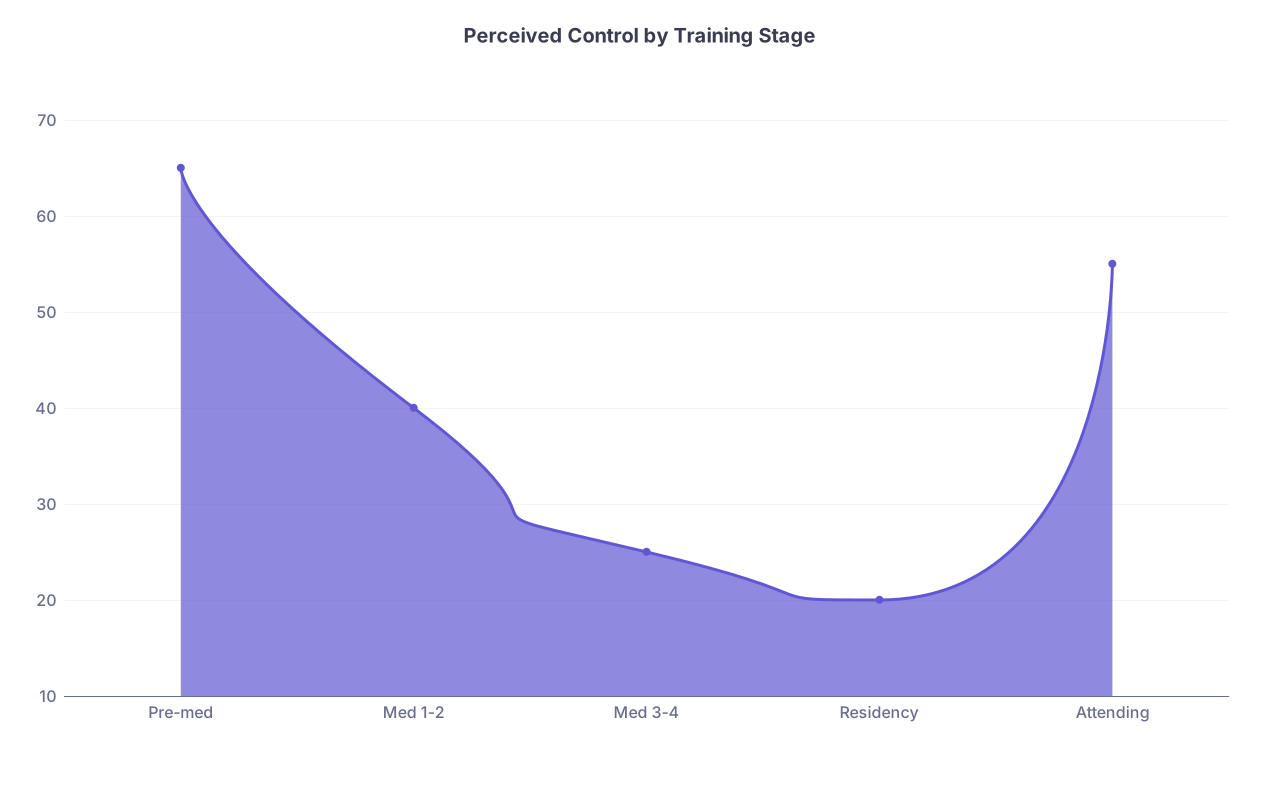
| Category | Value |
|---|---|
| Pre-med | 65 |
| Med 1-2 | 40 |
| Med 3-4 | 25 |
| Residency | 20 |
| Attending | 55 |
If just reading that makes your chest tighten, that’s worth listening to.
Ask:
- When people change my plans last minute, do I get mildly annoyed… or absolutely unhinged inside?
- Can I tolerate being told what to do by people I don’t fully respect?
- What happens to me mentally when I work hard and still don’t get the outcome I want?
Because in medicine, you will:
- Do everything “right” and still not match at your top choice
- Lose patients you did everything for
- Get schedules that don’t care about your life events
- Be evaluated using metrics that don’t reflect your real skills
If you need things to be fair and predictable to feel okay, medicine may feel like constant betrayal. You’ll either adapt your expectations (healthy) or marinate in resentment (slow poison).
You don’t have to love chaos. But you do need some plan for not letting systemic unfairness turn into “I hate this whole field.”
Question 4: What’s my relationship with work and worth?
This one’s ugly too.
A lot of us secretly think: “If I’m not constantly working, I’m not valuable.” Medicine loves those people. Chews them up. Praises them for being “dedicated.” Then wonders why they burn out.
If your self‑worth is tied 90% to productivity, here’s what’s going to happen:
- You’ll say yes to everything—research, leadership, teaching—until you resent everyone for “using you.”
- You’ll feel guilty resting, then hate medicine for “taking your life” when you were the one over‑volunteering.
- You’ll chase external achievements (Step scores, publications, fellowships) and then feel empty when hitting them doesn’t fix the baseline anxiety.
Ask yourself very honestly:
- If I had a lighter clinic day, would I feel relieved… or vaguely like I’m failing?
- If I took one weekend fully off, would I enjoy it or spend it spiraling about what I “should” be doing?
- Do I know who I am outside of “the person who works a lot and excels”?
If the answer is “nope,” medicine won’t magically teach you that. It will exploit it.
Resentment builds when you keep offering yourself on a platter to the system… and then get angry that the system takes what you offer. It always will.
You don’t have to fix your entire identity before applying. But you do need to recognize this dynamic and decide if you’re willing to do the uncomfortable work of separating “my worth” from “my output.”
Question 5: Am I allowed, in my own mind, to change my path later?
One huge predictor of long‑term resentment: people who feel trapped by their own narrative.
“I can’t leave now, I’ve already invested too much.” “If I switch specialties, I’ll look flaky.” “If I go part‑time, everyone will think I couldn’t handle it.”
Imagine this scenario:
You match. You grind. You become an attending. Five years in, you realize: this specialty is wrong for me. Or full‑time clinical work is wrong for me. Or clinical medicine at all is wrong for me.
What happens inside your head?
Do you think:
- “Okay, painful, but people pivot. I can explore teaching, admin, industry, something else.”
Or do you think:
- “I’m a failure. I wasted my life. I have to stay and pay for my choices with my happiness forever.”
If it’s the second one, that’s a risk. Because people do pivot. Hospital admin, consulting, med ed, telemedicine, industry, entrepreneurship. I’ve watched attendings leave EM for urgent care, inpatient for outpatient, clinical for non‑clinical.

The people who resent medicine are often the ones who made change morally impossible for themselves. They decide that leaving or adapting would mean they “failed,” so they stay stuck and bitter instead.
You can’t control the future. But you can decide right now that your life is allowed more than one chapter. That doesn’t make you flakey. It makes you an adult with evolving data.
Question 6: What kind of life do I want at 35—and does any version of medicine fit that?
Don’t picture “a doctor.” Picture “you at 35.”
Walk through a random Tuesday:
- What time are you waking up?
- Who are you living with?
- Are you making breakfast with someone? Alone? Rushing?
- What kind of work are you driving to?
- How long are you there?
- Do you pick up kids? Go to the gym? Collapse?
- Are you working from home on charting after dinner or fully done?
Now, can you see any realistic medical path consistent with that life?
If your dream Tuesday is:
- Getting to school events regularly
- Having most weekends off
- Sleeping at home
- Some flexibility over your schedule
Guess what? That’s not incompatible with medicine. It might mean:
- Outpatient IM, FM, psych, derm, PM&R
- Working 0.8–1.0 FTE in a decent system
- Saying no to certain high‑prestige but high‑cost roles
If your dream Tuesday is:
- Zero emergencies
- Zero nights
- Lots of remote work
- Long solo creative time
Then being a trauma surgeon is going to make you deeply, predictably miserable. Not because trauma surgery is “bad,” but because it’s a terrible match for the life script in your head.
Resentment = mismatch between expectations and reality, repeated daily.
Medicine contains many different lives. Your job now is to see whether at least one of them looks like something you could live inside without continuously bleeding out emotionally.
Question 7: How do I react when I see unhappy physicians?
Be honest about this one.
When you see:
- The exhausted attending muttering “Don’t do medicine”
- The jaded resident warning you away
- The older doc saying “This isn’t what it used to be”
What happens inside you?
Do you:
- Immediately dismiss them: “They’re just burned out, I’ll be different.”
- Absorb their pain like a sponge and think, “That’ll be me, I’m doomed.”
- Get curious: “What exactly made them so unhappy? Was it the specialty? The system? Their own choices?”
If your default is either total denial or total doom, you’re vulnerable—either to walking into the same trap, or to being paralyzed by fear and never acting.
Try this instead: turn them into data points.
Literally ask, if you can:
- “If you could go back, what exactly would you do differently?”
- “Was there a specific point where you realized you were unhappy, but kept going anyway?”
- “Is it the medicine you regret, or the way you’ve practiced it?”
I’ve heard:
- “I wish I’d chosen a less malignant residency; it colored everything.”
- “I stayed at one hospital for 20 years when I should have left at year 5.”
- “I ignored how much the schedule was killing me because the salary was good.”
- “I chose the competitive specialty instead of the one I actually liked.”
Notice the pattern: none of those are “I should never have gone into medicine at all.” They’re how they did it.
That distinction matters.
A quick reality check on “resentment risk”
Here’s the harsh truth that actually helped me:
There is no career where resentment isn’t possible.
Your friend in tech can burn out and hate his life.
The teacher with summers off can feel trapped and bitter.
The nurse can feel crushed by staffing ratios.
So you’re not choosing between:
- Medicine = maybe resentment
- Something else = guaranteed peace
You’re choosing:
- Which problems am I willing to have?
- In which problems do I still recognize myself?
| Path | Big Risks |
|---|---|
| Medicine | Long training, hours, admin |
| Tech | Layoffs, instability, churn |
| Law | Billable hours, adversarial |
| Academia | Low pay, publish or perish |
| Business | Travel, pressure, volatility |
Medicine has structural issues that can absolutely breed resentment. But if your core anxieties are about meaninglessness, boredom, feeling replaceable—medicine can actually be protective if you’re intentional.
What to do with all these questions
If your brain is screaming “I don’t know” to half of this—that’s fine. Honestly, that means you’re actually thinking, not just auto‑piloting.
Here’s what I’d do next, if I were you:
- Write out your answers. Not in your head. On paper. The specific, maybe‑embarrassing ones.
- Talk to three physicians in different settings. Outpatient, inpatient, maybe part‑time or non‑clinical. Ask them about their 35‑year‑old Tuesday. Compare it to yours.
- Notice where your anxiety is data and where it’s just noise.
- Data: “I really can’t handle chronic sleep deprivation.”
- Noise: “What if I become the one miserable doctor I saw on TikTok and nothing I do matters?”
- Give yourself permission to pause, delay, or change course later—even if you decide to move forward now.

| Step | Description |
|---|---|
| Step 1 | Start - Considering Medicine |
| Step 2 | Gather more clinical exposure |
| Step 3 | Talk to 3 diverse physicians |
| Step 4 | Reconsider or delay path |
| Step 5 | Proceed with eyes open |
| Step 6 | Can you name parts of the work you like? |
| Step 7 | Can you imagine a 35 year old Tuesday in medicine? |
| Step 8 | Are you willing to accept trade offs? |
You don’t need 100% certainty. That doesn’t exist. You need “I understand the likely trade‑offs, and I can see at least one future where I don’t hate myself for choosing this.”
If you can’t see that? That’s not cowardice. That’s your brain trying to protect you from locking into a life that feels wrong.

FAQ – Worried I’ll Resent Medicine Long-Term
1. What if I only realize I hate medicine after I’ve already invested years?
Then you’ll be like a lot of people in a lot of careers. It’ll hurt. You’ll grieve the time, money, and identity. And then—if you allow yourself—you’ll pivot. Maybe to a different specialty. Maybe to part‑time. Maybe to a parallel path (admin, industry, education). The trap isn’t “realizing late.” The trap is deciding that realizing late means you’re morally obligated to stay miserable forever to justify the sunk cost.
2. How can I tell if my fear is valid concern or just generalized anxiety?
Generalized anxiety sounds like: “What if everything is terrible no matter what I do?” and stays very vague and global. Valid concern is specific and testable: “I’m deeply affected by poor sleep, and I’m worried about call‑heavy specialties.” When your worry is specific, you can gather data—shadow, talk to residents, look at schedules. If every scenario ends with doom in your mind, regardless of the facts, that’s more anxiety than reality.
3. Is it a red flag that I’m already this worried before even starting?
Honestly? I think it’s a sign you’re awake. The red flag would be never questioning anything and then collapsing later. The only caution: don’t get stuck in analysis paralysis where you’re constantly “researching your life” and never actually living any version of it. At some point, you need to test your fears against real experiences—clinicals, shadowing, talking to honestly unhappy doctors and honestly content ones.
4. What if the parts of medicine I like are in a specialty I’m not competitive for?
Then you have a few paths: adjust your strategy to become as competitive as possible, explore adjacent specialties with similar day‑to‑day work but different competitiveness, or accept that chasing a prestige‑heavy niche at all costs might actually increase your resentment. I’ve seen people contort their entire lives to match a “dream” specialty, only to realize they liked the idea more than the reality. Focus more on the kind of work and lifestyle than on the name brand of the field.
5. How do I handle family pressure when I’m unsure about medicine?
You treat their expectations as background noise, not your compass. That’s harsh, but it’s true. You’re the one who will wake up for 30 years in the life you pick, not them. If you’re unsure, say: “I’m taking this seriously enough to question it. I need time and experience to be sure, and I’d rather pause now than end up hating my life later.” Some families will push back. But again: they don’t have to live your Tuesdays.
6. Is it realistic to have work-life balance in medicine, or am I lying to myself?
It’s realistic in some corners of medicine, under some conditions, if you’re willing to trade certain things. You can’t have 7‑figure salary, elite‑competitive specialty, major leadership roles, and tons of free time all at once. But you can absolutely have: decent hours, meaningful work, time with family, and a stable life if you choose your specialty, practice setting, and boundaries intentionally. The lie isn’t “balance is possible.” The lie is “you can have everything with no sacrifice.”

Key points to hang onto:
- Resentment usually comes from mismatch and trapped thinking, not from the mere fact of choosing medicine.
- You can’t remove all risk, but you can ask sharper questions now about your values, tolerance, and future life.
- You’re allowed to choose medicine—and you’re also allowed to change, adapt, or leave later. Your life isn’t a single irreversible decision, no matter what your fear is telling you.


