
It’s 11:30 p.m. The ABS, ABIM, ABFM, ABEM—pick your board—just published another exam window. Your co-resident just passed. Your attending just asked, “So, are you board-certified yet?” and you did that half-smile, half-winced nod.
You’re board-eligible but not certified. Maybe you failed once (or twice). Maybe you timed out. Maybe you never sat for it because life blew up—illness, childcare, burnout, immigration issues, financial pressure. Whatever the backstory, you’re in the same spot:
- You did the training.
- You have the MD/DO.
- You’re clinically capable.
- And doors are starting to close because you don’t have those three little words: “Board Certified in…”
You’re trying not to panic. Recruiters stop calling back the second they hear “not board certified.” Hospital bylaws are rigid. Insurers don’t want to credential you. You’re asking yourself, “Do I have to leave medicine? Is all this wasted?”
No. It’s not wasted. But you do need a new playbook.
This is that playbook.
Step 1: Get Clear on Your Actual Situation
Before chasing “alternative careers,” you need a ruthless, factual inventory. Not vibes. Facts.
Ask and answer:
Are you still technically board-eligible?
- Many boards give a limited eligibility window (e.g., 7 years after residency).
- If your window is open, your strategy is different than if it’s closed.
What’s your license status?
- Active, unrestricted license in which state(s)?
- Any disciplinary actions? Malpractice claims? These matter for non-clinical roles too.
What’s your clinical experience after training?
- Years in practice? Any niche skills? ICU, procedural, rural, urgent care?
What do you actually want:
- Still want patient contact, just not in a hospital?
- Want out of clinical entirely?
- Or you’re simply trying not to go broke while you regroup and maybe retry boards?
Write this down. Literally. You’re going to use it as your planning document.
Now, let’s talk where you still have leverage.
Step 2: Narrow Down the Types of Roles That Still Value You
There are four big buckets where being board-eligible (or even just licensed) still has strong value:
- Clinical roles with looser board requirements
- Utilization, chart, and review work
- Industry and corporate roles
- Education, advisory, and niche expert roles
I’ll walk through each with specifics.
Bucket 1: Clinical Work That Often Does Not Require Board Certification
You’re still a physician. There are clinical settings that care more about license + competence than “board-certified in…”.
1. Direct Primary Care / Cash-Pay Clinics
If you’re FM/IM/peds, or even something adjacent, cash-pay and membership-based practices can be more flexible because insurers and hospital bylaws don’t control them.
Realistic settings:
- Small independent DPC practices (often in suburban areas)
- Telehealth-first primary care membership companies
- Concierge practices that set their own internal credentials
What to know:
- You still need malpractice (they’ll care more about your claims history than your board status).
- You’ll be selling your personality and skills to patients, not your ABMS line.
- Income early on can be lean if you’re building your own panel from scratch.
How to pursue:
- Search “direct primary care physician” + “board eligible” on job boards.
- Cold email existing DPC clinics with a specific proposal: part-time coverage, chronic disease focus, women’s health, etc.
- Offer trial coverage days so they see your clinical competence.
2. Urgent Care and Occupational Medicine
This is where I’ve seen a lot of board-eligible-not-certified folks land.
Typical employers:
- National urgent care chains
- Employer-sponsored clinics
- Occ Med / work comp clinics
Why they’re more flexible:
- High volume, protocol-driven
- Often staffed with a mix of MD/DO/NP/PA
- Reimbursement less dependent on specific board certification
What helps you stand out:
- Procedural comfort: suturing, I&D, splinting
- Willingness to work evenings/weekends (this is currency)
- Prior ED/urgent care exposure, even from residency
Watch for:
- Some large corporations now prefer board-certified but will use “or board-eligible” as language. Talk to the medical director directly, not just HR.
3. Rural / Underserved Clinical Roles
Reality: In some rural or underserved regions, the choice is “board-certified doctor” or “no doctor at all.”
Settings:
- Critical access hospitals
- Rural health clinics
- FQHCs (some are stricter, some are not—depends heavily on leadership)
These can:
- Sponsor visas in some cases
- Be more flexible on board status if you show commitment and competence
Trade-offs:
- Location may be non-ideal
- Work can be broad-spectrum and demanding
- Sometimes lower pay than urban hospitalist gigs, but not always
Bucket 2: Utilization Management, Chart Review, and Remote Clinical Oversight
If face-to-face patient care is not your priority—or you need flexibility—this bucket becomes your lifeline.
4. Utilization Review / Medical Director Work (Payer Side)
Insurance companies, Medicare Advantage plans, and third-party administrators hire physicians for:
- Prior authorization reviews
- Appeals and grievances
- Medical necessity determinations
- Guideline and policy work
Board certification is preferred at many, but not universal. I’ve seen non-boarded but licensed physicians get associate medical director roles because:
- They had strong clinical documentation and communication skills.
- They had experience dealing with payers from the clinical side.
- They were willing to start per-diem and scale up.
How to position yourself:
- Emphasize:
- Experience with prior auth and charting
- Comfort reading long records and guidelines
- Ability to make clear, defensible decisions
- Target:
- “Physician reviewer”
- “Medical director – utilization management”
- “Physician advisor”
| Employer Type | Example Targets |
|---|---|
| National Insurers | United, Aetna, Cigna |
| Regional Health Plans | Blues plans, HMOs |
| UM Vendors | eviCore, NIA, AIM |
| TPAs | Optum, Carelon, others |
5. Chart Review, Disability, and IME Work
There’s a whole shadow economy of physician work around:
- Disability determinations (Social Security, private insurers)
- Workers’ compensation reviews
- Independent medical exams (IME)
- Legal chart reviews (plaintiff and defense firms)
Board certification helps, but it’s not the only credential. What they want:
- Clean, thorough, defensible reports
- Consistency and reliability
- Ability to meet deadlines
This work is often:
- 1099 contract
- Remote or partially remote
- Variable volume, good as a bridge while you explore other paths
How to start:
- Search “disability review physician,” “IME physician,” “file review physician.”
- Reach out directly to IME companies and medico-legal consulting groups.
- Build a CV that highlights any quality, documentation, or medico-legal work you’ve done.
Bucket 3: Industry and Corporate Roles Where MD > Board Cert
Boards matter less the further you move from direct billing and hospital privileges. This is where your MD/DO itself is the real asset.
6. Pharma and Biotech – Medical Affairs, Safety, and Clinical Development
These sectors absolutely value board certification—but I’ve seen non-boarded physicians hired into:
- Drug safety / pharmacovigilance
- Medical information / medical science liaison (MSL)
- Early clinical development associate roles
Why they might still hire you:
- You understand disease and treatment deeply from direct care.
- You can read, interpret, and communicate clinical data.
- You’re okay not having a clinic and focusing on data, writing, and cross-functional meetings.
What they care about more than you think:
- Communication skills (writing and speaking)
- Team fit
- Understanding of trials and evidence
To be blunt: if your resume says “internal med PGY-3, licensed, 3 years hospitalist, strong clinical trials exposure, multiple QI projects” and you interview well, you’re competitive for junior roles even without the board line item.
How to break in:
- Start with drug safety and MSL roles rather than “Senior Medical Director of Clinical Development.”
- Use LinkedIn to find physicians in those roles with similar backgrounds and ask for 15-minute calls.
- You must translate your CV into corporate language: outcomes, cross-functional work, data analysis.
7. Digital Health / Health Tech / Telehealth Startups
Founders love having an MD on the team. Board certification is a nice-to-have, often not mandatory.
Roles:
- Clinical lead / medical director
- Protocol development
- Content creation (patient education, provider training)
- Quality and safety oversight
Telehealth companies especially will flex if:
- You’re licensed in multiple states.
- You’re comfortable with structured documentation and guidelines.
- You’re willing to take on both strategy and some clinical shifts.
Don’t just look at huge players. The smaller Series A or B startups often can’t compete for big-name academic attendings and are very open to strong, articulate, non-boarded physicians who can own a domain.
8. Consulting and Advisory Work
Management consulting firms (MBB, boutique healthcare firms) prefer brand-name resumes, including board-certification, but it’s not an absolute barrier.
More realistic:
- Niche healthcare consulting shops
- Revenue cycle / coding / ops consulting
- Care delivery redesign teams (often spun out from health systems)
Also:
- Startups constantly need part-time medical advisors: review clinical content, design workflows, give feedback on product features.
Board certification rarely makes or breaks these micro-advisory roles. Your value is:
- Real-world understanding of clinical workflows
- Ability to call out unsafe or unrealistic ideas
- Network and credibility when interacting with other clinicians
Bucket 4: Education, Content, and Niche Expertise
You might not be boarded, but you’ve survived med school, residency, exams, and clinical chaos. That knowledge is monetizable.
9. Medical Education and Content Creation
Examples:
- Question bank writer (USMLE/COMLEX, specialty boards, NP/PA boards)
- CE/CME content writer or reviewer
- Textbook or review book contributor
- Online course creator for patients or clinicians
Companies in this space often ask “board-certified preferred,” but what they really care about:
- Accuracy
- Clarity
- Ability to explain complex ideas simply
You can prove this with sample work:
- Anonymized consult notes turned into teaching cases
- Sample Q&A explanations
- Blog posts, lectures, slide decks
Misc: Some medical schools, PA schools, and NP programs hire non-boarded MDs as lecturers, adjunct faculty, or skills lab instructors. Official title may be modest, but it’s stable work and builds an “education” identity.
10. Niche Clinical Roles That Use Your Specialty Without Classic Board Cert
Some examples I’ve seen:
- Former anesthesiology residents working in office-based sedation services under another supervising anesthesiologist.
- Non-boarded psychiatrists doing tele-psych under locums arrangements for correctional systems that prioritize access.
- Pathology-trained but non-boarded physicians working in industry labs in roles that are more QA/operations than classic anatomic/clinical path sign-out.
The pattern: your residency training gives you rare domain knowledge. Some organizations care more about that training than the board exam status.
Timeline: How to Rebuild a Career in 6–12 Months
You’re not going to fix this in a week. Treat it like a structured pivot.
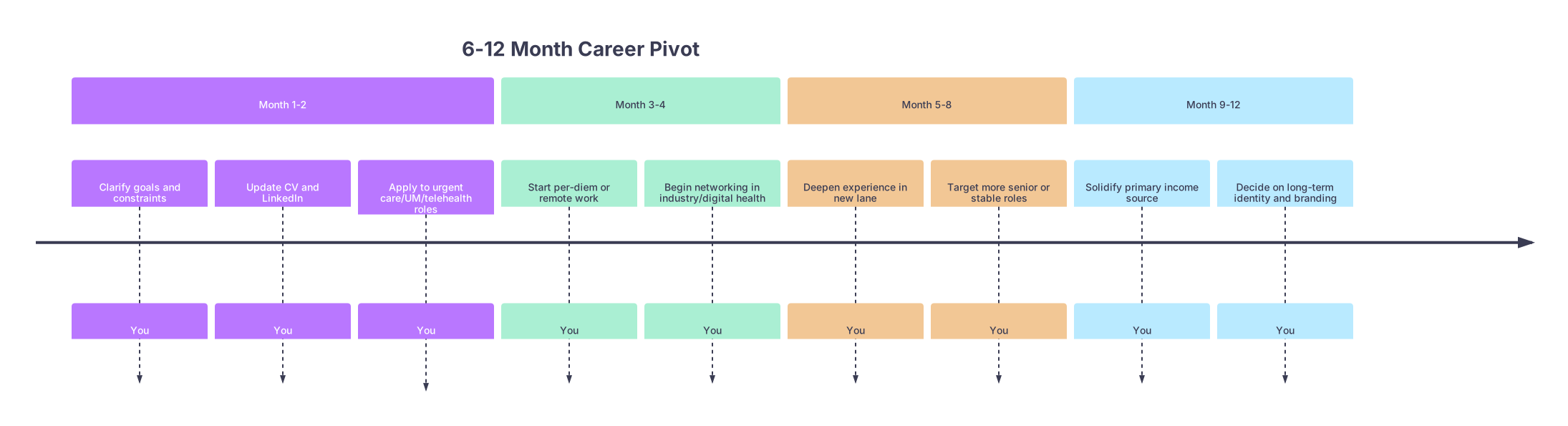
| Period | Event |
|---|---|
| Month 1-2 - Clarify goals and constraints | You |
| Month 1-2 - Update CV and LinkedIn | You |
| Month 1-2 - Apply to urgent care/UM/telehealth roles | You |
| Month 3-4 - Start per-diem or remote work | You |
| Month 3-4 - Begin networking in industry/digital health | You |
| Month 5-8 - Deepen experience in new lane | You |
| Month 5-8 - Target more senior or stable roles | You |
| Month 9-12 - Solidify primary income source | You |
| Month 9-12 - Decide on long-term identity and branding | You |
Key moves in that timeline:
- Month 1: Stop hiding from the issue. Decide if you’re done chasing boards or if you’ll try again later. It affects the story you tell.
- Month 2–4: Get some income flowing: urgent care, telehealth, chart review. Don’t wait for “perfect”; get to “decent and pays the bills.”
- Month 3–8: Layer in a pivot path: pharma, digital health, UM, education. This is where networking matters more than indeed-dot-com spam applications.
How to Explain “Board-Eligible but Not Certified” Without Sounding Defensive
You will be asked. Repeatedly. Have a clean, 2–3 sentence answer ready.
Structure it like this:
- One-line factual status
- Brief, non-dramatic context
- Clear present focus
Example 1 (failed attempts):
“I completed my [specialty] residency in 20XX and was board-eligible. I sat for the exam twice during a very challenging period personally and didn’t pass within my eligibility window. Since then I’ve focused on [urgent care/UM/telehealth/education] where my clinical background and documentation strengths are a strong fit, and that’s the direction I’m committed to now.”
Example 2 (never sat):
“I finished [specialty] training in 20XX and was board-eligible, but due to [major life event or health issue, stated briefly], I didn’t sit for boards during my eligibility window. My license is active and in good standing, and my focus now is on roles where board certification is not central, like [X, Y].”
Say it once. Calm, direct, no oversharing. Then pivot to what you bring.
What You Need to Stop Doing Immediately
I’ll be blunt here, because I’ve watched people waste years.
Stop:
- Applying blindly to classic hospitalist/attending roles that clearly require board certification and then being “shocked” by rejections.
- Hiding your status deep in the CV and hoping no one notices. They will.
- Telling yourself “I’ll just figure something out later” while your savings burn down.
Instead, accept the constraint and design with it. The system is rigid. You won’t beat credentialing committees with vibes. You can beat them by stepping sideways into spaces where those committees don’t control access.
Quick Visual: Where Board Certification Matters Less
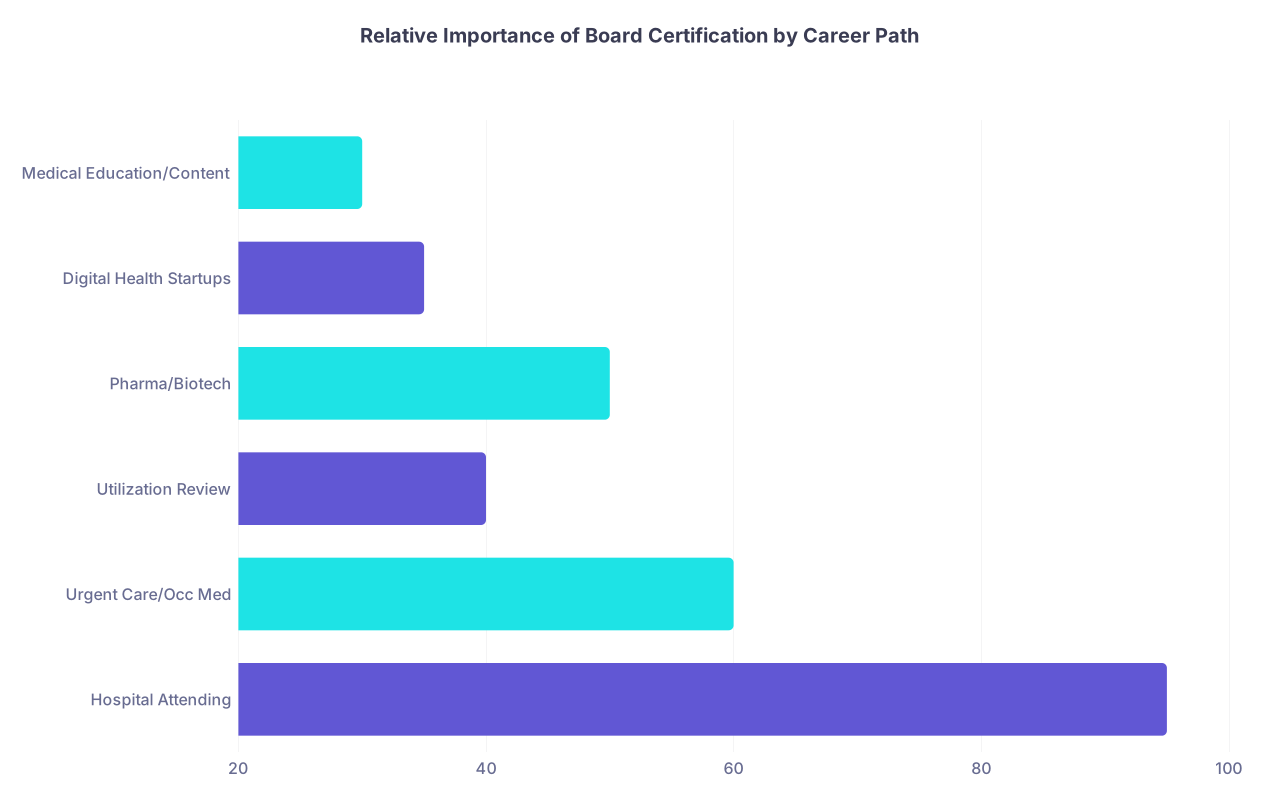
| Category | Value |
|---|---|
| Hospital Attending | 95 |
| Urgent Care/Occ Med | 60 |
| Utilization Review | 40 |
| Pharma/Biotech | 50 |
| Digital Health Startups | 35 |
| Medical Education/Content | 30 |
Action Plan: What To Do This Month
You’re reading this because you need moves, not theory. Here’s a concrete 4-week plan.
Week 1:
- Write your factual status and 2–3 sentence explanation.
- Update your CV emphasizing skills: documentation, guidelines, procedures, leadership, QI.
- Clean up LinkedIn. Put a neutral, accurate headline: “Licensed Internal Medicine Physician | Utilization Review and Telehealth Experience” instead of “Future Hospitalist.”
Week 2:
- Apply to:
- 10–15 urgent care / occ med roles that say “board-eligible” or don’t mention boards.
- 5–10 UM/physician reviewer roles.
- Reach out to 5 physicians on LinkedIn in UM, pharma, or digital health and ask for short informational chats.
Week 3:
- Start small chart review or telehealth gigs if you can get them quickly.
- Draft 1–2 sample pieces of medical writing (case explanation, short review), in case you decide to pursue education/content work.
Week 4:
- Evaluate what’s getting responses: double down there.
- Pick one pivot lane to pursue seriously (UM, pharma, digital health, education) while continuing income-generating clinical/remote work on the side.
Stop constantly refreshing board exam forums. That world is not where your next move is coming from right now.
FAQs
1. Should I keep trying to get board certified, or move on?
If your eligibility window is still open and you realistically have time, money, and mental bandwidth to study properly, it can be worth one more serious attempt—especially if you still want classic attending roles. But don’t make your entire life contingent on it. Build a parallel track: find work that doesn’t depend on certification, and prep for boards on top of a stable income, not from a place of panic.
2. Can I make a good income without board certification?
Yes, but it usually requires being flexible about how you work. Many non-boarded physicians do well with combinations of urgent care, telehealth, UM, disability review, or industry jobs. You may not walk straight into a $350k hospitalist job, but a mix of $140–220k roles plus some side work can reach surprisingly solid numbers. You trade some prestige and traditional career paths for autonomy and patchwork income at first.
3. Will not being board certified permanently stain my career?
It will permanently close some doors: many hospital staff positions, some academic roles, certain leadership posts. But “stain” is the wrong lens. Within 3–5 years in another lane (UM, pharma, digital health, education), what will matter more is your track record there. I’ve worked with people whose early non-cert status is now just a footnote in a solid industry career. You’re not doomed; you’re just off the classic track.
4. How do I handle the shame and judgment from peers and family?
Name it for what it is: shame, not fact. Your training and skill are real. A multiple-choice exam—or a missed window—doesn’t erase that. With peers, keep it short and factual: “I’m not boarded; I moved into UM/digital health/education and it’s a better fit.” With family, draw a boundary: you’re building a real career that supports your life, not chasing titles for their comfort. And surround yourself with at least a few people who care about your actual wellbeing, not just your CV line items.
Key points to remember:
- You are not unemployable; you’re just misaligned with a rigid subset of roles. There’s plenty of demand for licensed, trained physicians outside that slice.
- Pick a realistic lane where board certification is a “nice-to-have,” not a gatekeeper—then go all-in on becoming excellent and visible in that lane.
- Don’t wait for the system to bend for you. Accept the constraint, build sideways, and make your next chapter something you chose, not just the least-bad option.