
The fantasy that “you can always just do something non-clinical” is dangerously oversold to visa-dependent physicians. Most of those glossy “alternative careers for doctors” lists flat-out ignore immigration reality.
You do not have the same menu of options as a citizen. And pretending you do will waste years.
Let’s fix that.
This is for you if:
- You’re an IMG or international trainee in the US (or planning to come), on or expecting J‑1, H‑1B, O‑1, TN, or similar.
- You’re thinking about leaving clinical medicine, or you’re worried you may not match / get a waiver / keep your job.
- You want non-clinical options that are actually compatible with real-world visa constraints.
I’m going to be blunt about what works, what almost never works, and where people get trapped.
1. First reality check: Your visa comes before your “dream job”
If you’re visa-dependent, your career decisions are chained to one overriding question:
“Will this path support a work-authorizing visa and a realistic immigration strategy?”
You don’t get to ignore that and “figure it out later.” That’s how people end up back on a tourist visa packing their apartment in 30 days.
Here’s the hard hierarchy that actually runs your life right now:
- Can this job sponsor and maintain my current or next visa?
- How realistic is it that this specific employer will do that?
- Does this work get me closer to a green card or something more stable?
- Only then: Is the job interesting / aligned with my skills / decent pay?
If a non-clinical role fails #1–3, it’s not a viable primary path for you, no matter how cool it sounds.
Visa basics that shape your options
I’m not your lawyer, but I’ve watched enough people get burned to know the patterns. Roughly:
| Visa Type | Non-Clinical Options Reality |
|---|---|
| J-1 (clinical) | Extremely constrained. Waiver + clinical is the default. Non-clinical is tough unless you switch categories, go home, or change strategy. |
| H-1B (physician) | Some non-clinical roles possible if job is “specialty occupation” and employer willing. Cap-exempt vs cap-subject matters a lot. |
| O-1 | More flexibility if your extraordinary ability evidence fits non-clinical domain, but still needs serious employer and lawyer. |
| TN (Canada/Mexico) | Some non-clinical roles under categories like “Consultant,” “Scientist,” “Teacher,” etc., but must match degree and job content. |
| F-1 (student/OPT) | Best window for experimentation; OPT/CPT can support non-clinical work if job ties to your field. Transition to H-1B/O‑1 is the constraint. |
Bottom line: visa-dependent physicians have fewer non-clinical choices, and they’re mostly concentrated in certain employer types:
- Universities / academic medical centers
- Big hospital systems
- Major pharmaceutical / biotech companies
- Large consulting / tech / health-tech firms with established immigration teams
“Small startup that loves my story” is some of the worst advice you can take unless they’re already doing H‑1Bs and lawyered up.
2. Non-clinical paths that actually work with visas (and how to break in)
Let’s go through the realistic buckets. These are the ones I’ve seen work repeatedly for visa-dependent physicians.
A. Pharma / biotech medical affairs and clinical development
This is the single most viable non-clinical path for many international physicians, especially those with research or subspecialty training.
Common roles:
- Medical Science Liaison (MSL)
- Medical Director / Associate Medical Director (Medical Affairs)
- Clinical Scientist / Clinical Development Physician
- Pharmacovigilance / Drug Safety Physician
Why it can work on a visa:
- Big pharma and many mid-size biotechs already sponsor H‑1B, O‑1, and support green cards.
- Roles are clearly “specialty occupations” requiring advanced degrees.
- You can sometimes transition from a research-oriented H‑1B at a university into industry.
But there’s a catch: pharma doesn’t like pure “failed residency applicant” profiles with no differentiator. They want:
- Research experience (clinical trials, publications)
- Clear therapeutic area focus (oncology, cardiology, neuro, etc.)
- Communication skills and stakeholder management
If you’re in this situation:
- You’re on J‑1 doing fellowship with heavy research.
- You’re worried about not getting a waiver job or burning out clinically. Here’s what to do in the next 6–12 months:
- Get onto at least one clinical trial where your role is clear: sub‑investigator, protocol development input, safety review, etc.
- Learn the language of pharma: endpoints, KOLs, HEOR, phase I–IV, etc. (Read actual study protocols, not just abstracts.)
- Network with pharma people before you’re desperate: medical affairs folks from major companies at conferences; LinkedIn informational chats.
- Ask your PI if there are industry-sponsored trials with more physician interaction (investigator meetings, advisory boards).
Visa angles:
- If you’re J‑1, going straight into industry in the US as your first non-training job is very hard without going home or changing status through a different path. You usually need J‑1 waiver + H‑1B through someone first, or another strategy (like O‑1 built around your research).
- If you’re on H‑1B at a cap-exempt institution, moving to a cap-subject employer (most pharma) triggers the cap lottery unless you change into O‑1 or do a cap-exempt–to–cap-subject switch smartly. This needs an immigration lawyer involved early, not after you accept an offer.
B. Academic research and physician–scientist tracks (non-clinical heavy)
Some of the most stable visas I’ve seen for non-clinical-ish physicians are in research-heavy roles at universities or major centers.
Roles:
- Research Assistant Professor / Instructor (non-tenure track, grant-supported)
- Clinical research director / program lead
- Core lab or clinical trials unit leadership
Why it works:
- Universities are cap-exempt for H‑1B.
- Many are experienced with O‑1 and green card sponsorship under EB‑1B or EB‑2 NIW.
- Your MD plus a strong research CV fits neatly into their visa narratives.
This path is realistic if:
- You already have multiple first- or second-author publications.
- You can plausibly say you’re shifting from clinical practice to research leadership.
- You’re okay with academic salaries and grant pressure.
What to do if you’re considering this:
- Stop hiding your interest from your mentors. Tell one or two trusted faculty you’re thinking of a research-heavy path but need it to make immigration sense.
- Ask directly: “What non-clinical or minimal-clinical research roles do people here step into after fellowship/residency?”
- Collect evidence: lead a project, write a grant section, give research talks, manage coordinators.
Visa strategy specifics:
- Use your academic employer to get or maintain H‑1B/O‑1, and potentially an EB‑1B petition based on your scholarly work.
- If you want to later jump to industry, that research-heavy profile plus a stable status is valuable leverage.
C. Health systems leadership, quality, and informatics (but only in certain settings)
There’s a quiet category of physicians who migrate into:
- Quality improvement leadership
- Patient safety roles
- Clinical informatics / EHR optimization
- Medical director for utilization review / care management
Are these viable for visa holders? Sometimes.
Where I’ve seen it work:
- Large hospital systems where the physician starts as full clinical staff on H‑1B, then gradually moves into an internal non-clinical or mixed role.
- Academic medical centers where someone combines part-time clinical work with informatics or quality leadership, then sometimes reduces clinical time over years.
Where it usually doesn’t work:
- As a first non-training job directly into “Director of Quality” when you’ve done zero US independent practice.
- At small hospitals that barely know how to file a basic H‑1B.
If you’re in training now and might want this:
- Get on your hospital’s committees: quality, safety, EMR optimization, peer review.
- Volunteer for the annoying-but-visible projects: sepsis bundle compliance, readmission reduction, discharge documentation.
- Consider a part-time MPH, MHA, or informatics certificate if your program supports it. Not because letters matter magically, but because they justify your role for visas and future employers.
- Build a story: from “resident” to “I led three system-wide QI initiatives that changed policy.”
The realistic visa path:
- J‑1 → waiver clinical job (often underserved area) → internal shift over several years into more non-clinical leadership while maintaining enough clinical work to keep your visa/credentialing plausible.
- Or H‑1B through academic center → additional responsibilities → change job description slowly with lawyer input.
If you’re hoping to go straight from fellowship on J‑1 into pure “quality director, no patient care” in the US without going home or doing waiver work: that’s nearly impossible.
D. Medical communications, education, and consulting (with big-but-important warnings)
Let’s lump together:
- Medical writing / publications
- CME / education content creation
- Health economics / outcomes research (HEOR)
- Healthcare consulting (MBB, boutique health consultancies)
- Health-tech product roles where your MD is valued
These are constantly thrown around as “great non-clinical options for doctors.” For citizens? Yes, sometimes. For you on a visa? Maybe—only with the right employer.
You need to distinguish:
- Freelance / contractor grind (most med writing gigs, many education jobs, small consultancies, random startups).
- Large, stable companies with existing immigration infrastructure.
Freelancing doesn’t sponsor visas. Neither do most small agencies.
Realistic visa-compatible settings:
- Big consulting firms (McKinsey, BCG, Bain, LEK, etc.) – they sponsor H‑1B and sometimes O‑1, but they want top scores, brand-name degrees, and evidence you can do strategy work, not just “you’re an MD.”
- Major med comms agencies under large holding companies that already sponsor visas.
- Large, well-funded health-tech companies (think: big EHR vendors, established digital health companies) that treat you like a “product manager / clinical SME” in a specialty occupation slot.
If you’re desperate and on a ticking visa clock, this category is dangerous because:
- Ramp time: it can take 12–24 months to reposition yourself competitively.
- Competition: you’re up against MBAs, PhDs, and citizens who don’t need sponsorship.
- Many roles are remote/freelance/contract-only, which is useless for your status.
What to actually do if you’re interested:
- On F‑1/OPT: this is your best window. Get an internship, part-time role, or co-op with a big consulting/health-tech firm during study; transition to H‑1B from inside.
- As a resident/fellow: do part-time paid or unpaid work that builds concrete deliverables—white papers, slide decks, market analyses, EHR build projects—that you can show (at least in anonymized form).
- Focus first on employers who’ve done H‑1B or O‑1 for your target role type, not just in general.
3. Popular “non-clinical” paths that are mostly dead ends for visa holders
This is where people waste years and end up back at square one.
Coaching, entrepreneurship, and “build your own thing”
Everything in this bucket is seductive:
- Telehealth startup
- Coaching other IMGs
- Wellness / functional medicine brand
- App or platform for “doctor–patient communication”
As a side project? Great. As your primary visa anchor? Nearly impossible in the US unless:
- You already have permanent residency or a flexible visa (and even then, entity structures matter).
- You secure an O‑1 or EB‑2 NIW around your entrepreneurial work—which is rare without prior documented impact, revenue, and media.
Your own LLC, where you are the sole owner and worker, doesn’t magically give you a work visa. USCIS cares about employer–employee relationship, corporate governance, and whether the job clearly needs someone with your advanced-level skills.
Could a very well-funded startup sponsor an H‑1B or O‑1 for you? Yes. But if they’ve never done it, and you’re their first foreign hire, you are signing up to be their immigration experiment. Do that only after talking to an independent immigration lawyer, not their HR.
Pure telemedicine from abroad
Some try this route:
- Leave the US.
- Get licensed in one or more US states.
- Try to do US telehealth full-time from their home country.
Two problems:
- Visa: Once you leave and stop maintaining a US work-authorized status, you’re an offshore contractor. That might be fine short-term, but it doesn’t help you get back in legally.
- Stability: Telehealth-only positions for offshore physicians are unstable, heavily regulated, and often low-paid compared to US standards.
As a side income or temporary bridge? Maybe. As your structural US immigration strategy? No.
4. How to think in phases: 3 realistic paths
You’re not choosing “clinical vs non-clinical.” You’re managing phases of your life with immigration constraints.
Here are three patterns that actually work.
Path 1: Clinical-first, then phased non-clinical shift
Who this fits:
- J‑1 residents/fellows.
- H‑1B physicians in standard clinical roles.
Rough outline:
Phase 1 – Secure visa stability
- Finish training.
- Get J‑1 waiver or H‑1B job at a place that can eventually tolerate some non-clinical FTE (large system, academic center).
- Prioritize employers with proven immigration history.
Phase 2 – Add non-clinical responsibilities internally
- QI projects, informatics, committee leadership, research program building, liaison roles with industry.
- Use job title modifications and responsibilities to open doors: “Medical Director of X,” “Clinical Informatics Lead,” etc.
Phase 3 – Transition to majority non-clinical
- Either internally (e.g., 0.2 clinical / 0.8 informatics).
- Or jump to industry/consulting once you have US experience, references, and maybe an O‑1 built on your impact.
This is not glamorous. But it’s reliable. And it keeps you in status while you reposition.
Path 2: Academic/research anchor, then industry
Who this fits:
- Subspecialty IMGs with strong research.
- Anyone who likes the idea of being a physician–scientist more than day-to-day clinical grind.
Outline:
- Stay in or move into a research faculty or staff-scientist type role at an academic center.
- Use that time to:
- Publish.
- Present at conferences.
- Build collaborations with industry sponsors.
- Get H‑1B cap-exempt and possibly EB‑1B or EB‑2 NIW started.
- Once secure, leverage your profile to jump into clinical development, pharma safety, or medical affairs.
Many of the pharma MDs I’ve seen on visas came this way. Not from “I cold-applied to 500 MSL jobs as a PGY‑3.”
Path 3: Non-US regional strategy + re-entry later
This is the option almost no one talks about, but for some it’s the most rational.
If the US immigration puzzle looks impossible at your current step, it can actually be smarter to:
- Move to a country with more favorable physician immigration (Canada, UK, Australia, some EU spots).
- Build:
- Full registration and local experience.
- Non-clinical experience in that system (NHS leadership, NICE/HTA work, Canadian health authority roles, etc.).
- Then pursue:
- US O‑1 based on international impact.
- US industry role recruitment (pharma loves global experience).
- Or simply a life that doesn’t revolve around US immigration at all.
I’ve seen UK-trained specialists with leadership roles walk into US industry jobs with O‑1 much more smoothly than US-trained J‑1 fellows who never got a waiver.
5. Tactical steps if you’re in specific tough situations
Let’s go scenario-by-scenario.
Scenario A: You’re finishing residency on J‑1 and didn’t match fellowship / can’t find a waiver job
Do not:
- Panic-apply to random non-clinical jobs hoping someone will “figure out your visa.”
- Let your DS‑2019 expire while you “explore options” in the US.
Do this, in order:
- Talk to a competent immigration lawyer. Not the cheapest online. Someone who regularly works with physicians and J‑1 waivers.
- Clarify your realistic options:
- Late-cycle waiver positions in underserved areas.
- Return home + US telehealth part-time while planning a re-entry via another visa.
- Direct O‑1 if your CV is strong enough (publications, awards, impact).
- Parallel track:
- Start networking with pharma/industry folks, but be transparent about your timing and status.
- Ask explicitly: “Does your company ever sponsor O‑1/H‑1B for physicians transitioning from J‑1 clinical roles?”
Your goal is to avoid lapsing into “out of status” while chasing a fantasy non-clinical job that was never going to sponsor you.
Scenario B: You’re on H‑1B at an academic center and burned out clinically
You actually have leverage if:
- You’re cap-exempt.
- You’ve been there a while.
- You have academic output.
Options:
- Explore internal roles:
- Ask leadership: “Are there upcoming roles in quality, informatics, or research leadership where my time could be 0.5–0.7 FTE non-clinical?”
- Talk to your institution’s immigration office before changing your job description:
- Any material change in duties or worksite must be reflected in your H‑1B.
- Start external networking with industry, but:
- Clarify the cap issue: if you leave a cap-exempt H‑1B to a cap-subject employer, you may need to win the lottery unless you move to O‑1 or another strategy.
Set a 12–24 month plan, not a 2-month escape fantasy.
Scenario C: You’re still abroad, not in the US yet, and thinking “I’ll just do non-clinical there”
You have the most flexibility and the highest risk of self-deception.
If your primary aim is working non-clinically in the US, then:
- Applying only for pure clinical J‑1 pathways and hoping to “pivot later” is a weak plan.
- You might be better off targeting:
- Research-heavy fellowships with strong industry ties.
- PhD or research degrees in fields like epidemiology, biostatistics, informatics, or health economics, once you understand how they tie to visas.
Before you commit:
- Map one or two plausible visa pathways from where you’d start to where you want to end (job-wise).
- Consider whether a different country for residency might better align with your long-term non-clinical goals.
6. How to judge whether a specific non-clinical job is “visa-safe”
When you see a posting or get interest from a company, run it through this filter:
- Has this employer sponsored H‑1B or O‑1 for similar roles before?
- Is the job clearly a “specialty occupation” tied to your MD/training (not something any bachelor’s-level nurse or admin could do)?
- Is there a credible path from this job to a longer-term status (like green card)?
- Do they have in-house immigration counsel or a reputable outside firm?
If the answer to #1 is “no idea” and they say “we’ve never sponsored before, but we’re sure we can figure it out,” treat that as a last-resort, not a primary plan.
And always, always keep your own lawyer in the loop. Company lawyers work for the company, not for you.
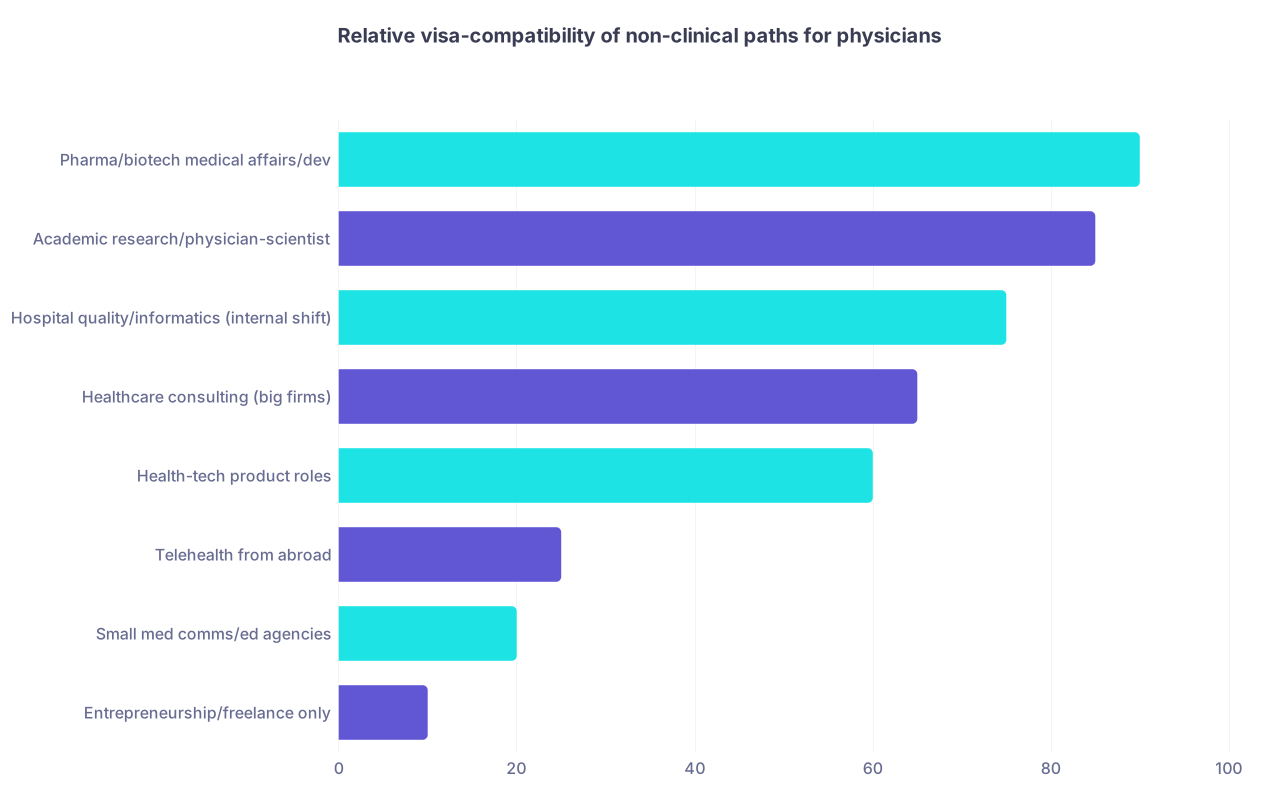
| Category | Value |
|---|---|
| Entrepreneurship/freelance only | 10 |
| Small med comms/ed agencies | 20 |
| Telehealth from abroad | 25 |
| Health-tech product roles | 60 |
| Healthcare consulting (big firms) | 65 |
| Hospital quality/informatics (internal shift) | 75 |
| Academic research/physician-scientist | 85 |
| Pharma/biotech medical affairs/dev | 90 |

| Step | Description |
|---|---|
| Step 1 | Training on J1 or H1B |
| Step 2 | Take clinical job with strong visa history |
| Step 3 | Consider research heavy or dual role |
| Step 4 | Build non clinical skills internally |
| Step 5 | Develop industry academic network |
| Step 6 | Target full non clinical roles |
| Step 7 | Maintain mixed role while strengthening profile |
| Step 8 | Need immediate stability? |
| Step 9 | Secure stable status or green card? |
7. Concrete moves you should make in the next 3–6 months
Regardless of your exact visa, there are a few high-yield steps almost everyone in your position should take.
Get a real immigration consult
One paid hour with a physician-focused immigration lawyer can save you years of wrong career moves. Go in with:- Your full CV.
- Current status details.
- Three target scenarios you’re considering.
Start documenting non-clinical impact now
Wherever you are:- Lead one measurable project (quality, research, informatics).
- Present it locally or nationally.
- Save every slide, email of praise, and result metric.
Build a small, focused network in one target domain
Do not “network with everyone.” Pick:- Pharma / med affairs, or
- Health systems leadership, or
- Consulting / health-tech and then:
- Talk to 5–10 people actually doing those jobs, preferably on visas or former IMGs themselves.
- Ask explicitly: “If you were in my visa situation, what would you do differently earlier?”
Clean up your story
Employers and USCIS both react badly to chaos. You want a narrative like:- “Clinically trained in X, developed deep expertise in Y, led projects in Z, now focusing on applying that to [research / industry / systems].” Not: “I tried this, then that, then burned out, and just want to leave clinical medicine.”
Key takeaways
- As a visa-dependent physician, your non-clinical options are constrained but real—pharma, academic research, and internal system roles are the most structurally reliable.
- Any plan that ignores visa mechanics (J‑1 waivers, H‑1B cap, employer history, O‑1 evidence) is not a plan; it is wishful thinking that often ends with you out of status.
- The smartest moves happen 12–36 months before you want to leave clinical work: build non-clinical impact, use stable employers to anchor your visa, and only then step into fully non-clinical roles.