
Alternative careers do not automatically kill your chances of returning to clinic — but how you leave and how you come back absolutely can.
Let me be blunt: programs are not allergic to nontraditional paths. They’re allergic to risk. If your time away from clinical medicine looks impulsive, unfocused, or like you’re running from responsibility, it will hurt you. If it looks intentional, productive, and clearly connected to your future clinical value, it can actually help you.
This is true whether you’re a med student eyeing industry, a resident thinking of taking a non-clinical job, or an attending considering a pivot.
Here’s the answer you’re actually looking for: you can go do something else and come back. But you have to protect your clinical currency while you’re away and build a story that programs, credentialing committees, and employers can trust.
1. The Real Question Programs Are Asking
They’re not really asking “Did you work in pharma / tech / consulting / start-ups?”
They’re asking:
- Are you safe to put in front of patients?
- Are you going to stick around this time?
- Has your clinical skill and knowledge decayed beyond what they can reasonably fix?
- Does your alternative experience bring something useful, or just baggage?
That’s it. If you can make them comfortable on those four points, your “detour” stops being a problem and starts being an asset.
Think of it the way a PD or CMO thinks when your file lands on their desk:
- “How long have they been away from active clinical work?”
- “What were they actually doing?” (Not just the job title. Daily work.)
- “Any red flags — professionalism issues, burnout, lawsuits, sudden resignations?”
- “What’s their current license/certification status?”
- “Why now? Why back?”
If your record answers those cleanly, you’re in good shape. If not, you’ve got work to do before you apply back.
2. Time Away: When Does It Start to Hurt?
Time away from clinic is not binary. It’s graded risk. Here’s the rough reality most PDs and credentialing committees use, whether they say it out loud or not.
| Time Away | Typical Reaction | What You Need To Show |
|---|---|---|
| < 1 year | Mild concern | Clear reason, light re-entry plan |
| 1–3 years | Moderate concern | Structured refresh, updated CME, strong explanation |
| 3–5 years | High concern | Formal re-entry program, supervision plan |
| > 5 years | Very high concern | Possible retraining, board/skill reassessment |
Is this rigid? No. But if you’ve been out for 4–5 years or more, expect serious questions and sometimes formal remediation.
And no, “I was working in a related field” is not enough by itself. If you haven’t actually been taking care of patients, everyone assumes skill decay unless proven otherwise.
3. Which Alternative Careers Raise Eyebrows (and Which Help)?
Some paths translate intuitively. Others are harder to justify unless you’re careful.
Generally viewed as neutral-to-positive (if explained well)
- Clinical research (industry or academic)
- Pharma / biotech (especially medical affairs, safety, clinical development)
- Health tech / digital health with clinical input roles
- Public health and policy (CDC, WHO, health departments, NGOs)
- Quality improvement, patient safety, clinical informatics
- Medical education, simulation, curriculum design
These are easy to defend: “I learned X that makes me better at caring for patients in Y way.”
Viewed as higher risk or confusing (unless you’re strategic)
- General management consulting with no health focus
- Non-clinical corporate roles far from medicine
- Full-time entrepreneurship totally outside healthcare
- Long-term locums with big gaps, frequent jumps, or non-renewals
- Non-medical jobs with no obvious transferable skills (sales, retail, etc.)
Do these kill your chances? No. But you need a tighter narrative and a stronger re-entry plan to reassure people you’re not just drifting.
4. The Four Things You Must Protect If You Want the Option to Return
If you’re even 20% sure you might want to go back to clinic someday, treat these as non-negotiable.
1. Licensing and Board Status
Do not let your license and board certification quietly die while you “figure things out.”
- Keep at least one active, unrestricted license if financially possible.
- Maintain board certification if there’s any realistic scenario where you’d return to that specialty.
- Track your CME and keep it organized. Not just random credits — pick clinically meaningful topics.
Letting things lapse says: “I didn’t take my long-term clinical future seriously.”
2. Clinical Currency
You need some thread of clinical continuity, especially if you’re out >1–2 years.
Options:
- Very part-time clinical work (per diem urgent care, telemedicine, weekend shifts)
- Volunteer clinics with meaningful responsibility (not just “I showed up twice”)
- Short locums stints to keep hands-on skills alive
If you truly can’t maintain any clinical work (visa issues, personal health, family obligations), then bulk up on clinical CME, simulation courses, and maybe short refresh rotations later.
3. Professional Reputation
Alternative careers can go sideways. Layoffs. Toxic teams. Failed startups.
Here’s the harsh part: if your story looks like a string of messy exits, you’re radioactive.
Be deliberate:
- Leave on decent terms whenever humanly possible.
- Keep at least one supervisor from each role who would unambiguously recommend you.
- Avoid public drama online. Yes, PDs and HR google you.
4. A Coherent Story
You need a narrative that passes the “30-second BS test”:
- Why you left.
- What you did.
- What you learned.
- Why you’re coming back now.
- How this makes you a better clinician.
If you can’t say that clearly in one minute, work on it before you apply.
5. How Different Groups Are Judged When They Come Back
The bar is not the same for everyone. Here’s how it usually plays out.
Medical students who step away
Example: you take 1–2 years for consulting, policy work, tech, or an MBA before residency.
This rarely hurts you if:
- You stay connected: some research, shadowing, or limited clinical work.
- You crush Step 2 / shelf exams when you come back.
- Your letters say you were strong clinically before and after the break.
Where it looks bad: you stepped away because you were failing, burned out, or marginal clinically and nothing in your file shows real improvement.
Residents who leave training
This is the trickiest group.
If you:
- Left in good standing, with program support.
- Have clear documentation (letters) that you were competent and professional.
- Can clearly explain whether you want to return to the same specialty or switch.
Then you’re still viable. But programs will dig hard into: “Are they going to quit again?”
If you left under a cloud (performance issues, professionalism, non-renewal), the problem isn’t the alternative career. It’s your record. You may need a true re-entry or remediation program, not just a new job.
Attendings who go non-clinical
Mid-career or late-career physicians often leave for:
- Medical director roles
- Pharma / device
- Administration
- Health tech
Returning after 1–3 years is common and usually feasible with a thoughtful plan. Returning after 7–10 years of zero clinical practice is much harder and may require:
- Formal re-entry programs
- Supervised practice periods
- Additional assessments
6. Turning an “Alternative Career” into a Selling Point
If you play it right, your detour can be your edge. But you have to connect the dots for people.
Here’s the move:
- Translate your experience into clinical language.
- Show impact, not fluff.
- Tie it directly to the job you want.
Example: Former pharma MSL returning to heme/onc clinic:
- “I’ve spent 3 years working with investigators across 40+ sites, troubleshooting real-world implementation of complex regimens.”
- “I’ve become very good at explaining high-stakes treatment decisions at different literacy levels — from IRBs to community oncologists to patients.”
- “That experience makes me dramatically better at aligning evidence, logistics, and patient preferences in the clinic.”
Example: Someone coming back from tech / digital health:
- “I’ve led design of patient-facing tools and learned very tangibly where communication breaks down.”
- “I understand workflows across different EMRs and systems, which lets me engage more realistically in QI and efficiency projects here.”
If your explanation sounds like generic “leadership, communication, teamwork,” you’re wasting it. Get concrete.
7. Fixing Damage If You’ve Already Been Away Too Long
If you’re reading this 6–10 years out and worried you’ve blown it, you might not have. But you’re not walking straight back into full-scope unsupervised practice either.
Here’s what serious re-entry often looks like:
- Honest skills and knowledge self-assessment (and probably an external assessment).
- High-yield CME and maybe a structured “mini-curriculum” before you touch patients.
- A re-entry program or supervised short-term role with clear goals.
- Limits on scope at first (simpler cases, no high-risk solo practice initially).
- A frank conversation with your malpractice carrier.
Is that annoying? Yes. Is it unreasonable? Not really. Nobody wants a rusty surgeon or hospitalist who hasn’t written an admission note since before ICD-10.
8. Tactical Steps Before You Leave (If You Want the Option to Return)
If you’re still planning your exit, do this now and you’ll thank yourself later:
- Get strong, explicit letters about your current clinical competence before you step away.
- Clarify with mentorship: “If I leave for 2 years, how do I look if I come back?”
- Set a time horizon. Tell yourself: “If I’m gone >X years, I’ll expect to need a formal refresh.”
- Map your CME and licensing plan for the next 3–5 years on paper.
- Keep a simple log of clinical exposure if you’re doing anything patient-related: dates, settings, responsibilities.
A lot of people drift into trouble because they thought the break would be “just a year” and wake up five years later with no license and no recent references.
9. How Programs and Employers Quietly Evaluate You
Let’s decode what happens behind closed doors.
Behind the scenes conversation for a returning candidate often sounds like:
“Okay, they were out 3 years in tech. Boards are still active. They did occasional telemed. Their letters are rock solid. They’re saying they missed patient care and their story checks out. Risk is manageable.”
Versus:
“They left residency after a conflict, bounced between three non-clinical jobs, no active license for 4 years, and we’re having trouble getting a straight story about why they left and why now. Hard pass.”
Same length of “alternative career.” Very different picture.
To stack the deck in your favor:
- Make it easy to verify your story.
- Offer references upfront who can speak to both your clinical and non-clinical work.
- Show insight: acknowledge skill rust and propose a mature re-entry plan instead of pretending you’re just “plug and play.”
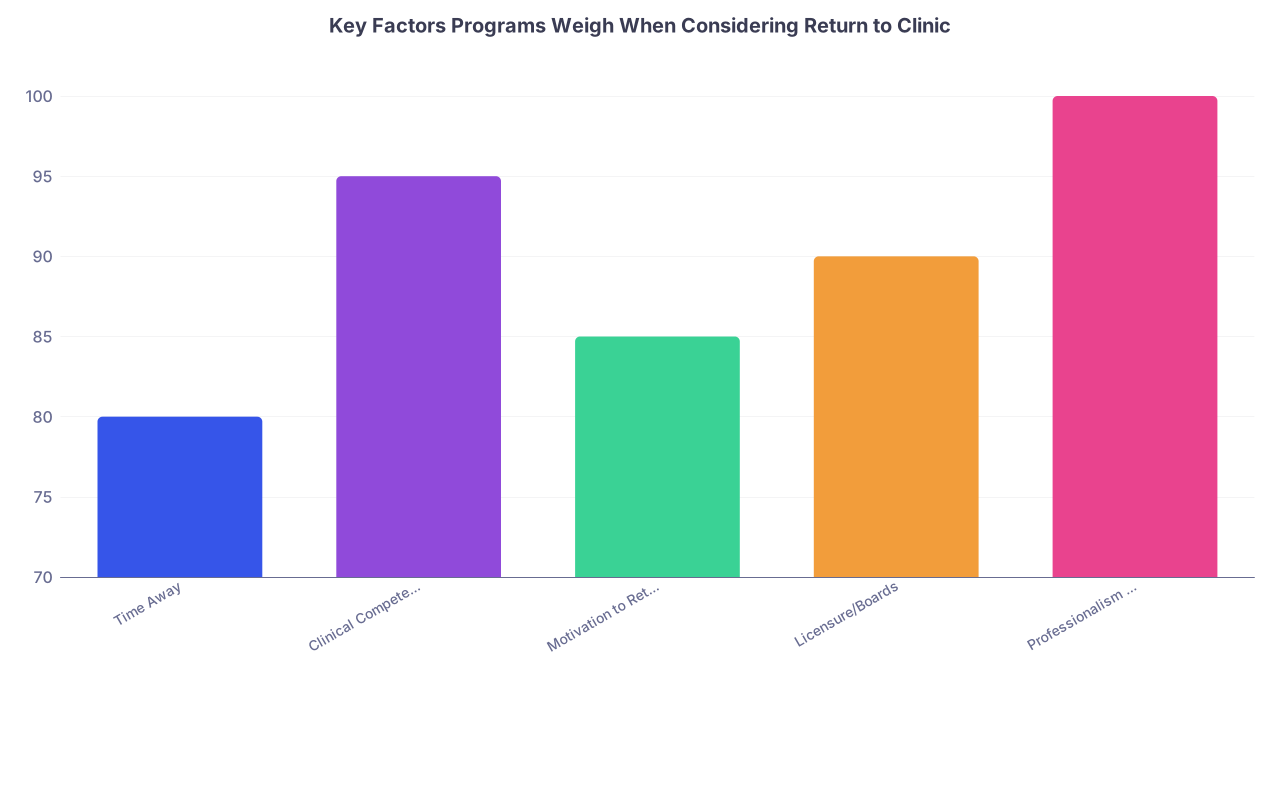
| Category | Value |
|---|---|
| Time Away | 80 |
| Clinical Competence | 95 |
| Motivation to Return | 85 |
| Licensure/Boards | 90 |
| Professionalism Record | 100 |
10. Bottom Line: Does an Alternative Career Hurt Your Chances?
Here’s the honest verdict.
Alternative careers hurt you when:
- They’re clearly an escape from failure or burnout with no growth or resolution.
- You let your clinical credentials rot with no plan.
- You collect vague, unfocused roles that make you look unreliable.
- You come back entitled, insisting you’re “the same” clinician you were 8 years ago.
Alternative careers help you when:
- You leave from a position of clinical strength, not crisis.
- You maintain clinical currency and keep your licensing house in order.
- You gain specific skills that you can articulate and apply back to patient care.
- You return with humility, insight, and a realistic plan to ramp back up.
So no, the fact that you went into pharma, consulting, tech, education, or policy does not automatically hurt your chances if you decide to return to clinic. What matters is how you managed your exit, your time away, and your re-entry.
If you treat your clinical career like an option you might want to exercise later — and you protect its value while you’re gone — you’ll still have doors open when you’re ready to walk back through them.

FAQ (Exactly 6 Questions)
1. I left residency before finishing. Can I still return to clinical training?
Yes, but you’ll be scrutinized more. Programs will want: (a) clear documentation of why you left, (b) letters confirming you were safe and professional, and (c) a convincing explanation of what’s changed. If you’ve been away >2–3 years, expect to need a structured re-entry plan and potentially to re-apply through the match or formal pathways rather than informally sliding into a PGY spot.
2. How long can I be away from clinical work before it seriously damages my chances?
Once you cross 1–3 years fully away from patient care, the questions start getting louder. Past 3–5 years, many hospitals and programs will want formal re-entry, supervised practice, or extra training. Past 5+ years, assume it’s possible but significantly harder, especially in procedural specialties. Maintaining part-time or occasional clinical work during your alternative career dramatically improves your odds.
3. Does working in pharma or industry make residency programs or hospitals suspicious?
No, not inherently. Pharma and industry roles are common now. What matters is whether you left clinical work in good standing and whether your industry experience clearly adds something. If you look like you chased money and are now bored, that’s less compelling. If you can show you understand evidence, safety, systems, and communication at a deep level, you’ll often be viewed as an asset.
4. I let my license lapse. Is that a deal-breaker?
It’s not ideal, but it’s not always fatal. You’ll need to reactivate or reapply for licensure, which may require CME, exams, or proof of recent training. Some states and boards are friendlier than others. What is a major problem is a lapsed license plus many years of no clinical work and no plan. Fix the license situation early and get legal or professional guidance if needed.
5. How can I show I’m still clinically competent if I haven’t touched patients in a while?
Layer your evidence: recent clinically focused CME, simulation or skills courses, short supervised refresh rotations, strong prior evaluations, and a clear re-entry plan. Do not pretend you’re “fully current” if you’re not — that spooks people. Instead: acknowledge rust, show concrete steps you’ve already taken, and outline how you’ll safely ramp up under supervision.
6. Should I mention my alternative career on applications, or will it raise unnecessary questions?
You should absolutely mention it — trying to hide 2–5 years of your life is much worse. The key is how you frame it. Lead with: why you chose it, what you actually accomplished, and how it makes you a better clinician now. Address the elephant in the room (why you’re returning) briefly but directly. If your explanation sounds like a coherent professional arc and not damage control, most reasonable reviewers will accept it.
Key points:
- Alternative careers are not the problem; unmanaged clinical decay and a messy story are.
- Protect your license, your reputation, and some thread of clinical contact if you want the option to return.
- Come back with a clear narrative and a realistic re-entry plan, and your “detour” can become your differentiator instead of your liability.