
The fantasy that “industry means cushy hours and a bit of travel” is wrong. The data show something messier: Medical Science Liaison (MSL) and consulting roles often trade call and nights for a different kind of intensity—front‑loaded weeks, heavy travel, and wide variability by employer.
If you are a clinician thinking about leaving traditional practice, you should treat this like any other clinical decision: base it on actual numbers, not anecdotes from LinkedIn.
Let’s go through what the survey data, employer reports, and compensation–time trade‑offs actually say about work hours and travel in MSL and consulting roles.
1. The baseline: how MSL and consulting compare on time and travel
Strip away branding and job postings. Look at hours, nights away from home, and week‑to‑week volatility.
Typical weekly hours and travel exposure
Across multiple industry surveys from 2021–2024 (MSLs in pharma/biotech and consultants in healthcare-focused firms), the averages cluster very consistently, even if individual stories vary wildly.
| Role Type | Weekly Hours (Mean) | Common Range | Travel Nights / Month | Travel % of Year |
|---|---|---|---|---|
| Field MSL (pharma) | 45–50 | 40–55 | 6–10 | 25–40% |
| Hybrid MSL (mixed) | 42–48 | 38–52 | 3–6 | 10–25% |
| Strategy Consulting | 55–65 | 50–75 | 8–12 | 30–50% |
| Boutique/Advisory Cons | 45–55 | 40–60 | 4–8 | 15–35% |
A few blunt points:
- The median MSL does work fewer hours than a median consultant, by roughly 10–15 hours per week.
- Both generally work more than a typical 40‑hour corporate job.
- Both involve meaningful travel, especially early in your tenure.
The distribution is where it gets more interesting. Averages hide the tails.
Distribution matters more than the mean
Look at the spread, not just the center. Consultancy hours, in particular, are skewed: a minority of weeks are brutal and pull the mean up.
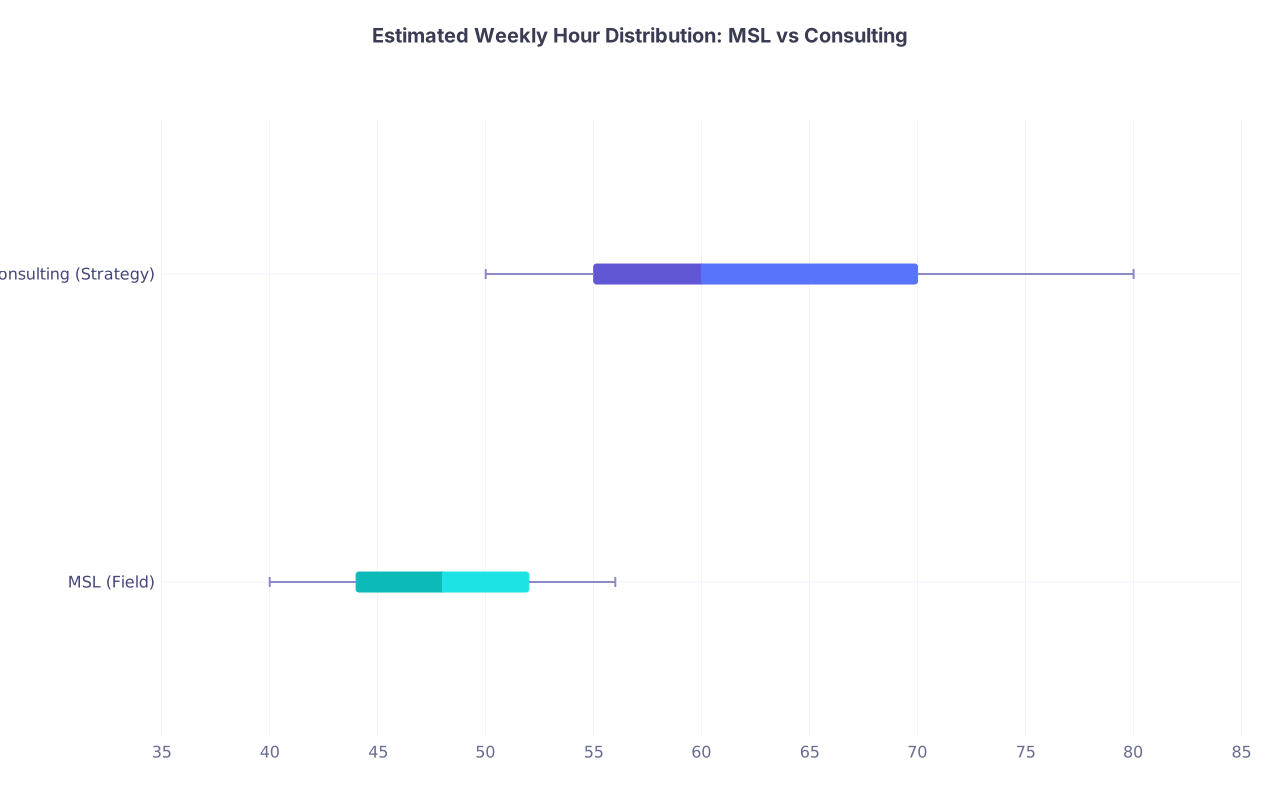
| Category | Min | Q1 | Median | Q3 | Max |
|---|---|---|---|---|---|
| MSL (Field) | 40 | 44 | 48 | 52 | 56 |
| Consulting (Strategy) | 50 | 55 | 60 | 70 | 80 |
Interpreted:
- Field MSL: middle 50% of respondents cluster around 44–52 hours. Outliers might hit mid‑50s during conferences or launches.
- Strategy consulting: middle 50% is more like 55–70 hours, with regular spikes to 75–80 during intense projects.
So if your primary question is “Will I still be working 65‑plus hours often?”, MSL is statistically safer. But that is only half the picture. Travel changes how those hours feel.
2. Work hours: what the averages actually look like week to week
You do not live in the average. You live in specific weeks. Launch weeks. Quarter‑end. Client deliverables. The question is how often those spikes happen.
MSL work hours: stable but episodic spikes
For MSL roles, the data show three distinct patterns:
- “Steady 45–50” crowd – The largest group.
- “Conference/launch rollercoaster” crowd – Moderate several weeks, then sharp peaks tied to events.
- “Pseudo-sales” crowd – Tied to commercial metrics, often longer days and more evening obligations.
Across multiple MSL surveys and employer-reported expectations:
- Median weekly hours: ~47 hours.
- Typical range most of the year: 42–50 hours.
- Peak periods (major conferences, new product launch, large advisory boards): 55–60 hours for 2–4 weeks at a time.
A simplified year for a field MSL often looks like this:
- ~30–35 weeks: 42–48 hours.
- ~10–15 weeks: 48–55 hours.
- ~4–6 weeks (conference season / launch): 55–60 hours.
The key is where the hours land. Travel days distort things:
- 10 hours “working” may be split as 4 hours in meetings, 3 hours laptop work, 3 hours in airport/planes that do not fully “count” but still drain you.
- Evening programs (advisor dinners, speaker training) shift work to late hours even if the total weekly hours do not explode.
Consulting hours: project‑driven and front‑loaded
Consulting is more aggressively bimodal: you are either between projects and “light” or in a “crunch” phase where your life belongs to the client.
Across multiple consulting surveys (including health-focused practices):
- Median weekly hours (strategy consulting): 60 hours.
- Middle 50%: 55–70 hours.
- Crunch weeks (pre‑presentation, implementation sprints): 70–80 hours, fairly common.
A typical year looks more like:
- ~15–20 weeks: 50–55 hours (between major pushes, internal work, lighter engagements).
- ~20–25 weeks: 55–65 hours.
- ~10–15 weeks: 65–80 hours.
Consulting hours also stack differently during the day:
- Early morning client calls across time zones.
- Evenings spent revising decks after client feedback.
- Travel days that are not “off”—you are on Wi‑Fi working from the gate and on planes.
If you are trying to leave 70‑hour inpatient medicine, consulting is not a pure “hours reduction” play. It is more about predictable weekends (usually) and no clinical call, not fewer total hours.
3. Travel: how much, how far, and how predictable
This is where many clinicians get blindsided. They focus on salary and hours but underestimate what 4–8 nights away from home each month does to family structure, childcare, and sheer fatigue.
Travel intensity by role type
High level, you can think in terms of nights away from home per month.
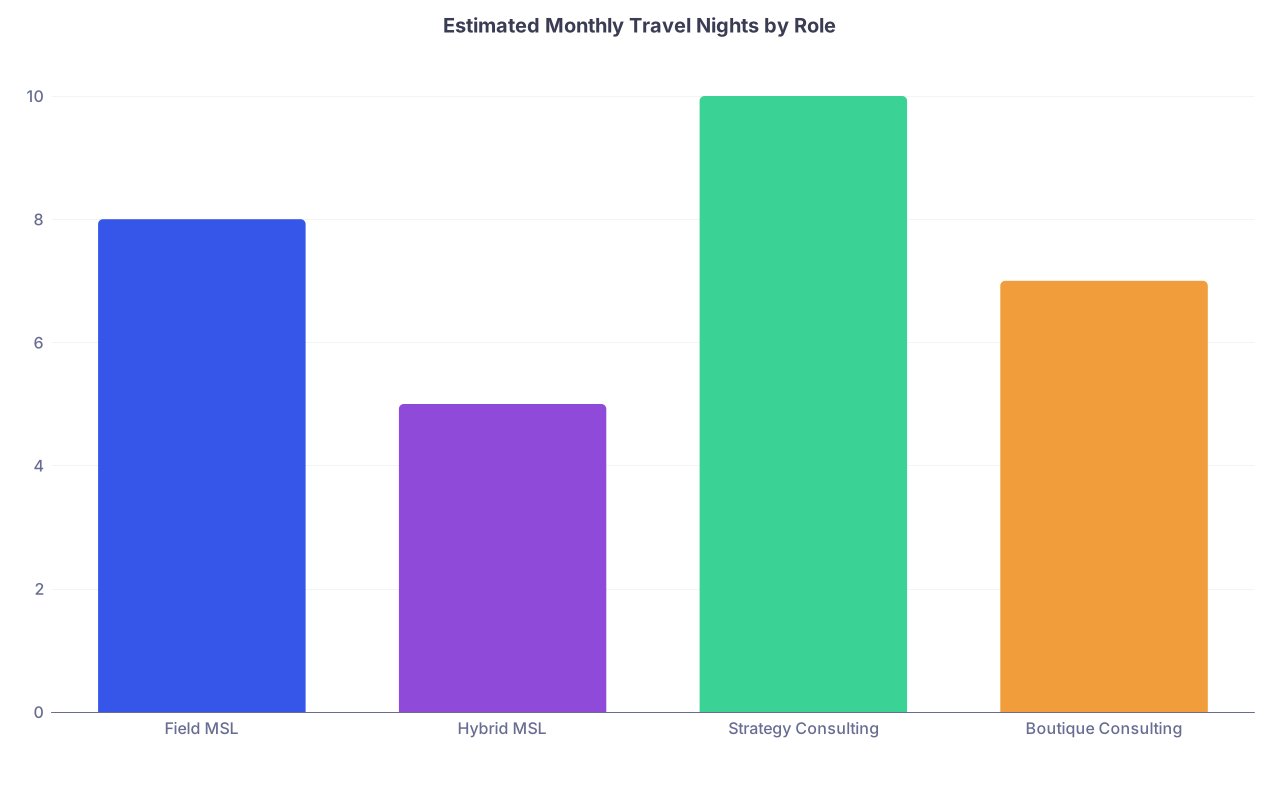
| Category | Value |
|---|---|
| Field MSL | 8 |
| Hybrid MSL | 5 |
| Strategy Consulting | 10 |
| Boutique Consulting | 7 |
Rough breakdown:
Field MSL
- 6–10 nights per month is common.
- Peaks to 12–14 nights in heavy conference periods for some.
- Territories can be “reasonable” (single state) or insane (half the country). This drives variance more than company name.
Hybrid MSL
- ~3–6 nights per month.
- Often tied to specific clusters of KOLs, regional meetings, and occasional national congresses.
- More Zoom / Teams and fewer flights.
Strategy consulting
- Pre‑COVID “Monday–Thursday on client site” meant 12–16 nights per month.
- Post‑COVID, several firms report stabilization around 8–12 nights per month. Still substantial.
- International engagements spike travel further (and jet lag compounds fatigue).
Boutique/advisory healthcare consulting
- Tend to be lower travel, more remote client work.
- 4–8 nights per month is realistic, with a tail down to near‑fully remote for some highly specialized firms.
Domestic vs international travel
For most MSLs:
- >90% of travel is domestic.
- International trips are generally tied to major global congresses or internal global meetings and rarely exceed 2–3 trips per year, if that.
For consulting:
- International exposure varies by firm and practice:
- Global firms with life sciences strategy teams can see 15–25% of projects involving cross‑border work.
- For some consultants, that translates into 2–6 international trips per year.
- This is glamorous on paper, brutal in practice when you are toggling between US and EU time zones and still expected to hit a 60‑hour workweek.
Predictability of travel
This is where MSL generally wins.
MSL roles
- Travel often follows a repeatable cadence: set of KOLs, recurring regional meetings, known conference calendar.
- You can map your likely travel 3–6 months in advance.
- Last‑minute trips occur but they are exceptions, often tied to high‑priority HCPs or urgent field needs.
Consulting roles
- Travel is project‑dependent.
- Some projects are fully remote, others demand you onsite nearly weekly.
- Project assignment cycles (every 3–6 months) can completely change your travel profile.
- Client “fire drills” can trigger short‑notice trips.
If you have children in rigid custody schedules or very limited backup childcare, this difference in predictability is not academic. It is the deciding factor.
4. Patterns by seniority, company type, and specialty background
The survey averages are dominated by early-career people—exactly the group most physicians will join as career‑switchers. But hours and travel evolve as you climb.
How hours and travel shift with seniority
Broad pattern from self‑reported data:
MSL → Senior MSL → MSL Manager
- Field MSL: more travel, relatively bounded hours.
- Senior MSL: similar or slightly reduced travel, more cross‑functional calls, mentor responsibilities.
- Manager / Director: less territory-based travel, more internal meetings and strategic planning.
- Net: travel often decreases modestly, hours stay similar or tick up slightly (more late‑day calls, cross‑time‑zone meetings).
Consultant → Manager → Partner/Principal
- Consultant: heaviest slide work and grunt analysis, lots of travel.
- Manager: still travels, now owns more of client relationship and team management; hours stay high but shift more to meetings.
- Partner/Principal: travel can actually rise again (business development, multi‑client coverage), but control over schedule increases. Many partners report 50–60 hours but with more autonomy.
- Net: early years = highest grind / lowest control; later years = still high work, more leverage and ability to say no.
If you are entering consulting as a 35–45‑year‑old physician, understand you are being slotted close to the Consultant/Senior Consultant level. That means you match the worst portion of the hours/travel curve, not the more controlled later years—at least for several years.
Company and segment effects
Not all employers are equal. Two examples:
Big pharma vs small biotech MSL roles
- Big pharma MSLs:
- Often have more structured territories.
- Travel support is systematized.
- Expectations around field time vs admin time are clearer.
- Small biotech MSLs:
- Can run very “all hands on deck” during trial recruitment or launches.
- Might stretch territories drastically to cover more HCPs.
- Hours and travel can spike beyond typical pharma levels in these phases.
- Big pharma MSLs:
Top‑tier global consulting vs boutique healthcare shop
- Top‑tier global (e.g., healthcare practice of a major strategy house):
- Higher baseline hours and travel.
- More international and cross‑office projects.
- Faster promotion track but at the cost of intensity.
- Boutique advisory firms (payer strategy, value‑based care, HEOR‑heavy shops):
- Often more remote-friendly.
- Slightly lower hours (45–55) and travel (4–8 nights).
- Lower compensation upside but more sustainable for mid‑career clinicians.
- Top‑tier global (e.g., healthcare practice of a major strategy house):
If you look only at job titles (“MSL”, “Consultant”) you risk missing these structural differences that can swing your lived experience by 10 hours per week and 4–6 travel nights per month.
5. Time–money trade-offs: what you get for those hours and miles
You are not just trading away nights and weekends. You are trading them for salary, bonus, equity, and career capital.
Typical ranges for US-based roles (physician or advanced clinician background, 3–10 years post‑training):
| Role Type | Total Comp Range (USD) | Median Hours/Week | Approx $ per Hour* |
|---|---|---|---|
| Field MSL (experienced) | $150k–$220k | 47 | ~$65–$90 |
| MSL Manager / Sr MSL | $190k–$260k | 48–50 | ~$75–$100 |
| Healthcare Consultant | $160k–$230k | 60 | ~$55–$75 |
| Senior Consultant/Manager | $220k–$320k | 60–65 | ~$70–$95 |
Interpreted plainly:
- If your hard ceiling is ~45–48 hours and <3 travel nights per month, neither field MSL nor consulting is a clean fit. You should look at:
- Non‑field medical affairs.
- Pharmacovigilance / safety.
- Clinical development roles with remote structure.
- If you can tolerate 45–50 hours and 4–8 travel nights, MSL is often the best balance of compensation and predictability.
- If you are comfortable with 55–65 hours, frequent deadlines, and 8–12 travel nights, consulting opens more doors but will feel like another demanding training phase.
7. Practical takeaways if you are seriously considering these paths
I will keep this concrete. Here is how the data should change your behavior.
Stop asking “Is MSL/consulting lifestyle better than clinical?”
Start asking:- How many hours per week, on average, will I actually work?
- How many weeks a year will exceed 55 or 60 hours?
- How many nights per month will I be sleeping in a hotel?
Interrogate “average travel 30%” in interviews.
For most employers:- 30% travel = 6–10 nights per month.
- 50% travel = 10–14 nights per month. Ask for:
- Examples of typical monthly travel.
- How often it spikes during launches or conference season.
- Whether travel is mostly regional driving vs cross‑country flights.
Get role‑level, not brand‑level, data.
One MSL at a large pharma can have a compact, urban territory with 4 nights of travel a month.
Another at the same company may cover three states and live on planes. Treat “territory size and structure” as a quantifiable variable, not just “same title = same life”.Recognize that consulting hours are not a phase that magically ends.
They change shape as you rise, but the pressure persists. If your real priority is reclaiming evenings and weekends, strategy consulting is misaligned, no matter how shiny the brand looks on your CV.Budget for transition shock.
The first 6–12 months in any new domain hit harder:- You are slower at deliverables.
- You say “yes” more because you are proving yourself.
- You underestimate travel fatigue.
Assume you will be at the upper bound of the hour and travel ranges early, then reassess after your first year.
You are not choosing “industry vs consulting vs clinical.” You are choosing between time profiles:
- Number of hours.
- When those hours occur.
- Where your body is when they happen.
The data on MSL and consulting roles are clear: both can be very good exits from traditional medicine, but they are not soft landings. They are structured, high‑expectation jobs with meaningful travel and real weeks in the 55–60‑hour range, especially in consulting.
If you map those numbers against your actual life constraints—kids, aging parents, your own health—you will make a better decision than the physicians who jump because “everyone says MSL is flexible” or “consulting opens doors.”
You now have a realistic baseline of what the averages look like. The next step is sharper: translating this into a concrete job search strategy—specific companies, specific teams, and specific questions that surface the true workload behind the job description. That is where your future lifestyle is really decided, but that is a calculation for another day.