It’s late. You’re post-call from a brutal gen surg rotation or an actual surgery prelim year. You’re staring at ERAS, your CV is 90% surgical, and your gut is screaming: “I can’t keep doing this.” At the same time, the idea of going unmatched is sitting in your chest like a brick.
You’re thinking: Maybe I pivot to Internal Medicine. Maybe as a primary choice. Maybe as a backup. But you have no idea how to actually make that transition without blowing up your career.
This is the situation. You’re not just “exploring options.” You need a concrete backup plan from surgery to medicine that:
- Keeps you matchable.
- Doesn’t burn bridges you still might need.
- Makes sense on paper to PDs who will see your entire past.
Let’s walk through what to do, step by step.
1. First: Decide What You Actually Want (Not Just What You Fear)
You can’t build a credible backup plan if you don’t know your real hierarchy:
- Do you truly still want surgery as #1 and medicine as insurance?
- Or are you mentally already done with surgery and leaning medicine as real primary?
- Or are you in a prelim spot you know won’t convert, and you just need a stable categorical home?
Be brutally honest. The answer changes your tactics.
If surgery is still your dream and you’re just afraid of not matching: You need a two-lane plan: real surgery application + serious IM backup that doesn’t look like you just slapped it together in October.
If you’re actually done with surgery: Stop pretending in your materials. Your story needs to be: “I learned X from surgery, but I belong in medicine because Y.”
If you’re in a dead-end prelim: The main goal is continuity of training and a categorical slot. For many, that’s IM.
Write this down (literally):
- “If I got a great categorical surgery offer today, I would / would not take it.”
- “If I got a solid IM categorical offer today, I would / would not take it.”
If your answers are:
- Surgery: would not
- Medicine: would
Then you’re not doing a “backup.” You’re doing a transition. That matters for how you talk to PDs and mentors.
2. Reality Check: How Medicine PDs See a Surgery-to-IM Switch
Medicine PDs are not dumb. They’ve seen this before. Some are sympathetic. Some are suspicious.
Here’s what they’re thinking when they see surgery → medicine:
- “Is this person running away from something (hours, culture, incompetence)?”
- “Are they going to be happy here or will they keep re-applying to surgery from my program?”
- “Will they function? Do they have any medicine experiences at all?”
- “Are they professional, or did they blow things up over there?”
You need to proactively answer those questions in your favor:
- I’m not running away from medicine; I’m moving toward a better fit.
- I am not planning to re-apply to surgery. I’m committed to IM.
- I’ve gotten exposure to medicine (rotations, consults, electives) and liked it.
- I’ve maintained professionalism and strong performance in surgery.
The docs who’ll sink you fastest: surgery PDs or faculty quietly telling IM PDs, “They’re difficult. They quit. They disappeared.” So as much as you may hate your current situation, do not burn that bridge on your way out.
3. Tactical Timeline: What to Do Month-by-Month
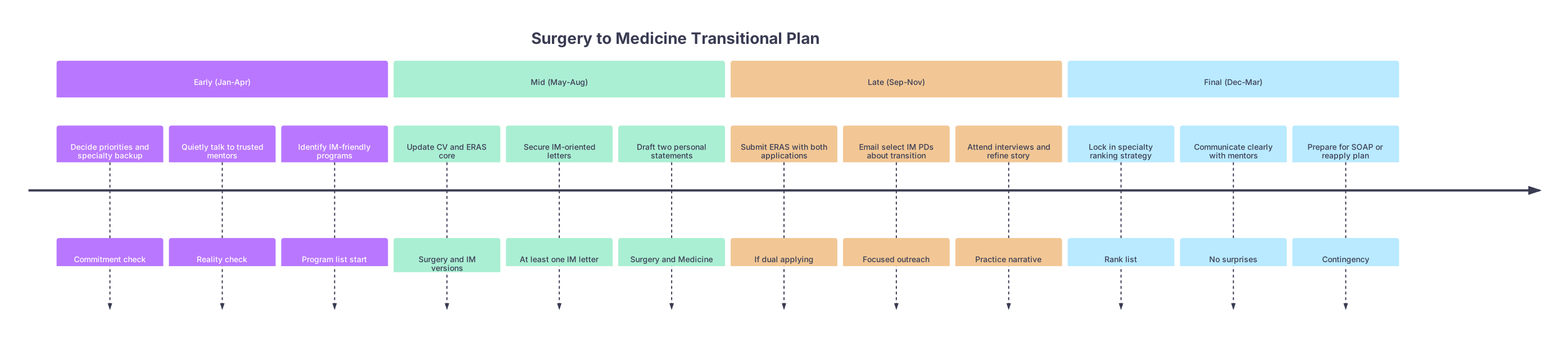
| Period | Event |
|---|---|
| Early (Jan-Apr) - Decide priorities and specialty backup | Commitment check |
| Early (Jan-Apr) - Quietly talk to trusted mentors | Reality check |
| Early (Jan-Apr) - Identify IM-friendly programs | Program list start |
| Mid (May-Aug) - Update CV and ERAS core | Surgery and IM versions |
| Mid (May-Aug) - Secure IM-oriented letters | At least one IM letter |
| Mid (May-Aug) - Draft two personal statements | Surgery and Medicine |
| Late (Sep-Nov) - Submit ERAS with both applications | If dual applying |
| Late (Sep-Nov) - Email select IM PDs about transition | Focused outreach |
| Late (Sep-Nov) - Attend interviews and refine story | Practice narrative |
| Final (Dec-Mar) - Lock in specialty ranking strategy | Rank list |
| Final (Dec-Mar) - Communicate clearly with mentors | No surprises |
| Final (Dec-Mar) - Prepare for SOAP or reapply plan | Contingency |
You might not match this exact timeline, but the phases are the same.
4. Building a Two-Track Application (Surgery + Medicine)
If you’re truly dual-applying in the same cycle, you need two coherent application “packages” built off one underlying ERAS.
Core principle
You’re not two different people. You’re one person whose path involves surgery exposure and interest in medicine. But you must tailor how you present that story.
Think in components:
- Common: Education, exams, core experiences, activities.
- Surgery-facing pieces: Surgery personal statement, surgery LORs, surgery-heavy program list.
- Medicine-facing pieces: Medicine personal statement, at least one IM LOR, more IM-oriented program list.
Personal statements: how to split the story
You need two statements that don’t contradict each other if someone ever sees both.
For Surgery PS:
- Emphasize technical challenge, OR environment, acute care.
- Show maturity: team player, resilience, etc.
- Keep any doubts or transition thoughts OUT.
For Medicine PS:
- Emphasize clinical reasoning, longitudinal care, complexity of comorbidities.
- Refer to surgery as a valuable training experience that clarified your fit.
- Example framing: “My time in surgery showed me how much I’m drawn to managing complex medical problems before and after the OR, not just the procedures themselves.”
What you avoid:
- “I hated surgery, so I picked medicine.”
Instead: “Surgery sharpened what I value most: in-depth problem solving and long-term patient relationships, which I found align more with internal medicine.”
5. LOR Strategy: Who Writes for Which Side
Letters will make or break this.
You want separate LOR portfolios:
For surgery programs:
- Chair or PD letter (often required).
- 1–2 strong letters from core surgery attendings.
- Optional: one letter from a non-surgical but relevant attending if they know you extremely well.
For medicine programs:
- At least one letter from an internal medicine attending (core clerkship or sub-I).
- One from a non-surgical but medical subspecialty (e.g., cardiology, ICU, heme/onc) who saw you work like a PGY-1.
- If you must, one strong “character/professionalism” letter from a surgeon that you can reframe as “broad clinical performance.”
What PDs hate seeing:
- Zero medicine letters.
- All your “strongest” letters are from chiefs who clearly think you’re a future surgeon. It doesn’t help your IM story.
If you’re already in a surgery prelim year with almost no IM:
- Look for:
- ICU rotations staffed by intensivists with IM background.
- Medical consult service.
- Night float with cross-cover on medicine floors (if any).
- Ask explicitly:
“I’m applying to internal medicine this cycle. Would you feel comfortable writing me a strong letter focusing on my clinical reasoning and work ethic?”
If they hesitate, don’t force it. A lukewarm letter is worse than no letter.
6. Targeting Programs: Where a Surgery-to-IM Switch Actually Works
You’re not applying to the most competitive academic IM programs with this story and expecting miracles. You’re playing a different game: realistic, stable, trainable.
| Program Type | Fit for Switchers | Why |
|---|---|---|
| Community IM, non-university | Excellent | More flexible, value work ethic |
| University affiliate IM | Good | Some academic exposure, still practical |
| Big-name academic IM | Variable to poor | Heavily research/trajectory focused |
| Prelim-only IM | Usually avoid | You need categorical stability |
| New or expanding programs | Often good | Need bodies, more open to nontraditional |
You want to prioritize:
- Community or community-university hybrid programs.
- Programs that already take prelim surgery residents into IM sometimes. This is a thing; ask around.
- Cities/regions where you have ties: “I grew up here,” “partner’s job is here,” etc. PDs love retention.
How to research quickly:
- Look at current residents on program websites:
- Any ex-surgery? PGY-2s or PGY-3s with prior surgery prelim years?
- Ask seniors or chiefs quietly:
- “Do you know programs that have historically taken surgery-to-IM transfers or re-applicants?”
If you’re late in the cycle, double down on places that:
- Historically interview IM reapplicants or prelims.
- Have large classes (more flexibility).
- Are expanding or just opened.
7. How to Explain the Switch Without Sounding Dangerous
You’ll be asked this. Almost every single IM PD or interviewer will ask:
“So you started out in surgery. Tell me about that path and why internal medicine now.”
There are only three correct angles. Pick the one that’s true for you.
Angle 1: Evolving self-awareness
“I was genuinely drawn to surgery as a student. I liked the decisiveness and procedures. During my training, I realized what I was consistently most engaged in was the pre- and post-op management: optimizing comorbidities, adjusting insulin, managing heart failure, sorting through complex diagnostic workups. I enjoyed the medical thinking more than the OR. That wasn’t a crisis—it was a clarification. IM is the environment where that curiosity and style of thinking makes sense long term.”
Angle 2: Lifestyle + values without sounding lazy
Do not say “hours.” You can talk about sustainability and what you want your long-term career to look like.
“I can handle hard work. Surgery proved that. But looking at 30–40 years of a career, I realized I care more about having protected time for thinking, teaching, and seeing patients longitudinally, not living primarily on an OR schedule. Medicine lets me do that while still taking care of high-acuity patients.”
Angle 3: Real positive experiences in IM settings
Bring receipts.
“On my ICU block, staffed by IM intensivists, I noticed I was staying late to follow up on labs and imaging for complex medical issues, and honestly, I looked forward to that more than the OR cases. Those experiences made it obvious that internal medicine is a better fit for how my brain works.”
What you absolutely avoid:
- Trashing surgery: “Toxic culture,” “Surgeons are terrible,” “I hated my PD.”
- Blame-shifting: “They didn’t support me,” “Program was malignant.”
Even if that’s somewhat true, it makes you sound risky.
Instead: Be factual, not emotional. If there were genuine issues:
- “There was a mismatch in expectations and support that made me reevaluate long-term fit. I’ve addressed what I could control, and through that process, it became clear that internal medicine aligns better with my strengths.”
8. If You’re in a Surgery Prelim Now: Protect Your Reputation
You might be exhausted, maybe even bitter. Do not let that show on paper or in behavior.
Rules:
- Show up. On time. Every day. Finish the year strong unless staying is actively unsafe for your health.
- No venting about attending surgeons or PDs in any semi-public setting that can be traced.
- If you need to leave early (e.g., mental health, severe burnout), do it with documentation and professionalism, not a midnight disappearance.
Because PDs talk. And IM PDs will absolutely call your surgery PD informally for off-the-record opinions.
I’ve seen this exact sentence tank an otherwise decent IM application: “He’s clinically fine, but honestly, a lot of drama, a lot of complaining. Not sure I’d take him again.”
Your objective: “She worked hard, she was reliable, she realized surgery wasn’t for her, but she stayed professional.”
9. Rank List Strategy: If You’re Dual Applying
Here’s the hard part. If you actually still love surgery, but fear being unmatched, how do you rank?
You need to answer two questions:
- Is 1 year of unemployment / scramble / SOAP better or worse than a 3-year IM residency you’re lukewarm about?
- Would you be willing to switch back to surgery after IM (via fellowship like critical care, cardiology, GI, etc., or never)?
Most people underestimate how bad not matching feels. It’s brutal on your confidence, finances, and visa status (if applicable). For most, a solid IM categorical is far better than another spin of the roulette wheel.
Practical ranking:
If you’re 100% sure surgery is primary dream and you’ll regret it forever:
- Rank your realistic surgery programs first.
- Then rank every IM categorical program you’d be reasonably okay training at.
- Don’t be cute. Don’t leave IM programs off because “maybe I’ll do SOAP.” SOAP is misery.
If you’re 70–100% sure you want IM:
- Rank IM categorical programs over any surgery programs you’re ambivalent about.
- You can still rank 1–2 truly great surgery programs if you’d be thrilled there, but be honest with yourself.
Remember: the algorithm tries to give you your highest ranked possible choice. Your list must reflect your true preference order, not some imagined “what PDs want to see” strategy.
10. SOAP and Reapplication: Worst-Case Backup to Your Backup
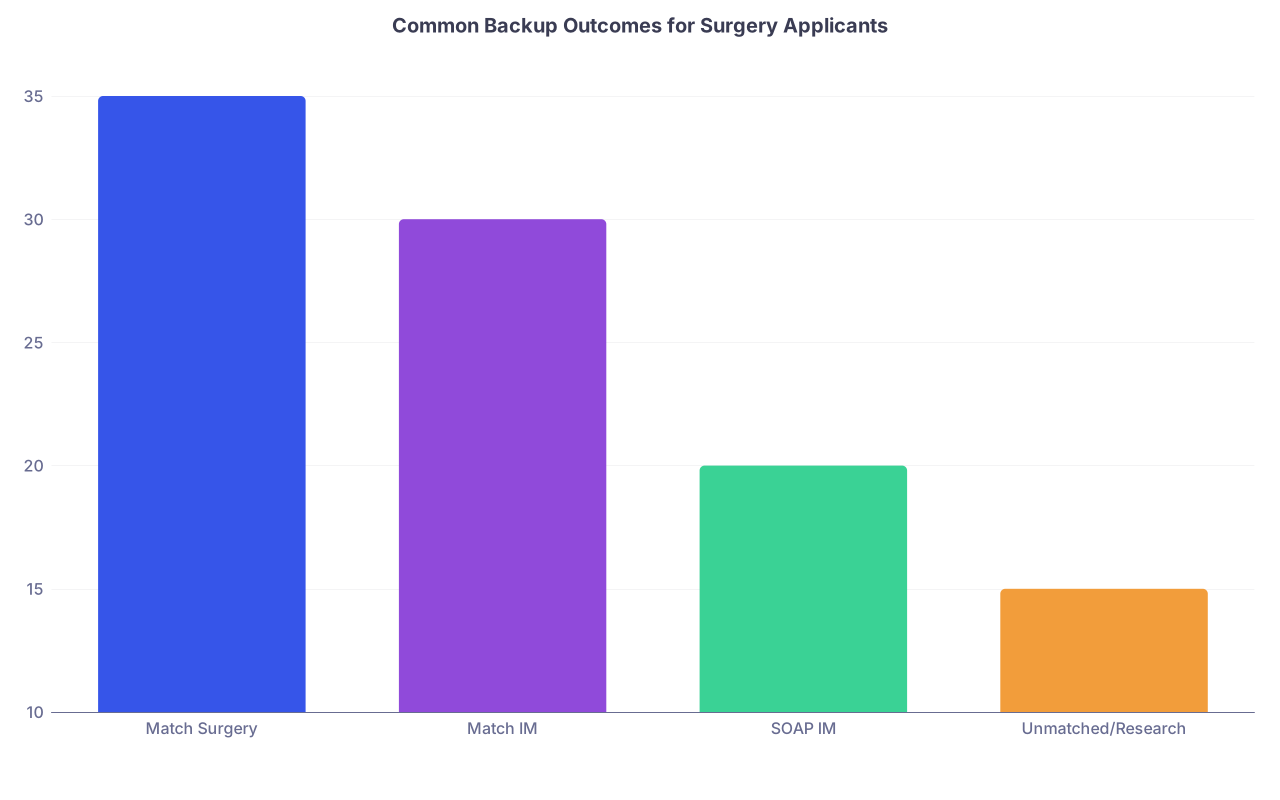
| Category | Value |
|---|---|
| Match Surgery | 35 |
| Match IM | 30 |
| SOAP IM | 20 |
| Unmatched/Research | 15 |
If everything falls apart and you end up in SOAP or unmatched:
You still have options to pivot toward medicine:
SOAP into:
- Any categorical IM spot.
- Transitional year or prelim IM spot with programs that have historically converted prelims to categorical when openings arise.
- Avoid random prelim spots with no path to categorical unless you have a well-defined plan.
If fully unmatched:
- Find a research position in a department of medicine or IM subspecialty.
- Do hospitalist-scribe roles, quality improvement jobs, or clinical research with embedded patient care exposure.
- Reapply with a clear medicine narrative, updated LORs, and at least one new IM-specific experience.
You cannot just “sit out” a year and reapply stronger. An empty year with no clinical or academic explanation looks terrible.
11. Quick Case Examples: What Works vs What Fails
Example that works:
- Categorical gen surg intern. Solid reviews. Realizes mid-year they don’t want to operate for the rest of their life.
- Finishes the year professionally.
- Gets an ICU attending (IM background) and a medicine consult attending to write strong LORs.
- Writes IM PS focused on longitudinal care and complex medical management.
- Applies mostly community IM programs with some universities, is honest in interviews, ranks IM over marginal surgery programs.
- Matches IM categorical, does great, maybe later subspecializes in cards or pulm/crit.
Example that fails:
- Prelim surgery resident, fights constantly with chiefs and PD.
- Ghosts the program mid-year, no attempt to repair.
- Slaps together an IM PS saying, “I realized surgery wasn’t right for me.”
- Has only surgery LORs; no IM letters, no clear rationale.
- Applies mostly brand-name IM programs “because I did a surgery year.”
- PDs quietly call surgery PD, hear: “Unreliable, burned bridges.”
- Goes unmatched, struggles to find meaningful next steps.
You’re trying to be the first scenario, not the second.
FAQs
1. Do I have to tell surgery programs I’m also applying to internal medicine?
No. You’re not obligated to announce dual-application to every PD. But if directly asked in an interview, don’t lie. You can say: “I’m primarily committed to surgery but given the competitiveness and my need for training continuity, I have also applied in internal medicine as a backup. That said, if I match here in surgery, I will train here.”
2. Will internal medicine PDs penalize me for initially choosing surgery?
Some will be cautious; many won’t, if your story is coherent and your behavior has been professional. If you can show that surgery gave you strong work ethic, resilience, and exposure to high-acuity care, IM PDs often view you as someone who knows what hard work looks like and chose medicine intentionally, not by default.
3. How many IM programs should I apply to as a backup if surgery is still my primary target?
For a genuine backup, think in the 25–40 range of IM programs that you’d actually go to. Not three “just in case.” If your scores or red flags make surgery a stretch, lean toward the higher end. This is not the place to be stingy; the cost of another unmatched cycle is far higher than extra application fees.
4. Can I still go into a procedural or critical-care heavy field if I switch to internal medicine?
Yes. Many ex-surgery folks end up in pulm/crit, cardiology (especially interventional), GI, or heme/onc. You won’t be “just a clinic doctor” unless you choose that path. If you like procedures and acuity, IM gives you multiple fellowships that scratch that itch without requiring a lifetime tied to the OR schedule.
Key takeaways:
- Decide honestly if surgery is still your true #1 or if you’re already mentally in internal medicine. Your strategy hinges on that.
- Build a credible IM application: at least one IM letter, a clear narrative, and a realistic program list aimed at places that actually take nontraditional applicants.
- Protect your reputation where you are, even if you’re miserable. PDs talk, and professionalism in transition is often the difference between matching IM and being stuck in limbo.