
The belief that you “can’t switch because your whole CV is built for one field” is nonsense.
You can retrofit a backup specialty onto a very lopsided application. I’ve seen it done late, messily, and still successfully. But you cannot do it by wishful thinking or vague “transferable skills” lines. You need a structured salvage plan.
You’re in this situation if:
- You built everything for one competitive specialty (derm, ortho, plastics, ENT, optho, rad onc, neurosurg, etc.).
- The numbers, signals, vibes, or mentors are telling you: you need a backup.
- You’re staring at your CV thinking, “I’ve got nothing for IM / FM / psych / pathology / anesthesia / EM / etc.”
Here’s how to actually retrofit a backup specialty onto what you’ve already got—without blowing up your primary plan.
Step 1: Be Honest About Why You Need a Backup (and How Aggressive It Has to Be)
You cannot pick the right backup until you define the actual risk level you’re dealing with.
Ask yourself, and answer on paper:
- What specialty is my primary?
- What are my concrete risk flags?
- No home program?
- Below-average Step 2 for that field?
- Failed Step attempt?
- No away rotations?
- Visa issues?
- No research / weak letters?
- What outcome am I trying to prevent?
- Unmatched entirely?
- Unmatched in the U.S.?
- Being forced into a prelim year with no clear path?
Do not hand-wave this. If your risk is high, your backup needs to be more than a “just in case I panic” specialty. It needs to be a truly matchable plan.
Here’s a rough calibration:
| Risk Level | Example Situation | Backup Strategy |
|---|---|---|
| Low | Strong scores, some interest in competitive field, no major red flags | Light, parallel backup |
| Moderate | Average scores, limited home support, mediocre research | Balanced dual-application |
| High | Below-average scores, failed exam, IMG, late pivot | Heavy investment in safer backup |
| Critical | Prior non-match, significant professionalism/academic issues | Backup becomes primary |
If you’re in the high/critical zone, the backup isn’t “backup” anymore. It’s your main lifeboat. Treat it that way.
Step 2: Choose a Backup That Actually Fits Your Existing CV
Retro-fitting works best when your backup specialty can plausibly claim your prior choices as “aligned,” even if they weren’t originally.
You’re not starting from zero. You’re repurposing.
Think in themes, not labels
Look at your CV and circle themes:
- Procedures vs cognitive work
- Outpatient vs inpatient
- Chronic disease vs acute care
- Systems / QI / leadership vs bench research
- Patient populations you’ve actually seen more of (peds, elderly, underserved)
Then map those themes to realistic backups. A few common patterns:
| Primary Focus | Plausible Backup | Why It Can Sound Coherent |
|---|---|---|
| Ortho / Neurosurg | Anesthesia | OR exposure, procedural mindset, acute care |
| Derm / Plastics | Internal Med / FM | Chronic disease, continuity, systemic thinking |
| ENT / Urology | General Surgery / Anesthesia | OR, anatomy, periop care |
| Radiology | IM / Neurology / EM | Diagnostic thinking, imaging-heavy rotations |
| EM | IM / FM | Acute care, triage, broad differential training |
Example: You did 3 ortho projects, 2 ortho aways, and you’re worried. A backup of anesthesia or internal medicine is far easier to justify than psychiatry out of nowhere. Not because psych is worse. Because your story will sound contrived.
Rule of thumb: If you can’t explain in 2 sentences how your existing experiences naturally lead into that backup specialty, it’s probably the wrong backup.
Step 3: Reframe Your Current CV Through the Backup Lens
You do not need a new life. You need a new narrative.
Take your current CV and, line by line, ask: “How would a [backup specialty] PD want to see this?”
Example: You’re an ortho-leaning student backing up with anesthesia.
Original CV angle:
- Research: “Outcomes after ACL reconstruction in young athletes”
- Leadership: Ortho interest group president
- Clinical: Two ortho aways, home ortho sub-I
Retro-fit angle:
- Research: Perioperative outcomes and functional recovery after major orthopedic procedures
- Leadership: Organized pre-operative education initiatives and multidisciplinary care discussions for surgical patients
- Clinical: Extensive experience with perioperative care, OR workflow, and multidisciplinary surgical teams
Same facts. Different framing.
Do this for:
- Research titles and bullet descriptions
- Leadership roles
- Volunteer work
- QI projects
- Even hobbies, if relevant
You’re not lying. You’re re-emphasizing the parts that overlap with your backup specialty’s values.
Step 4: Plug the Most Embarrassing Gaps—Fast
There are two unforgivable sins with backup specialties:
- No meaningful clinical exposure in that field.
- No letters from that field.
Everything else can be stretched. These two cannot.
You need:
- At least one rotation in the backup specialty (ideally a sub-I, but even a solid elective is better than nothing).
- At least one, preferably two, letters from attendings in that backup specialty who can speak to:
- Clinical performance
- Fit for that field
- Teamwork and reliability
If you are late in the game, here’s how to triage.
If you’re still pre-ERAS submission
- Rearrange your schedule to add:
- A 4-week sub-I in the backup field, or
- Two shorter blocks that get you strong exposure and interactions
- Tell those attendings early:
- “I’m primarily applying to X, but I’m strongly considering Y as a backup. I’d appreciate feedback on my fit and, if appropriate, a letter.”
If it’s late (near applications) or already application season
This is where people either get scrappy or they go unmatched.
- Add any available elective / selectives in the backup field, even if after ERAS opens. Programs will still like that you’re making the effort.
- Ask for letters from:
- The backup specialty rotation
- Related fields (e.g., IM for cards backup, surgery for anesthesia backup) who can at least speak to your inpatient acumen and work ethic.
- Consider:
- A local away rotation if you can still schedule it.
- Virtual electives / case-based courses if they exist (not ideal, but shows interest).
You’re aiming for the minimum credible evidence that you:
- Know what the field actually is.
- Didn’t pick it out of a hat in September.
Step 5: Build Two Parallel Application Packages (Without Mixing the Stories)
If you’re dual-applying, you’re not writing “one personal statement that sort of fits both.” That’s how you end up sounding vague and unserious to everyone.
You’re building parallel but consistent lives.
You need distinct versions of:
- Personal statement
- ERAS experiences descriptions (or at least the top ones)
- Program lists and filters
- Talking points for interviews
Personal Statements: Two Clean Stories
Primary specialty statement:
- Full “origin + growth + why this field + what I’ll bring.”
- You can mention adjacent interests (critical care, procedures, etc.) but keep the focus tight.
Backup specialty statement:
- Do NOT say: “I always wanted derm but now I guess I could be happy in internal medicine.”
- Do say:
- How your actual experiences led you to respect and enjoy this backup field.
- How your prior focused work (even in another field) gives you unique strengths for them.
- What you see yourself doing in that specialty long-term (even if it’s truly a backup in your heart).
If you cannot write a sincere, positive statement for the backup field, you picked the wrong backup.
ERAS Experiences: Re-order and Re-emphasize
You can’t have two entirely different ERAS applications, but you can:
- Re-order experiences so the most backup-aligned ones are in the top 3 for programs in that field (through signaling, geographic focus, and the experiences you highlight in interviews).
- Use your limited “meaningful experiences” text to pull out angles the backup specialty will care about:
- Systems-based practice for IM/FM
- Crisis management for EM
- Longitudinal relationships for psych/FM
- Team-based OR work for anesthesia/surgery
Don’t rename things dishonestly. Just adjust what you spotlight.
Step 6: Decide Program Lists and How Hard to Push Each Field
Dual applying without a strategy is how you spend $3k and still get burned.
Here’s the basic fork in the road:
- Are you willing to risk going unmatched in order to maximize shots at your dream field?
- Or is matching somewhere this year the priority?
That dictates your program list distribution.
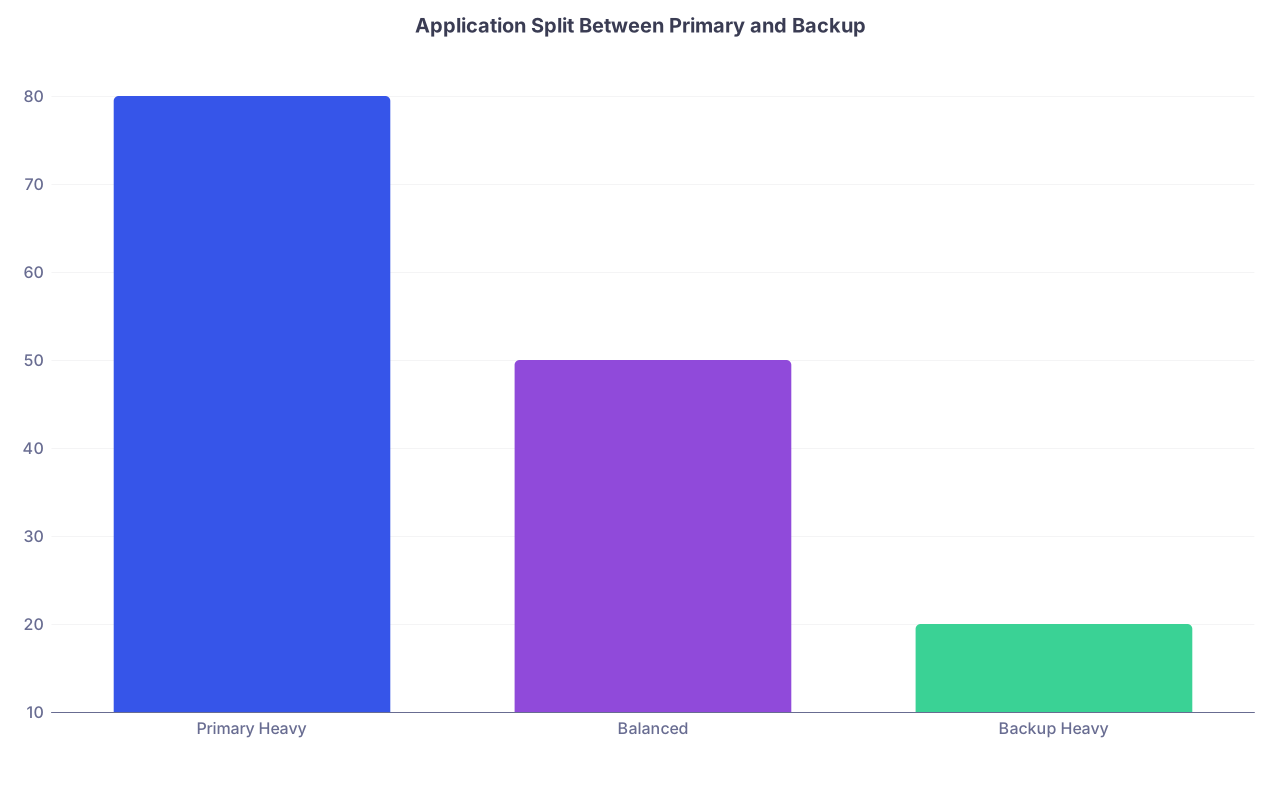
| Category | Value |
|---|---|
| Primary Heavy | 80 |
| Balanced | 50 |
| Backup Heavy | 20 |
Rough patterns I’ve seen work:
- Very strong but competitive-field applicant:
- 60–80% primary, 20–40% backup
- Average candidate in highly competitive field with no huge red flags:
- 40–60% primary, 40–60% backup
- Prior non-match or clear risk profile:
- ≤30% primary, ≥70% backup
Geography is another lever. For example:
- Primary specialty: mostly coastal / big-name programs.
- Backup specialty: more community-heavy, broader geographic spread, includes “safety” regions.
Step 7: Handle Letters Without Torching Either Side
This part makes people anxious. Fair. Letters can kill you or save you.
You need to:
Identify which letters are:
- Absolute musts for your primary (e.g., 2 ortho letters, 1 surgery chair letter).
- Strong but field-flexible (IM attending who loved you, research PI who knows you well).
- Field-specific for backup (anesthesia, IM, psych, etc.).
Assign letters strategically:
- For primary field: Heaviest concentration of specialty-specific letters.
- For backup: At least 1–2 specialty-specific, plus strong generalist letters.
If your school allows different letter sets per program/specialty (most do), construct:
Primary set:
- 2–3 in-field letters
- 1–2 strong general clinical/research letters
Backup set:
- 1–2 in-backup-field letters
- 2–3 strong general letters (IM, surgery, research) that don’t scream “this person only wants ortho.”
Be explicit when asking:
- “I’m applying primarily to X and also to Y as a backup. Would you be comfortable writing a letter that supports me for Y as well?”
- If they hesitate even a little, do not use that letter for backup. A lukewarm or conflicted letter is worse than having one fewer “famous” name.
Step 8: Prepare a Coherent Story for Interviews in Both Fields
Let’s be blunt: They will sniff out your original plan if you’re sloppy.
You need two versions of your story that share facts but differ in emphasis.
Primary specialty interview version
- Honest about long-standing interest.
- You can acknowledge:
- “I also applied to [backup] because of how competitive [primary] is, but my goal is clearly to train in [primary].”
- Do not:
- Trash the backup field.
- Act like backing up is shameful. PDs know the game.
Backup specialty interview version
This is where many people screw up.
Do not walk in apologizing for being there. You chose to apply. Own it.
Your story should sound like:
- “I spent a lot of time in [primary], and it made me realize I care about [shared value that backup also has]…”
- “What I found most fulfilling was [continuity of care / medically complex patients / acute resuscitation / procedural skillset / team dynamics], which aligns very well with [backup]…”
- “That’s why I made a deliberate decision to also apply in [backup], and I’d be genuinely excited to train and build a career in this field.”
If they ask “If you got both, which would you choose?”:
- You do not need to answer hypotheticals that would only hurt you.
- You can say:
- “If I am fortunate enough to match, I will commit fully to the program and specialty that matches me. I’m looking for a place where I’ll thrive long term, and I would not be interviewing here if I didn’t see that potential.”
Step 9: Time-Box the Retro-Fit Work So You Don’t Tank Your Primary Plan
The hidden danger of backup-building is that you sabotage the original application by spreading yourself too thin.
Create a short, brutal timeline:
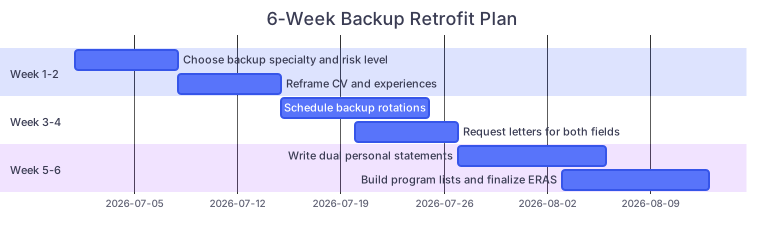
| Task | Details |
|---|---|
| Week 1-2: Choose backup specialty and risk level | a1, 2026-07-01, 7d |
| Week 1-2: Reframe CV and experiences | a2, 2026-07-08, 7d |
| Week 3-4: Schedule backup rotations | b1, 2026-07-15, 10d |
| Week 3-4: Request letters for both fields | b2, 2026-07-20, 7d |
| Week 5-6: Write dual personal statements | c1, 2026-07-27, 10d |
| Week 5-6: Build program lists and finalize ERAS | c2, 2026-08-03, 10d |
You’re not letting this drag out. Put specific days to:
- Decide backup.
- Reframe CV.
- Lock in rotations.
- Request letters.
- Draft both personal statements.
- Finalize program lists.
If backing up starts to delay your primary personal statement or letters, you’re over-engineering. The retrofit should be fast, imperfect, and good enough—not a second full career redesign.
Step 10: Reality Check – Are You Willing to Actually Do the Backup?
Last piece. Brutal but necessary.
A backup is only useful if you could see yourself waking up for that job for the next 30 years without hating your life.
Ask yourself:
- If I match only in the backup specialty, could I:
- Show up and do this work?
- Learn to care about the problems in this field?
- Find niches (fellowships, practice settings) that fit my personality?
If the honest answer is “absolutely not,” then:
- Either your primary is worth the risk and you should apply only there (eyes open), or
- You picked a lazy backup that “seems easier” instead of one you could live with.
Do not apply to a backup specialty you’d resent. That’s not a plan. That’s just fear.
FAQs
1. Should I tell programs I’m dual-applying in my personal statement?
No. Not in writing. Your personal statement for each specialty should read as if that field is your intended career. You can acknowledge dual-application verbally in interviews if asked directly, but putting it in writing usually weakens your perceived commitment.
2. Can I use the same research-heavy CV to apply to a more clinically oriented backup specialty like FM or EM?
Yes, but you must translate it. Emphasize what your research taught you that matters clinically: working with teams, understanding outcomes, patient-centered questions, QI spin-offs. And you must pair that with strong clinical letters and at least one real rotation in the backup field so it doesn’t look like you only live in the lab.
3. How many backup applications is “enough” to feel safer?
It depends on your risk profile, but for a moderate-risk applicant backing up into a moderately competitive field (IM, FM, psych, anesthesia, EM), I start breathing easier when:
- You’re applying to at least 25–30 programs in the backup, and
- Those programs include a mix of community, university-affiliated, and a wide geographic spread. For higher risk (failed exam, IMG, prior non-match), that number can jump to 60+ in the backup.
4. What if my mentors in the primary specialty tell me not to back up?
Then you need more data points. Their incentives are not perfectly aligned with yours—they want good applicants in their field and may be overly optimistic. Talk to:
- A neutral advisor (student affairs dean, program director in a different specialty).
- Someone who has been on a residency selection committee.
- Recent grads who actually went through the Match. If three independent people look at your scores, CV, and the recent match data and tell you backup is smart, trust that over one “you’ll be fine” from an enthusiastic attending.
With a clear-eyed risk assessment, a deliberate backup choice, and a fast, focused retrofit of your existing CV, you can walk into application season with two coherent stories instead of one desperate scramble. Once you survive Match Day with an actual spot, then we can talk about how to shape your residency path toward the career you really want—but that’s a problem for future you, and a story for another day.