If your dream specialty barely sponsors visas, what is your actual Plan B?
You already know the problem. You’re an IMG or on a visa, you love a competitive specialty (or even a normal one), and then you realize half the programs do not sponsor anything, another chunk only do J‑1, and the few that do H‑1B are hyper‑competitive.
So people tell you: “Just have backups.”
Backups where? In what specialties? At which programs that actually sponsor your visa type? That’s the real question.
Let’s walk through how to pick backup specialties and backup programs when you have visa constraints – not in theory, but in the way that keeps you from going unmatched.
Step 1 – Get brutally clear on your specific visa reality
“Visa issues” is too vague. Your exact situation changes the whole strategy.
Ask yourself, and answer honestly:
Are you currently:
- Outside the US with no status
- On F‑1 (likely with OPT)
- On J‑1 (research, observer, etc.)
- On H‑1B with a cap‑subject employer
- Something else (dependents, etc.)
For residency, do you:
- Accept J‑1 sponsorship
- Strongly prefer H‑1B but will take J‑1
- Need H‑1B only (for family, waiver plans, immigration strategy)
Here’s how that changes your world:
- J‑1 acceptable: Your pool is much larger. Most universities and many community programs sponsor J‑1.
- H‑1B preferred but J‑1 ok: You’ll prioritize H‑1B where realistically possible (backup specialties included), but won’t die on that hill.
- H‑1B only: Your options narrow dramatically. Backups are not optional; they’re your lifeline.
If you’re H‑1B only and applying to something like dermatology, neurosurgery, plastics, or ENT with no real US track record, you are essentially buying lottery tickets. That’s fine—if you also build an actual matchable Plan B in a more visa‑friendly specialty.
Step 2 – Understand which specialties are more visa‑friendly (reality, not rumor)
Some specialties are just structurally better for visa applicants because they’re larger and have more community programs, which tend to be more flexible.
Broadly (there are exceptions), here’s the pattern I’ve seen year after year:
| Specialty | Visa-Friendliness (General) | Typical Program Type Mix |
|---|---|---|
| Internal Medicine | High | Many community, some university |
| Family Medicine | High | Heavily community |
| Pediatrics | Moderate–High | University + community |
| Psychiatry | Moderate | Growing number of IMGs |
| Neurology | Moderate | Mix, some IMG-heavy |
| General Surgery | Low–Moderate | University-heavy, competitive |
Now the harsh bit: your competitive dream specialty is almost never your best visa backup.
If your main target is:
- Internal Medicine (academic) → A realistic backup is community internal medicine or family medicine.
- General Surgery → Backup might be prelim surgery + categorical IM/FM, or just IM/FM depending on your risk tolerance.
- Psych, Neuro, Peds → Backup often winds up being family medicine or community IM if your CV is weak.
Do not pick a backup specialty that’s just as unfriendly to visas as your primary choice. That’s how people go unmatched “with backups.”
Step 3 – Separate “specialty choice” from “program choice” for backups
You have two separate layers of backup:
- Backup specialties
- Different field (e.g., Psych → FM, or Surgery → IM)
- Backup programs within the same specialty
- Less competitive / more IMG‑friendly / more visa‑friendly programs in your existing field
Do not lump this together in your head. Because a lot of you actually only need a program backup, not a specialty backup—particularly if you’re in a visa‑friendlier field and just aiming too high.
Questions to ask yourself
Do I actually love my main specialty enough that I’d rather:
- Scramble to SOAP for prelim or transitional and reapply,
- Than match into IM/FM/Peds/etc.?
If I’m honest: is my profile strong enough for my dream specialty plus visa needs?
Example: Non‑US IMG, 220s USMLE, 0 US letters, wants categorical GS with H‑1B only. That’s not bold. That’s delusional.
If your numbers / CV and visa needs put you in the danger zone, then you need both:
- More visa‑friendly programs within your main specialty, and
- A different specialty where enough programs sponsor your visa type.
Step 4 – Build a visa‑aware program list (this is the part people do lazily and regret)
Genuinely, this is where most applicants screw up. They casually “check if they sponsor” while browsing, instead of building a systematic list.
You need something closer to this:
| Column | Example Entry |
|---|---|
| Program Name | ABC Medical Center IM |
| Specialty | Internal Medicine |
| Visa Type | J-1 only |
| IMG Friendly? | Yes (60% IMGs) |
| City/State | Chicago, IL |
Then filter and sort ruthlessly.
Where to find visa info (and how to not get misled)
- FREIDA
Often has visa info, but it can be outdated. - Program websites
Sometimes accurate, sometimes copy‑pasted from three years ago. - Email the coordinator (short and direct) if it’s not clearly stated.
What you want is specific:
- “We sponsor J‑1 only.”
- “We sponsor J‑1 and H‑1B.”
- “We do not sponsor visas.”
Anything vague like “case by case” or “depends on the year” goes into a caution column. You can still apply—but do not count it as your safety net.
Step 5 – Match your risk level to your visa + backup plan
People pretend they’re risk‑tolerant until they open the NRMP email and see “We are sorry to inform you.”
Think concretely. Here’s how visa reality changes risk:
If you’re J‑1-OK, average profile (mid‑220s/230s, a few US LORs): You can afford medium risk. You can apply broadly to your main specialty and add one backup specialty where:
- Programs are IMG‑friendly
- A solid chunk explicitly sponsor J‑1
If you’re H‑1B-only, average profile: You cannot afford to be cute. This is where I see some of the worst match outcomes. You can’t just apply to IM at university programs with H‑1B and think you’re safe. You probably need:
- Main specialty: mostly J‑1 + H‑1B programs that lean IMG-friendly
- Backup specialty: something like family medicine or community IM with a known record of H‑1B sponsorship
If you’re strong (250+, US clinical experience, solid letters, research): You can push harder on your primary specialty. But still not at the cost of having no serious backup in a visa‑friendly field. I’ve watched 250+ applicants go unmatched because they were H‑1B‑only and only applied to top‑tier IM university programs.
Step 6 – Choosing which backup specialty makes sense with visa constraints
You’re not just picking anything “easier.” You’re picking something that:
- Has significantly more sponsoring programs than your primary path.
- Has historical IMGs in the roster.
- Still fits you enough that you won’t hate your life.
Let’s walk through a few typical situations.
Scenario 1 – You’re an IMG going for Internal Medicine (dream = academics, visas = J‑1 OK)
Not terrible. IM is relatively visa‑friendly.
Realistic backup paths:
- Within IM:
- Community IM programs with high IMG percentage
- Programs in less popular locations (Midwest, South, rural)
- Backup specialty:
- Family Medicine (lots of community programs, many sponsor J‑1)
- Pediatrics in some regions
Strategy:
- Apply widely in IM first (80–120+ programs if you’re average).
- Add 20–40 FM programs with clear visa sponsorship and IMG history.
- Use your personal statement and experiences to show genuine interest in primary care if you add FM. Don’t make it obvious that FM is a throwaway.
Scenario 2 – You’re a non‑US IMG targeting General Surgery, H‑1B-only
This is where the danger climbs fast.
Surgery + H‑1B only is already a bottleneck. For many, the true Plan B isn’t “less competitive general surgery program.” It’s “different specialty altogether.”
Realistic backup options:
- Prelim Surgery
Only if you clearly understand:- Low guarantee of categorical spot after
- Visa issues continuing after prelim year
- Internal Medicine / Family Medicine with H‑1B track record
Better if long‑term stability and immigration goals matter more than the word “surgeon” on your badge.
If you insist on surgery as primary:
- Apply to a selective list of GS programs known to sponsor H‑1B and consider IM/FM as a backup where programs offer H‑1B.
- Do not rely solely on prelim spots unless you’re comfortable reapplying with the same or worse visa constraints.
Scenario 3 – You’re aiming for Psychiatry, J‑1 OK, mid-range profile
Psych has become more competitive, but it still has decent room for IMGs and J‑1s.
Reasonable backup:
- Family Medicine or Internal Medicine (community)
- Some applicants add both Psych + FM or Psych + IM.
Make sure your story holds together:
- Don’t submit one personal statement saying “lifelong passion for psychotherapy” and another saying “lifelong passion for whole‑family primary care” in sloppy copy‑paste fashion. Create at least a coherent narrative for each.
Step 7 – Concrete program list building: how many in each category?
You want to see your list as a portfolio. Dream, realistic, safety. Main specialty, backup specialty.
Quick rough framework (adjust for your stats/visa):
- Total applications (for an IMG with visa issues): often 80–150 programs across all specialties, sometimes more.
- Example split for an average IMG, J‑1 OK, main target IM:
- 70–90 IM programs with:
- Mix of mid‑tier university + community, majority J‑1 sponsoring
- 20–40 FM programs with:
- Clear J‑1 sponsorship, IMG‑rich, community‑heavy
- 70–90 IM programs with:
For H‑1B‑only applicants, you sometimes need:
- 100+ total programs because your eligible pool shrinks dramatically.
- More heavy concentration in specialties/programs historically known to process H‑1B.
Step 8 – Timing: when to actually decide your backups
The worst time to “decide” backups is two days before ERAS submission. That’s when people panic and just throw in random FM programs with no visa check and no thought.
Better sequence:
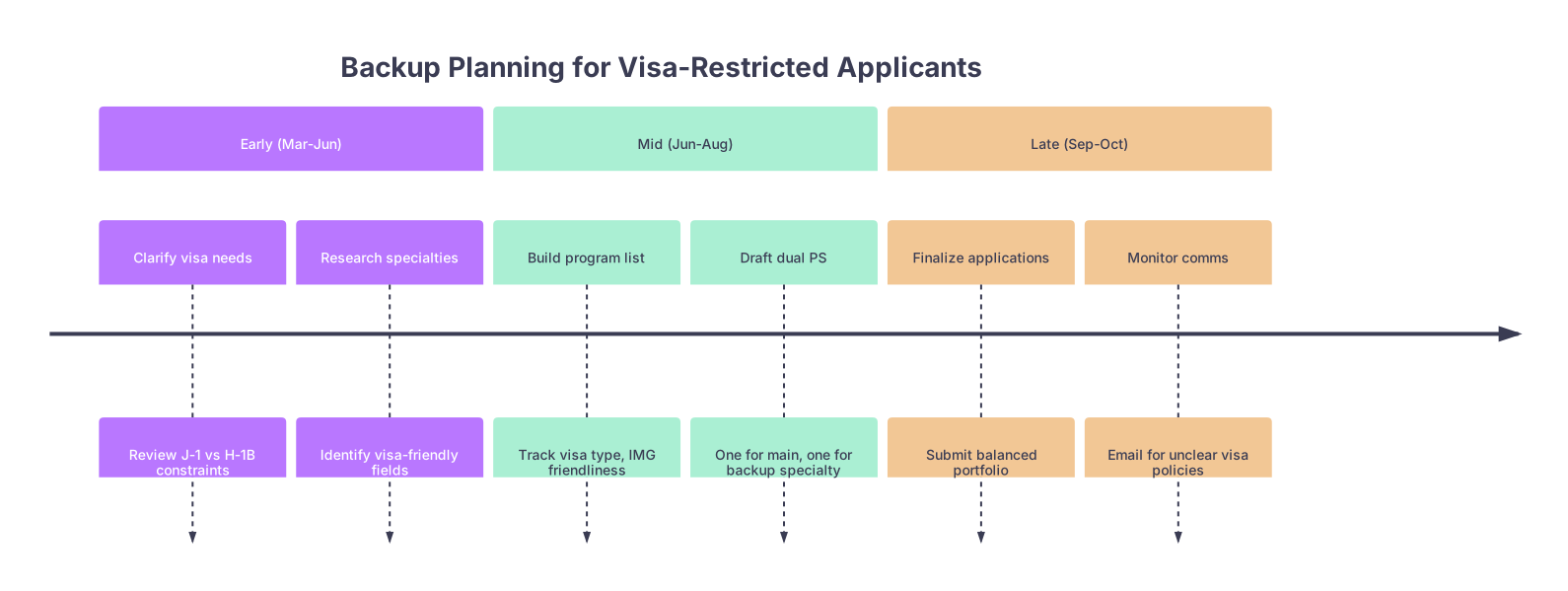
| Period | Event |
|---|---|
| Early (Mar-Jun) - Clarify visa needs | Review J-1 vs H-1B constraints |
| Early (Mar-Jun) - Research specialties | Identify visa-friendly fields |
| Mid (Jun-Aug) - Build program list | Track visa type, IMG friendliness |
| Mid (Jun-Aug) - Draft dual PS | One for main, one for backup specialty |
| Late (Sep-Oct) - Finalize applications | Submit balanced portfolio |
| Late (Sep-Oct) - Monitor comms | Email for unclear visa policies |
If you’re past that and it’s already application season, you still do the same steps—just compressed. But don’t skip the list building and visa tracking part.
Step 9 – Red flags and traps for visa-constrained backups
Let me be blunt about a few things I’ve seen wreck otherwise decent chances:
Relying on “We consider H‑1B on a case‑by‑case basis.”
Translation in many places: “If we absolutely love you and you’re our top pick, we’ll ask legal. Otherwise no.”
Those are not your safety schools.Assuming last year’s match list guarantees this year’s policy.
Programs change chairs. Legal departments change their posture. Funding shifts. Always confirm.Picking a backup specialty you clearly do not respect.
FM is not the leftover bin. If you talk or write about it like that, a decent FM PD will smell it. Your backup has to at least sound like something you can commit to.Underestimating community programs.
Many community‑based IM/FM programs:- Sponsor visas reliably
- Love IMGs
- Offer strong training and reasonable opportunities afterward
They may not be shiny on paper. But they match you—and that beats unmatched plus pride.
Step 10 – How to message this in your application materials
You’re probably juggling two questions in your head:
- “Will programs in my main specialty think I’m not committed if I apply to backups?”
- “Will backup programs think I’m using them?”
Nobody sees your entire ERAS portfolio. They only see what you send to them.
So do this smartly:
Separate personal statements
- Main specialty: Deep dive into why that field, what you bring to it.
- Backup specialty: Authentic reasons (even if discovered later) why this field actually fits you.
Letters of recommendation
- It’s fine if your IM letter is used for both IM and FM. That’s normal.
- If possible, at least one letter from someone in the backup specialty area is helpful—but not mandatory.
Interview explanations (if asked)
If program directors ask why you applied to multiple specialties, you can say something like:- “My primary interest is X, but being an IMG with visa needs, I wanted to make sure I matched into a field where I could grow and serve long‑term in the US. I could see a fulfilling career in Y for [specific reasons], and I’m genuinely excited about what your program offers in that area.”
That’s honest. It’s strategic. And it does not make you look flaky.
Visual: how your portfolio might actually look
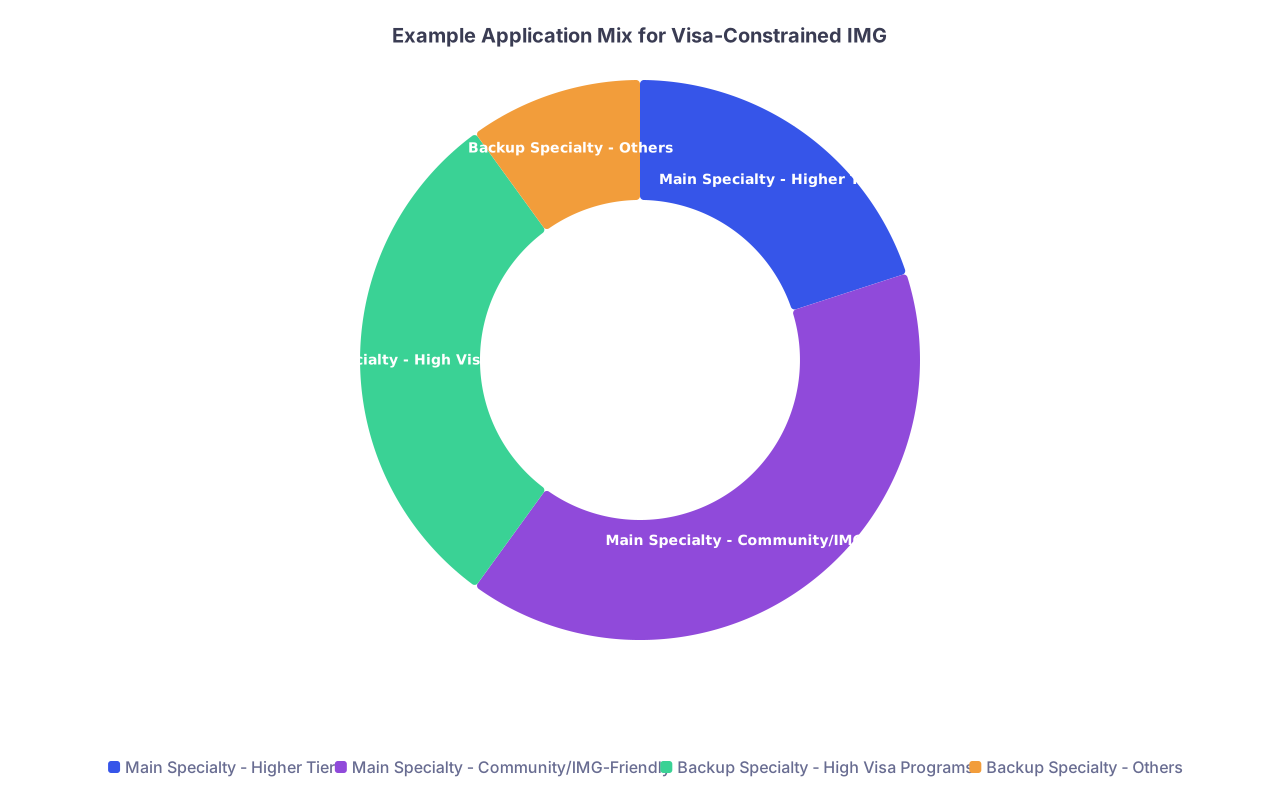
| Category | Value |
|---|---|
| Main Specialty - Higher Tier | 20 |
| Main Specialty - Community/IMG-Friendly | 40 |
| Backup Specialty - High Visa Programs | 30 |
| Backup Specialty - Others | 10 |
You’re not just adding random backups. You’re deliberately weighting toward programs that:
- Sponsor your visa type
- Have IMGs like you
- Sit at a competitiveness level that matches your stats
A quick reality check before we wrap up
Ask yourself three hard questions:
- If my dream specialty completely shuts me out because of visa + competitiveness, have I applied to enough realistic, visa‑sponsoring programs in another field to actually match?
- Am I counting on vague “maybe H‑1B” programs as if they’re genuine options?
- If I go unmatched, can I live with the fact that I knew this risk and still didn’t build a proper backup?
If any of those answers makes your stomach drop a bit, that’s your cue to adjust your list now, not two weeks before rank order lists.

Key takeaways
- Your specific visa situation (J‑1 vs H‑1B vs flexible) should directly shape both your specialty choice and your program list construction.
- A real backup requires more visa‑friendly specialties and programs, not just “slightly weaker” versions of your dream that still barely sponsor visas.
- Build a structured, visa‑aware program spreadsheet, split between main and backup specialties, and apply broadly enough that at least one path is realistically matchable.