

You’re a med student or early resident, and you already know clinic Room 3 in Suburbia, USA (or the UK, or Australia) is not your final destination. You want to work abroad. Maybe MSF. Maybe WHO. Maybe long term in another country’s health system. And now you’re asking the right question:
Where should you train now if you already know you want to work internationally later?
Let me be blunt: most people think about this backwards. They pick a residency or postgraduate program like they’ll live and die in that country, then five years later try to retrofit an “international career” onto whatever random training they did.
You can do better than that.
Below is the framework I’d use if I were planning an international career from the start.
Step 1: Decide what “working internationally” actually means for you
“Work internationally” is vague. You need to narrow it down, because the best place to train depends heavily on the type of international work.
Think in buckets:
Short-term humanitarian / volunteering
Things like Médecins Sans Frontières (MSF), disaster relief, medical missions, crisis response.Long-term clinical work abroad
Being a regular doctor in another country’s system: UK NHS, Australia, New Zealand, Gulf states, EU, Singapore, etc.Academic / public health / global health policy
WHO, NGOs, universities, research institutes, policy roles, implementation science.High-income “expat” medicine
Contract work in the Middle East, cruise ships, offshore, or private international hospitals.
You don’t need a perfect answer, but you do need a direction. Because each of those buckets points you toward different ideal training environments.
Step 2: Understand which training systems “export” best
Some training systems travel well. Others are very local.
In global terms, these systems are the most “portable”:
| System / Country | Portability | Typical Path Options |
|---|---|---|
| US (ACGME) | Very High | Fellowships, NGOs, Gulf, some EU/Asia |
| UK (NHS) | Very High | Commonwealth, EU, NGOs, Gulf |
| Canada | High | US, Commonwealth, NGOs |
| Australia/NZ | High | Asia-Pacific, Gulf, NGOs |
| Western EU | Moderate | EU, some NGOs |
If you want maximum future flexibility, train in one of those systems if you can. Licensing bodies worldwide recognize them and have clear pathways to convert or supplement that training.
That said, which of those is “best” for you depends on your passport, your target region, and your tolerance for pain (US visas, UK pay, Australian bottlenecks, etc.).
Step 3: Matching training system to your goal
1. If you want humanitarian / NGO / crisis work
For serious field work (MSF, ICRC, etc.), I’d prioritize:
- Strong, hands-on training in a broad specialty
- Comfort with low-resource and high-acuity care
- A passport and degree that lets you deploy easily
Best specialties:
- Emergency medicine
- General surgery
- Anesthesia / critical care
- Family medicine with solid procedural skills
- OB/GYN, pediatrics (if you’re committed to those populations)
Where to train?
If you can get into them, these systems are ideal:
- UK (NHS) – Especially if you can do time in district general hospitals. You see real pathology, you learn to work with constrained resources, and the NHS name carries weight with NGOs.
- US – ACGME training in EM, surgery, anesthesia, peds, or OB is gold. Many NGOs love US-trained specialists for complex cases and teaching roles.
- Canada / Australia / NZ – Also well regarded; often good EM/FM pipelines for global health.
What to look for in a specific program:
- Formal global health or international health tracks
- Established partnerships with hospitals in low- and middle-income countries
- Real elective time abroad (not just a brochure)
- Faculty who actually go to the field regularly
Red flag: programs that “support” global health in theory, but in practice make it impossible to leave for more than 1–2 weeks.
2. If you want long-term clinical work in another high-income country
Here’s the ugly truth: long-term job prospects are driven by licensing red tape, immigration policy, and workforce shortages. Not by romance.
So, pick training that lines up cleanly with your target country’s pathways.
Examples:
You want to end up in the UK
Best path:- Train in the UK (undergrad or postgrad). Obviously.
Second best: - Train in another recognized system (US, Canada, AUS/NZ), then use UK specialist registration pathways.
- Train in the UK (undergrad or postgrad). Obviously.
You want Australia or New Zealand
They favor:- Australian/NZ training
- UK and Irish training
- Canadian and US training (to a decent extent)
If you already know you want to be there, doing foundation or postgraduate training in the UK or directly in AUS/NZ is usually smarter than doing all of it in a random country and hoping for recognition.
You want to work across the EU
Easiest route:- Get your medical training + specialization recognized within the EU (Germany, Netherlands, Scandinavia, etc.), then move within the bloc.
US/UK training can be converted in some cases, but it’s more paperwork and sometimes re-training.
- Get your medical training + specialization recognized within the EU (Germany, Netherlands, Scandinavia, etc.), then move within the bloc.
You want Gulf / high-pay expat roles (UAE, Qatar, Saudi, etc.)
These employers like:- US board certification
- UK CCT / consultant status
- Canadian/Australian fellowships
In other words: train in one of the top portable systems above.
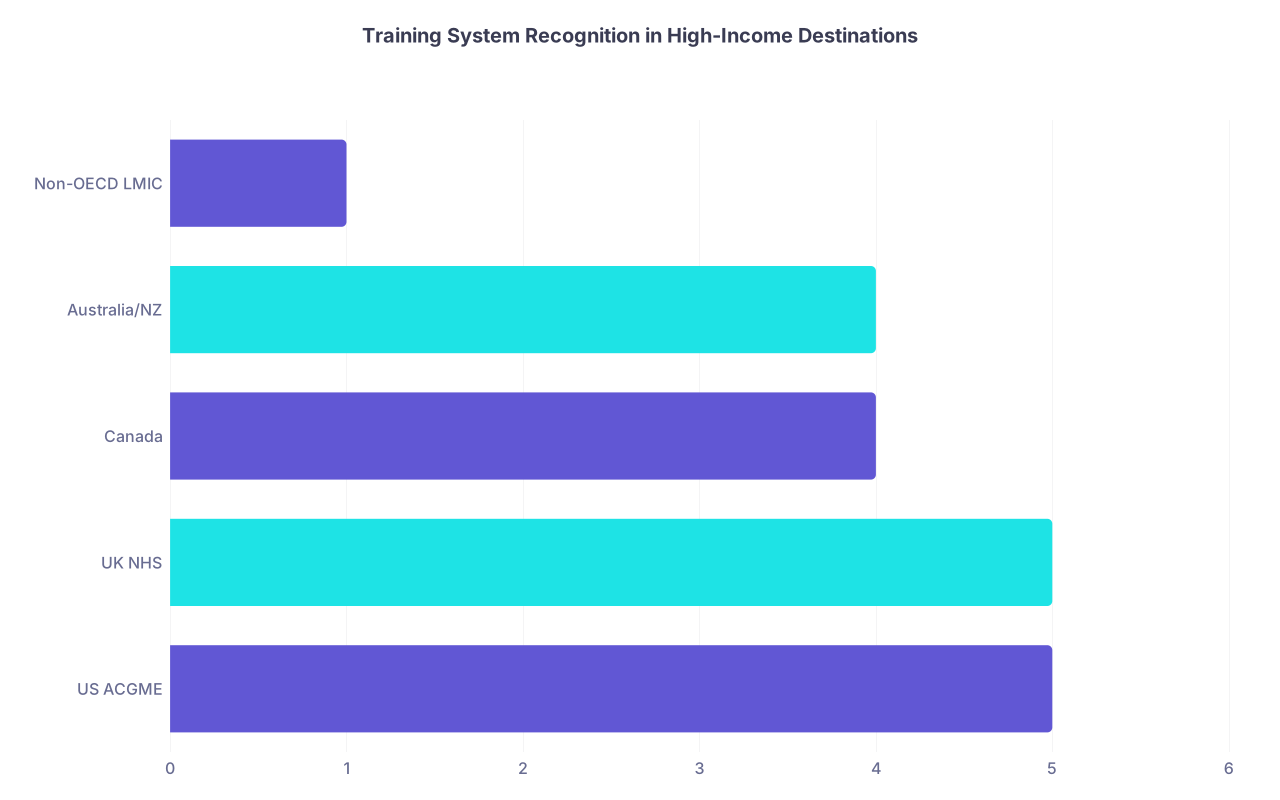
| Category | Value |
|---|---|
| US ACGME | 5 |
| UK NHS | 5 |
| Canada | 4 |
| Australia/NZ | 4 |
| Non-OECD LMIC | 1 |
(Scale 1–5: rough “ease of recognition” globally. Non-OECD LMIC training can be excellent locally, but the paperwork to move is often painful.)
3. If you want global health, public health, WHO-type careers
Here’s where people often screw up. They obsess over which residency is “most global,” when what actually opens doors is:
- A strong clinical base in any recognized system
- Plus a serious graduate degree and portfolio:
- MPH / MSc Global Health / Health Policy
- Implementation or health systems research
- On-the-ground experience in low- and middle-income countries
Where to train clinically?
I’d pick:
- Wherever you can get solid, respected clinical training with:
- Protected time for research
- Access to a public health or global health department
- Mentors with actual WHO/NGO/global policy roles
That often means:
- Academic centers in the US (places like UCSF, Hopkins, Harvard, UW, McGill, U of Toronto)
- Big university hospitals in the UK (LSHTM ties, Oxford, UCL, etc.)
- Large teaching hospitals in Canada, Australia, Western Europe with strong public health schools attached
Then, during or after training:
- Do an MPH or related degree at a school that lives and breathes global health, not just “offers a global elective.”
Step 4: Consider your passport and language now, not later
Nobody likes to talk about this, but your passport matters more than your Step score if you want to work internationally.
Some realities:
- EU/EEA passport → massive freedom across Europe and easier entry elsewhere.
- US/Canadian/Australian/NZ/UK passports → easier NGO deployment, visas, and overseas hiring.
- LMIC passports → can still absolutely have international careers, but you’ll face more visa hoops and sometimes explicit country restrictions by NGOs and governments.
What does that mean for where you should train?
If you hold:
- An EU passport: strongly consider training somewhere in the EU that has wide recognition. Germany, Netherlands, Scandinavia, France, etc. Give yourself the built-in mobility.
- A Commonwealth passport (UK, Canada, Australia, NZ, etc.): those systems cross-recognize each other better than most. Training inside that club usually makes international moves less painful.
- A non-OECD passport: if at all possible, doing your postgraduate training in one of the “big five” portable systems (US, UK, Canada, Australia, NZ) will dramatically expand your options. They’re brutal to get into, but they change the rest of your career.
Also: language. If you know you want to work in Francophone Africa, training in France or Belgium and becoming fluent in French is a huge asset. Same for Spanish in Latin America, Portuguese (Brazil/Mozambique/Angola), etc.
Step 5: Specialty choice matters more than you think
You can’t fix a mismatch later with enthusiasm. Some specialties are naturally more international.
Highly portable for international clinical and humanitarian work:
- Emergency medicine
- Internal medicine / general medicine
- Family medicine / GP (if it’s actually broad in scope)
- General surgery
- Anesthesia / critical care
- Pediatrics
- OB/GYN
Moderately portable:
- Psychiatry
- Radiology
- Pathology
Harder to use internationally (not impossible, but narrower paths):
- Very niche subspecialties (interventional cardiology only, pediatric electrophysiology, etc.)
- Procedure-heavy specialties requiring complex equipment (dermatologic cosmetic laser practice is not wildly useful in a refugee camp)
If you already know international work is your future, don’t put yourself in a corner specialty that depends on one specific country’s insurance system and machinery.
Step 6: Choosing between US vs UK vs “local then move”
The classic decision point for many students:
Training in the US first
Pros:
- Globally respected, especially for procedure-heavy specialties.
- Very strong specialty training and fellowships.
- High salaries (can pay down loans, then go abroad).
Cons:
- Visa nightmare for non-US citizens.
- Narrow early; less generalist exposure if you go straight into a subspecialty.
- Harder to work in low-resource settings if you only ever trained in high-resource tertiary centers.
Best if:
- You want to be a specialist with top-tier technical skills.
- You’re eyeing expat jobs, Gulf region, high-level NGO/academic roles.
Training in the UK first
Pros:
- NHS is known globally; training is widely recognized.
- More generalist early on; good fit for global and humanitarian work.
- Easier to pivot into Australia/NZ, Gulf, sometimes EU.
Cons:
- Pay is… not inspiring.
- System is strained; opportunities are there but you have to hustle for them.
- Pathways can be bureaucratic.
Best if:
- You want to be a generalist (GP, EM, internal medicine, surgery) with strong systems experience.
- You like the idea of Commonwealth mobility and NGO work.
Training “locally” then moving
If you’re in a low- or middle-income country now, this can work, but you must be strategic:
I’ve seen three versions:
- Do undergrad med school locally → postgraduate training abroad.
Best option if feasible. Gives you a recognized specialty and mobility. - Do full specialty locally → later try to convert abroad.
Works sometimes, but often you end up repeating a chunk of training or being under-recognized. - Do local training + stacked global health degrees (MPH etc.) → global health roles that are more academic or policy than purely clinical.
This can be powerful if clinical licensing abroad is a barrier.
Step 7: What to prioritize inside any training program
Whatever system you end up in, if you know you want an international career, prioritize:
- Breadth over hyper-specialization in your early years
- Real responsibility, not just time at the computer checking boxes
- Electives and rotations in low-resource or different cultural settings
- Mentors who are actually doing international work now, not “interested in it”
- Research or projects that involve cross-border or global themes

| Step | Description |
|---|---|
| Step 1 | Define goal type |
| Step 2 | Choose target region |
| Step 3 | Select training system |
| Step 4 | Pick broad useful specialty |
| Step 5 | Join program with global track |
| Step 6 | Do electives abroad |
| Step 7 | Add MPH or global work if needed |
| Step 8 | Apply for international roles |
Step 8: How to shortlist specific places and programs
You’re looking for concrete signals, not marketing fluff. When evaluating where to train:
Search for:
- “Global health track [program name]”
- “International electives [specialty] [country]”
- “[Program] alumni MSF / WHO / UNICEF / Partners In Health”
Then check:
- Do they have formal MOUs with hospitals in other countries?
- How many residents/fellows actually leave for 4+ weeks per year?
- Are there faculty with titles like “Director of Global Emergency Medicine” or “Professor of Global Surgery”?
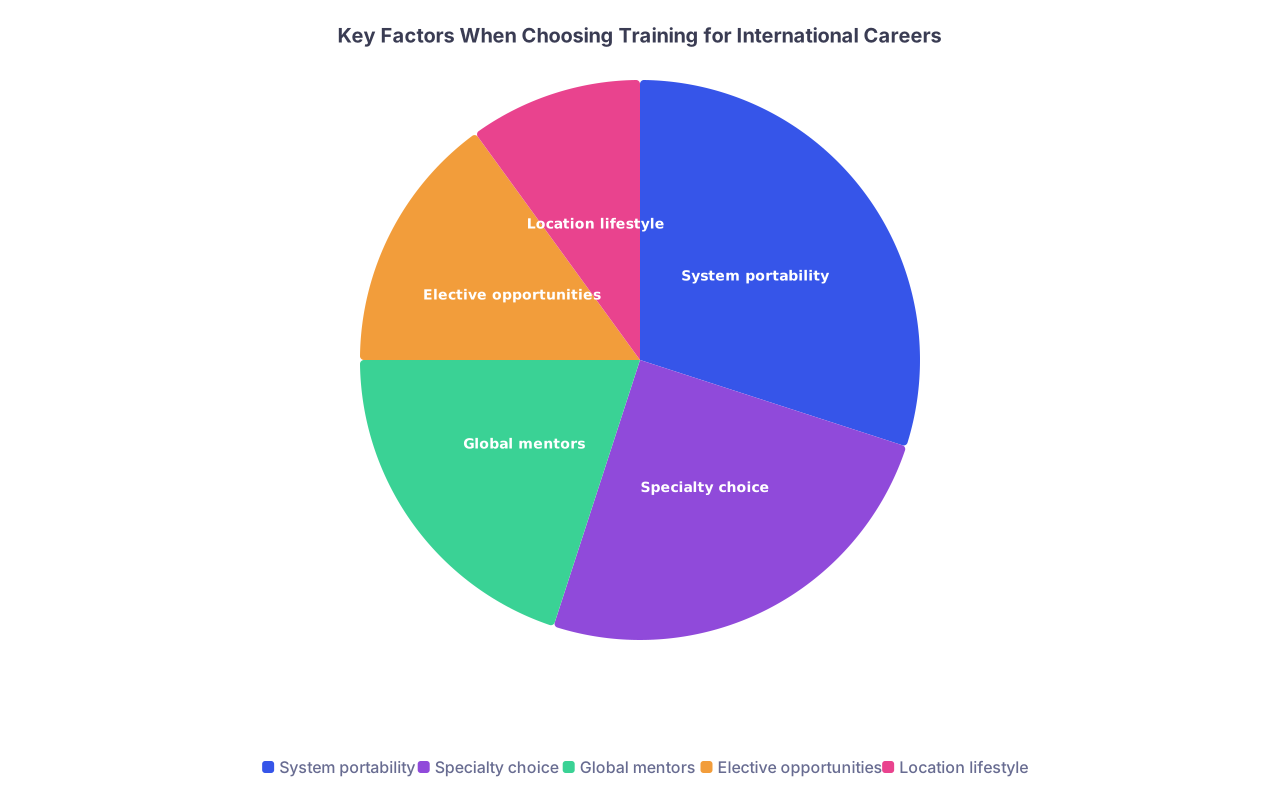
| Category | Value |
|---|---|
| System portability | 30 |
| Specialty choice | 25 |
| Global mentors | 20 |
| Elective opportunities | 15 |
| Location lifestyle | 10 |
Bottom line: I’d rather be in a mid-tier hospital with a serious global track and committed mentors than a “Top 10” academic center that never lets you leave the building.
Quick country-by-country summary
Here’s the quick-and-dirty version if you’re deciding at a high level:
| Goal Type | Top Training Choices |
|---|---|
| Humanitarian / NGO | UK, US, Canada, AUS/NZ |
| Long-term in UK/EU | Train in UK or EU |
| Long-term in AUS/NZ | AUS/NZ, UK, then US/Canada |
| Gulf / high-pay expat | US, UK, Canada, AUS/NZ |
| Global health / WHO | US or UK with strong public health |
And remember: there’s no single “right” place. There are blatantly smarter choices depending on your target.


FAQ: Training for an International Medical Career
1. Should I pick a “global health” residency or the strongest clinical program?
If you have to choose, pick the strongest clinical program that still lets you get some global exposure. Weak clinical training with lots of travel photos doesn’t help you or your future patients. The ideal is strong core training plus a genuine global track. But if it’s one or the other, I’d take robust clinical skills every time.
2. Is an MPH mandatory if I want to work internationally?
No. For pure clinical humanitarian work, it’s nice but not required. For serious global health, policy, or WHO-type roles, an MPH or similar degree becomes very useful and sometimes expected. The trick is timing: often best done after you’re far enough in training that you know your niche and can build a coherent profile, not just “generic MPH person.”
3. I’m in med school in a low- or middle-income country. Is it even realistic to work abroad later?
Yes, but the path is steeper. Easiest route is: finish your degree, pass the relevant exams (USMLE/PLAB, etc.), then do your specialty training in a globally portable system if you can. If that’s not possible, you can still aim for global health research, NGO roles, and sometimes clinical posts with additional training and conversion steps. I’ve seen it done. Many times. It just requires more planning and persistence.
4. Does it matter if I start in family medicine vs internal medicine vs EM for global work?
It does, but not as much as people obsess about. All three are highly usable for international work if your training is broad. EM is fantastic for acute and humanitarian work. Family medicine is great for long-term community work and primary care systems. Internal medicine is strong for hospitals and non-communicable disease work. The bigger mistake is picking something ultra-narrow and then discovering nobody needs that particular niche in the places you want to go.
5. What’s one concrete step I can take this month toward an international career?
Email two people:
- a faculty member at your school or hospital who actually works internationally now, and
- a program you’re interested in that advertises a global track. Ask each of them for 15 minutes to discuss your goals and what they’d do in your shoes. Then actually show up and listen. That will give you more real-world signal than 20 hours of random internet searching.
Open a document right now and write down: your top two international career scenarios, your ideal region, and three training systems that fit those goals. Then start looking for specific programs in those systems that have real, not cosmetic, global opportunities.


