The default advice about in‑person board review courses for residents is outdated and often wrong.
You do not automatically need a $1,000–$2,500 live course to pass your boards. For many residents, it’s overkill, poorly timed, and mostly a very expensive way to feel like you’re “doing something.” But there are situations where they’re absolutely worth the cost.
Let me walk you through a sharp, honest way to decide.
The Short Answer: Who Should and Should NOT Pay
Here’s the blunt breakdown.
An in‑person board review course is usually NOT worth it if:
- You’re a reasonably strong standardized test taker
- You passed prior exams (USMLE/COMLEX) without drama
- Your program has decent in‑house teaching and question banks
- You’re willing to self‑study 1–2 hours most days for 2–3 months
A course might be worth the cost if:
- You’ve failed a major board exam before
- Your in‑service / yearly exam scores are weak or declining
- You have ADHD, major procrastination, or you simply never study unless someone is in the room with you
- Your program pays for it or heavily subsidizes it
So the real question isn’t “Are board review courses worth it?”
The real question is: “Given who you are, are you the kind of resident who benefits from them?”
What You Actually Get for Your Money
Strip away the marketing and here’s what a live board review course usually includes:
- 3–7 days of intensive lectures (8–10 hours/day)
- A condensed “high‑yield” syllabus or workbook
- Some board‑style questions (often not as good as the best banks)
- Access to lecture recordings for a limited time
- Food/coffee / maybe a hotel discount
| Feature | Typical Range |
|---|---|
| Tuition | $900 – $2,500 |
| Duration | 3 – 7 days |
| Daily hours | 8 – 10 hours |
| Question count | 300 – 1,000 (varies widely) |
| Recording access | 30 – 365 days (program‑dependent) |
What you do not get:
- A guarantee you’ll pass
- Magic high‑yield secrets no one else knows
- Personalized remediation (beyond maybe a brief Q&A)
- Extra hours in your week
You’re basically buying a structured cram session plus curated content, wrapped in the psychological comfort of sitting in a room with “experts” and a bunch of other anxious residents. That’s not nothing. It’s just not mystical.
The Hidden Costs Residents Underestimate
Everyone looks at the tuition and forgets the rest.
1. Direct & Indirect Financial Cost
You’re not just paying $1,500 for tuition.
You’re also often paying for:
- Travel (flight or gas)
- Hotel for several nights
- Food out (these days, not cheap)
- Possible parking / local transit
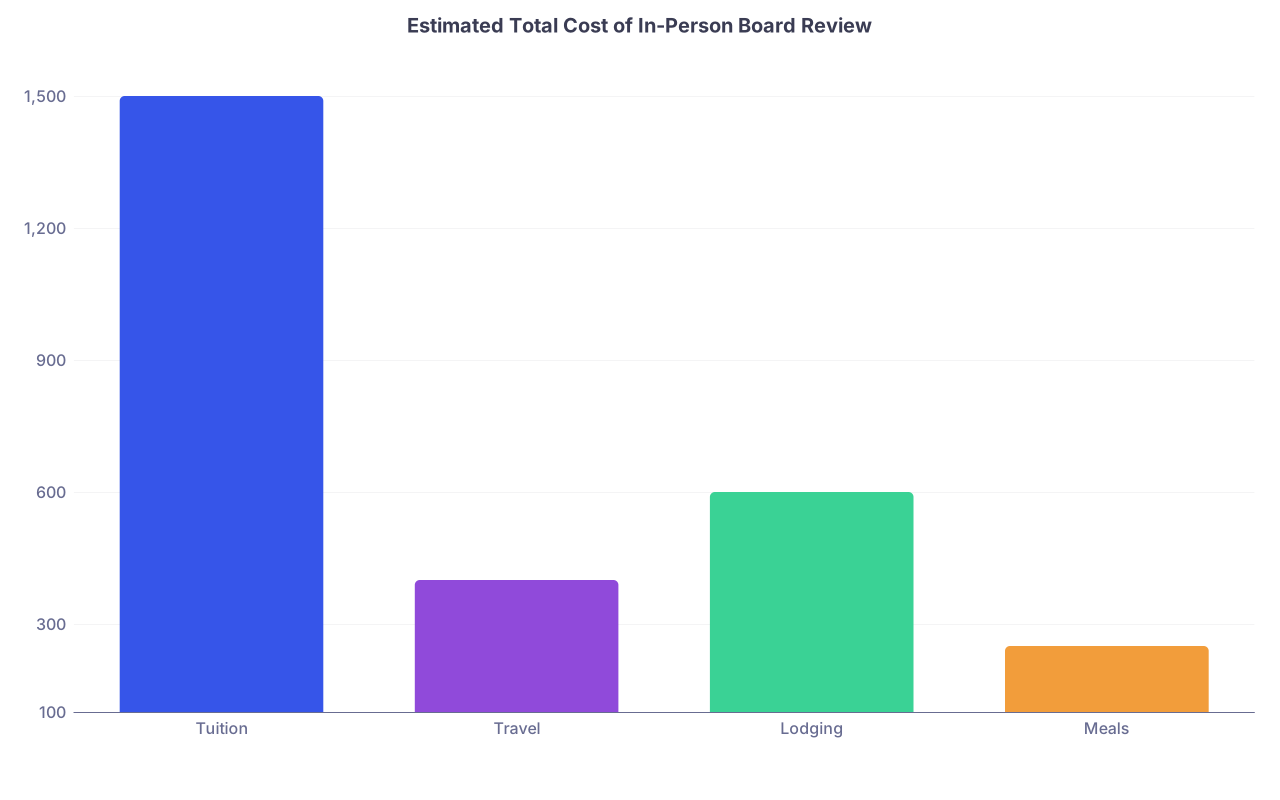
| Category | Value |
|---|---|
| Tuition | 1500 |
| Travel | 400 |
| Lodging | 600 |
| Meals | 250 |
A “$1,500 course” easily turns into $2,500–$3,000 all‑in. On a PGY‑2 salary, that’s brutal.
If your program or department reimburses most of it? Whole different conversation. Then your “cost” is primarily time and energy.
2. Time & Cognitive Bandwidth
Take 5 days of lectures + travel. That’s basically a week of your life.
- You might need to trade calls or rearrange schedules
- You’ll be exhausted during and after
- You’re not doing questions during those hours, you’re passively consuming slides
I’ve seen residents return from week‑long courses fried, then barely touch the course materials afterward.
3. Opportunity Cost
That same week could be:
- 1,500–2,000 high‑quality practice questions + reviewing explanations
- Two passes through a condensed outline
- Sleep, exercise, and mental health you probably need more than another lecture
If you’re tight on time (and all residents are), you have to ask: Will this course produce more score gain than that same time + money spent on Q‑banks and focused solo review?
For a lot of people, the answer is no.
When a Live Course IS Worth the Money
It’s not all negative. There are residents for whom in‑person courses are genuinely high‑value.
1. You Have a History of Struggling with Big Exams
If you:
- Barely passed Step 1/2/3 or COMLEX levels
- Failed a prior board exam (primary certification or subspecialty)
- Have in‑service exam scores well below national mean
…you’re in a higher‑risk group. Pass rates are not uniform. Programs know this. The stakes for failing are high: remediation, repeat testing, delayed promotion, job offers contingent on passing boards.
In that scenario, a well‑run, in‑person course can be:
- A hard reset on your approach
- A structured review of core content you never fully solidified
- A psychologically anchoring event that forces you to get serious
Is it perfect? No. But it’s often better than pretending you’ll fix years of shaky foundation by half‑hearted question blocks “when you’re not tired” (so, never).
2. You Need External Structure to Actually Study
Be honest with yourself. If left alone:
- Do you default to Instagram and charting rather than studying?
- Have you already “planned” to study multiple times and done almost nothing?
- Did you only really study for prior exams once you registered for a live course or had a scheduled group?
If yes, then a live course is basically purchased discipline. You’re paying someone to put you in a chair, remove distractions, and walk you through the content.
That’s not weak. That’s self‑awareness. Just expensive.
3. Your Program Pays (or Strongly Recommends)
If your residency:
- Provides a vetted course for your entire class
- Pays full or major partial tuition
- Builds it into your schedule as protected time
Then it’s usually smart to go. You may still need your own question‑based prep before and after, but saying no to something your program is funding and endorsing puts you at a disadvantage relative to co‑residents.
One caveat: if the track record is terrible (“everyone who went last year still struggled”), you’re allowed to question it. Ask upper levels what actually helped them.
When Courses Are Almost Never Worth It
Flip side. Some situations where I’d almost always skip paying out of pocket.
1. Strong Prior Test Performance + Decent Prep Habits
If this describes you:
- You scored comfortably above passing on step exams / in‑service tests
- You finish Q‑banks on time and review explanations thoroughly
- You can stick to a study schedule without external pressure
Then you’re exactly the person the course brochures target—because you look like a guaranteed “success story.”
But you’re also exactly the person who least needs them.
You’ll learn more per hour from:
- A high‑quality question bank (or two)
- A structured 8–10 week plan
- One solid rapid‑review resource
Than from 50 hours of someone reading slides at you.
2. Courses That Are Pure Lecture Marathons
Some live courses are nothing more than 10‑hour lecture days with:
- Minimal interactive questioning
- Little to no emphasis on test strategy
- Outdated slides recycled yearly
That’s glorified med school all over again. You already know how that goes—high yield while you’re in the room, then fast forgetting without active retrieval.
If there is no real question practice, no emphasis on how to think through board vignettes, and no structured plan after the course, I would pass.
3. Very Late Booking or Pure Panic Purchases
Residents do this all the time:
- Realize 4–6 weeks before boards they are behind
- Panic‑buy a course as a Hail Mary
- Burn a week on lectures with almost no dedicated time afterward
If you’re already close to the exam and underprepared, you usually need targeted, high‑yield question review, not a firehose of content you don’t have time to consolidate.
A Simple Framework: Should YOU Pay For One?
Use this like a checklist. If you answer “yes” to most in a section, follow that direction.
Step 1: Risk Level
- Have you ever failed Step/COMLEX or a major in‑service?
- Are your recent practice tests close to or below the passing threshold?
- Do you feel your foundation in core knowledge is weak (not just “rusty”)?
If you’re high‑risk → courses become more defensible.
Step 2: Study Discipline
- Have you consistently followed through on past study plans?
- Did you complete Q‑banks for prior exams on schedule?
- Do you actually study when you say you will, after a call month?
If your honest answers are “no” across the board, then a structured live course might be your best shot at doing anything substantial.
Step 3: Money & Support
- Will your program reimburse most of the tuition?
- Do you have savings/side income that makes a $2,000 hit tolerable?
- Or will this go on a high‑interest card you’ll be paying off for years?
If you’re going to wreck your finances for a course you don’t really need, skip it and invest in top‑tier Q‑banks and 1–2 excellent review resources.
Step 4: Quality of the Specific Course
Not all board review courses are equal. Before you pay:
- Ask recent grads from your program what actually helped them pass
- Look for pass‑rate guarantees or honest stats, not just cherry‑picked testimonials
- Check whether their questions and content are updated for the current exam blueprint
If the word on the street is “We went, but the Q‑bank + self‑study mattered way more,” trust that.
How to Get 80% of the Benefit Without Going
You can mimic the advantages of an in‑person course without leaving your apartment.
Pick one comprehensive Q‑bank
Commit to finishing it. UWorld, TrueLearn, Rosh, ExamMaster—depends on specialty, but pick one serious bank and live in it.Use a structured timeline
8–12 weeks, with daily question goals and one full‑length practice exam every 2–3 weeks. No fluff.Add one primary content resource
A video series or a good board review book. Use it to review weak areas after you see your Q‑bank patterns.Create your own “mini‑course weekend”
Two days off, 6–7 hours/day, focused only on one big domain (cardio, OB, whatever is your weak spot). No calls. No clinic. Full immersion. This gives you 80% of the “intensive review” feel, at almost no cost.

| Step | Description |
|---|---|
| Step 1 | Resident evaluates need |
| Step 2 | Strong case for live course |
| Step 3 | Consider intensive self study |
| Step 4 | Attend program supported course |
| Step 5 | Focus on Q bank and review resources |
| Step 6 | High exam risk |
| Step 7 | Poor self discipline |
| Step 8 | Program pays |
Quick Specialty‑Specific Note
Some specialties have a stronger tradition of live courses (e.g., general surgery, anesthesiology, IM subspecialties). That doesn’t automatically mean they’re required—but it does mean:
- There’s usually more word‑of‑mouth data from prior classes
- Some employers care about you being “board‑certified on first attempt” more in very competitive subspecialties
Ask recent grads from your own specialty and program what truly moved the needle. Their answer is worth more than any brochure.
Key Takeaways
- In‑person board review courses are not essential for most residents to pass.
- They can be worth it for high‑risk test takers or those who need external structure—and especially if your program pays.
- For many, a disciplined plan built around a top‑tier Q‑bank plus one solid review resource gives better ROI than a $2,000 lecture marathon.
FAQ (Exactly 5 Questions)
1. Do program directors care whether I took a live board review course?
No. They care whether you pass your boards, not how you prepared. The only time this becomes relevant is if you fail—then they may suggest or require a formal course for remediation.
2. Are online/live‑stream board review courses better or worse than in‑person?
For most residents, online live or on‑demand courses are more efficient: no travel, cheaper, easier to pause and review. You lose the “forced immersion” of being physically present, but you can recreate some of that with scheduled protected time if you’re disciplined.
3. If I can afford only one resource, should it be a course or a question bank?
Question bank. Every time. Questions + explanations teach you content, pattern recognition, and timing in the exact format you’ll be tested. A course is supplemental. A good Q‑bank is foundational.
4. When is the best time in residency to take a live course if I decide to do it?
Usually in the few months leading up to your exam, ideally after you’ve already covered a chunk of material independently. Going too early (a year out) means you’ll forget most of it. Going too late leaves you no time to reinforce what you learned.
5. What red flags should I watch for when evaluating a specific course?
Be wary of programs that: won’t share clear pass‑rate data, use obviously outdated slides, have minimal or low‑quality practice questions, or rely heavily on hype/testimonials instead of transparent outcomes. If several recent grads roll their eyes when you mention the course name, listen to them.