You are not “a little behind.” You are in emergency mode. Treat it that way.
If you are 4 weeks from your board exam and underprepared, you do not need motivation. You need a battle plan. Hour by hour. What to do on Day 3, Week 2, the final 48 hours. And what to ruthlessly cut.
I am going to give you exactly that: a 4‑week countdown schedule built for residents who are behind and still on service. Not a fantasy “protected study month.” A real-life, post-call, pager-still-going-off schedule.
Use this as a template, then adjust for your specialty and rotation intensity.
Big Picture: Your 4-Week Crisis Strategy
At this point you should stop pretending you can “do everything.” You cannot. You will not.
You will:
- Live in question banks.
- Anchor to 1 primary review resource (max 2).
- Accept that some esoteric topics will be weak.
- Focus on high-yield and pattern recognition.
- Protect sleep like an ICU bed.
Here is the macro structure for the next 4 weeks:
| Week | Primary Goal | Daily Question Target | Review Material Time |
|---|---|---|---|
| 4 | Triage + Content Patch | 80-100 | 1.5-2 hours |
| 3 | Volume + Patterning | 100-120 | 1-1.5 hours |
| 2 | Exam-Style Blocks | 120-140 | 1 hour |
| 1 | Simulation + Weakness Repair | 80-100 | 1-1.5 hours |
And yes, these numbers assume:
- You are working 50–80 hours / week.
- You are tired.
- You still choose to push.
If your schedule is lighter, increase questions and lengthen review blocks. But do not reduce sleep below 6 hours consistently. You will pay for that on exam day.
Week 4: Stabilize and Triage (Days 28–22)
At this point you should stop “organizing resources” and start doing questions immediately.
Primary goals this week:
- Establish your daily routine around your actual rotation.
- Get a diagnostic sense of your gaps.
- Build a tight, realistic resource list.
Your resource list should be brutally short:
- 1 main Qbank (UWorld, MedStudy, TrueLearn, Rosh, depending on specialty).
- 1 concise text / outline (e.g., MKSAP summaries, MedStudy books, Boards & Beyond-style videos for IM, Anesthesia Secrets, etc.).
- Optional: 1 rapid-fire audio for commutes (e.g., crack-the-boards audio, specialty podcasts).
Anything beyond that is fantasy. Shelf it.
Week 4 Daily Structure
Assume a “typical” resident workday: 6:30–5:30, no 24‑hour calls this week. Adjust as needed.
Morning (Pre‑work, ~60–75 min)
At this point you should:
- Do 20 timed, mixed questions (random topics) to simulate exam conditions.
- Review only the explanations for questions you got wrong or guessed.
- Flag recurrent weak topics.
Post‑work (Evening, 2–3 hours depending on fatigue)
- Do another 40–60 questions (timed, mixed if possible).
- Rapidly review explanations with a bias toward:
- Why the correct answer is right.
- Why your choice was wrong (what did you miss or mis-prioritize?).
- Spend 45–60 minutes on targeted reading or videos in your top 2–3 weak areas that day.
Specific Day-by-Day Targets (Week 4)
Day 28 (Start of Week 4):
- Take a short baseline assessment (e.g., 40–60 question block, exam-style).
- Write down your 5 main weak domains. Not 20. Five.
Days 27–25:
- Focus your “content patch” time on those 5 domains.
- Maintain 80–100 questions per day.
- Do not get lost in chapters; target sections tied to missed questions.
Days 24–22:
- Shift to more mixed blocks, still with 1–2 focused topic blocks per day if needed.
- Begin building a short “Rapid List” doc or notebook:
- Classic triads, must-know scores, staging systems, drug toxicities, algorithms.
- Keep it under 4–5 pages total by the end of this week.
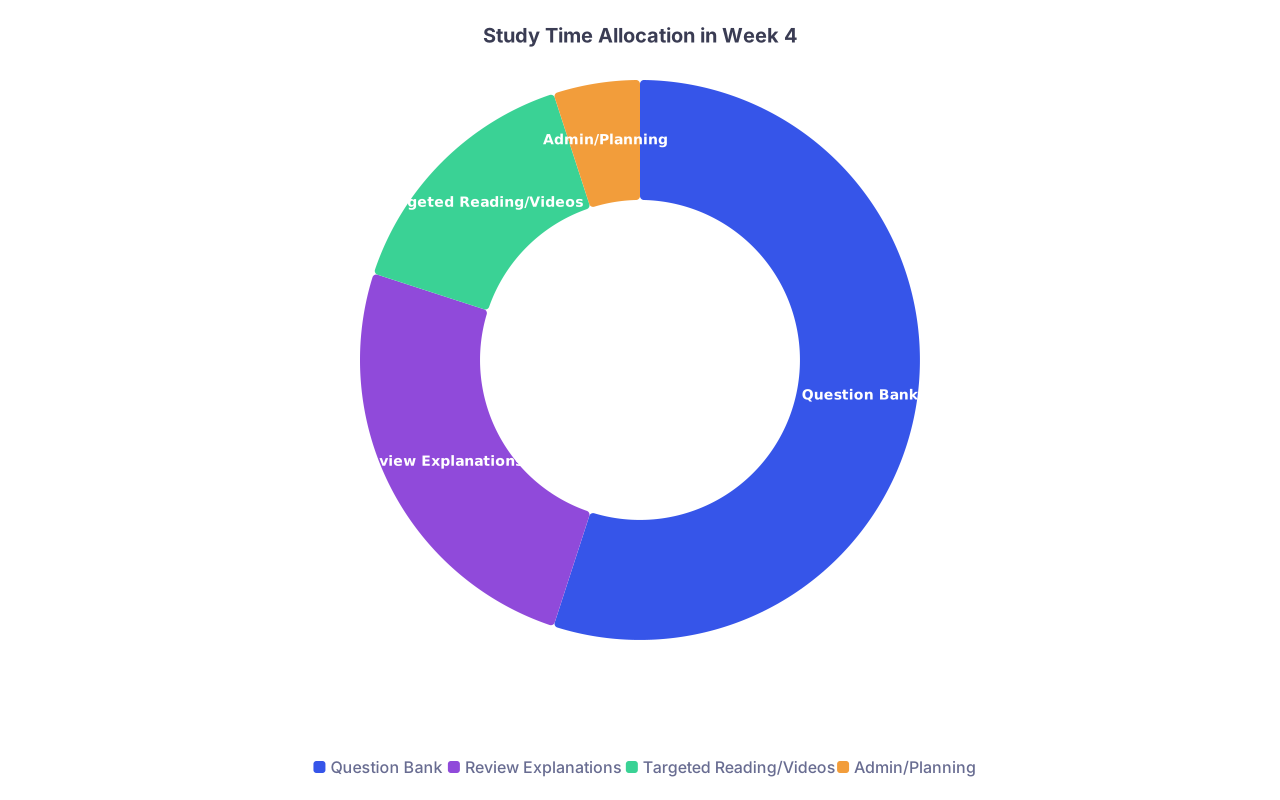
| Category | Value |
|---|---|
| Question Bank | 55 |
| Review Explanations | 25 |
| Targeted Reading/Videos | 15 |
| Admin/Planning | 5 |
By the end of Week 4, you should:
- Have completed roughly 500–600 new Qbank questions.
- Know your top 5–7 weak systems cold (not fixed, just clearly identified).
- Have a stable daily routine, even on tiring service days.
Week 3: Volume and Pattern Building (Days 21–15)
Now you shift from “what do I not know” to “what does the board love to ask again and again.”
At this point you should:
- Prioritize mixed, exam-style blocks.
- Hammer repetition of common patterns (ACS workup, sepsis bundles, ventilator changes, arrhythmia algorithms, prenatal care, etc. depending on specialty).
- Start tightening your timing under pressure.
Weekly Targets (Week 3)
- Qbank: 700–800 questions across the week.
- Study time: 3–4 hrs per weekday, 6–8 hrs per weekend day (if not on call).
- One half-length simulated exam (2–3 blocks back-to-back).
Daily Breakdown (Typical Workday, Week 3)
Pre‑work (60–75 min)
- 20–25 timed, mixed questions.
- Very brief review of explanations. No deep dives in the morning.
Post‑work (2.5–3 hours)
- 2 blocks of 20–25 timed questions.
- Review explanations with a notebook or digital doc open:
- Add important algorithms or if/then rules to your “Rapid List”.
- 30–45 minutes of high-yield content:
- Board review book sections for topics missed that day.
- Rapid board-style lecture.
Structure Your Week 3 Like This
Day 21 (start of Week 3):
- Do two back-to-back blocks in test-like conditions (no phone, no interruptions).
- Time each block, check if you finish with ≥5 min to spare.
- Identify any timing problem (staring at questions, rereading often).
Days 20–18:
- Focus: Qbank heavy. 100–120 questions/day.
- Review: Do not write essays in your notes. Single-sentence “If X, think Y” style.
Day 17:
- Half-day simulation: 3 consecutive blocks if possible (Sat/Sun works best).
- Practice break timing (e.g., 10 min between blocks).
- Afterward, do a brutally honest post-mortem:
- Top 5 missed patterns.
- Any consistent misreads (“I always ignore the one abnormal lab I actually needed”).
Days 16–15:
- Reinforce exam-style stamina.
- Begin gently cycling through your “Rapid List” daily.

By the end of Week 3, you should:
- Have done 1200–1400 total questions across Weeks 4 and 3 combined.
- Have clear pattern recognition for the “bread and butter” topics in your specialty.
- Know your timing tendencies and begun correcting them.
Week 2: Full Exam Mode (Days 14–8)
At this point you should be acting like you are already in the exam window. No more casual question blocks. Everything is simulated.
Primary goals in Week 2:
- Build endurance for full exam day.
- Sharpen test-taking strategy (not just content).
- Deepen knowledge in recurring weak spots, not chase obscure topics.
Weekly Targets (Week 2)
- 800–900 questions.
- 1 full-length mock exam (or as close as your Qbank allows).
- 2–3 shorter “mini-mocks” (3–4 blocks).
Day-by-Day Skeleton (Week 2)
Day 14 (start of Week 2): Full-Length Simulation if possible
- Approximate your real exam number of questions/blocks.
- Sit in one place. Minimal breaks. Real snack and water setup.
- Afterward:
- Record your score and timing per block.
- Categorize misses:
- Knowledge gap.
- Misread question.
- Overthinking / changing from right to wrong.
- Fatigue / rushing.
Days 13–11: Repair + Reinforce
Each day:
- 2 exam-style blocks post-work (40–60 questions total).
- 1 smaller block pre-work (20–25 questions).
- 60 minutes of surgical repair on your weakest 2–3 recurring topics:
- Example for IM: hyponatremia algorithms, valvular lesions, COPD/asthma stepwise therapy.
- Example for OB/Gyn: fetal heart tracing categories, hypertensive disorders, postpartum emergencies.
Your “Rapid List” should now be 4–6 pages. Not 20. If it is bloated, cut it.
Day 10: Mini-Mock
- 3–4 consecutive blocks if schedule allows.
- Focus on:
- Maintaining consistent pace.
- Avoiding catastrophic blocks (where fatigue tanks your accuracy).
Days 9–8: Precision Days
- Slightly reduce volume (80–100 questions/day).
- Increase review quality:
- For each missed question, ask:
- “What 5‑second thought would have saved me here?”
- Put that thought into your Rapid List.
- For each missed question, ask:
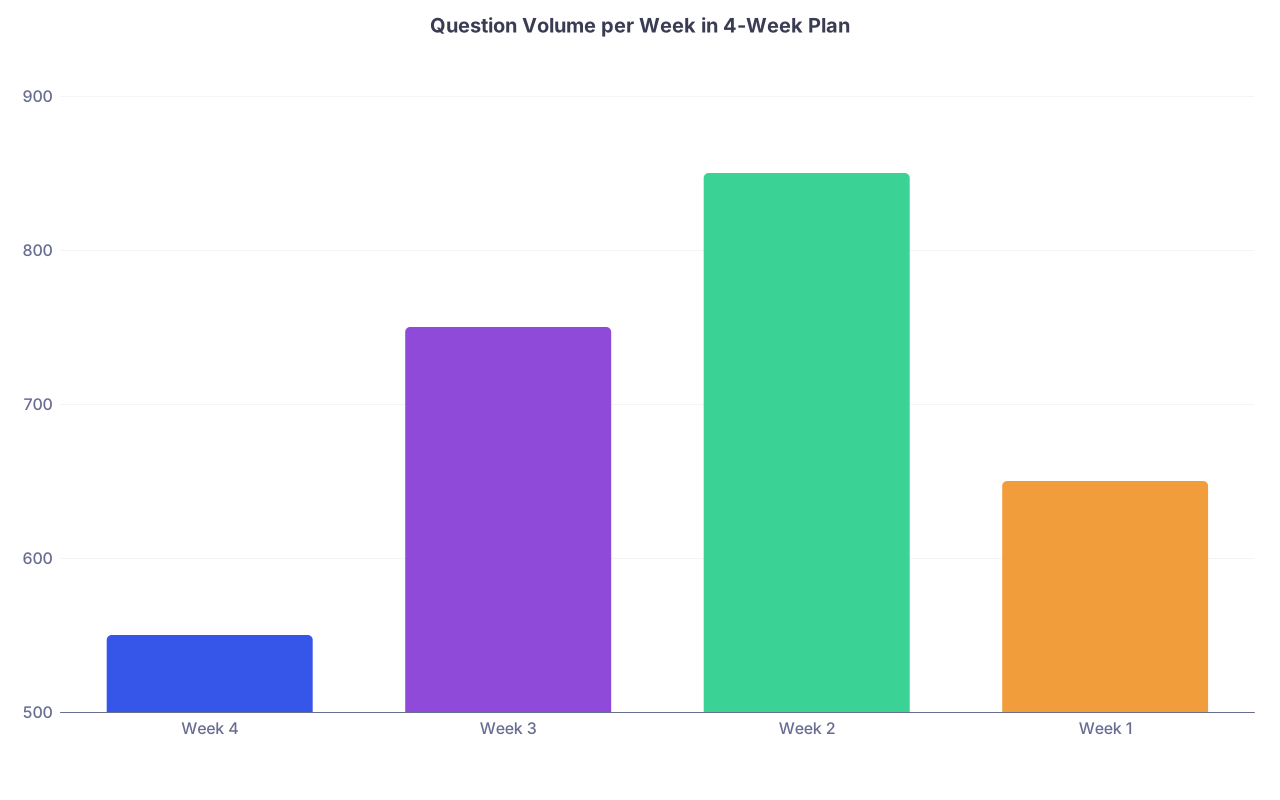
| Category | Value |
|---|---|
| Week 4 | 550 |
| Week 3 | 750 |
| Week 2 | 850 |
| Week 1 | 650 |
By the end of Week 2, you should:
- Have experienced something that feels like exam day at least once.
- Have a realistic sense of your expected range (not perfect, but honest).
- Know exactly which 3–4 topics scare you. Those get priority next week.
Week 1: Final Countdown (Days 7–1)
This is where people either sharpen or panic. Your job is to sharpen.
At this point you should:
- Stop adding new resources.
- Tune your brain and your stamina.
- Protect your sleep aggressively.
Structure of the Final Week
Split into two distinct phases:
- Days 7–3: Active reinforcement and targeted repair.
- Days 2–1: Tapering, confidence building, and mental reset.
Days 7–3: Sharpen and Stabilize
Daily:
- 80–100 timed, mixed questions.
- Shorter but higher-quality reviews.
- Daily Rapid List run-through (10–20 min).
Specific milestones:
Day 7:
- Last heavy-content day. If there is a core topic you still feel inadequate in (e.g., ventilator management, prenatal screening, anticoagulation choices), this is your final chance for a 1–2 hour focused push.
Days 6–5:
- One more “mini-mock” of 3–4 blocks if schedule allows. Not full-length.
- Confirm your test-day logistics:
- Route to testing center.
- Required documents.
- Snacks, drinks, layers of clothing.
- Transportation backup if car/metro fails.
Day 4–3:
- Begin decreasing total daily study time by 10–20%.
- Keep question counts around 60–80.
- Spend more time on:
- High-yield charts.
- Your Rapid List.
- Annoying memorization (drug side effects, cutoffs, staging).
Days 2–1: Taper and Protect
This is where underprepared residents make a big mistake: they try to “cram like Step 1” and destroy their sleep. Bad move.
Day 2 (48 hours before exam):
At this point you should:
- Drop to 40–60 low-stress questions max.
- Focus on:
- Reviewing your Rapid List twice.
- Light reading of summary tables.
- Physical reset:
- Eat real food.
- Hydrate.
- Aim for a proper bedtime aligned with exam wake-up time.
Do not start new major topics. No “I never really learned vasculitides, let me spend 3 hours now.” That is how you flood and panic.
Day 1 (Day Before Exam):
- 0–20 very light questions, if any. Untimed. For comfort, not learning.
- 60–90 minutes max of:
- Skimming Rapid List.
- Looking at 1–2 key diagrams / charts.
- Afternoon:
- Pack everything: ID, confirmation email, snacks, water, comfortable clothes.
- Drive or map out your route to the testing center if unfamiliar.
- Evening:
- No high-adrenaline media right before bed.
- Some residents sleep terribly the night before no matter what. Fine. Focus on the 2–3 nights prior being solid.
You want to walk into the exam under-revved but alert. Not fried.
Handling Call, Nights, and Brutal Rotations
You are a resident, not a full-time student. The schedule above assumes “normal busy.” If you are on nights or heavy ICU weeks, adjust intelligently.
If You Are On Nights
- Make your “pre‑work” block happen before your shift, when you have the most mental clarity.
- During slow periods:
- 5–10 questions at a time on your phone or iPad.
- Focus on reviewing explanations more than raw volume.
- After nights:
- Forget big question blocks. Protect sleep.
- 20–30 very low-intensity questions before bed is enough.
If You Are On ICU / Trauma / Heavy Call
You will not hit ideal question counts. Accept that. What you can do:
- Lock in a non-negotiable 45–60 minute daily minimum:
- Usually after sign-out + quick decompress + snack.
- Even if that means just 20–30 questions.
- Use post-call days efficiently:
- 60–90 minutes, then crash.
- Avoid trying to “catch up” with a 6‑hour post-call marathon. It never works. You just burn out.
Quick Specialty-Specific Adjustments
You know your board better than I do in a generic article, but some patterns are consistent.
Internal Medicine:
Prioritize:- Cardiology, pulmonology, infectious disease, rheum basics, endocrine.
Do not obsess over rare zebras.
- Cardiology, pulmonology, infectious disease, rheum basics, endocrine.
Pediatrics:
Heavy:- Vaccines, developmental milestones, congenital heart, infectious rashes, failure to thrive, asthma.
Surgery:
Focus:- Pre-/post-op management, fluids/electrolytes, trauma resuscitation, common complications, basic onc.
OB/Gyn:
Hammer:- Fetal heart tracings, hypertensive disorders, labor management, contraception, gynecologic cancers.
Anesthesia:
Emphasize:- Airway, hemodynamics, pharm, vent physiology, crisis algorithms.
Same game: identify the 4–5 “money” topics that will show up repeatedly and push those relentlessly.
7 Non-Negotiables for This 4-Week Sprint
- Question-first approach. Explanations and targeted reading serve the questions, not the other way around.
- One primary resource. Not five. Pick and commit.
- Daily minimum, even on terrible days. Momentum matters more than hitting the perfect target.
- Sleep protection. Chronically <6 hours is self-sabotage.
- Honest tracking. Write down:
- Questions done.
- Blocks completed.
- Top 3 weak topics each week.
- No social comparison. Your co-resident who finished 2 full Qbanks is irrelevant to your next 4 weeks.
- Planned taper. Last 48 hours are about clarity, not cramming.
FAQ (Exactly 3)
1. What if I am so behind that I have done almost no questions and my exam is 4 weeks away?
You still follow this structure, but you must prioritize Qbank volume aggressively. Forget full-length textbooks entirely. Aim for:
- 100–120 questions/day on lighter days.
- 60–80 on heavy service days.
You will not cover “everything.” The goal becomes maximizing pattern recognition and nailing the most testable, common scenarios. People pass from this position every year. The ones who fail usually spent the last 4 weeks reading passively instead of doing questions.
2. Should I postpone my exam if I feel this unprepared?
If you have the real option to postpone without major career or contract consequences, and you have done almost no prep, postponing can be reasonable. But residents often do not have that luxury (program expectations, credentialing timelines, fellowship apps). Ask:
- Have I done at least a few hundred questions?
- Can I commit to the schedule above honestly?
- Will postponing actually create more study time, or just more procrastination space?
If postponing simply pushes the same problem 3 months later with no structural change in your life, it solves nothing.
3. How do I handle anxiety when I keep seeing low Qbank percentages?
You treat Qbank performance as training data, not a verdict. Step back weekly and look at trends:
- If your scores are inching up or staying stable while questions get harder and more mixed, you are improving.
- If certain topics are always red, that is useful: they go on your priority list.
- Stop checking the percentage after every block; look at your weekly average instead.
And remember: Qbanks are often harder and more detailed than the real exam. I have watched plenty of residents living in the 55–60% Qbank range pull off solid passing scores. The difference was not brilliance. It was consistent, focused work in the final month and not mentally quitting.