The worst mistake residents make about exam accommodations is waiting until they’re in crisis to even think about them.
You should be asking “Do I need accommodations?” before you’re failing NBMEs, burning out, or having panic attacks in the testing center parking lot.
Let’s walk through how to decide—cleanly, logically, and without the guilt/shame swirl that usually shows up around this topic.
The real question: “Do I qualify?” vs “Do I deserve this?”
Most residents secretly ask the wrong question.
They ask: “Do I deserve accommodations? Am I disabled enough?”
The boards (USMLE/COMLEX) don’t care how you feel about deserving. They care about two things:
- Do you have a documented condition that substantially limits a major life activity (like reading, concentrating, sitting for long periods)?
- Is there a clear link between that limitation and what the exam requires (sustained attention, reading speed, visual processing, etc.)?
If the answer to both is yes, you should seriously consider requesting accommodations. Not someday. Now.
Step 1: Get brutally honest about your actual difficulties
Forget labels for a second. Look at your real-world functioning when it comes to test demands.
Ask yourself:
Do I consistently:
- Run out of time even when I know the content?
- Need way more breaks than other people to stay functional?
- Have migraines or pain that tank my performance in long sittings?
- Struggle to read dense text on screens or paper at a normal speed?
- Freeze or dissociate in high-stakes test environments despite preparation?
Do my practice tests under “standard” conditions look way worse than:
- My in-service performance?
- My clinical performance?
- My evaluations and how attendings describe me?
If you’re constantly hearing “You’re so strong clinically, I don’t get why your scores are low,” that’s a red flag that something about the testing format—not your knowledge—may be the main bottleneck.
This is exactly where accommodations might be appropriate: to remove that artificial bottleneck so the exam is measuring your knowledge and reasoning, not your disability or condition.
Step 2: Know what conditions commonly qualify
No, it’s not “only for people with extreme disabilities.” That’s a myth.
Here are conditions that often justify exam accommodations when well-documented:
| Condition Type | Common Impact on Exams |
|---|---|
| ADHD | Speed, focus, impulsivity |
| Specific learning disorder | Reading speed, decoding, written expression |
| Anxiety disorders | Panic, cognitive freeze |
| Major depression | Processing speed, focus |
| Visual impairments | Reading, screen tolerance |
| Hearing impairments | Instructions, audio cases |
| Chronic pain / migraines | Stamina, breaks needed |
And yes, you can have more than one condition. ADHD + anxiety. Chronic pain + depression. That combination often hits you hardest on a 7–9 hour exam.
If you’ve never been evaluated but strongly suspect ADHD, a learning disorder, or something similar based on lifelong patterns (e.g., “I always needed double time in college”), that’s a sign to get formally assessed—not a reason to just grind harder.
Step 3: Understand what boards actually offer
Before you decide whether to request, it helps to know what “accommodations for boards” actually means.
Typical accommodations (USMLE, COMLEX, specialty boards) include things like:
- Extra time (e.g., 1.25x, 1.5x)
- Extra or extended breaks
- Separate, quiet room
- Small group or solo testing room
- Permission for:
- Medications, snacks, glucose-monitoring supplies
- Assistive devices (screen readers, magnification, tinted overlays)
- Alternate formats (for severe visual/hearing impairments)
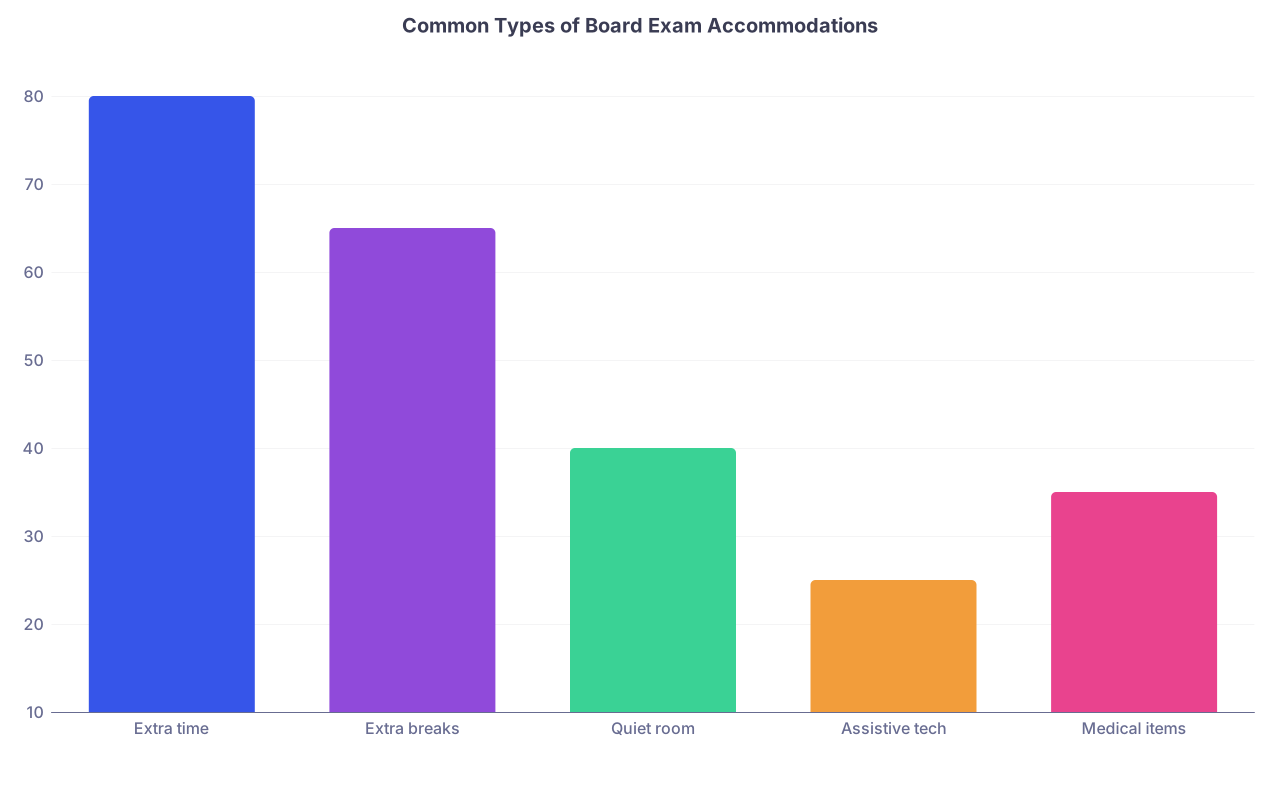
| Category | Value |
|---|---|
| Extra time | 80 |
| Extra breaks | 65 |
| Quiet room | 40 |
| Assistive tech | 25 |
| Medical items | 35 |
No one is rewriting the test to be easier. They’re changing the conditions under which you take it so the exam is less about “Can your nervous system survive today?” and more about “Do you know medicine?”
Step 4: The decision framework – 5 questions to answer honestly
Here’s the simple framework I use when residents ask me: “Should I request accommodations?”
1. Do my struggles significantly worsen under test conditions?
If outside exams you can:
- Think clearly
- Retain information
- Make decisions
- Learn reasonably quickly
…but the moment you’re under timed, high-stakes conditions you:
- Go blank
- Can’t read questions at normal speed
- Make tons of careless errors
- Run out of time constantly
then your performance gap under exam conditions matters. That’s exactly what accommodations are meant to address—if a disability or condition is the driver.
2. Is there an existing diagnosis—or a very strong suspicion?
You’re a resident. You know the drill. Board organizations want documentation, not vibes.
You’re in a stronger position if you:
- Already have:
- ADHD, SLD, anxiety, depression, PTSD, sensory issues, etc. diagnosed
- Prior accommodations in undergrad/med school (extended time, note takers, etc.)
- Or have very strong, long-standing patterns that suggest something (e.g., always reading slowly, always finishing exams late, documented by teachers in the past)
If you don’t have a diagnosis yet but recognize yourself in this, the logical next step is not “push through” but “get a formal evaluation” (more on that below).
3. Have I already optimized everything else and still hit the same wall?
Accommodations ≠ shortcut.
Before pulling this lever, make sure you’ve:
- Fixed basic logistics:
- Sleep window not insane (yes, even on ward months you can protect 1–2 days before your exam)
- Minimal post-call studying; realistic schedule
- Used good board prep strategies:
- Question-heavy, spaced repetition, not endless rereading
- Multiple practice tests under “standard” conditions
If, after all that, your test performance still lags far behind your clinical skills and knowledge, accommodations become a rational, not desperate, option.
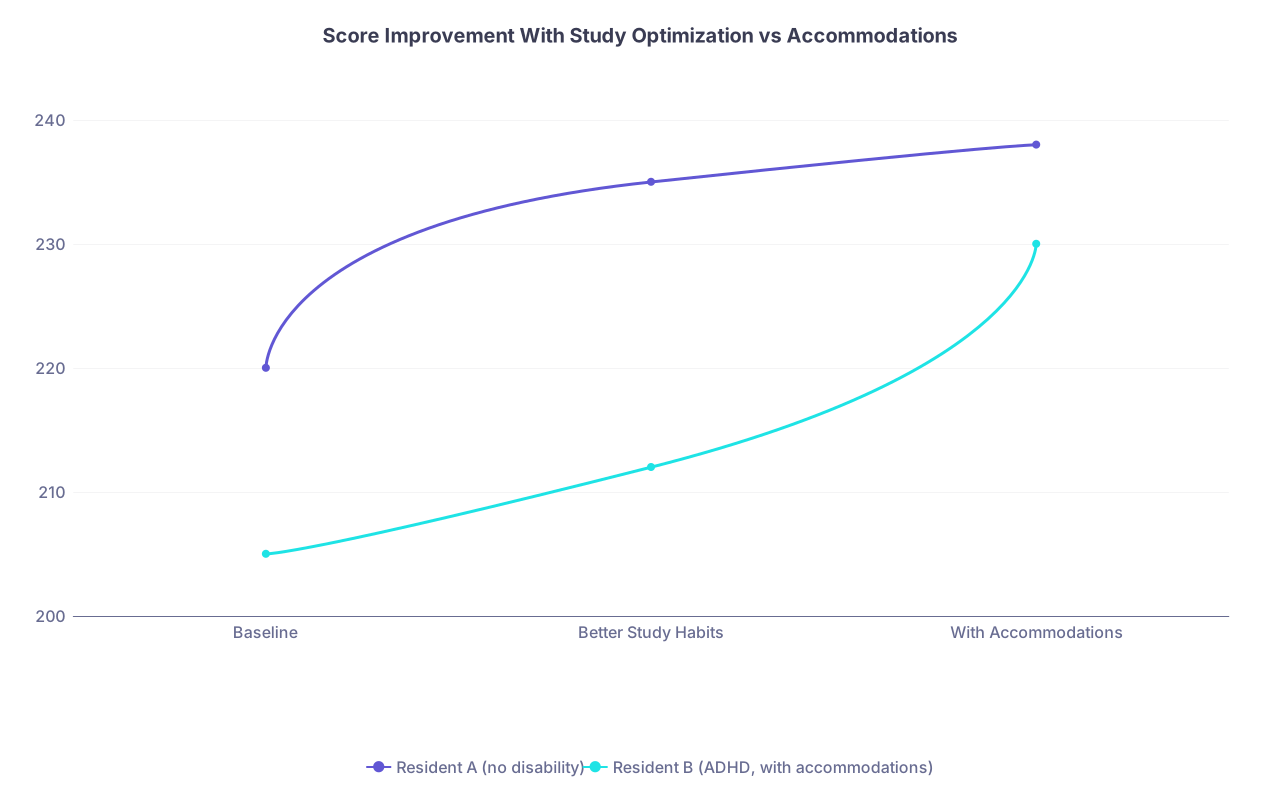
| Category | Resident A (no disability) | Resident B (ADHD, with accommodations) |
|---|---|---|
| Baseline | 220 | 205 |
| Better Study Habits | 235 | 212 |
| With Accommodations | 238 | 230 |
4. Will this condition still be there on test day and beyond?
The boards look for chronic or long-term conditions, not temporary blips.
You’re a good candidate to request accommodations if:
- Your condition has been present for years (often since childhood for ADHD/SLD)
- Symptoms persist across environments
- Treatment helps but doesn’t fully normalize your functioning in test conditions
You’re less likely to be approved if:
- It’s an acute issue (e.g., 2-week insomnia flare)
- Documentation is thin or brand new, with no history tying it back
That doesn’t mean you shouldn’t try. It means you should be realistic and thorough with documentation.
5. What happens if I don’t get accommodations?
This is the gut-check question.
Picture the next major exam (Step 3, COMLEX Level 3, in-training exam, board certification) under:
- Standard conditions
- Your most realistic schedule in residency
- With your current health and limitations
Ask:
“If everything goes the way it usually goes for me, what’s the likely outcome?”
- If the honest answer is: “I’ll probably pass, just not with my dream score,” that’s one situation.
- If the honest answer is: “There’s a real chance I’ll fail again even if I know the material,” that’s another.
Failing or barely scraping by repeatedly has costs:
- Emotional: shame, anxiety, impostor syndrome
- Practical: delays in graduation, contract issues, remediation, visa headaches for IMGs, etc.
Sometimes the bigger risk is not requesting accommodations.
Step 5: How to actually pursue accommodations (without losing your mind)
If you’re leaning toward “Yes, I should request,” here’s the clean sequence.

| Step | Description |
|---|---|
| Step 1 | Notice exam struggles |
| Step 2 | Gather records |
| Step 3 | Schedule evaluation |
| Step 4 | Review board guidelines |
| Step 5 | Talk to program or student services |
| Step 6 | Submit request early |
| Step 7 | Plan test with accommodations |
| Step 8 | Appeal or adjust strategy |
| Step 9 | Existing diagnosis |
| Step 10 | Approved? |
Step 5A: Read the actual board’s policy
Don’t guess. Go to the exact exam you’re planning:
- USMLE: “USMLE test accommodations”
- COMLEX: “NBOME test accommodations”
- ABIM, ABFM, ABS, etc.: “[Board name] disability accommodation policy”
You’ll find:
- Forms they require
- Specific documentation they want (e.g., psychoeducational testing within X years)
- Deadlines (often months before your preferred test date)
Step 5B: Get your documentation tight
Usually they want:
- A detailed letter from:
- A licensed psychologist/psychiatrist OR
- Your treating physician (for medical/physical conditions)
- Educational or neuropsychological testing (for ADHD/learning disorders)
- History of prior accommodations (school, MCAT, USMLE steps, etc.), if applicable

Key point: The report must connect the dots. Not just “ADHD present” but:
- How it affects reading speed, focus, and sustained attention
- Past evidence (grades, teacher comments, failed exams)
- Why specific accommodations are appropriate
Thin, generic letters are the fastest way to get denied.
Step 5C: Use institutional support (yes, even as a resident)
As a resident, you’re in a weird middle ground: not a med student, not fully independent.
You still have options:
- Talk to:
- Your program director (if you trust them)
- GME office
- Institutional disability services (many academic centers extend services to residents)
- They can:
- Help you find evaluators
- Draft supporting letters
- Adjust your schedule around board prep and test dates
You are not the first resident in your program to deal with this, even if no one talks about it.
Common fears that keep people from requesting (and why they’re mostly wrong)
Let’s hit the greatest hits.
“Programs will think I’m weak.”
Most program leadership doesn’t care whether you test with 1x or 1.5x time. They care whether you:
- Pass your exams
- Don’t disappear without explanation
- Are safe with patients
What actually freaks them out is when a resident fails multiple times and only then reveals there was a longstanding issue.
“It’ll follow me forever / show up on my license.”
For USMLE/COMLEX and major specialty boards:
- Score reports and licenses generally do not show that you tested with accommodations.
- Accommodations are about testing logistics, not your permanent record.
Always read the policy for your specific board, but the fear that “everyone will know” is usually exaggerated.
“Other residents are struggling too. I should just tough it out.”
Yes, residency is hard for everyone.
But:
- Not everyone has ADHD that cuts their reading speed by 40%.
- Not everyone gets migraines after 60 minutes in front of a bright screen.
- Not everyone’s PTSD spikes in confined, high-stakes environments.
You’re not asking for the exam to be easy. You’re asking for it to be fair given your documented limitations.
When you probably shouldn’t request accommodations
Let me be blunt: accommodations are not a fix for:
- Poor content knowledge
- Bad question strategy
- Zero practice under realistic timing
- Last-minute cramming during 80-hour weeks
If your main problems are:
- “I haven’t actually finished UWorld once”
- “I never review my incorrects”
- “I haven’t done any full-lengths”
then no amount of extra time will save you.
In that case, your priority is fixing your studying, not chasing accommodations.
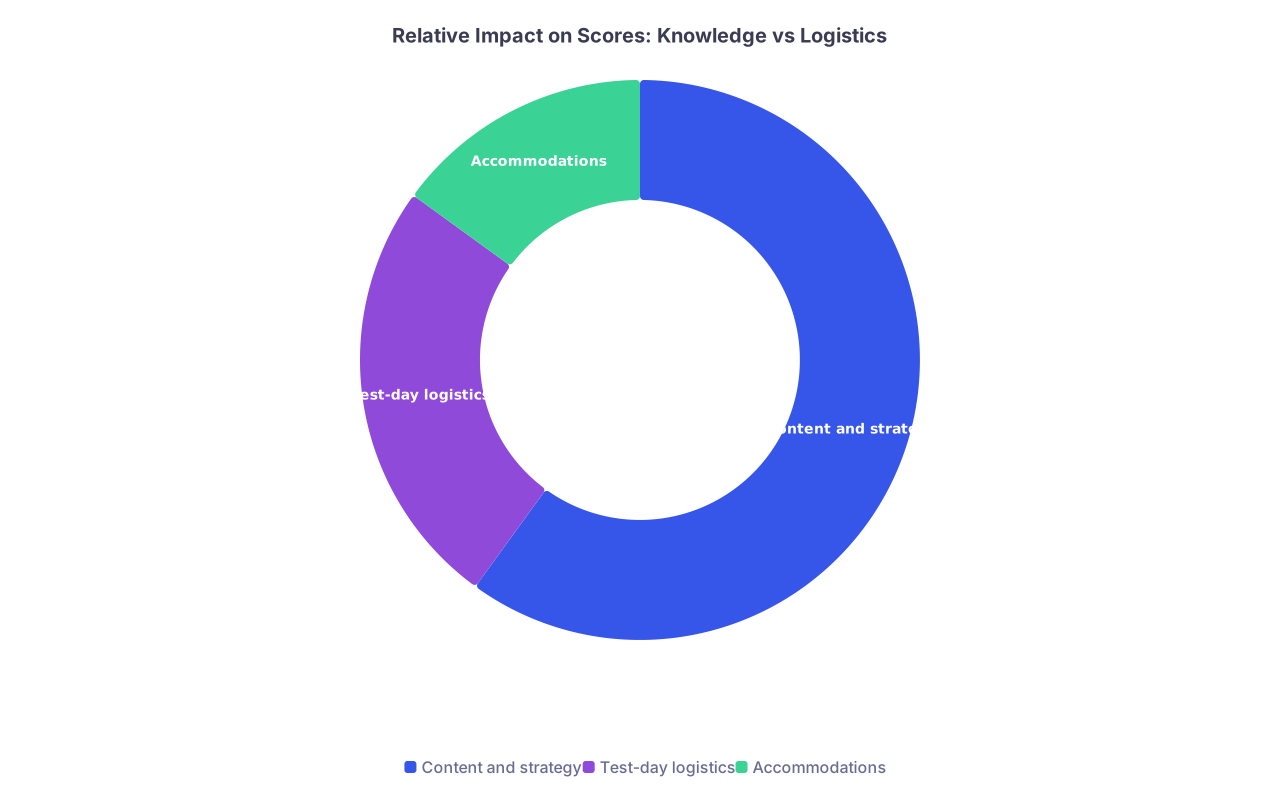
| Category | Value |
|---|---|
| Content and strategy | 60 |
| Test-day logistics | 25 |
| Accommodations | 15 |
Accommodations amplify solid preparation. They don’t replace it.
The bottom line
You should seriously consider requesting exam accommodations for boards if:
- You have a documented or strongly suspected condition that affects how you test
- Your exam performance is significantly worse than your actual knowledge and clinical performance
- You’ve tried reasonable study/test strategies and still hit the same functional wall
- The cost of repeated poor performance (or failure) is high for your career and mental health
None of this makes you less of a physician. It makes you someone who understands that brains and bodies differ, and that standardized tests are imperfect tools that sometimes need adjusting to be fair.
FAQ: Exam Accommodations for Boards (6 Questions)
1. Will requesting accommodations hurt my chances for fellowship or future jobs?
Unlikely. Scores sent to programs typically don’t indicate whether you tested with accommodations. Most PDs and employers never see that information. What will hurt you far more is failing multiple times or delaying exams for years because you’re afraid to ask for what you legitimately need.
2. Do I need full neuropsych testing, or is a doctor’s letter enough?
For ADHD and learning disorders, most boards want comprehensive psychoeducational or neuropsychological testing done relatively recently (often within 3–5 years). A short clinic note saying “ADHD, needs extra time” is almost always too weak. For medical, visual, or physical issues, a detailed letter from a treating specialist plus objective records (imaging, ophthalmology reports, etc.) is usually the core.
3. I never had accommodations before med school. Does that mean I don’t qualify now?
No. It makes the case a bit more complex, but not impossible. Plenty of high-functioning people with ADHD/SLD or chronic conditions skate by until the demands of med school/residency + long board exams finally expose the problem. Your evaluator will need to explain why this wasn’t diagnosed earlier and show a consistent history of difficulty once demands crossed a certain threshold.
4. How early should I apply for accommodations before my exam date?
Aim for at least 4–6 months before when you want to test, longer if you still need an evaluation. Many boards state timelines (e.g., 60–90 days), but decisions often take longer, and denials/appeals chew up time. If you’re a resident, build this into your rotation planning with your program.
5. What if my request is denied—am I just stuck?
Not necessarily. You can:
- Appeal with stronger documentation or clarification
- Adjust your exam timing to align with a lighter rotation
- Improve test-taking strategy and simulate test conditions more aggressively
But yes, you may have to take the exam under standard conditions while continuing to build your documentation for future tests (e.g., board certification).
6. I’m worried my co-residents will judge me if they find out. Should I keep it secret?
You don’t owe anyone details about your medical or mental health. Share only with people who actually need to know: your evaluator, the board, maybe your PD or GME office if schedules need to shift. If you do choose to tell peers, pick the ones who’ve shown they can handle vulnerability without gossip. But don’t sacrifice your career and health to protect some imaginary image of “invincible resident.”
Do this today:
Open your board’s official “test accommodations” page and read the documentation requirements. Then, based on what you just read, decide: do you need an evaluation, a records request, or just a conversation with GME? Pick one concrete step and schedule it before you go to bed tonight.