Are you more likely to become the psychiatrist you want to be if you train in a big-name academic center… or at a busy community psych program that just grinds through real-world cases?
Here’s the answer: neither is “better” in a vacuum. But one is almost certainly better for you, your goals, and the way you like to work. Let’s sort that out.
First: What Actually Counts as “Academic” vs “Community” Psych?
Forget the marketing on ERAS. Programs love to call themselves “academic-community hybrids” because it sounds safe.
Functionally, look at these questions:
- Where do you spend most of your time?
- Who are the core faculty?
- What’s the culture: research and conferences, or throughput and service?
Broadly:
Academic psychiatry programs
Based at university hospitals or major academic medical centers; heavy on teaching, structured didactics, and research. Names you know: MGH, Columbia, UCSF, Pitt, Michigan, etc.Community psychiatry programs
Based at county hospitals, community mental health centers, or non-university affiliated hospitals. Usually higher volume, less research, more “service heavy.” Many strong programs fall here: large county systems, safety-net hospitals, VA-heavy programs, etc.
Some programs truly are mixed: university-based but heavy county rotations (think UCLA + county, or state hospital plus university service).
Instead of obsessing over labels, judge by the daily life:
- How many residents are actually doing research?
- Are faculty publishing… or just talking about it?
- What percentage of time is in safety-net/community settings vs tertiary university hospital?
- What happens on a “typical” inpatient day?
The Real Trade-offs: What You Gain and Lose in Each
Let me walk through the things that actually matter for your career.
1. Case Mix and Clinical Volume
Academic:
- More subspecialty exposure: first-episode psychosis clinics, perinatal, neuropsychiatry, OCD programs, TMS/ECT, consultation-liaison for rare cases.
- Often more “interesting” or rare pathology, especially on consult services.
- Volume can be lower and more controlled, with more time per patient.
Community:
- Higher sheer volume of bread-and-butter psych: schizophrenia, bipolar, severe depression, polysubstance use, chronic psychosis, personality disorders.
- More exposure to systems issues: homelessness, incarceration, no-show rates, insurance battles.
- Less subspecialty nuance, more “this patient is back for the 14th time with the same crisis.”
If you want to be a highly competent general psychiatrist who can handle chaos in the real world, community training can be fantastic. If you want niche or academic subspecialty work, academic gives you earlier and richer contact with those services.
2. Teaching, Structure, and Supervision
Academic:
- Typically more structured didactics, grand rounds, journal clubs, case conferences.
- Supervision often more protected and formal: dedicated psychotherapy supervision, multiple weekly supervisors, scheduled teaching rounds.
- You’re surrounded by fellows (CL, addiction, child, forensics) who model subspecialty thinking.
Community:
- Teaching quality is highly variable. Some community programs have superb, focused teaching. Others basically treat you as cheap labor.
- You may get more informal “hallway teaching” from busy attendings rather than polished powerpoints.
- Less likelihood of multiple layers of subspecialty fellows; often just you and the attending (which can be great or terrifying).
If you need structure to learn and care about a deep didactic foundation, strong academic programs usually serve you better. If you learn best by doing, community can accelerate your comfort and independence.
3. Autonomy vs Hand-Holding
Academic:
- Early years often more protected. More layers above you: fellows, senior residents, attendings who like to discuss every nuance of clozapine titration.
- Autonomy usually increases later in residency.
- Some graduates feel less ready for high-volume outpatient or community work because they trained in relatively “cushier” environments.
Community:
- You may be “thrown in” earlier. Writing more notes, handling more crises, seeing more patients per day.
- Often more autonomy in decision-making, partly because the system has to move fast.
- The flip side: if supervision is weak, you can develop bad habits or feel unsupported.
Ask directly on interview day:
“When do you feel like people actually trust you to run a service?”
“How many patients do senior residents typically carry?”
Listen for real numbers, not vague fluff.
4. Research, Fellowships, and Academic Careers
If you’re even thinking about an academic or research-oriented career, this part is non-negotiable.
Academic psych:
- Easier to:
- Get involved in clinical or basic research
- Publish
- Present at APA or subspecialty meetings
- Mentors already plugged into fellowships and early-career awards.
- Name recognition does matter for competitive fellowships (top CL, forensics, research-heavy child psych).
Community psych:
- Some community programs have almost zero research infrastructure. If they say “we encourage scholarly activity,” ask:
“How many residents published last year, and in what?” - You can still go into academics from community programs, but you’ll be swimming upstream. You’ll need to hustle for multi-site projects, QI studies, or external mentors.
Here’s the blunt rule:
If you want a research career, major fellowship, or high-level academic job and you have access to a strong academic psych program → you should strongly favor academic.
5. Lifestyle, Call, and Burnout Risk
Both sides can be good or bad. Depends far more on the specific program than the category. That said:
Academic:
- Sometimes more protected from chaos: better ancillary support, stronger social work, more consultants.
- Some academic psych programs are almost “cush” compared to other specialties in the same hospital: decent hours, lighter call, strong outpatient focus later.
- But: conferences, presentations, scholarly work, and culture of “being involved” can add hidden time.
Community:
- Often heavier inpatient workloads, more night float, more weekend call.
- More emotional strain with severe, chronic, and under-resourced populations.
- On the plus side, fewer “academic expectations” on top of your clinical work. When you’re off, you’re actually off.
On interviews, stop asking “Is wellness valued?” Everyone will say yes. Ask:
- “How many weekends per month are you on?”
- “What are duty hour violations like, honestly?”
- “What time do people actually go home on inpatient?”
6. Future Job Options and Earning Power
Here’s where students get unnecessarily anxious.
Reality:
Most psychiatrists end up in outpatient, community, or hybrid positions, not pure academic roles. And almost all employers care more about:
- Are you board-certified?
- Can you handle a full panel safely?
- Are you a nightmare to work with?
than whether you trained at a fancy name.
Academic psych training:
- Helpful if:
- You want a full-time faculty job at an academic center
- You want to be “the OCD person” or “the perinatal person” and run a specialty clinic
- You want to lead research or major QI work
- Won’t magically pay you more in private or community practice. Sometimes the opposite: heavy academic tilt and low volume experience can make the first year out feel like a shock.
Community psych training:
- Employers know you can handle high volume, complex systems, and limited resources.
- You’re often immediately useful in community clinics, CMHCs, VAs, correctional psych, and telepsych roles.
- You can still join academic centers later, especially if you pick up teaching, QI, or niche skills along the way.
Which Is Better for You? A Simple Decision Framework
Strip away the noise. Answer these honestly.
You’re likely better suited for an ACADEMIC psych program if:
- You’re seriously considering:
- Child & adolescent at a top fellowship
- CL at a big academic center
- Forensics at a high-profile program
- A research-heavy or NIH path
- You get energized by:
- Journal clubs, grand rounds, and discussing trial data
- Having multiple mentors and niche clinics
- The idea of writing, presenting, and teaching
- Your red flag is:
- “I don’t want to become a pure workhorse churning out notes in a county system.”
You’re likely better suited for a COMMUNITY psych program if:
- You’re drawn to:
- County psychiatry, CMHCs, VA, correctional work, or high-volume outpatient
- Being clinically solid and efficient more than being famous in a subspecialty
- You’re less interested in:
- Formal research
- Climbing the academic ladder
- You want:
- Early autonomy
- Real-world, messy psych
- A clear sense of “I can handle whatever walks in the door”
Quick Comparison Table
| Factor | Academic Psych | Community Psych |
|---|---|---|
| Case Mix | More subspecialty, rare | Higher volume, bread-and-butter |
| Research | Stronger, built-in | Variable to minimal |
| Teaching | Structured, formal | Variable, often informal |
| Autonomy Early | Usually less | Often more |
| Career Fit | Academic, subspecialty | General, community-focused |
How to Read Between the Lines on Interview Day
Most programs sound identical on paper. Your job is to ignore the brochure and listen to what residents actually say.
Ask residents:
- “How many of your seniors are going into academics vs community practice?”
- “Do people actually do research here? Who did what, last year?”
- “Do you feel overworked, underworked, or about right?”
- “What’s one thing you’d change about the program if you could?”
Watch their faces more than their words. When I hear a resident pause and say, “We… have opportunities for research if you want them,” and then cannot name a single resident publication—clear sign it’s essentially non-research.
And do a basic sanity check on outcomes:
If nearly all graduates land solid jobs and are board-certified, you’re arguing over style, not whether you’ll “make it.”
Two Common Mistakes People Make
Chasing prestige for no reason.
Applying only to big-name academic programs when you have zero interest in research or subspecialty work. You grind through years of stuff you do not care about and could have been just as happy (or happier) at a strong community program.Writing off academic psych as “not for me” too early.
If you’re at all curious about subspecialties, teaching, or writing, at least apply to some academic programs. You can always choose not to become a researcher. Much harder to retroactively get academic mentorship and infrastructure if you never had it.
Where I Land on the Question
If I had to give you a forced-choice, no-context answer, here’s the closest I’ll get:
For most people who want straightforward, flexible, well-paying careers as general psychiatrists → a strong community or hybrid program is perfectly “enough” and often better for building real-world confidence.
For anyone who is even 30–40% serious about academics, niche subspecialties, or research careers → a solid academic program is the better long-term bet.
The real mistake is pretending they’re interchangeable. They’re not. They shape how you think, who mentors you, what doors are easiest to open, and how comfortable you feel seeing 8 vs 18 patients in a day.
Pick the one that trains you to be the psychiatrist you actually want to be, not the one that sounds good on Match Day.
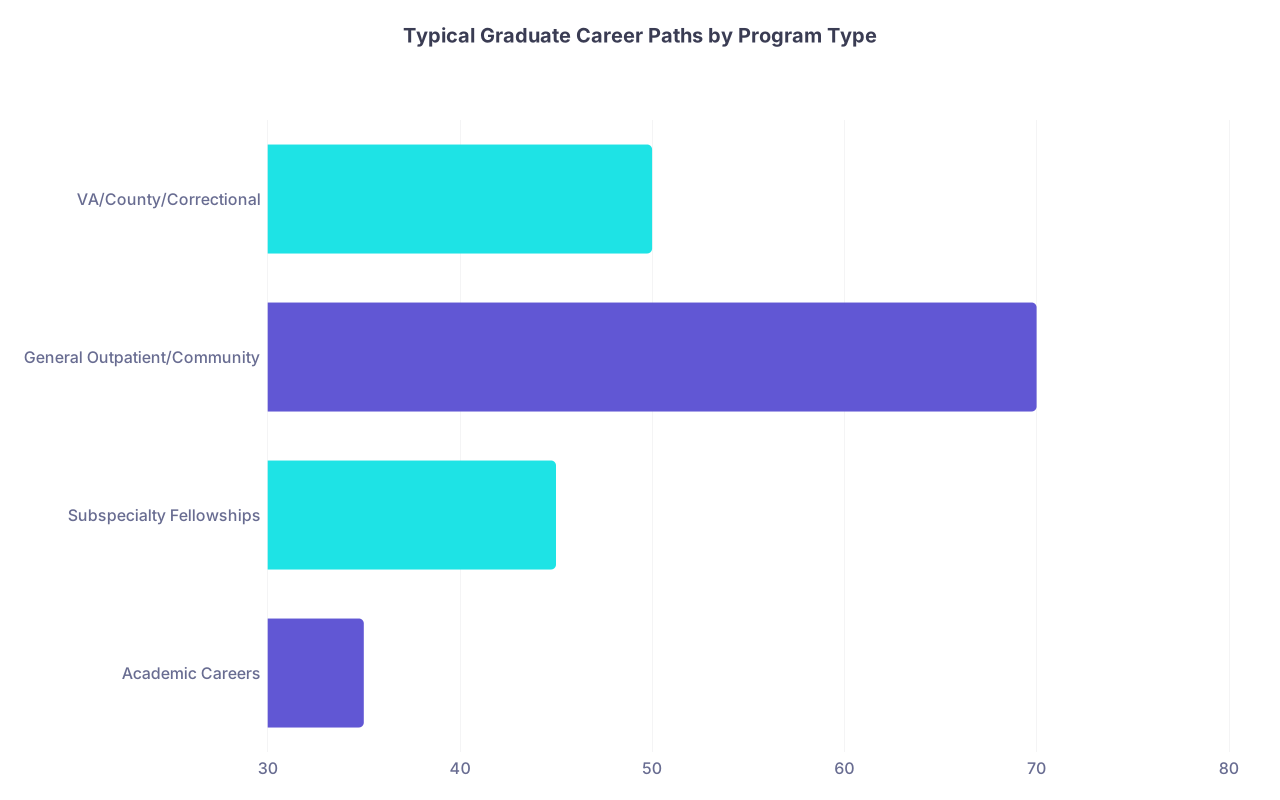
| Category | Value |
|---|---|
| Academic Careers | 35 |
| Subspecialty Fellowships | 45 |
| General Outpatient/Community | 70 |
| VA/County/Correctional | 50 |

| Step | Description |
|---|---|
| Step 1 | Start - Choose Psych |
| Step 2 | Favor academic program |
| Step 3 | Academic or strong hybrid ok |
| Step 4 | Favor community or county program |
| Step 5 | Hybrid program a good fit |
| Step 6 | Interested in research or academics |
| Step 7 | Want competitive subspecialty |
| Step 8 | Prefer high volume real world |
FAQ: Academic vs Community Psych
1. Will a community psych residency hurt my chances of getting a fellowship?
Not automatically. For less competitive fellowships (addiction, many CL, general child psych in non-top-10 programs), a solid community residency with strong clinical training is fine. Where you may feel a disadvantage is for top research-heavy fellowships, or ultra-brand-name places, where academic letters, publications, and established mentors matter more. If you’re in a community program and want those, you’ll need to deliberately seek research and mentorship early.
2. Is academic psychiatry always more competitive to match into?
No. Some community programs are extremely competitive, especially well-run county/VA programs in desirable cities. Some mid-tier academic programs are easier to match than a high-volume, resident-loved county program in a major metro area. Competitiveness is driven by location, lifestyle, culture, and reputation among residents—more than just “academic” vs “community.”
3. Can I go into private practice if I train in an academic program?
Absolutely. Plenty of academic-trained graduates leave for full-time private practice, telepsych, or group practices. Your residency type doesn’t lock you out of private practice. What matters is your comfort with outpatient management, medication management, documentation, and running visits efficiently. Just make sure your academic program provides enough real outpatient volume, not just specialty clinics.
4. Do academic programs really give better didactics than community ones?
Often yes, but not always. Academic programs usually have more protected teaching time, visiting professors, structured curricula, and required conferences. Some community programs match or exceed this, others barely hold weekly lectures. You cannot assume. Ask for a sample didactic schedule and ask residents how often it’s actually protected, or if it gets blown up by staffing needs.
5. If I’m undecided about academics vs community, what should I prioritize now?
Apply broadly and rank programs based on overall fit, culture, location, and training quality, not just label. If you’re even slightly curious about academics, make sure at least a few of your top choices have credible research and mentorship available. You can do less research than you planned; it’s much harder to do more if nothing exists. Hybrid programs with university + county or VA rotations are often a great middle path.
6. What’s the biggest red flag at a community psych program? At an academic one?
For community: residents feeling like “warm bodies,” minimal supervision, chronic duty hour violations, and no clear educational structure beyond service. For academic: toxic competitiveness, residents doing research because they feel coerced not excited, and graduates who feel unprepared for real-world volume or documentation. In both, the single biggest red flag is residents quietly telling you they would not choose the program again. That matters more than anything on the website.
Key takeaways:
- Neither academic nor community psych is universally “better”; the right choice depends on your goals, tolerance for volume, and interest in research or subspecialty work.
- If you care about academics, research, or niche subspecialties, favor academic or strong hybrid programs; if you want high-volume, real-world readiness, community or county-heavy programs often shine.