
The most dangerous mistake in choosing a psychiatry residency is pretending research‑heavy and community‑focused programs are basically the same. They are not. They train different psychiatrists, create different careers, and attract very different personalities.
You are not just picking a brand name. You are picking the problems you will be solving for the rest of your career. Let us make that decision deliberately, not by inertia, prestige, or what your classmates are posting on Instagram.
Step 1: Get Completely Clear On What “Research‑Heavy” vs “Community‑Focused” Actually Means
Most applicants use these labels loosely. Programs do not. Here is how I define them in a way that actually maps to your day‑to‑day life.
Research‑heavy psychiatry programs
Typical characteristics:
- Large academic medical center, often with:
- NIH funding
- T32 or other training grants
- Multiple subspecialty research labs (psychosis, mood, addictions, neuroimaging, etc.)
- Faculty with major grant portfolios and high H‑indices
- Protected research time during PGY‑3 or PGY‑4 (sometimes earlier)
- Strong pipeline to:
- Fellowships at major academic centers
- K‑awards, T32 research tracks, or early faculty positions
- Industry (pharma, device, digital mental health)
What it feels like as a resident:
- Constant exposure to:
- Journal clubs that actually read the methods
- Grand rounds with people who wrote the guidelines
- Trials, registries, or implementation projects happening around you
- Culture that values:
- First‑author papers
- Posters at APA, SOBP, ACNP
- Curious residents who ask, “What is the evidence for that?” and then actually go find out
Community‑focused psychiatry programs
Typical characteristics:
- Safety‑net hospitals, county systems, VA‑heavy, FQHC partnerships
- Diverse, underserved, high‑acuity patient populations
- Strong emphasis on:
- Systems‑based practice
- Interdisciplinary teamwork
- Social determinants of health
- Public psychiatry, addiction, C‑L in real‑world settings
- Faculty with:
- Public sector leadership roles
- Strong clinical and teaching focus
- Sometimes MPH or policy backgrounds rather than PhDs
What it feels like as a resident:
- Clinic days that are packed, sometimes chaotic
- Less time arguing about which scale to use, more time figuring out:
- Housing
- Guardianship
- Coordination with probation officers and shelters
- Culture that values:
- Showing up
- Reliability
- Being able to manage 15 complex patients in a morning without melting down
Here is a simple side‑by‑side:
| Factor | Research-Heavy | Community-Focused |
|---|---|---|
| Primary mission | Knowledge generation | Service & access |
| Typical setting | Academic medical center | Safety-net / VA / county |
| Research time | Built-in, protected | Limited or elective |
| Patient population | Tertiary referrals | Underserved, local |
| Career pipelines | Academia, industry | Public psychiatry, clinical leadership |
If you do not recognize yourself clearly in one of those columns, that is the first problem to solve.
Step 2: Run A Brutally Honest Self‑Assessment
You cannot pick the right program if you are lying to yourself about your goals. I see this every year: students chasing prestige into research‑heavy programs when they have zero intention of ever writing a grant.
Work through these prompts. Quickly, but honestly.
A. Your day‑to‑day preferences
Ask yourself:
On an average Thursday, would you rather:
- Spend 3 hours in an fMRI meeting troubleshooting protocols?
- Or see 10 walk‑in patients at a county clinic with social chaos?
When you read an RCT, what excites you more:
- “I want to run something like this someday.”
- Or “Good to know. Now how do I use this in clinic tomorrow?”
During med school, did you:
- Actually enjoy data collection, IRB writing, and revising manuscripts?
- Or mostly “help” on papers for the line on your CV?
Here is a shortcut: remember the last time you were on a clinical rotation and on a small research project. Which felt draining, and which felt energizing?
B. Your career endpoint (not the fantasy version)
Five to ten years post‑residency. Pick one sentence that sounds closest to you:
- “I want to be faculty at a major academic center, running a lab or being the go‑to person for a subspecialty.”
- “I want to be a clinically strong psychiatrist in a community, VA, or public setting, maybe running a service.”
- “I want to work part‑time clinically and part‑time in industry, policy, or digital mental health.”
- “I have no idea. I just know I like patient care and want options.”
Reality check:
- If you pick the first or third: strongly consider research‑heavy programs.
- If you pick the second: community‑focused programs will train exactly what you need.
- If you pick the fourth: either is possible, but you need optionality. That changes your selection criteria.
Step 3: Understand How Each Type Shapes Your Skill Set And Lifestyle
This is where applicants get blinded by brand names and forget the actual skills they will come out with.
Clinical exposure: depth vs volume
Research‑heavy:
- Deep exposure to rare or highly complex cases
- Tertiary referrals, subspecialty clinics, integrated consult services
- More time per patient, more supervision, more multi‑disciplinary teams
- Downside: you may see fewer “bread and butter” 15‑minute med checks
Community‑focused:
- Huge volume of common, messy, real‑world psychiatry
- Polysubstance use, homelessness, trauma, comorbid medical disease
- You will learn to manage with limited resources
- Downside: less depth in ultra‑niche areas unless you carve them out
Research skills vs systems skills
Research‑heavy programs will likely make you good at:
- Reading literature critically
- Designing protocols
- Working with data, statisticians, and IRBs
- Writing in a way journal editors respect
Community‑focused programs will likely make you good at:
- Navigating systems (Medicaid, housing, courts, social services)
- Working with case managers, social workers, law enforcement
- Program building in low‑resource settings
- Leading teams that are drowning in demand
You can learn both sets of skills anywhere, theoretically. In practice, culture drives what you actually master.
Step 4: Use A Simple Decision Framework
Here is a framework I give to lost MS4s every season.
Framework: The 4 non‑negotiables
You should choose programs primarily on these four axes:
- Clinical training quality
- Research or scholarly infrastructure
- Mentorship and culture
- Alignment with your realistic 5–10 year goals
Forget the brochure language. Ask targeted questions that expose the reality underneath.
Step 5: Concrete Questions To Ask On Interviews (And Red Flags To Watch)
Stop asking, “How supportive is your program of research?” Everyone answers, “Very.” You need to ask questions that force specific, checkable answers.
If you are leaning research‑heavy
Ask:
“How many residents in the last 5 years have:
- First‑authored a paper?
- Won intra‑ or extramural research funding?
- Matched into research‑track fellowships or taken academic jobs?”
“Is there guaranteed, scheduled protected research time? When does it start, and how is it protected in practice?”
“Do residents have direct mentorship from PIs, or are they primarily working with fellows/postdocs?”
“What happens if a resident’s project is not progressing? Who intervenes?”
Red flags:
- Vague answers about “lots of opportunities” but:
- No specific resident names, projects, or outcomes
- Faculty described as “very busy” and “hard to get time with”
- “Protected time” that:
- Can be pulled for service needs “during busy times”
- Only exists as elective time that you have to fight for
Here is what good vs bad research infrastructure looks like at a glance:
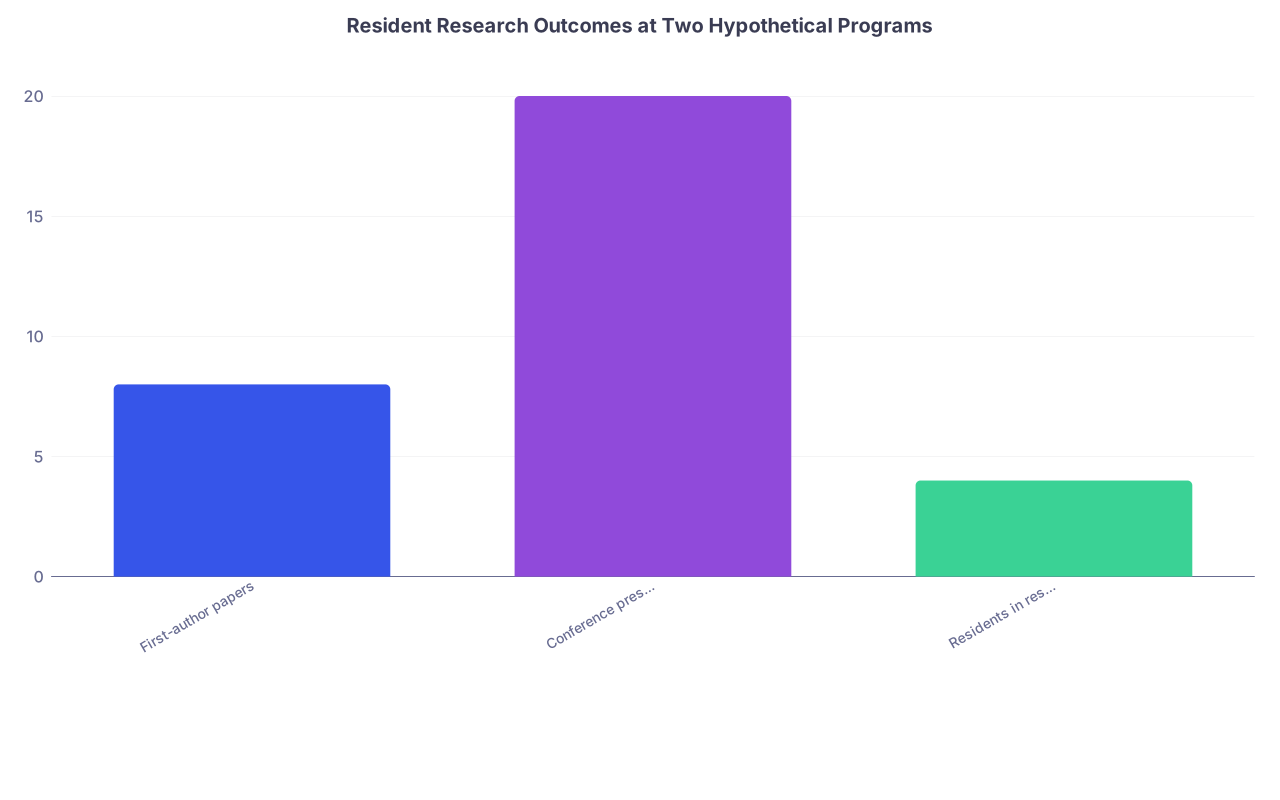
| Category | Value |
|---|---|
| First-author papers | 8 |
| Conference presentations | 20 |
| Residents in research fellowships | 4 |
…Now imagine another program where those numbers are 1, 3, and 0. Same “we support research” line in the brochure. Completely different reality.
If you are leaning community‑focused
Ask:
“Where do your graduates practice in their first job? How many go into:
- CMHCs?
- VAs?
- Academic vs purely clinical roles?”
“What are your primary community partners, and how long have those relationships been in place?”
“How does the program handle resident safety in high‑risk community settings?”
“What is the patient volume like in outpatient clinics for PGY‑3 and PGY‑4? How many patients per half‑day, and what kind of support staff?”
Red flags:
- Community clinics that:
- Turn over every 1–2 years
- Residents describe as “chaotic” without clear supervision
- Graduates all going into suburban private practice despite “social justice” branding
- Vague answers about burnout, or jokes about “survival”
Step 6: Understand Hybrid Programs And Special Tracks
Many programs are neither pure research factories nor purely community safety‑net. Some have explicit tracks:
- Research tracks (sometimes funded by T32)
- Public/community psychiatry tracks
- VA‑focused curricula
- Dual degree options (MPH, MSCR)
Look closely at the structure:
Do residents in the research track get:
- Different schedules?
- Built‑in mentorship?
- Formal coursework (epidemiology, statistics, trial design)?
Do residents in community/public tracks get:
- Dedicated rotations at specific community sites?
- Policy, advocacy, or leadership training?
- Mentors who are actually doing public psychiatry as a career, not as an afterthought?
You are trying to avoid the “imaginary track”: the one that exists only on a website bullet point but not in schedules, budgets, or protected time.
Step 7: Fix The “I Want It All” Problem
Most strong applicants want this fantasy combination:
- Big‑name academic brand
- Heavy underserved population exposure
- Robust research infrastructure
- Supportive culture with perfect work‑life balance
- In a city they love, with a reasonable cost of living
That program does not exist. Here is how to make adult tradeoffs instead of magical thinking.
Rank your actual priorities
Make a forced‑rank list:
- Location / family constraints
- Clinical training strength
- Research opportunity
- Community exposure / underserved work
- Lifestyle / call burden
- Prestige
Now, here is the part almost nobody does: assign “must have” vs “nice to have.”
Example:
- Must have:
- Strong clinical training
- At least functional research mentoring (if you might do academics)
- City within 2 hours of partner’s job
- Nice to have:
- Built‑in T32 research track
- Dedicated public psychiatry fellowship on site
- Top‑tier national brand
Once you are clear on this, the ranking process gets boringly straightforward.
Step 8: Specific Paths And What They Actually Require From Your Program Choice
Let us map program type to realistic careers.
Path A: Academic / research psychiatrist
If you truly want to run trials, lead a lab, or heavily publish:
You should strongly favor:
- Research‑heavy programs with:
- Proven track record of K‑awards and T32 placements
- Faculty who will put their name behind you
- Protected research time baked into the schedule, not begged for
You will likely need:
- 2–3 solid projects during residency
- At least one first‑author paper
- Strong letters from recognized names
- Comfort with stats and methodology
You can come from a community‑focused program and still do this, but you will be swimming upstream. Your nights and weekends will be research. Your mentors may be external. You are choosing the hard mode.
Path B: Public / community psychiatrist and leader
If you want to be medical director of a county system, lead a VA clinic, or run a CMHC:
You should favor:
- Community‑focused programs with:
- Heavy public psychiatry exposure
- Mentors who actually hold those jobs
- Strong relationships with local systems
You will need:
- Real comfort with:
- High‑volume outpatient work
- Chronic SMI management
- Collaboration with social services, criminal justice, housing systems
- Leadership opportunities during residency:
- Chief roles
- Committee work
- Quality improvement projects that actually change clinic flow
You can come from a research‑heavy program and do this. But you may feel underprepared for system chaos if your training was mostly in tertiary clinics with lots of resources.
Path C: Mostly clinical, some academic or teaching
Many people want a blend:
- 80–90% patient care
- Some teaching, maybe a niche like women’s mental health or ADHD
Almost any solid program can get you here. For you, the main decision is cultural:
- Do you want to be surrounded by faculty who:
- Talk grants and RCTs all day?
- Or are in the trenches in county clinics and VAs?
Choose the ecosystem that matches where you want to grow.
Step 9: Evaluate Burnout Risk And Support Structures
Both program types can burn you out. In different ways.
Research‑heavy burnout:
- Pressure to produce:
- Papers
- Abstracts
- Grants
- On top of:
- Inpatient months
- Night float
- Required clinics
Watch for:
- Residents with impressive CVs but flat affect
- Jokes about “never seeing daylight during PGY‑2”
- Faculty who brag about 80‑hour weeks
Community‑focused burnout:
- High emotional load:
- Homelessness
- Trauma
- OD deaths
- System failures
- Constant tension between what patients need and what the system can provide
Watch for:
- Residents describing themselves as “tired all the time” or “just surviving”
- High attrition among faculty at community sites
- Little protected time for case discussion / Balint / debriefing
On interview day, ask two pointed questions:
- “What is one concrete thing the program changed in the last 2 years to reduce resident burnout?”
- “If a resident is struggling, what actually happens? Walk me through the steps.”
If they cannot answer, you have your warning.
Step 10: Build A Short, Rational Rank List Instead Of Panic‑Ranking 30 Programs
You do not need 20 “top choices.” You need a clear top tier that fits your actual goals.
Here is a simple structure:
- Tier 1: Ideal fit (3–5 programs)
- Strong match with your top 3 priorities
- You can name specific mentors or rotations you are excited about
- Tier 2: Solid training, some compromises (5–8 programs)
- Good clinical base
- Missing one thing (location, research depth, community exposure)
- Tier 3: Safety net (the “I can live here and get trained” group)
- Acceptable but not exciting
Then, within each tier, order based on gut preference after you have done the rational analysis. It is fine for your gut to be the tiebreaker; it is a disaster when your gut is the only input.
To visualize how different programs balance research vs community focus, it sometimes helps to sketch it out:
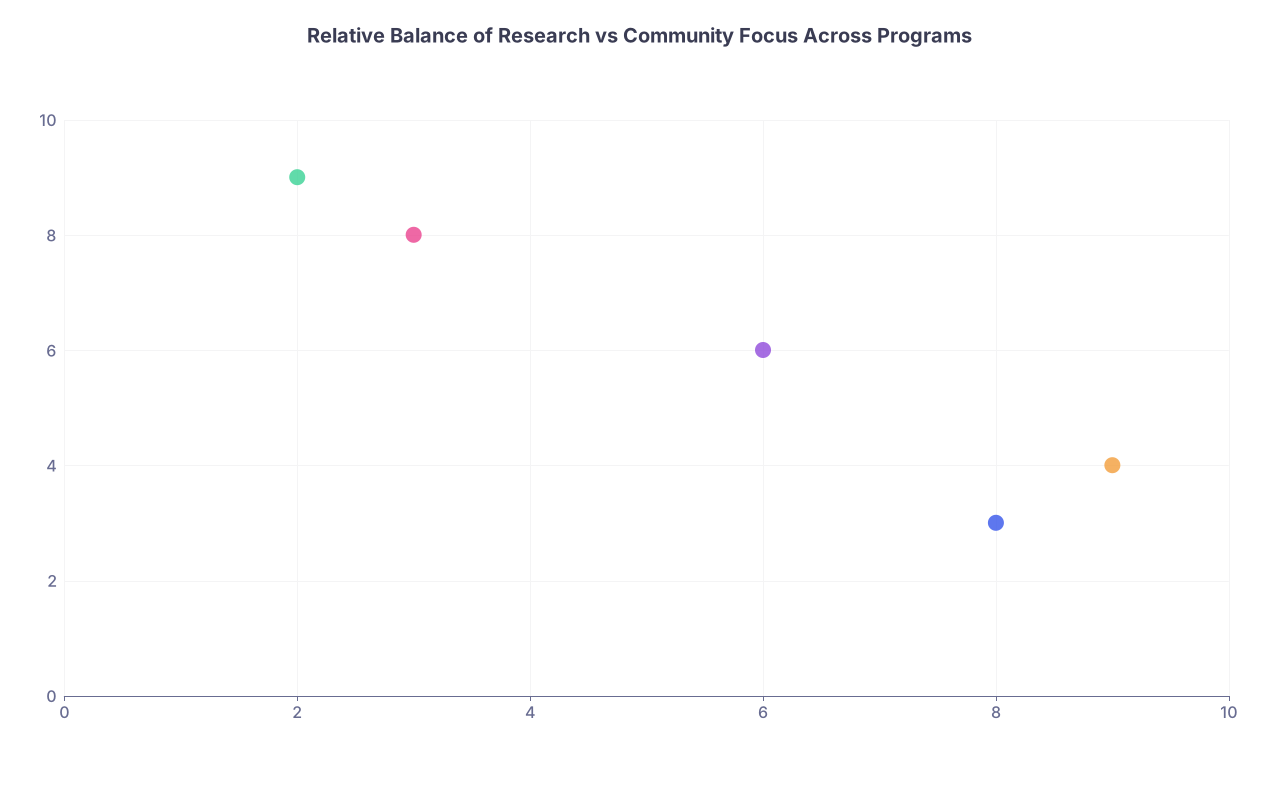
| Category | Value |
|---|---|
| Program A | 8,3 |
| Program B | 6,6 |
| Program C | 2,9 |
| Program D | 9,4 |
| Program E | 3,8 |
(Think of x = research intensity, y = community focus. You want to know where your preferred cluster sits.)
Step 11: Do A Reality Check With People Two Steps Ahead Of You
Do not only talk to current residents. Talk to people:
- 2–5 years out of residency
- Who trained at the kinds of programs you are considering
- Who are doing now what you think you might want
Ask them:
- “If you could do it again, would you choose the same type of program?”
- “What did your program do really well for your current job?”
- “What did you have to learn on the fly after residency because your program skimmed over it?”
Patterns from those conversations are usually more predictive than whatever the PD says on interview day.
Step 12: If You Are Still Stuck, Use This Tie‑Breaker Protocol
You have two programs. One more research‑heavy, one more community‑focused. You like them both. You are frozen.
Do this:
- Write a one‑paragraph “future you” story for each:
- “At Program X, my weeks look like… My mentors are… The patients I see most often are…”
- Put it away for 24 hours.
- Re‑read both. Pay attention to:
- Which paragraph makes you feel relief and excitement
- Which makes you feel tense or like you are playing a role
Then use the following rule:
- If you are even slightly research‑curious and both are otherwise equal:
- Lean toward the research‑heavy or hybrid program. It is easier to dial research down later than to build an academic foundation from scratch.
- If you are clearly exhausted by academic expectations, and you loved your community rotations:
- Lean toward the community‑focused program. You will be happier, and a happier resident becomes a better psychiatrist.
If you need to, put confidence numbers next to each program and force yourself to choose:
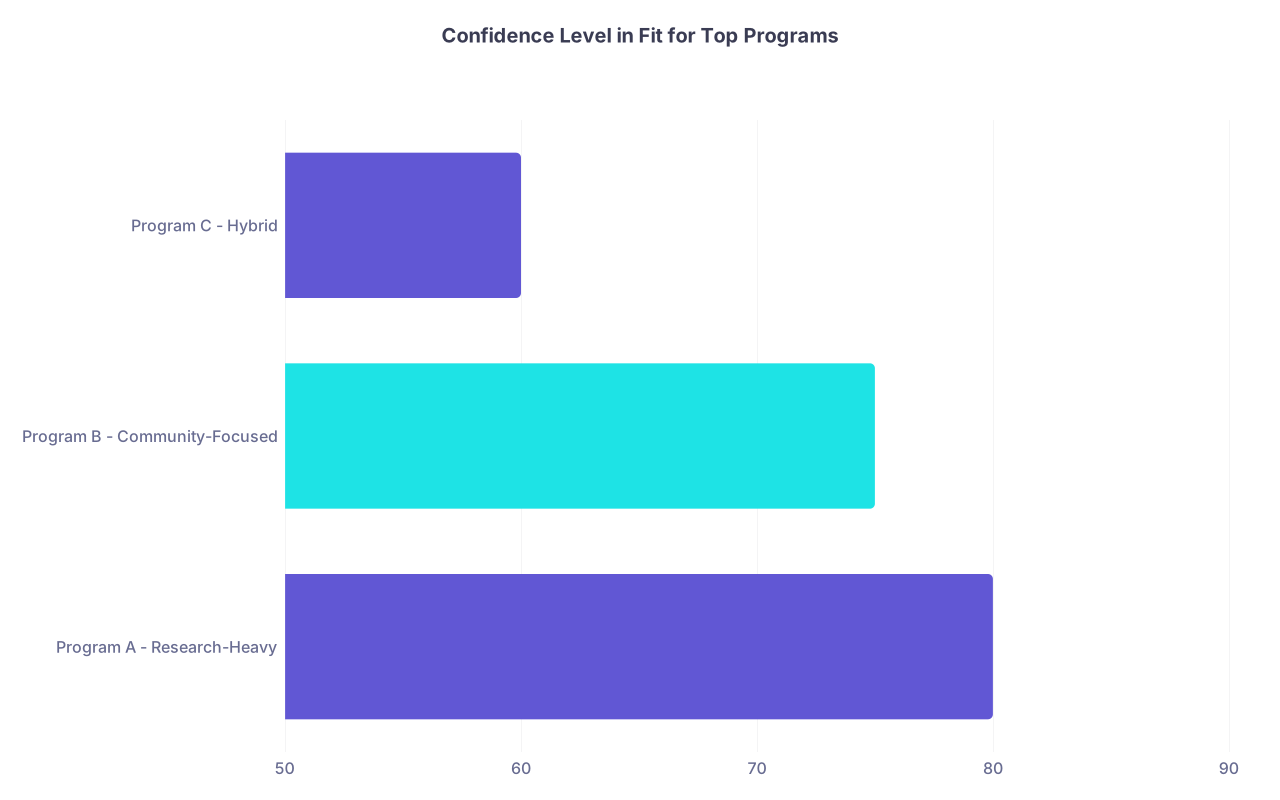
| Category | Value |
|---|---|
| Program A - Research-Heavy | 80 |
| Program B - Community-Focused | 75 |
| Program C - Hybrid | 60 |
Pick the highest. Stop second‑guessing unless a new fact appears.
FAQ (Exactly 3 Questions)
1. Can I still do research if I match into a community‑focused psychiatry program?
Yes, but you will probably be building more yourself. You might work with smaller clinical projects, QI, or collaborate remotely with academic mentors. Expect research to happen on your own time more often, with less built‑in infrastructure. People do it successfully, but it requires more self‑direction and fewer excuses.
2. Will a research‑heavy program make me a worse “real‑world” clinician?
Not automatically. Many academic programs have strong safety‑net or VA rotations. The risk is that your outpatient volume and systems exposure might be lower, so you need to deliberately seek high‑volume clinics, community electives, and moonlighting (late PGY‑3/4 when allowed) that keep you grounded in real‑world psychiatry.
3. Which matters more for fellowship and jobs: program type or my own record?
Your own record wins. A motivated resident at a mid‑tier community program with strong letters, solid clinical reputation, and a couple of meaningful scholarly or systems projects will beat a disengaged resident at a big‑name research program. That said, research‑heavy programs do open specific doors in academia because of their networks and track records. Use that advantage only if it aligns with where you actually want to go.
Three take‑home points:
- Research‑heavy and community‑focused psych programs are built for different careers and different personalities. Do not pretend they are interchangeable.
- Make your choice based on concrete structures: protected time, mentorship outcomes, patient populations, and where graduates actually end up working.
- If you might want academics, bias slightly toward research capacity; if you crave real‑world impact and systems work, bias toward community focus. Then commit and squeeze every drop out of wherever you train.