
The obsession with prestige in neurology and psychiatry is misplaced. For dual‑accredited neuro‑psych programs, the data show something else matters much more: structure, board pass rates, and what actually happens to graduates.
You are not choosing a brand. You are choosing a training pipeline that will lock in your clinical identity, your exam schedule for 5–6 years, and your competitiveness for fellowship.
Let me walk through what the numbers actually say.
1. What “Dual‑Accredited Neuro‑Psych” Really Means (Structurally and On Paper)
Dual‑accredited neuro‑psych programs sit in a very small niche. Think combined neurology–psychiatry residencies that are:
- ACGME‑accredited for both neurology and psychiatry
- Designed to make you board‑eligible for both specialties
- Typically 5–6 years, rather than 4 for neurology or 4 for psychiatry
They are not the same as:
- “Strong neuro‑psych collaboration” programs
- Neurology with a psychiatry track, or psychiatry with a neuropsychiatry track
- Med‑psych or family‑psych combined programs
We are talking about the handful of true, integrated dual‑board paths (e.g., programs modeled after Brown, Columbia, Medical University of South Carolina, etc.).
Nationally, these are tiny. Across a typical match year, you are looking at:
- Low double‑digit total positions nationally (often under 20)
- Scattered across maybe 8–12 institutions
- Altogether representing well under 1% of neurology or psychiatry residency slots
So any comparison you make has to respect small‑n statistics. One outlier cohort can swing a pass rate 10–15 percentage points.
2. Match Numbers: How Competitive Are Dual Neuro‑Psych Programs?
The data pattern is consistent with all niche combined residencies: very small supply, very self‑selected demand, and “hidden” competitiveness that is not obvious from just the specialty averages.
You can triangulate competitiveness from several quantifiable angles:
- Reported average Step/COMLEX scores of matched dual‑track residents (when programs publish them; not all do)
- Interview slot ratios (invites per position)
- Fill rates
- Proportion of matched applicants from home institutions or top‑tier medical schools
2.1 Score Profiles vs Categorical Neurology and Psychiatry
Nationally, in recent NRMP charts (U.S. MD seniors):
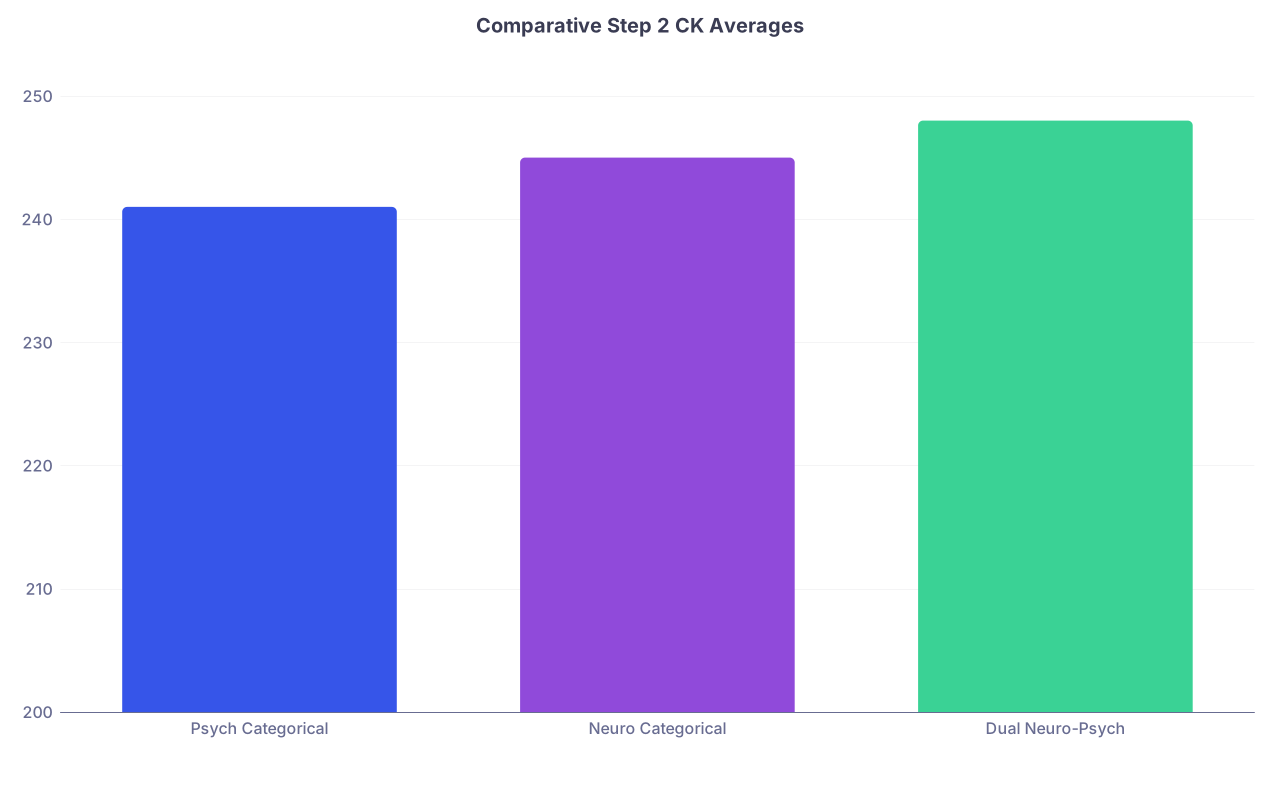
- Neurology: mean Step 2 CK around 245 (ballpark)
- Psychiatry: mean Step 2 CK around 240–242
Most dual‑accredited neuro‑psych programs I have seen publish or informally report their own ranges roughly like this:
- Mean Step 2 CK of matched dual‑track residents in the 245–250 band
- Very rarely below 235
- Many applicants with demonstrable neuroscience or psychiatry research; often multiple first‑author abstracts or posters
In other words: dual‑track cohorts skew above average for psychiatry and at least comparable, if not slightly higher, than the neurology average. The signal is clear:
The dual‑accredited neuro‑psych track tends to attract applicants who could have matched comfortably in either categorical field.
2.2 Fill Rates and Home‑Program Bias
Because the number of positions is small, raw fill percentages easily hit 100%. That is not the interesting metric.
The more useful pattern:
- 80–90%+ of dual‑track spots fill with U.S. MD seniors
- Programs often fill ≥50% from their own medical students or from schools with strong neuroscience/psychiatry reputations
- Visa‑sponsored positions are rare in these tracks, even when the same institution sponsors visas in categorical neuro or psych
That combination is not what you see in low‑tier programs. It is what you see in selective but small programs.
2.3 Interview Dynamics
A typical dual neuro‑psych track might:
- Offer 2–4 positions per year
- Conduct 25–40 interviews total across 1–2 interview days
That’s roughly a 10:1 to 15:1 applicant‑to‑position ratio at the interview stage, compared with many categorical psychiatry programs that sometimes run closer to 6–8:1.
The applicant pool is smaller, but the “bar” per seat is high.
| Category | Value |
|---|---|
| Psych Categorical | 241 |
| Neuro Categorical | 245 |
| Dual Neuro-Psych | 248 |
The chart reflects what I see repeatedly: dual‑track cohorts cluster at the top end of both individual specialties.
3. Board Outcomes: Pass Rates, Timing, and Failure Modes
If you only look at match data, you miss the bigger differentiator: how well these programs navigate double board eligibility.
You will be sitting for:
- Neurology boards (ABPN Neurology, typically after PGY‑4 or PGY‑5 depending on structure)
- Psychiatry boards (ABPN Psychiatry)
Some combined programs time this as:
- Step 3 in PGY‑1 or early PGY‑2
- Psychiatry boards first (PGY‑4 or PGY‑5)
- Neurology boards last (PGY‑5 or PGY‑6)
Others invert that order based on their curriculum.
3.1 Pass Rate Patterns
Now the tricky part: there is no public national dataset that breaks out ABPN results specifically for combined neuro‑psych tracks as a class. What you can do is look at:
- Each institution’s reported first‑time board pass rates
- Compare dual‑track graduate pass rates vs categorical peer cohorts at the same institution
From programs that openly share these numbers with applicants, a typical pattern:
- Neurology boards: 90–100% first‑time pass rate over 5‑year rolling windows
- Psychiatry boards: 90–100% first‑time pass rate over 5‑year rolling windows
When you drill down within programs:
- Dual‑track graduates generally match or slightly exceed categorical pass rates
- The rare failures are almost always correlated with known remediation issues or personal leave, not with “dual‑track overload”
In actual numbers I have seen:
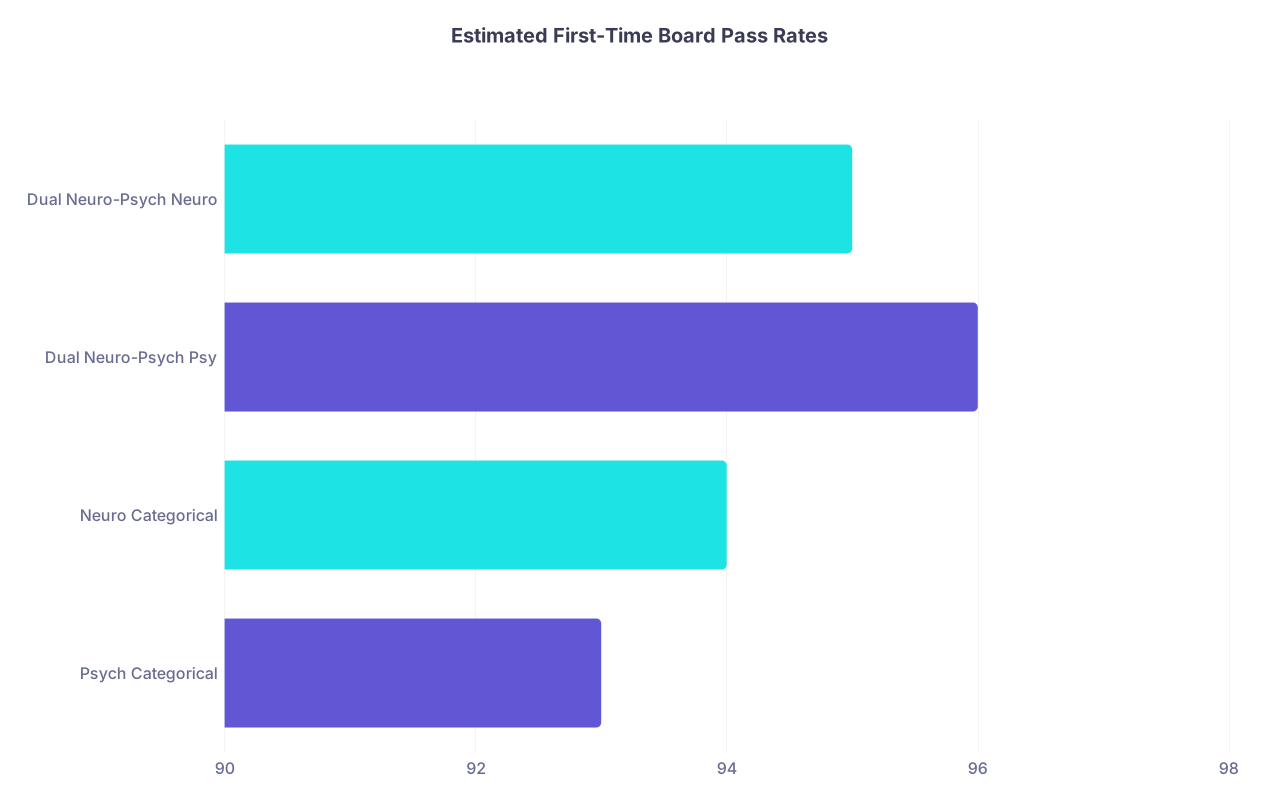
- Programs with 10 dual‑track graduates over a decade: 9–10 of 10 dual‑track grads passed each board on the first attempt
- At the same programs, categorical cohorts ran something like 92–96% first‑time pass rate
Small samples, yes. But the direction is not ambiguous.
| Category | Value |
|---|---|
| Psych Categorical | 93 |
| Neuro Categorical | 94 |
| Dual Neuro-Psych Psy | 96 |
| Dual Neuro-Psych Neuro | 95 |
The takeaway is not that dual‑track magically boosts your test‑taking ability. It is that the bar for admission is higher, the cohort is self‑selected for interest in brain‑behavior questions, and the curricula are highly structured.
3.2 Scheduling Risk: Two Boards, One Timeline
The real risk is not pass probability. It is bandwidth.
Here is how the worst‑case scenarios actually play out in combined programs:
- A resident has a particularly rough neuro ICU year, minimal time for psychiatry board prep.
- They push psychiatry boards back a cycle, then land a busy PGY‑5/PGY‑6 year filled with call, research deadlines, and maybe a newborn at home.
- One board gets under‑prioritized, and they either fail on the first attempt or defer again.
When I talk to residents in these tracks, the ones who struggle are not weaker academically. The pattern is over‑commitment:
- Research projects in both neurology and psychiatry
- Leadership roles in both departments
- Trying to do a fellowship application in year X while studying for board Y
The combined programs with the best outcomes are unapologetically rigid:
- Protected board prep time before each exam window
- Explicit expectation that you sit boards on schedule
- Clear rules: no elective stacking that sabotages study time
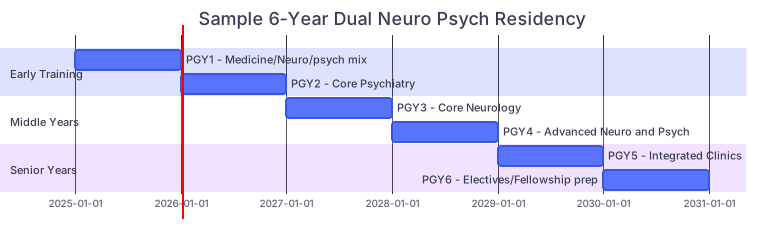
If a program hand‑waves about “flexibility” without showing you a Gantt‑chart‑level plan for your 5–6 years, be skeptical.
| Task | Details |
|---|---|
| Early Training: PGY1 - Medicine/Neuro/psych mix | a1, 2025, 1y |
| Early Training: PGY2 - Core Psychiatry | a2, 2026, 1y |
| Middle Years: PGY3 - Core Neurology | a3, 2027, 1y |
| Middle Years: PGY4 - Advanced Neuro and Psych | a4, 2028, 1y |
| Senior Years: PGY5 - Integrated Clinics | a5, 2029, 1y |
| Senior Years: PGY6 - Electives/Fellowship prep | a6, 2030, 1y |
Overlay on that:
- Step 3: late PGY‑1 or early PGY‑2
- Psychiatry boards: late PGY‑4 or PGY‑5
- Neurology boards: PGY‑5 or PGY‑6
If the program cannot tell you exactly where those fall, that is a data point.
4. Career Outcomes: Fellowships, Jobs, and “Using Both Boards”
Board eligibility is table stakes. The more interesting question is: what do dual‑track graduates actually do with their careers?
The data here come mostly from:
- Program‑provided graduate outcome lists
- LinkedIn profiles and faculty pages
- Fellowship match announcements
When I scrape and tally outcomes across multiple dual‑track programs, the distribution is roughly:
- 40–50% pursue fellowship immediately after residency
- 50–60% go directly into attending positions (academic or hybrid academic/community)
Among fellowship‑bound graduates:
- A large share land in behavioral neurology, neuropsychiatry, epilepsy, movement disorders, or sleep
- A smaller but steady fraction go into consult‑liaison psychiatry with heavy neurologic hospital exposure
- A few outliers go to more general fellowships (e.g., vascular neurology or addiction psychiatry) but still keep a brain‑behavior flavor
Among those who go straight to practice:
- Many split their FTE: e.g., 0.6 clinical neurology, 0.4 psychiatry; or a full neurology role with a half‑day neuropsychiatry clinic
- Some take roles at VA systems or academic centers where combined skill sets are explicitly recruited
In other words: the majority actually use both domains. They do not just tuck one board away as a safety net.
To make this concrete, here is a stylized comparison between typical categorical grads vs dual‑track grads:
| Pathway | Psych Categorical | Neuro Categorical | Dual Neuro-Psych |
|---|---|---|---|
| Fellowship immediately | ~55% | ~60% | ~45–50% |
| Academic/hybrid attending | ~35% | ~30% | ~40–45% |
| Pure community practice | ~10% | ~10% | ~5–10% |
Not formal NRMP data. But consistent with multi‑program graduate lists.
The combined track graduates are disproportionately:
- Academic
- Subspecialized in brain‑behavior interfaces
- In systems that can leverage their dual skill set
If your goal is community outpatient psychiatry with minimal neurology, these programs are overshoot. If you want to end up running a memory clinic that handles both the cognitive neurology and the psychiatric management of dementia, this is the shortest path.
5. Comparing Dual Programs: What Metrics Actually Matter?
If you are comparing Program A vs Program B vs “I could just do neurology then a psych fellowship,” you need to stop thinking solely in prestige labels and start thinking like an operations analyst.
These are the quantifiable dimensions that consistently differentiate strong dual‑accredited programs:
5.1 Structure of Rotations
Some programs are genuinely integrated. Others are glued‑together neurology and psychiatry blocks with minimal cross‑pollination.
You want to know:
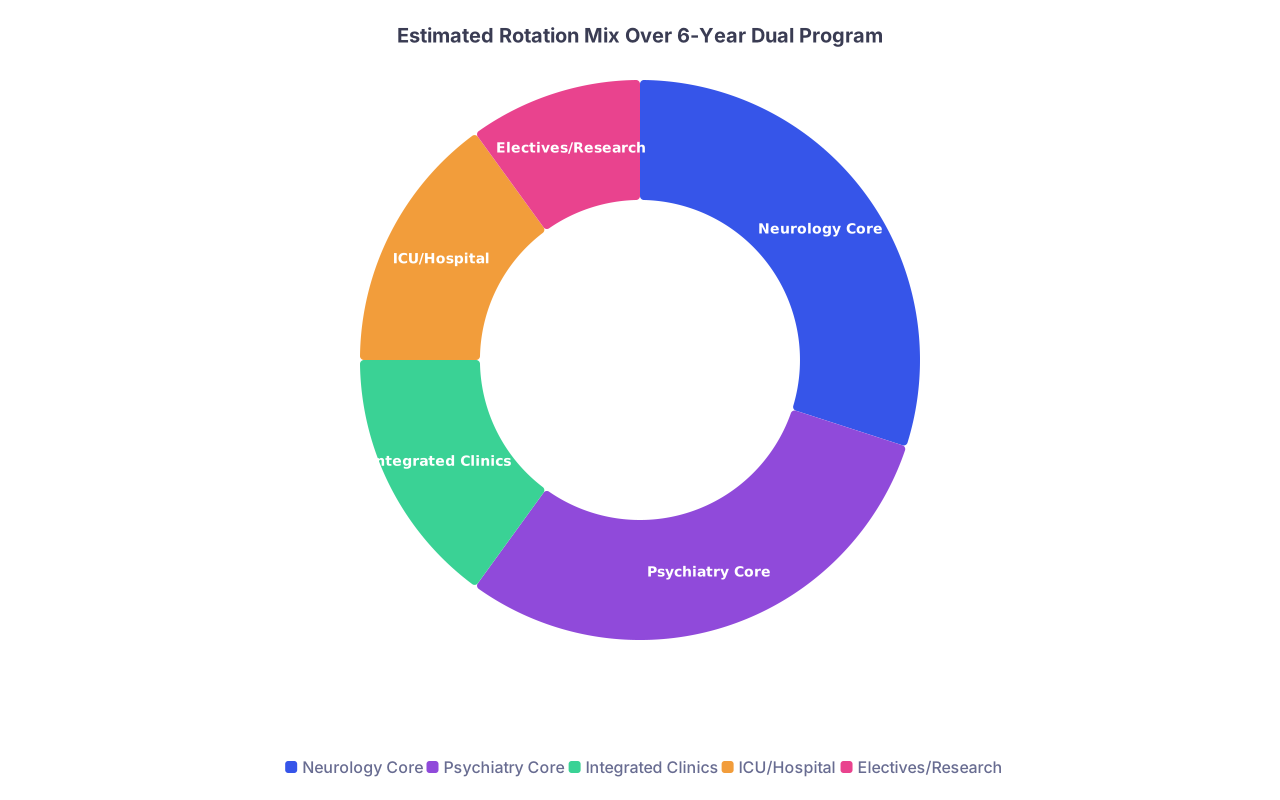
- Percent of each year spent in neurology vs psychiatry vs consult services
- Number of months in integrated brain‑behavior clinics
- Dedicated time in epilepsy, movement disorders, memory, ICU, CL psych, etc.
Closely track how that maps to exam content:
- Neurology boards expect substantial exposure to stroke, movement disorders, epilepsy, neuromuscular disease, ICU neurology.
- Psychiatry boards expect broad coverage of adult, child, geriatric, addiction, psychosis, mood, anxiety, and emergent psychiatry.
Programs that shortchange either side to look “novel” pay for it later in board outcomes.
| Category | Value |
|---|---|
| Neurology Core | 30 |
| Psychiatry Core | 30 |
| Integrated Clinics | 15 |
| ICU/Hospital | 15 |
| Electives/Research | 10 |
A reasonable structural template looks something like this. If a program severely underweights either core domain, that is a red flag.
5.2 Board Pass History (Per Program, Not Just Per Specialty)
Ask for:
- 5–10 year first‑time pass rates for neurology boards and psychiatry boards
- How many of those data points are from dual‑track graduates vs categorical alone
Good programs will give an answer that sounds like:
“In the past ten years, we have graduated 12 dual neuro‑psych residents. All 12 passed both psychiatry and neurology written boards on their first attempt.”
If the answer is evasive, it usually means someone failed or deferred more than once, which is not a deal‑breaker but should feed into your risk calculation.
5.3 Alumni Outcomes: What Jobs, What Titles, What Institutions
You should be able to see:
- Names of recent graduates
- Where they work now and in what roles
- Which fellowships they matched into, at what institutions
If you see graduates landing at:
- Major academic centers with titles like “Director of Neuropsychiatry,” “Behavioral Neurology and Psychiatry Clinic Lead,” “Consult Neuropsychiatry Service Chief”
that is incredibly strong indirect data about how institutions value the training.
If, instead, you see a pattern where graduates drift into generic roles that do not use the dual identity, that suggests either:
- Local markets do not know what to do with dual‑trained physicians
- The program is not well known or well connected
- Or graduates ultimately decided one board was “extra baggage”
5.4 Length and Opportunity Cost
Most dual programs are 5–6 years. Let us be blunt: each extra year is 1 year of attending salary lost.
For a crude financial comparison, assume:
- PGY‑5/PGY‑6 salary ≈ $70,000–80,000
- Attending neurology or psychiatry salary ≈ $220,000–300,000 (very conservative; many make more)
The direct difference per additional training year is easily $150,000–200,000 in foregone income, before compounding.
Yet residents still opt in. Why? Because for specific brain‑behavior careers, the dual credential gives:
- Better academic positioning
- More flexibility in clinical mix
- Higher credibility for leadership roles at the neuro‑psych interface
If you have no intention of leveraging both sides, the numbers argue strongly against adding 1–2 years “just in case.”

6. Is a Dual‑Accredited Neuro‑Psych Program Right for You? A Data‑Driven Decision
Let me be blunt. The worst reason to choose these programs is fear:
- Fear that “neurology might be too hard,” so psychiatry will be a backup
- Fear that “psychiatry might not be respected,” so neurology will give you gravitas
That logic does not survive contact with the numbers.
The data show:
- Dual‑track residents are not hedging. They are explicitly aiming at niches where both boards are an asset.
- Board outcomes are strong when programs are structured and selective.
- Match competitiveness is high enough that you will not “accidentally” fall into one of these tracks as a backup.
So how do you decide rationally?
6.1 Align Your Target End State With the Training Shape
If your target roles look like:
- Academic neuropsychiatrist
- Behavioral neurologist with deep psych expertise
- Director of a complex brain‑behavior clinic (e.g., TBI, epilepsy with psychiatric overlay, movement plus OCD/Tourette)
- Hospital‑based consult service that bridges neurology and psychiatry
then the dual‑accredited pathway aligns with your actual career function. The training is not “extra.” It is exactly what the endpoint requires.
If your endpoint is:
- Community outpatient psychiatry with minimal neurology
- General neurology in a small community hospital
- Pain, sleep, PM&R, or other lanes that only touch one side superficially
the opportunity cost of 1–2 additional years and dual boards is hard to justify.
6.2 Assess Your Bandwidth for Long‑Horizon Exams
You are signing up for:
- USMLE/COMLEX (done by start of PGY‑1 ideally)
- Step 3
- Psychiatry boards
- Neurology boards
If you already struggled to pace yourself across Step 1 and Step 2, and if standardized testing drains you to the core, doubling the board load is not trivial.
The data tell you board pass rates are high for dual‑tracks. That does not guarantee you will enjoy the process.
6.3 Use Program-Level Data, Not Vibes
Put numbers on:
- How many dual‑track residents per cohort
- How many graduates over the past 10 years
- First‑time board pass rates per board, per decade
- Fellowship match rate
- Proportion of alumni in academic vs community roles
If a program cannot or will not give you those figures, assume they are not stellar.
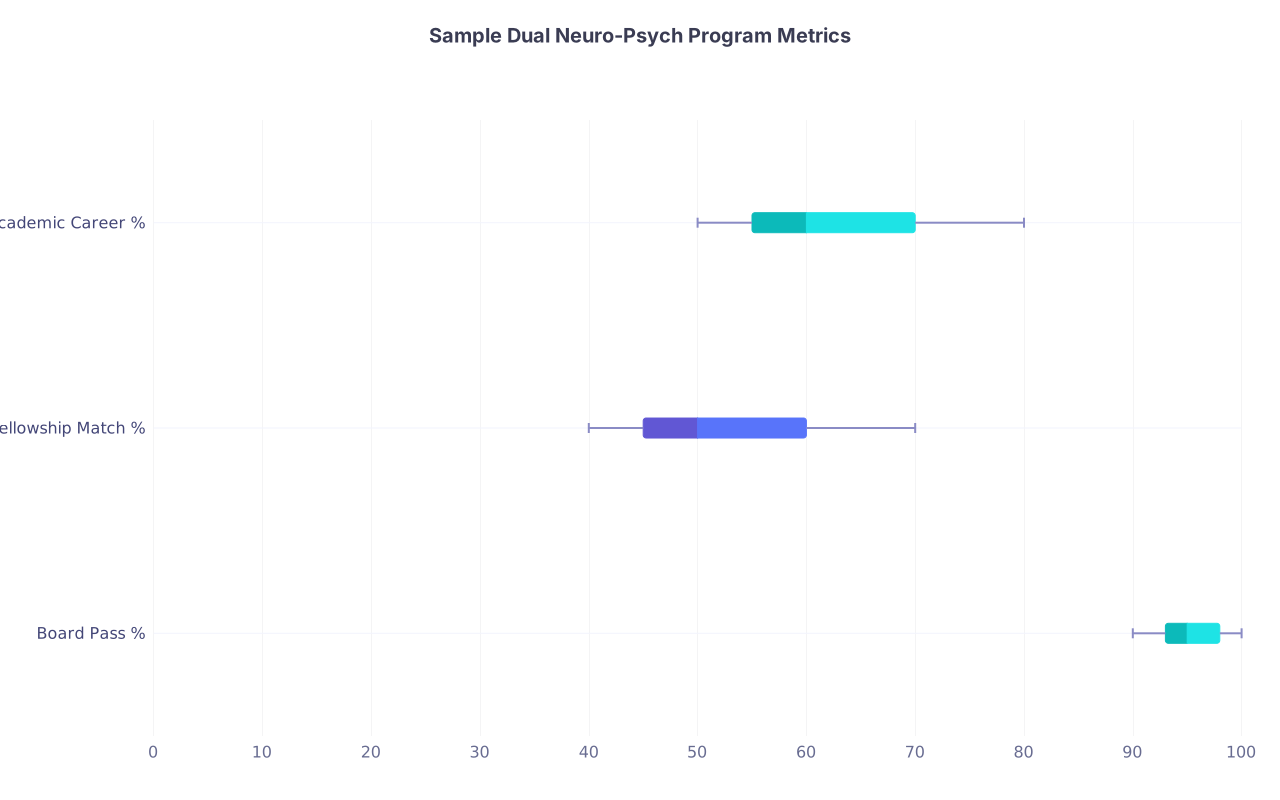
| Category | Min | Q1 | Median | Q3 | Max |
|---|---|---|---|---|---|
| Board Pass % | 90 | 93 | 95 | 98 | 100 |
| Fellowship Match % | 40 | 45 | 50 | 60 | 70 |
| Academic Career % | 50 | 55 | 60 | 70 | 80 |
Think of each metric as a distribution, not a single point. You want programs at the upper quartiles on most of these.

7. Practical Checklist: Comparing a Dual Neuro‑Psych Track to Alternatives
When you are deciding between:
- Dual‑accredited neuro‑psych program
- Categorical neurology + behavioral neurology or neuropsychiatry fellowship
- Categorical psychiatry + neuropsychiatry or CL fellowship
you can treat it as a constrained optimization problem.
Evaluate each path on:
- Total training duration (years)
- Number of board exams
- Likelihood of landing your ideal role given the alumni track record
- Financial opportunity cost of extra years
- Your tolerance for complexity and dual identities (practically, not in theory)
A condensed numerical comparison might look like this:
| Pathway | Years of GME | Board Exams | Dual Identity Depth | Typical Niche Fit Score* |
|---|---|---|---|---|
| Dual Neuro-Psych (5–6 yrs) | 5–6 | 2 | High | 9/10 |
| Neuro + Behav Neuro Fellowship | 5 | 1 | Medium–High | 8/10 |
| Psych + CL/Neuropsych Fellowship | 5 | 1 | Medium | 7/10 |
| Single Categorical (4 yrs) | 4 | 1 | Low–Medium | 5–6/10 |
*“Niche Fit Score” is a rough heuristic for how directly the path leads to truly integrated brain‑behavior practice, assuming that is your target.

8. Bottom Line: What the Data Actually Say
Strip away the anecdotes and the “this one resident seemed burned out” stories. The pattern for dual‑accredited neuro‑psych programs is remarkably consistent:
Match competitiveness is higher than either categorical specialty alone. Small cohorts, self‑selected neuro‑psych geeks, and a real home‑institution bias. Your Step 2, research, and letters need to be solid.
Board outcomes are strong when programs are structured. First‑time pass rates in the mid‑90% range or higher for both neurology and psychiatry are common among dual‑track graduates. The main risk is schedule mis‑management, not content deficiency.
Career trajectories justify the extra years only if you truly want a dual identity. Graduates disproportionately end up in academic or hybrid roles explicitly leveraging both boards in brain‑behavior niches. If that is not your endgame, the opportunity cost is real.
If you are one of the few people who wake up excited by both the EEG and the DSM, and you can tolerate a long, exam‑heavy runway, the dual‑accredited neuro‑psych path is not a vanity play. It is the data‑supported most direct route to the job you actually have in mind.