
It’s March. You’re a third-year med student finishing a rotation, and there’s one thing you’re absolutely sure about: you need to end up in a specific city. Maybe it’s because of a partner’s job in Chicago. Aging parents in Miami. Kids already settled in school in Seattle. Or maybe you just know you’ll burn out if you’re more than 30 minutes from that one city that actually feels like home.
You open FREIDA or Residency Explorer. You filter by your city and specialty. And your stomach drops.
Three programs. Maybe four. One of them is malignant and everyone knows it. One is insanely competitive. One doesn’t even usually take IMGs or DOs. Suddenly your “I’ll just work hard and it’ll work out” plan feels like a fantasy.
Here’s what you’re actually up against—and how to adapt your specialty plan when geography is non‑negotiable.
Step 1: Get Real About Your Constraint
If you need a specific city, you don’t have a specialty problem first. You have a geometry problem.
Most students start with: “I want to do dermatology, where should I apply?”
You’re in a different bucket: “I must be in Dallas—what can I realistically train in within 30–45 minutes of Dallas?”
So first: define how hard the boundary is.

Ask yourself and anyone attached to you:
- Is it literally this city only? Or “within a 1‑hour commute”?
- Are suburbs OK? Adjacent smaller cities?
- Is a two‑hour drive acceptable if you could come home post-call every few days?
- Is this permanent (elderly parent who cannot move) or short term (partner in a 3‑year grad program)?
The difference between “must be within Boston city limits” and “within 60–90 minutes of Boston” changes your options massively. I’ve seen people go from 3 to 20+ programs just by admitting that a 45–60 min commute from a suburb is survivable for 3–5 years.
Then classify your constraint:
- Red line: This city only, no exceptions.
- Orange line: This metro area, including satellite cities within ~1 hour.
- Yellow line: This region (e.g., SoCal, New England), but would be nice to land in this specific city.
If you’re truly red‑line locked, you’re playing on nightmare difficulty. Doesn’t mean it’s impossible. But it does mean you have to be smarter and more flexible about specialty and route.
Step 2: Map the Actual Programs—Don’t Guess
You can’t plan off vibes. You need a clean inventory of reality.
Use FREIDA, Residency Explorer, or even program websites and build a real list. Organize it.
| Specialty | # Categorical Programs | Total Positions / Year | Notes |
|---|---|---|---|
| Internal Medicine | 3 | 60 | One community, two university |
| Family Medicine | 4 | 48 | Several unopposed community options |
| Psychiatry | 1 | 8 | New program, partial ACGME history |
| General Surgery | 1 | 5 | Very competitive academic center |
| Pediatrics | 1 | 12 | Medium-sized university program |
Do this for your actual city/metro:
- List every program within your realistic geography (red/orange/yellow line).
- Include:
- Program type (university, community, community/university affiliate)
- Size (categorical spots per year)
- Reputation/competitiveness
- Historical bias (IMG/DO friendly or not, if you can get this info)
You need to know if you’re dealing with:
- A city like Houston: tons of programs across multiple specialties.
- A city like Portland: limited programs and some specialties with 1–2 options.
- A city like a mid‑size regional city: maybe IM and FM only, no surgical subspecialty.
This mapping step often forces the first hard conversation: you may simply not be able to train in some specialties in that city. There is no categorical neurosurgery in many mid‑size cities. You can’t match to a program that doesn’t exist.
Step 3: Reality Check Your Profile Against Local Competitiveness
Now you’ve got supply. Time to evaluate demand and your position in line.
Harsh truth: if you’re trying to squeeze into 1–3 programs in one city, being “average competitive” is not enough. You either:
- Need to be a standout for that specialty, or
- Need to pick a less competitive specialty, or
- Need an indirect route (transitional/prelim → move later, or different specialty → fellowship in-city).
Look honestly at:
- Step/COMLEX scores (or pass/fail + Step 2 score strength)
- Class rank / AOA / Gold Humanism
- School reputation
- Red flags (leave of absence, failed exam, major professionalism events)
- Research and connection to the local city/programs
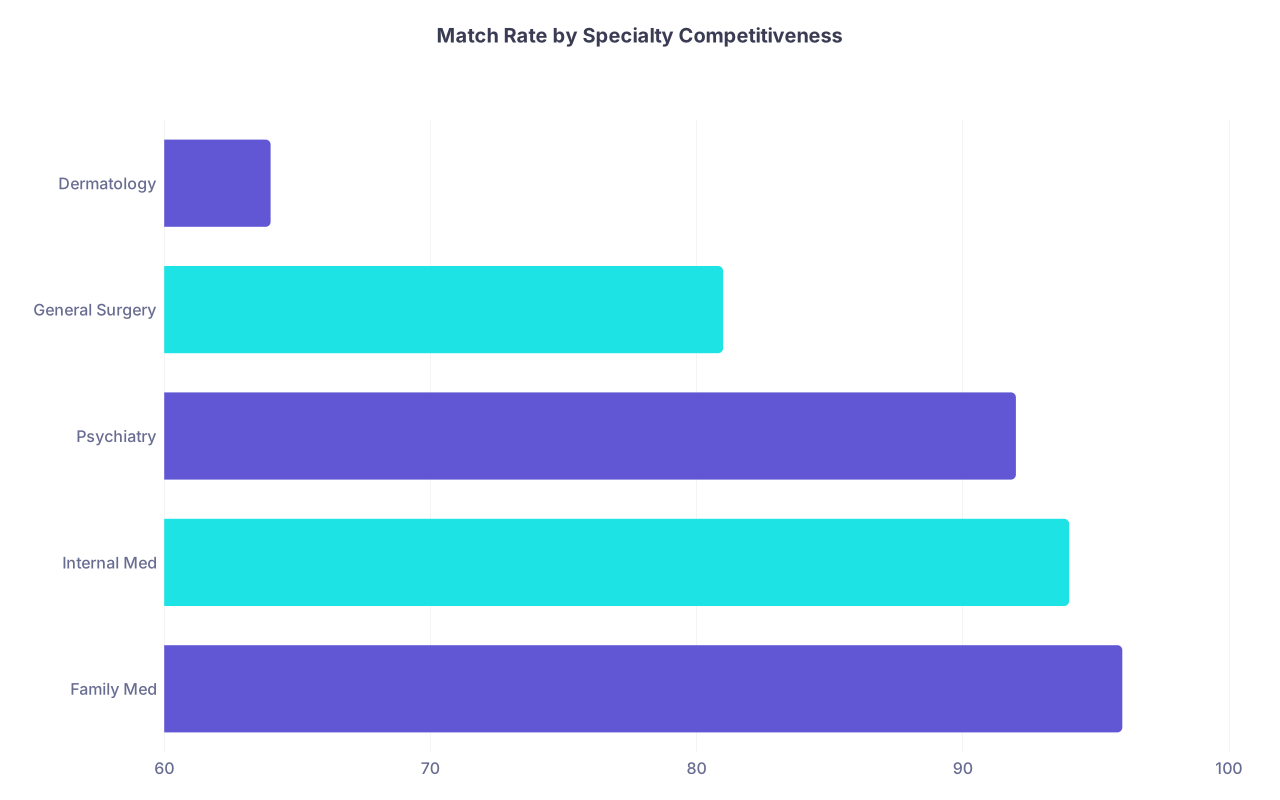
| Category | Value |
|---|---|
| Family Med | 96 |
| Internal Med | 94 |
| Psychiatry | 92 |
| General Surgery | 81 |
| Dermatology | 64 |
If you’re in the “average applicant” range and the city has only one super‑competitive academic surgery program, matching gen surg there as a categorical PGY‑1 is a lottery ticket. I’ve seen very strong people miss in that situation.
Be blunt with yourself:
- “Could I match this specialty somewhere?” is a different question than:
- “Could I match this specialty in this ultra-limited city pool?”
If the answer to the second question is “maybe, if the stars align,” that’s not a real plan if your city boundary is non‑negotiable.
Step 4: Decide Your Hierarchy: City vs Specialty vs Training Type
You don’t get everything. You have to rank what you’re willing to flex. This is the core decision.
Here are the three main levers:
- Specialty
- Location (city vs region)
- Route (categorical vs prelim/transitional vs extra years/fellowship)
You can’t lock all three.
I push people to write this out explicitly:
“I would rather do [A] in [B] than [C] in [D].”
Some examples:
- “I would rather do FM in San Diego than gen surg anywhere.”
- “I would rather be in New York City in IM than in the Midwest in derm.”
- “I’d rather do prelim IM in my city and reapply gen surg than match categorical gen surg 1,000 miles away.”
Once you admit your real preference stack, the path becomes obvious—even if it’s not pretty.
Step 5: Strategy by Constraint Scenario
Let’s get concrete. I’ll walk through common real-world setups and how I’d advise you to adapt.
Scenario A: Highly Competitive Specialty, Tiny City Pool
Example: You want dermatology in San Francisco. You must be in SF for spouse’s tech job. There are only 1–2 programs in the city + immediate surroundings.
This is the hardest version.
Your realistic options:
Commit to city, flex on specialty.
You accept that being in SF with a stable partner is more important than derm. You look at:- Internal medicine → allergy/immunology, rheum, or outpatient focus
- Family med with strong procedures + aesthetics later
- Possibly IM → heme/onc, cards, etc., if that scratches the intellectual itch
Keep specialty dream, flex on route.
You try:- Preliminary year in IM or TY in your city
- Heavy derm research year there
- Reapply derm later, but now also open to other cities for training This means you’re not actually city-locked for residency; you’re city-locked now for life reasons but plan to move later.
Go all in on 1–2 local programs and accept a huge risk of not matching.
I rarely recommend this if your geographic need is truly inflexible and you can’t afford an unmatched year.
If your constraint is permanent (aging parents who truly need you nearby), the smart move in this setup is usually to pivot specialty.
Scenario B: Moderately Competitive Specialty, Limited Programs, Non-Negotiable City
Example: Psychiatry in a city with one 8‑spot program. Your stats are decent, not superstar.
Here, the moves are:
Become “that student” for this program:
- Rotate there as much as you can.
- Join QI or research projects early.
- Get letters from program leadership.
- Make them see you as a safe, known quantity.
Broaden to surrounding metro area (hell yes to 45–60 min commute).
Consider a nearby specialty if there’s a much larger program footprint (e.g., IM or FM with strong psych opportunities later).
Your biggest lever here is fit and familiarity. These small programs love people they already trust who actually want to stay in the city long-term.
Scenario C: Less Competitive Core Specialty, City Has Several Options
Example: Internal medicine or family medicine in Chicago, Houston, NYC, etc.
Here, you actually have leverage.
You can usually:
- Stay in your city and keep your preferred specialty.
- Focus on:
- Getting lots of local letters.
- Ranking broadly within the metro area.
- Not being picky about big-name vs community.
The risk here is arrogance. I’ve seen people aim only at top-tier university programs in their city, ignore the community options, then end up scrambling. If city is king, you rank every reasonable program within that radius above any program outside.
Step 6: Understand Indirect Routes (And Their Limits)
People love the fantasy of: “I’ll match anywhere in IM, then transfer PGY‑2 back to my city’s gen surg program.”
Reality: inter-program transfers are rare, messy, and heavily timing-dependent.
Still, there are workable indirect routes:

Common ones that actually happen:
IM or FM now → subspecialty fellowship in your city:
Train elsewhere, then return for cards, GI, heme/onc, sports med, geriatrics, etc.
Good if:- Your city has strong fellowships.
- You’re okay being away 3 years and then back.
Prelim year in your city → subsequent match elsewhere (or there):
- You do a TY or prelim IM/surg in your city.
- You apply broadly for your categorical specialty.
- Sometimes the local program loves you and offers you a categorical spot later if one opens.
- Not guaranteed. You must be okay with leaving if that never materializes.
Research year in your city before or after med school:
- For super-competitive specialties, you embed yourself in that city’s academic world.
- Boosts your chances locally or regionally.
- But again, not a guarantee.
What doesn’t reliably work:
- Banking on mid-residency transfers to the exact same PGY level in your must-have city.
- Assuming “if I’m here for prelim, they’ll definitely take me categorical.”
I’ve seen programs keep prelims at arm’s length with zero intention of offering categorical spots. You can’t build your life around “maybe they’ll like me.”
Step 7: Tactical Adjustments to Your Application
Once you’ve picked your approach (flex specialty vs route vs region), you adjust your application tactics.
Here’s where you get specific.
Make Yourself “Local”
Programs are more willing to gamble on you if they believe two things:
- You actually want to be in that city long-term.
- You won’t bolt at the first better “name-brand” offer elsewhere.
You do this by:
- Mentioning specific city ties in your personal statement or secondary questions.
- Getting letters from attendings in that city.
- Showing continuity: med school, rotations, research, or family/community work there.
I’ve literally heard PDs say: “We rank her higher—she’s from here and wants to stay. Less likely to leave.”
Stop Being Picky About Program “Prestige”
If the main goal is “I need to be in Denver,” then:
- A solid community IM program in Denver > fancy university IM 1,500 miles away.
- A smaller new psych program in your city > long-established program in a place you hate.
You can fix prestige later with fellowships, jobs, and how you practice. You can’t teleport your family to your dream academic hospital.
Apply Broadly Within Your Radius
If you’re orange-line (metro area), do not just pick the 2 shiny university programs downtown. Add:
- Community programs 40–60 min out.
- Osteopathic programs if relevant.
- Newer programs that might be happy to have motivated, local-tied applicants.
Many people sabotage themselves by being “city-locked” and “prestige-locked.” That combo is how you end up unmatched.
Step 8: Contingency Planning for Worst-Case Outcomes
You need a “what if this doesn’t work” plan. Not as a thought experiment. As an actual Plan B.
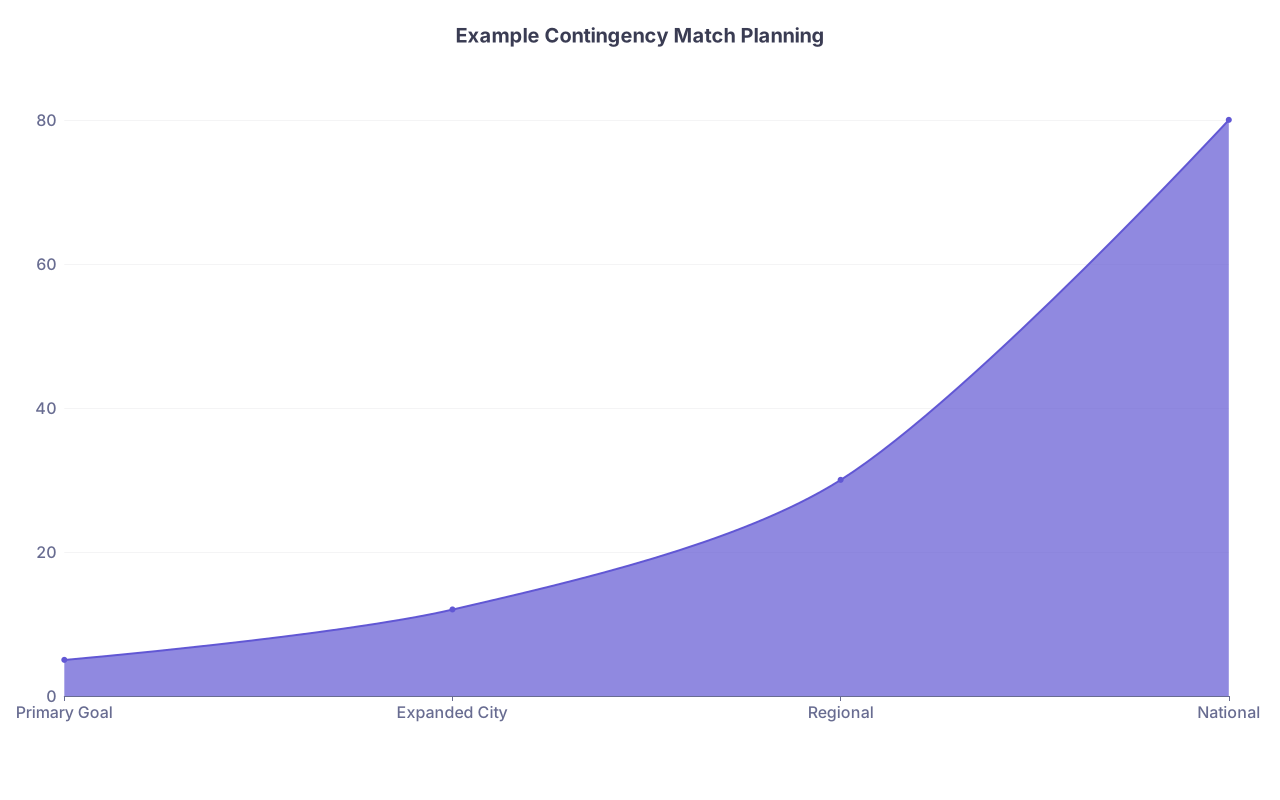
| Category | Value |
|---|---|
| Primary Goal | 5 |
| Expanded City | 12 |
| Regional | 30 |
| National | 80 |
Think in tiers:
Tier 1 (ideal):
Specific city + preferred specialty + categorical spot.Tier 2 (acceptable):
- Specific city + slightly less preferred specialty, or
- Metro area + preferred specialty.
Tier 3 (backup if match seems unlikely):
- Regionally close state or city where family could occasionally visit.
- One-year position (prelim or TY) near your needed city.
- Specialty you didn’t initially love but can live with.
Put actual names and programs under each tier.
You should know, before you submit your rank list:
“If I don’t get City X in Specialty Y, I will still be okay with Z because…”
This doesn’t feel good. But it’s way better than opening the match email to “You did not match” with zero idea what now.
FAQ (Exactly 3 Questions)
1. Should I pick a less competitive specialty just to stay in my city, even if I’m not sure I’ll like it as much?
If your city need is truly non-negotiable (elderly parent, shared custody, immigration constraints, etc.), then yes, sometimes you intentionally pick a less competitive specialty to guarantee a spot nearby. But don’t do it blindly. Shadow, rotate, talk to attendings living that life. Plenty of people discover they’re just as happy in IM with cards or rheum, or in FM with sports med, as they would’ve been in ortho or derm. The mistake is picking a “backup” specialty without testing whether you can stand doing it for 30 years.
2. Can I just match anywhere in my dream specialty and then transfer back to my city after PGY‑1?
You can try, but treating that as your primary plan is risky. Transfers depend on open positions, PD relationships, timing, and your performance. Most programs are stable; they don’t suddenly have extra PGY‑2 spots each year. If you go this route, assume you’re doing all years at your initial program. If a transfer happens, great. If not, you still need that residency to be livable. Don’t sign up for a toxic program you hate under the fantasy of an easy transfer out.
3. How much should I tell programs about my city-specific constraint?
You should be honest, but strategic. It’s fine to say, “My partner works here and our families are nearby, so I hope to build my career in this city long-term.” That reads as stability, not desperation. What you don’t say is, “I can only rank programs in this city; I can’t go anywhere else.” That makes you sound trapped and raises questions about how flexible you’ll be with scheduling, extra shifts, etc. Emphasize commitment to the area and community, not your personal cornered situation.
Key Takeaways
- If you’re city-locked, you’re playing a different game: you must be more flexible on specialty, prestige, and route than your classmates.
- Build an honest map of programs and a clear hierarchy of what you’ll flex: specialty, exact city vs metro, or training pathway.
- Have a concrete Plan B and C before you apply—because hoping everything magically aligns is not a strategy.