
The biggest mistake students make who “like the OR and clinic” is pretending that every hybrid is the same. It is not. Neurosurgery hybrid is a different planet from ENT hybrid, which is different again from interventional neurology, which is miles away from ortho spine.
If you feel pulled toward both clinic and the OR, you’re not confused. You’re standing at a real fork in the road where one branch is neurosurgery and the other is “everything else hybrid.” The wrong move here will cost you years and quite possibly your sanity.
I’m going to walk you through how to decide between neurosurgery and other OR–clinic blends, with concrete scenarios and not the usual “follow your passion” nonsense.
Step 1: Get Real About What “Hybrid” Actually Means by Specialty
“Hybrid” sounds nice on paper. In practice, it’s wildly different depending on the field.
Let’s lay out a rough comparison first, then I’ll break it down.
| Specialty | OR Time % | Clinic/Outpatient % | Lifestyle Intensity | Training Length |
|---|---|---|---|---|
| Neurosurgery | 70–90 | 10–30 | Extreme | 7+ years |
| Ortho (spine-heavy) | 50–70 | 30–50 | High | 5 years + |
| ENT / Plastics | 40–60 | 40–60 | Moderate–High | 5–6 years |
| General Surgery | 60–80 | 20–40 | High | 5+ fellowship |
| Interventional Neuro | 10–30 | 70–90 | High but shiftable | 4 neurology + |
If you tell me, “I love the OR… but I also want meaningful clinic time,” we need to ask a much more precise question:
Do you actually want:
- A surgical identity with some clinic for continuity and follow-up
or - A clinic-based identity with some procedures or OR time?
Because neurosurgery is squarely the first. Interventional neuro via neurology is squarely the second. ENT, ortho, plastics, even vascular or colorectal sit somewhere in between.
Here’s the rule that almost always holds:
If your first love is the OR and your second love is longitudinal patient relationships, neurosurgery might be right.
If your first love is clinic/diagnostics and your second love is procedures, you should not be in neurosurgery.
Step 2: Understand What Neurosurgery “Hybrid” Actually Feels Like
Neurosurgery is sold as: high-stakes surgery + longitudinal care of complex patients + some clinic. That’s not wrong. But the proportions and intensity matter.
What your life actually looks like in neurosurgery
PGY 1–3: Basically live in the hospital. You’re managing:
- ICU patients post-craniotomy, SAH, TBI
- ED consults at 2 am for “rule out cord compression”
- Daily 6 am pre-rounds, long OR days, then notes
Clinic? You might see it once a week, maybe. And most of that is:
- Pre-op assessments
- Post-op wound checks / imaging review
- Chronic spine pain follow-up with failed back syndrome tossed in
PGY 4–7: More OR. Bigger cases. More responsibility. You start to carve out a niche (spine vs vascular vs functional vs tumor). You still get clinic, but surgery is the core.
Post-residency practice: The “hybrid” neurosurgeon
A realistic attending week in a general neurosurgery practice might look like:
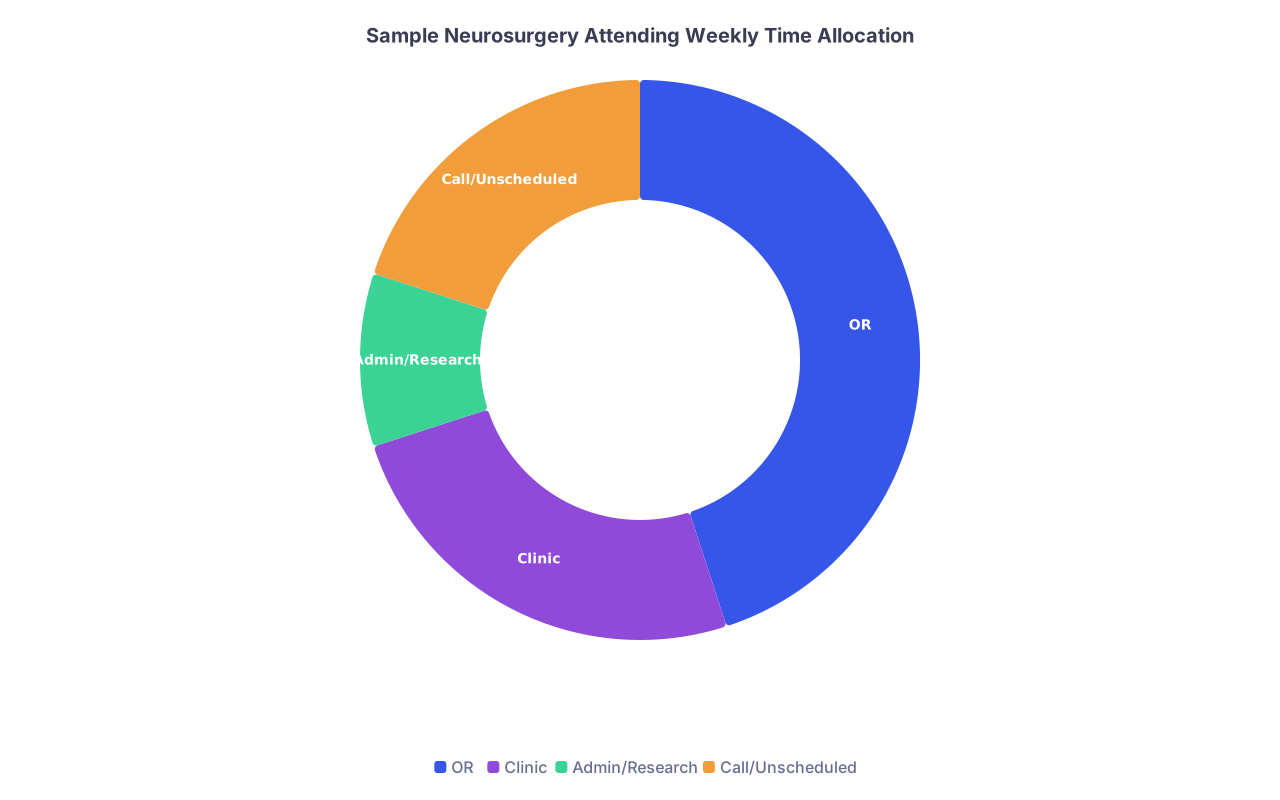
| Category | Value |
|---|---|
| OR | 45 |
| Clinic | 25 |
| Admin/Research | 10 |
| Call/Unscheduled | 20 |
- 2–3 full OR days
- 1–2 full clinic days
- Call that nukes your nights/weekends at unpredictable intervals
If you fantasize about full clinic days: the reality is they usually exist to feed your OR. New spine consults, tumor follow-ups, DBS programming, etc. It’s not a “primary care for the nervous system.”
The part nobody admits: the emotional payload
Neurosurgery clinic is not like ENT clinic.
You will routinely:
- Tell a 38-year-old with 3 kids they have a GBM with a miserable prognosis
- See spinal cord injury patients you decompressed who will never walk again
- Follow aneurysm patients who survived but are cognitively destroyed
If your draw to clinic is “I like happy outpatient continuity and building relationships,” neurosurgery clinic is going to feel heavy and sometimes brutal.
If what you crave is high-acuity decision-making with continuity—“I want to see this through with the patient and family”—then this fits you better.
Step 3: The Main Alternatives if You Want OR + Clinic But Aren’t Sure About Neuro
Now let’s talk about the other hybrid routes people genuinely confuse with neurosurgery.
1. Orthopedic surgery (especially spine)
You like: hardware, biomechanics, big surgeries, and seeing patients in clinic for pain and function.
Ortho spine versus neurosurgery spine looks similar on the surface—ACDFs, laminectomies, fusions—but the ethos is different.
- Ortho: more musculoskeletal, deformity, trauma, biomechanics
- Neurosurg: more central nervous system, intradural, vascular, tumors
Clinic in ortho spine is often:
- Lots of back/neck pain
- Radiculopathy, spinal stenosis
- Conservative management, injections, PT before surgery
If you enjoy managing musculoskeletal complaints, watching people’s function improve, and less ICU/brain death, ortho spine is usually more sane than neurosurgery.
2. ENT (Otolaryngology)
True hybrid specialty.
- OR: sinus surgery, head and neck cancer, thyroid, ear surgery, airway
- Clinic: hearing loss, sinusitis, voice, sleep apnea, cancer follow-up
ENT clinic has plenty of chronic follow-up without the constant existential horror of malignant brain tumors. Yes, head and neck cancer is rough, but you’ll also see a lot of fixable, outpatient issues.
Someone who says, “I love the OR. But I also really liked seeing patients in clinic and talking through their symptoms and quality of life stuff,” is often much happier in ENT than neurosurgery.
3. Plastics
Again, a strong hybrid:
- OR: recon, hand, craniofacial, cosmetic
- Clinic: pre-op consults, post-op checks, elective cosmetic consultations
If what you like about the OR is precision, anatomy, and aesthetics—and what you like about clinic is counseling patients, setting expectations, and seeing visible transformation—plastic surgery gives you all of that without the constant life-or-death weight neurosurgery carries.
4. General surgery plus a niche fellowship
Colorectal, surgical oncology, vascular, HPB—all of these offer some mix of clinic and OR.
Typical pattern:
- Weekly clinic days for new consults and follow-up
- OR days for resections, vascular reconstructions, etc.
- Some emergency call, but usually less relentless than neurosurgery
If you liked your general surgery rotation and your favorite parts of clinic were working up belly pain, weight loss, rectal bleeding, or claudication, this lane is worth examining.
5. Neurology → Interventional or procedures
This is for people who say: “I love brains, I like procedures, but I don’t want to live in the OR.”
Interventional neurology / neuroendovascular:
- Background: Neurology residency → neurocritical care or vascular neuro → endovascular fellowship
- OR/cath lab: aneurysm coiling, thrombectomy, AVM/AVF work
- Clinic: stroke clinic, secondary prevention, cognitive and neuro follow-up
You’re not doing craniotomies. You’re in the angio suite, plus heavy clinic and ICU time.
If you want brains and blood vessels, like shift-based work more than marathon open surgeries, and can tolerate more clinic, this beats neurosurgery for many people who think they “love neuro but want procedures.”
Step 4: Hard Questions That Usually Clarify Neuro vs Other Pathways
I’m going to give you a filter that I’ve seen break the deadlock for a lot of students who sit right where you are.
Answer these honestly. Not aspirationally. Not how you wish you were.
A 12-hour OR day with a complex, high-risk case followed by a rough post-op night in the ICU:
- Draining but deeply satisfying → you skew toward neurosurgery/ortho.
- Feels like too much on a regular basis → look at ENT, plastics, gen surg fellowships, neurology.
Hearing, “This patient is probably going to die, but we might be able to buy them time or prevent a devastating deficit. It’s your call whether to operate”:
- You feel a serious pull to take responsibility → neurosurgery, maybe vascular surgery.
- Your gut response is dread at that kind of weight → steer away from neurosurgery.
Your favorite part of the day:
- Being scrubbed in, not looking at the clock, solving technical problems in real time → surgery-based hybrid is right for you.
- Long, detailed conversations in clinic, medication titration, chronic disease management → neurology, PM&R, rheum, GI, etc., with procedural options.
Your tolerance for training length and pain:
- You’re genuinely okay with 7+ years of some of the most brutal residency call schedules in medicine → neurosurgery stays on the list.
- You already feel exhausted imagining it → don’t ignore that.
Step 5: What to Actually Do in Medical School to Decide
This is where most students get lazy. They shadow one neurosurgeon for 2 days and one ENT for 1 day and then try to guess. That’s not enough.
Here’s a concrete plan.
1. Commit to at least one full week with each contender
At minimum:
- 1 week with neurosurgery (inpatient-heavy, OR + clinic if possible)
- 1 week with an ENT or ortho or plastics team
- 1 week with neurology, ideally seeing stroke and neuro ICU
When you’re there, track three things for yourself daily:
- Energy level at 4 pm
- How you feel before going in the next morning
- Which part of the day you replay in your head on the drive home
Do not ask, “Did I like it?” Ask, “Could I do this pace and emotional load for 20–30 years?”
2. Spend a full day in each: clinic only vs OR only
You need to feel them separated.
For neurosurgery specifically:
- A pure OR day: residents, attendings, the whole flow
- A pure clinic day: new patient consults, post-ops, bad news visits
Do the same for ENT or ortho or plastics.
What you’re looking for: which day flies by, and which day leaves you drained or bored. That’s your honest internal compass.
3. Talk to residents at different stages
Do not just talk to the PD or the unicorn attending who “has great balance.” Talk to:
- A PGY-1 or 2 in neurosurgery: how often are they home before 7–8 pm?
- A mid-level resident (PGY-3–5): ask what they hate and what they love. You want the unfiltered version.
- A chief or recent grad: ask what kind of job they’re actually taking and why.
Then do the same in at least one alternative hybrid field: ENT, ortho, plastics, general surgery.
You’re listening for this pattern: where do people sound burned out, bitter, or trapped vs. tired but fundamentally aligned with their work?
Step 6: Matching Strategy If You’re Torn Between Neuro and Other Hybrids
This is the practical part a lot of people screw up.
Option A: You’re 70% sure about neurosurgery
You lean neuro, but ENT/ortho/other is still whispering.
What to do:
- Do a sub-I in neurosurgery early enough to get a letter.
- Do at least one away rotation in neurosurgery at a different program.
- Also rotate in your second-choice surgical field, but commit your ERAS primarily to neurosurgery.
Do not try to dual-apply neurosurgery + another surgery-heavy field unless you really know what you’re doing and have an advisor in your corner. Programs can smell hedging, and neurosurgery in particular is relationship-heavy.
Option B: You’re 50/50 neuro vs another surgical hybrid
You’re truly split.
My honest advice: you probably should not go into neurosurgery unless/until it pulls clearly ahead.
Neurosurgery is not the specialty you “sort of like.” It is too long and too brutal for lukewarm commitment.
In this case, I’d tell you:
- Spend another serious block of time in neurosurgery early in MS4.
- Compare that with a similarly serious block in ENT/ortho/plastics/general.
- If neurosurgery doesn’t clearly win, choose the other surgical hybrid and build a great life there.
You can often find spine-heavy, tumor-heavy, or complex oncologic work in other fields without the same cost.
Option C: You think you love neuro but really love clinic
If your favorite experiences so far:
- Neuro clinic, stroke workups, EEG interpretation, cognitive evaluations
- Interpreting imaging more than operating on it
You’re probably a better fit for neurology with procedural subspecialty (interventional, EMG, sleep, etc.) than neurosurgery.
Use that realization early to reorient. Don’t force yourself into neurosurgery just to “stay close to the brain.”
Step 7: A Few Red Flags That You’re Forcing Neurosurgery
I’ve seen these patterns over and over. If you see yourself in these, pay attention.
You keep saying, “I’ll just suck it up for residency, then life will be better.”
Reality: if you hate the work and only like the idea of the status, you’re in trouble. The work does not magically become easy; you just become more responsible.You like the idea of being a neurosurgeon more than your actual days on neurosurgery.
Title, prestige, cool cases on Instagram—those are not reasons to choose a 7-year residency.Every resident you meet looks miserable, and you keep telling yourself you’ll “do it differently.”
You will not beat the system. If everyone looks burned, that is data.You keep trying to talk yourself out of how much you enjoyed ENT/ortho/plastics because “it’s not as hardcore.”
Being less hardcore and more sustainable is not a character flaw.
A Quick Visual: Decision Flow

| Step | Description |
|---|---|
| Step 1 | Drawn to OR and Clinic |
| Step 2 | Consider Neurology or IM with procedures |
| Step 3 | ENT, Ortho, Plastics, Gen Surg |
| Step 4 | Neurosurgery is reasonable fit |
| Step 5 | OR or Clinic First? |
| Step 6 | Okay with 7+ years intense training? |
| Step 7 | Comfort with life or death stakes daily? |
FAQ (Exactly 4 Questions)
1. If I like neuro and the OR, should I always choose neurosurgery over neurology?
No. Ask what you actually enjoyed: the diagnostic puzzles, localization, and talking to patients (neurology) or the physical act of operating for long hours under pressure (neurosurgery). If you left neuro clinic energized and neurosurgery call drained you, neurology plus a procedural subspecialty (interventional, neurocritical care) is far better for you than forcing neurosurgery.
2. Can I switch from neurosurgery to another surgical specialty if I realize I hate it?
Sometimes, but it’s messy and not guaranteed. You’ll be applying as a PGY-1 or 2 to match into ENT/ortho/gen surg, often with a non-traditional trajectory and variable program support. You should go into neurosurgery assuming you’re in it for the long haul. If you’re already thinking about “escape plans,” that’s a warning sign.
3. How much research do I need if I might apply neurosurgery but want ENT/ortho as a backup?
If neurosurgery is even a serious maybe, you need a real research footprint—multiple projects, ideally a few neuro-focused outputs (posters, abstracts, maybe a paper). ENT and ortho also like research, but neurosurgery is particularly research-heavy. You can position your work broadly (neuro-onc, spine outcomes, neuroimaging) so it’s still relevant if you pivot to ENT, ortho spine, or surgical oncology.
4. What if I loved neurosurgery cases but hated the ICU and inpatient grind?
That combination is dangerous. Neurosurgery is not just cool tumor resections; it’s long ICU rounds, high-failure situations, and constant emergencies. If those parts drain you, you’re probably better off in a field where the procedural side is front-loaded but the overall acuity is lower—ENT, plastics, or ortho, for example. Loving the OR is necessary but not sufficient for neurosurgery.
Key points, stripped down:
- Neurosurgery “hybrid” is surgery-first, clinic-second, with extreme training length and emotional weight.
- ENT, ortho, plastics, and neurology-based paths offer real OR–clinic blends with very different daily realities.
- Your honest reactions to clinic-only days, OR-only days, and high-stakes responsibility should drive this choice—not prestige, not Instagram, not what sounds hardcore.