
The most confusing fork in early residency choice is not surgery vs medicine. It is Med‑Peds vs categorical Pediatrics.
If you are even slightly drawn to both adult and pediatric medicine, the system will push you to “just pick one.” That is often lazy advice. The real decision is more nuanced, and the training pathways are structurally different in ways that will shape your career for decades.
Let me break this down specifically.
1. What Med‑Peds Actually Is (And Is Not)
People misunderstand Med‑Peds constantly. So let us get this clean first.
Combined Internal Medicine–Pediatrics (Med‑Peds):
- Is a 4‑year ACGME‑accredited residency.
- Graduates are board‑eligible in BOTH Internal Medicine and Pediatrics.
- Training is fully integrated and accredited as if you did two separate programs compressed into four years (not “watered‑down peds” and not “pseudo‑family med”).
Pediatrics (categorical):
- Is a 3‑year ACGME‑accredited residency.
- Graduates are board‑eligible in Pediatrics only.
- More time for depth in child health, development, and pediatric subspecialty exposure.
Here is the core structural difference: peds gives you 3 years to go very deep in one population. Med‑Peds gives you 4 years to be fully competent in two populations and two inpatient ecosystems.
You are not “half” of each. You are full IM + full Peds, on a compressed timetable, with near‑zero fluff.
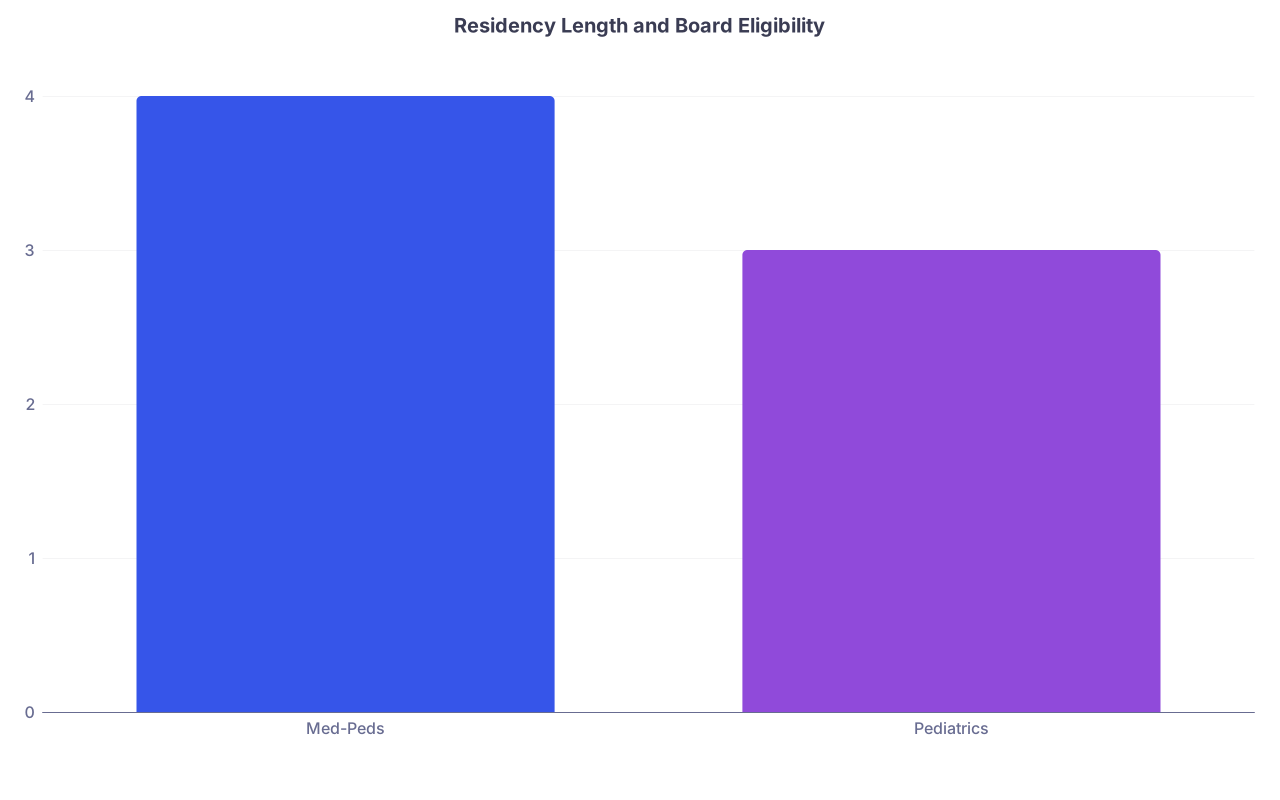
| Category | Value |
|---|---|
| Med-Peds | 4 |
| Pediatrics | 3 |
2. Training Structure: How the Rotations Actually Look
Most applicants only ever see the glossy brochure version. Let us talk about actual month‑by‑month life.
Med‑Peds Rotation Structure
Every program has its own pattern, but they all must meet ACGME requirements for both IM and Peds. Common structures:
- 3–4 month switches: 3–4 months of IM, then 3–4 of Peds, repeating.
- 2+2 models in some places (4‑week IM, 4‑week Peds repeatedly).
- Longitudinal continuity clinic in BOTH adult and pediatric clinics across all 4 years.
A typical 4‑year Med‑Peds arc looks like this (simplified):
- PGY‑1: Heavy ward time on both sides. Adult inpatient, peds inpatient, newborn nursery, NICU, ICU exposure depending on program.
- PGY‑2: More ICU, more supervisory roles starting on one side, electives start to appear.
- PGY‑3: Supervisory on both IM and Peds. Subspecialty rotations, electives, sometimes global health or advocacy.
- PGY‑4: Senior resident on both sides, often chief‑equivalent responsibilities, plus focused electives that shape your career niche.
On paper you meet essentially all the core IM and Peds requirements: wards, ICU, ED, continuity clinic, subspecialties, geriatrics, newborn, adolescent, etc. The difference is you move back and forth between systems constantly. You do not live in one universe for very long.
Pediatrics Rotation Structure
Peds is more straightforward and more cohesive socially:
- PGY‑1: Mostly inpatient peds wards, newborn nursery, ED, some NICU, a bit of clinic.
- PGY‑2: More complex inpatient, step‑up in NICU/PICU, more ED, subspecialty consult services.
- PGY‑3: Senior on wards, NICU/PICU, ED; more electives, maybe chief blocks.
You have a single continuity clinic, one set of conferences, one departmental culture. You grow up professionally in one tribe.
Key Day‑to‑Day Differences
Med‑Peds:
- Two email lists. Two call schedules. Two sets of leadership.
- One month you are admitting 75‑year‑olds with decompensated heart failure. Two weeks later you are managing RSV bronchiolitis in 6‑month‑olds.
- You are always “the Med‑Peds resident” in every room. People will ask you to weigh in when a kid is turning 18 or an adult with congenital disease shows up.
Peds:
- Very cohesive identity. One department, one grand rounds, one chief group.
- Developmental milestones, vaccine schedules, behavioral pediatrics, child advocacy woven into almost everything you do.
- Adult medicine is off your radar. You will not be managing cirrhosis, COPD, NSTEMI. At all.
If you crave variety and hate monotony, Med‑Peds feels like oxygen. If you thrive on immersion and depth in a single population, peds will feel more natural.
3. Call, Workload, and Burnout: Who Has It Worse?
There is no honest version of this where either path is “easy.” But the texture of stress is different.

Med‑Peds Work Patterns
You essentially live two parallel residency lives:
- Call systems: You follow the call/shift patterns of whichever service you are on. IM may be night float heavy; Peds may still have 24‑hour calls. You do both.
- Workflows: Adult wards often run on different rounding styles and documentation norms than Peds. You learn both and constantly switch.
Burnout risk in Med‑Peds tends to come from:
- Identity fragmentation. Never fully “one of the group” on either side if your program culture is weak.
- Scheduling chaos. The constant switching can make you feel like you are always re‑orienting.
- Expectation inflation. Faculty often perceive you as unusually capable or “the flexible one”; you may get pulled into complex or crossover cases more often.
That said, a well‑run Med‑Peds program (think: strong Med‑Peds core faculty, true Med‑Peds clinics, real mentorship) is one of the healthiest resident cultures I have ever seen. The residents tend to self‑select as resilient, quirky, and fairly independent.
Pediatrics Work Patterns
Peds has its own pain points, but they are more uniform:
- Inpatient services: During viral seasons, pediatric wards and PICUs are intense. High census, high acuity, emotionally charged.
- NICU/PICU: Night shifts and long blocks in critical care for very small, very sick humans. High emotional load.
Where burnout hits in Peds:
- Emotional weight. Child abuse cases, oncology diagnoses, chronic complex kids. It wears on people.
- Perceived undervaluation. Peds often feels underpaid and under‑resourced relative to complexity of care.
- Repetitiveness. For some, seeing the same bread‑and‑butter well‑child / URI / asthma pattern day in and day out becomes draining.
Reality Check
Neither path is “chiller.” Anyone selling you that is lying or has not done the job recently. The right question is:
Do you want your hard to be:
- emotionally pediatric‑centric, deeply tied to families and child advocacy (Peds), or
- cognitively broad, constantly toggling between two systems and age groups (Med‑Peds)?
4. Board Exams, Competence, and Breadth vs Depth
This is where the structural difference becomes very concrete.
Board Eligibility
Med‑Peds grads sit for:
- American Board of Internal Medicine (ABIM) exam.
- American Board of Pediatrics (ABP) exam.
Peds grads sit for:
- ABP exam only.
| Pathway | Exams Required | Exam Focus | Timing (Typical) |
|---|---|---|---|
| Med-Peds | ABIM + ABP | Adult + Pediatric | PGY-4 or postgrad |
| Pediatrics | ABP | Pediatric only | PGY-3 or postgrad |
Studying for one board is already a major project. Med‑Peds means two different exam blueprints, two styles of questions, two sets of guidelines. It is doable; thousands do it. But you need to be realistic about bandwidth.
Clinical Competence
The common fear: “If I do Med‑Peds, I will be less strong in pediatrics than my categorical peds colleagues.”
Here is the honest answer:
- For bread‑and‑butter general peds, a Med‑Peds grad who paid attention is absolutely comparable.
- For deep subspecialty nuance (say, complex rheum, advanced NICU, pediatric heme‑onc), categorical peds residents will have more exposure during residency.
The same applies on the IM side. You will meet the requirements in both but you will always have less time in any single silo than someone who only does that silo for 3 years.
In practice:
- Most Med‑Peds grads going into pure peds practice feel totally comfortable clinically.
- If you plan a very niche pediatric subspecialty (e.g., pediatric cardiology with heavy cath lab ambitions), a pure peds path is usually cleaner and gives more early depth.
5. Fellowship Options: What Opens and What Closes
This is where the choice has very real opportunity cost.
From Pediatrics Residency
From a standard 3‑year Peds program, you can pursue:
- All pediatric subspecialties:
- Neonatology
- Pediatric Critical Care
- Pediatric Cardiology
- Pediatric Heme‑Onc
- Pediatric Endocrinology
- Pediatric Pulmonology
- Adolescent Medicine
- Pediatric ID
- Pediatric GI
- Pediatric Rheumatology
- Pediatric Nephrology
- Developmental‑Behavioral Peds
- Child Abuse Pediatrics
- Academic general pediatrics / hospitalist / advocacy / global health tracks.
If your brain lights up on NICU, PICU, peds cards, or peds heme‑onc, a straight peds pathway is usually more direct.
From Med‑Peds Residency
You inherit essentially the full menu of:
- Adult IM fellowships:
- Cardiology
- Pulmonology/Critical Care
- GI
- Heme‑Onc
- Nephrology
- Endocrinology
- Rheumatology
- ID
- Geriatrics
- Hospital Medicine fellowships
- Pediatric fellowships (most are open to Med‑Peds applicants; check individual program policies).
Plus a few unique or especially synergistic combinations:
- Adult congenital heart disease (adult cardiology + peds background is gold).
- Cystic fibrosis centers (care from infancy into adulthood).
- Sickle cell programs.
- Transition medicine fellowships or positions focusing on childhood‑onset chronic disease in adults.
- Combined subspecialty training (less common but real in places: e.g., combined adult/peds ID tracks, adult/peds rheum).
Peds alone does not get you adult fellowships. Med‑Peds keeps both doors open. That is the key asymmetry: Peds is narrower but deeper in kids; Med‑Peds is structurally wider.
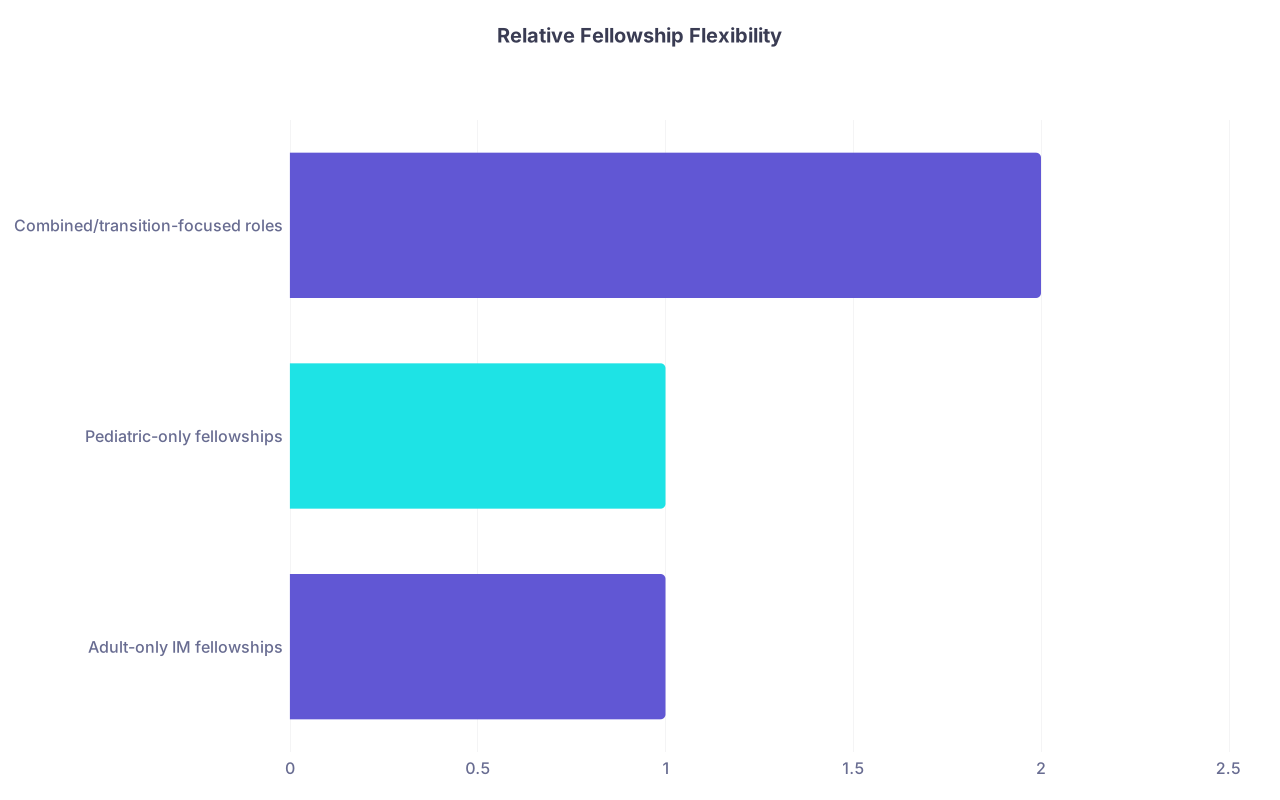
| Category | Value |
|---|---|
| Adult-only IM fellowships | 1 |
| Pediatric-only fellowships | 1 |
| Combined/transition-focused roles | 2 |
(Interpretation: Peds = 1 lane; IM = 1 lane; Med‑Peds = both lanes plus unique “bridge” roles.)
6. Career Trajectories: Where You Actually End Up Practicing
This is the part nobody tells you clearly during MS3: most Med‑Peds grads do NOT split their time 50/50 forever. Most Peds grads do what you expect—pure pediatric practice.
Typical Pediatrics Grad Careers
Common endpoints after categorical peds:
- General pediatrician:
- Community outpatient clinic.
- Hospital‑based academic general peds.
- Urgent care / fast‑track pediatric settings.
- Pediatric hospitalist:
- Academic children’s hospitals.
- Community hospitals with pediatric wards.
- Pediatric subspecialist:
- NICU, PICU, subspecialty clinics, procedural services.
The career is almost entirely inside children’s hospitals, pediatric clinics, and child‑focused systems. Your professional language is growth curves, immunization schedules, milestones, developmental assessments, school issues, family systems.
Typical Med‑Peds Grad Careers
Here is the surprising truth: a lot of Med‑Peds graduates end up doing primarily one population in routine practice, but use their dual training in niche ways.
You see several recurring patterns:
Combined Med‑Peds outpatient primary care
- One clinic, all ages, from newborn to 90+.
- You can follow kids with chronic disease into adulthood.
- Very strong fit for FQHCs, academic Med‑Peds clinics, underserved settings.
Adult hospitalist with pediatric background
- Clinical role is mostly adult.
- Peds training informs how you handle young adults with childhood‑onset disease (CF, congenital heart disease, sickle cell).
- Often become the de facto “transition medicine” person.
Med‑Peds hospitalist (true combined wards)
- Some hospitals have roles where you admit both adults and kids.
- More common in smaller or rural systems consolidating hospitalist coverage.
Subspecialist with dual comfort
- Example: adult pulmonology but running a CF center that spans pediatric and adult patients.
- Example: rheumatology seeing JIA patients into adulthood.
Do all Med‑Peds grads keep both boards clinically active long‑term? No. Over time, many gravitate to one side in practice and maintain the other through consults, admin, or transition work. But the option remains for decades.
7. Lifestyle, Salary, and Job Market Differences
Let me cut through the nonsense here: neither path is a road to derm‑level money or lifestyle.
Compensation
Very rough, broad strokes in the U.S.:
- General pediatrics: lower end of physician compensation spectra among specialties.
- General IM: modestly higher than peds on average.
- Hospitalist medicine (adult): often pays more than outpatient general peds.
- Subspecialty peds: variable; many still lower than adult counterparts (peds rheum, peds endo, etc.).
Med‑Peds per se does not earn you a “Med‑Peds differential.” You are hired either as:
- general IM,
- general peds,
- Med‑Peds primary care (often similar to IM pay scales), or
- a subspecialist with whatever your subspecialty pays.
The structural financial difference:
- Peds is more likely to point you to lower‑paid pediatric‑only roles.
- Med‑Peds tilts your probabilities toward either:
- adult medicine roles (often slightly better compensated), or
- unique Med‑Peds/transition positions (comp tends to follow local adult med scales more than peds scales).
Lifestyle and Schedule
Real‑world patterns:
- Outpatient peds: decent control of schedule, predictable office hours, some nights/weekends, phone call.
- Hospitalist peds: shift‑based, blocks of days/nights, heavy during viral seasons.
- Med‑Peds outpatient: similar to IM or peds clinic schedules; main difference is patient mix.
- Adult hospitalist (common Med‑Peds route): 7‑on/7‑off or similar blocks, which some love and some hate.
Again, nothing about Med‑Peds inherently “buys” you better lifestyle. It just gives you more levers to pull when shaping your attending job.
8. Personality Fit: Who Belongs in Med‑Peds vs Peds
This is the section most people feel intuitively but never verbalize.
Classic Pediatrics Resident Profile
Obviously stereotypes, but you will recognize them:
- Loves kids more than adults. Genuinely energized by babies, toddlers, teenagers.
- Very comfortable with parents, family dynamics, developmental delays, school systems.
- Motivated by prevention, advocacy, longitudinal family relationships.
- Less interested in multi‑morbid geriatric cases or “adult problems” like heart failure, cirrhosis, COPD.
Their nightmare rotation: endless clinic days of 60‑year‑olds with diabetes, CHF, and med reconciliation lists. If that sounds like you, Med‑Peds is probably overkill. Go peds.
Classic Med‑Peds Resident Profile
Again, broad strokes:
- Likes complexity and variety. Easily bored doing exactly one kind of medicine.
- Not turned off by adults. Enjoys ICU, step‑down, complex inpatient on both sides.
- Drawn to young adults with childhood‑onset disease, chronic complex patients, and systems issues.
- Often a little contrarian. They heard “pick one” and said, “No, I actually want both.”
Their nightmare: being told they will never again care for an adult, or never again see a child. If you feel a little loss imagining giving up either population, that is the Med‑Peds signal.
9. How to Decide: Concrete Questions To Ask Yourself
You are not going to reason your way into the perfect future. But you can narrow the field intelligently.
Question 1: When you picture your “favorite patient,” how old are they?
If your gut image is a 3‑year‑old with asthma and loving parents who bring birthday cards to clinic—peds bias.
If it is a 28‑year‑old with sickle cell who has been hospitalized since childhood and trusts you more than anyone—Med‑Peds bias.
Question 2: How do you feel on adult medicine rotations?
- If you truly dread adult wards and find adult pathology uninteresting, forcing yourself through 24 months of IM equivalents in Med‑Peds will be miserable.
- If you enjoy both wards but get annoyed that you have to leave after 4 weeks every time, you are a good Med‑Peds fit.
Question 3: Do you want late‑game flexibility or early clarity?
- Peds: You commit early to being a children’s doctor. Your training, mentorship, and networking all align cleanly around that.
- Med‑Peds: You delay locking in. At PGY‑3 you could decide to be an adult hospitalist, a peds subspecialist, a Med‑Peds primary care doc, etc.
If indecision terrifies you and you crave a clear singular identity, Med‑Peds may feel unsettling. If indecision feels like “options,” Med‑Peds is your friend.
Question 4: Can you tolerate a 4‑year residency vs 3 years?
One more year is not trivial:
- One more year of resident salary.
- One more year before attending‑level income and autonomy.
For some, that is a dealbreaker. For others, the dual competence is worth the extra year ten times over.

| Step | Description |
|---|---|
| Step 1 | Start - Consider future patients |
| Step 2 | Choose Pediatrics |
| Step 3 | Choose Internal Medicine |
| Step 4 | Choose Med-Peds |
| Step 5 | Choose Pediatrics or IM based on stronger pull |
| Step 6 | Like caring for adults? |
| Step 7 | Like caring for kids? |
| Step 8 | Want flexibility and dual training? |
10. My Blunt Take: When Each Path Is Clearly Better
Let me stop dancing around it and give you actual opinions.
You should almost certainly choose CATEGORICAL PEDIATRICS if:
- You do not like adult medicine. At all.
- Your dream is NICU, PICU, pediatric cardiology, or a highly specialized peds subspecialty and you are 90% sure of it.
- The idea of one more year of residency makes you physically ill.
- You care most about deep family relationships, child advocacy, and you want your entire professional identity around kids.
You should strongly consider MED‑PEDS if:
- You genuinely enjoy adult and pediatric medicine on your rotations.
- You are fascinated by chronic diseases that start in childhood and continue across the lifespan (CF, sickle cell, congenital heart disease, childhood cancer survivors, complex neurodisability).
- You want maximal flexibility: primary care vs hospitalist vs adult vs peds vs hybrid roles.
- You can tolerate being the “bridge” doctor who often ends up handling the weird transition issues nobody else wants.
The biggest mistake I see: students who like both adult and pediatric medicine, have no idea what they want long‑term, and default into peds because “Med‑Peds seemed like too much” without ever talking to an actual Med‑Peds resident or faculty. That is self‑sabotage.
Talk to both groups. Ask them what jobs their alumni actually took. Look at their clinic structures. Med‑Peds with a strong identity feels very different than Med‑Peds as an afterthought tacked onto two siloed departments.
FAQ (Exactly 6 Questions)
1. Do Med‑Peds residents get less NICU/PICU experience than categorical pediatrics residents?
Often yes, somewhat less. You meet minimum ACGME requirements but may not get as many total months in NICU/PICU as a categorical peds resident, because you must also fulfill adult ICU and ward time. If your career goal is pure NICU or PICU and you want maximal exposure, straight peds is usually cleaner.
2. Can Med‑Peds graduates match into competitive pediatric fellowships like heme‑onc or cardiology?
Yes, they can and do, but you must be intentional. You need strong peds mentorship, research, and letters on the pediatric side. Some programs are very comfortable with Med‑Peds applicants; a few may prefer categorical peds. It is program‑specific, not universally closed or open.
3. If I do Med‑Peds, do I have to maintain both IM and Peds board certification forever?
No, but it is common early on. Many attendings maintain both for 5–10 years, then sometimes drop one if they have fully shifted to a single population. Maintaining both does mean double MOC requirements and exam cycles, which some people eventually abandon if not clinically relevant.
4. How different is Med‑Peds from Family Medicine in practice?
Very different in training focus. Family Med includes OB, procedures, psychiatry, and broader community medicine, but does not go as deep into inpatient adult medicine or inpatient pediatrics as Med‑Peds. Med‑Peds is essentially full IM plus full Peds. If you want heavy inpatient, complex adult and pediatric medicine, and potential subspecialty fellowships, Med‑Peds aligns better than FM.
5. Are Med‑Peds programs as competitive as pure pediatrics?
Generally, Med‑Peds sits somewhere between peds and categorical IM in competitiveness, varying by institution. The total number of spots is much smaller than peds. Top Med‑Peds programs (e.g., at major academic centers) can be quite competitive because there are so few positions and they attract a very self‑selected applicant pool.
6. What should I look for when evaluating Med‑Peds programs vs peds programs on the interview trail?
For Med‑Peds: look for a clear Med‑Peds identity—dedicated Med‑Peds clinics, core Med‑Peds faculty, visible Med‑Peds leadership, and a cohesive resident group. Ask where graduates end up (adult vs peds vs combined). For peds: look at NICU/PICU exposure, faculty approachability, advocacy opportunities, and fellowship match lists. In both, pay close attention to resident culture and how tired or supported they look; that is your real daily life.
Key points, no sugar‑coating:
- Pediatrics gives you depth and identity in child health, faster and more cleanly; Med‑Peds gives you breadth and long‑term flexibility at the cost of one extra year and a more complex training experience.
- If you actively dislike adult medicine, you have your answer: choose peds. If you genuinely like both and care about transition and complex chronic disease across the lifespan, Med‑Peds is usually the smarter bet.