
The data is blunt: if you want a sane outpatient life with longer visits and smaller panels, psychiatry wins; if you want higher visit volume, more procedures, and broader medical complexity, internal medicine takes it. The numbers on panel sizes, visit lengths, and RVUs make that gap obvious.
Let me walk through it like I would for a resident trying to decide between psych and IM with a spreadsheet open, not a vision board.
1. Core practice model: how the templates actually look
Most students hear vague generalities: “Psych has longer visits,” “IM is more rushed.” That is not useful. Clinic templates, panel sizes, and RVU expectations are where the real difference lives.
In a typical outpatient environment:
- Psychiatry is selling cognitive time.
- Internal medicine is selling throughput.
Here is a simplified but realistic snapshot of what a full-time outpatient clinician might look like in each field, based on large system norms, MGMA/AMGA survey data, and what I have seen in real EHR builds.
| Metric | Outpatient Psychiatry | Outpatient Internal Medicine |
|---|---|---|
| Clinic days per week | 4–4.5 | 4.5–5 |
| Patient visits per day | 10–14 | 18–24 |
| New visit length (scheduled) | 60–90 minutes | 30–60 minutes |
| Follow-up visit length | 20–30 minutes | 15–20 minutes |
| No-show rate (urban, general) | 15–30% | 5–15% |
| Typical work RVUs per day | 16–24 | 20–32 |
You can see the trade: psychiatry trades volume for time. IM trades time for volume. The annual math follows directly from that.
Assume 46 working weeks per year (vacation, CME, holidays). Multiply out daily volumes:
- Psych: 12 patients/day × 4.5 days/week × 46 weeks ≈ 2,484 visits/year.
- IM: 21 patients/day × 4.5 days/week × 46 weeks ≈ 4,347 visits/year.
You will physically see almost twice as many patients per year in IM for a similar FTE, everything else being equal.
2. Panel sizes: how many lives you are responsible for
The panel size question is where the psych vs IM difference really hits. It is not even close.
For outpatient-only clinicians:
Internal medicine primary care panels:
- Typical employed target: 1,400–2,000 patients.
- Aggressive or RVU-heavy systems: 2,000–2,500+.
- Concierge/Membership models: 400–800, but that is an outlier structure.
Outpatient psychiatry panels:
- Typical general adult: 300–800 active patients.
- Medication-management heavy models (15–20 min follow-ups): can push toward 1,000+.
- Psychotherapy-heavy models (45–50 min) with med management: 150–400.
You can think of three knobs:
- Visit length.
- Visit frequency.
- No-show rate.
Psych tends to have longer visits, somewhat higher no-show rates, and often shorter intervals between visits (q1–3 months). That keeps panels smaller.
Internal medicine has shorter visits and longer intervals (often q6–12 months for stable patients), which drives up the panel capacity.
Let us put some approximate numbers behind a stable “classic” setup for each.
Hypothetical but realistic setups
Scenario A – General Adult Psychiatrist, mix of new and follow-up, mostly med management with occasional brief therapy:
- Follow-up visit interval: average every 3 months (4 visits/year).
- Average scheduled follow-up length: 25 minutes.
- No-show rate: 20%.
- Available follow-up slots per week: say 50 (5 hours morning, 5 hours afternoon, 5 days a week, but some time reserved for new patients, admin, etc.), but let us use an annual capacity instead.
Working backward:
- Suppose the psychiatrist has capacity for 2,300 completed visits per year (based on earlier 2,484 scheduled, minus no-shows).
- Half are new/complex visits and longer follow-ups; half are standard follow-ups. To simplify, assume average 4 visits per active patient per year.
- Panel ≈ 2,300 ÷ 4 ≈ 575 active patients.
This 400–700 range is what I see repeatedly in large groups for full-time outpatient psychiatrists.
Scenario B – Outpatient IM physician, mainly primary care:
- Average follow-up interval: every 9–12 months for stable; more frequent for chronic disease. Effective average might be ~1.4 visits per active patient per year when you blend sick visits, annuals, and chronic care.
- No-show rate: 10%.
- Annual completed visits ≈ 3,900 (4,347 scheduled × 0.9).
Panel ≈ 3,900 ÷ 1.4 ≈ 2,785 active patients.
Most systems will cap it somewhat lower (1,800–2,200) to keep things from collapsing, but the math explains why physician panels drift upward so easily: every time visit intervals stretch, your effective panel can balloon.
To summarize:
| Specialty/Model | Typical Panel Range |
|---|---|
| General Outpatient Psychiatry | 400–800 |
| Med-management heavy Psychiatry | 700–1,200 |
| Psychotherapy-heavy Psychiatry | 150–400 |
| Outpatient IM (traditional PCP) | 1,400–2,200 |
| High-volume IM PCP | 2,000–2,800 |
If your primary stressor is responsibility for too many patient lives, IM is numerically worse by a factor of roughly 2–4.
3. Visit length and daily flow: how your time actually feels
Let us compare clinics where both are essentially “busy but sustainable.”
Psych clinic: cognitive density per hour
A standard outpatient psychiatry morning might look like:
- 1 new patient (60–90 minutes).
- 6–8 follow-ups (20–30 minutes each).
- A bit of administrative time embedded.
Why the longer slots?
- Medication adjustments with side effect counseling.
- Suicide risk assessments.
- Collateral from family/therapists.
- Complex social context review.
- High charting burden per encounter (narrative).
Visit length is not just “because psych is slow.” It is because doing it safely and thoroughly takes time.
IM clinic: complexity per unit time
Internal medicine templates in big systems are often built around:
- New patient: 40–60 minutes.
- Annual physical: 30–40 minutes.
- Typical follow-up: 15–20 minutes.
- Work-in/sick visit: 15–20 minutes.
You often have double-booking blocks for acute visits, plus some chronic care management shoved in the portal.
In a 4-hour session, a “standard” template might have:
- 10–12 slots (20-minute baseline, some 40-minute).
- Adjusted upward with double-booking if you are behind on access targets.
So yes, psych visits are longer. But more importantly, IM visit slots are shorter relative to the number of problems patients bring. That mismatch is where IM burnout frequently starts.
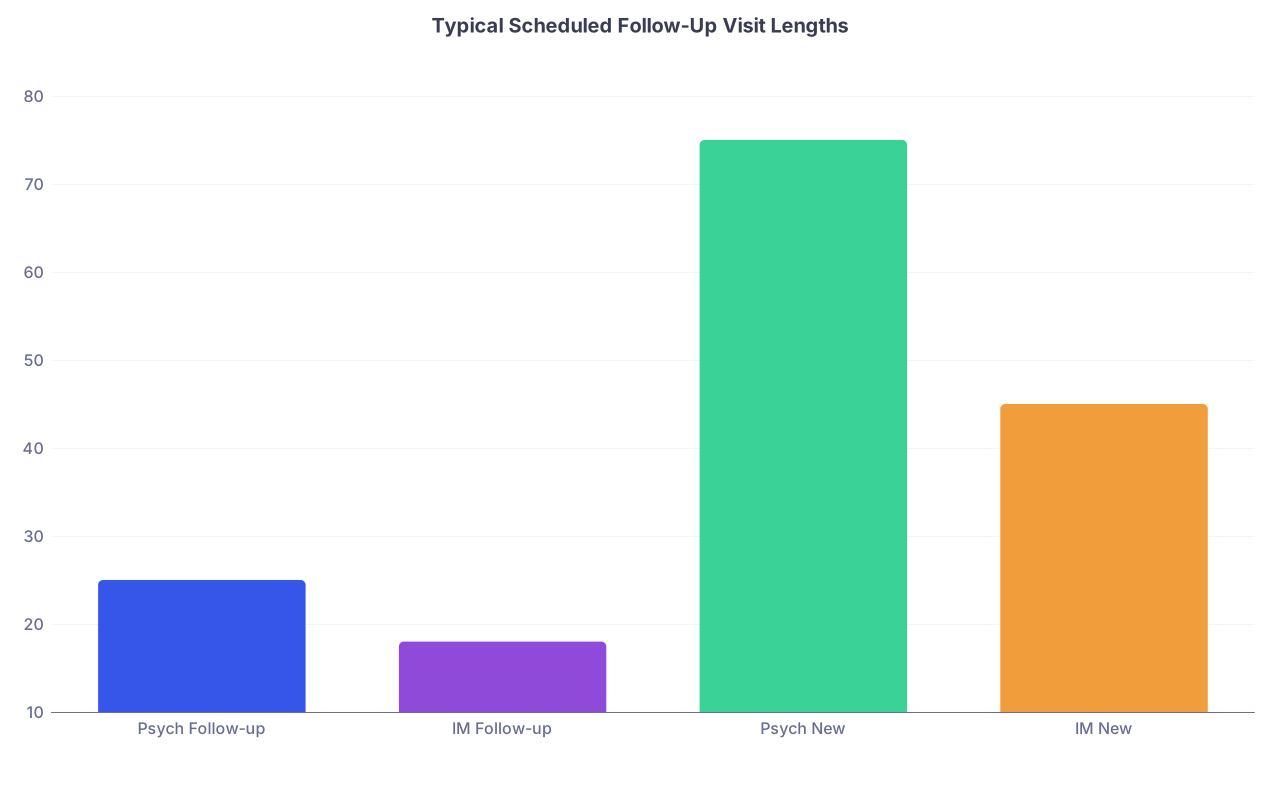
To visualize the difference in scheduled visit lengths:
| Category | Value |
|---|---|
| Psych Follow-up | 25 |
| IM Follow-up | 18 |
| Psych New | 75 |
| IM New | 45 |
Those are midpoints of common ranges: 20–30 vs 15–20, 60–90 vs 30–60. The ratio is roughly 1.3–1.5x follow-up time and 1.5–2x new visit time in psych compared to IM.
4. RVU math: what you get “paid” for
If you want to understand the pressure you will feel, ignore salary for a minute and look directly at work RVUs (wRVUs). That is the currency your employer uses to measure your output. It drives “productivity expectations.”
Common outpatient codes and RVUs
Here are typical work RVUs for standard evaluation and management (E/M) codes and key psychiatry codes:
| Code / Service | Used By | Approx wRVU |
|---|---|---|
| 99213 – Established, low/mod complexity | IM, Psych (med mgmt) | ~1.30 |
| 99214 – Est, moderate complexity | IM, Psych | ~1.90 |
| 99215 – Est, high complexity | IM, Psych | ~2.80 |
| 90792 – Psych diagnostic eval (no med) | Psych | ~3.00 |
| 99204 – New, mod complexity | IM, Psych | ~2.60 |
| 99205 – New, high complexity | IM, Psych | ~3.20 |
| 90833 – Psychotherapy add-on (16–37m) | Psych | ~1.50 |
| 90836 – Psychotherapy add-on (38–52m) | Psych | ~2.00 |
Exact values vary slightly by year and payer, but the ballpark is stable enough to model with.
Typical productivity targets
Across large health systems and MGMA-type benchmarks:
Full-time outpatient psychiatry:
- Common annual target: 4,500–6,000 wRVUs.
- More aggressive groups: 6,500+.
Full-time outpatient IM (non-procedural):
- Common annual target: 5,500–7,000 wRVUs.
- High expectation settings: 7,500–8,500+.
Take a midline for each:
- Psych: 5,500 wRVUs/year.
- IM: 6,500 wRVUs/year.
Divide by 46 weeks and ~4.5 clinic days/week:
- Psych ≈ 5,500 ÷ (46 × 4.5) ≈ 26.5 wRVUs/day.
- IM ≈ 6,500 ÷ (46 × 4.5) ≈ 31.3 wRVUs/day.
That is the rough pressure level.
Now translate to visits.
Example daily patterns to hit those RVUs
Psych, mixture of new and follow-up, mostly med management:
- 2 new 90792 equivalents @ 3.0 wRVU = 6.0.
- 8 99214 equivalents @ 1.9 wRVU = 15.2.
- 2 visits with 90833 psychotherapy add-on @ 1.5 wRVU = 3.0.
Total ≈ 24.2 wRVUs for 12 visits.
You can add a few more psychotherapy add-ons or one more higher-complexity visit and hit 26–27 easily.
IM, standard follow-ups and some new patients:
- 2 new 99204 @ 2.6 wRVU = 5.2.
- 10 99214 @ 1.9 wRVU = 19.0.
- 2 99215 @ 2.8 wRVU = 5.6.
Total ≈ 29.8 wRVUs for 14 visits.
Again, you can adjust complexity coding and volume slightly and sit right at 31–32.
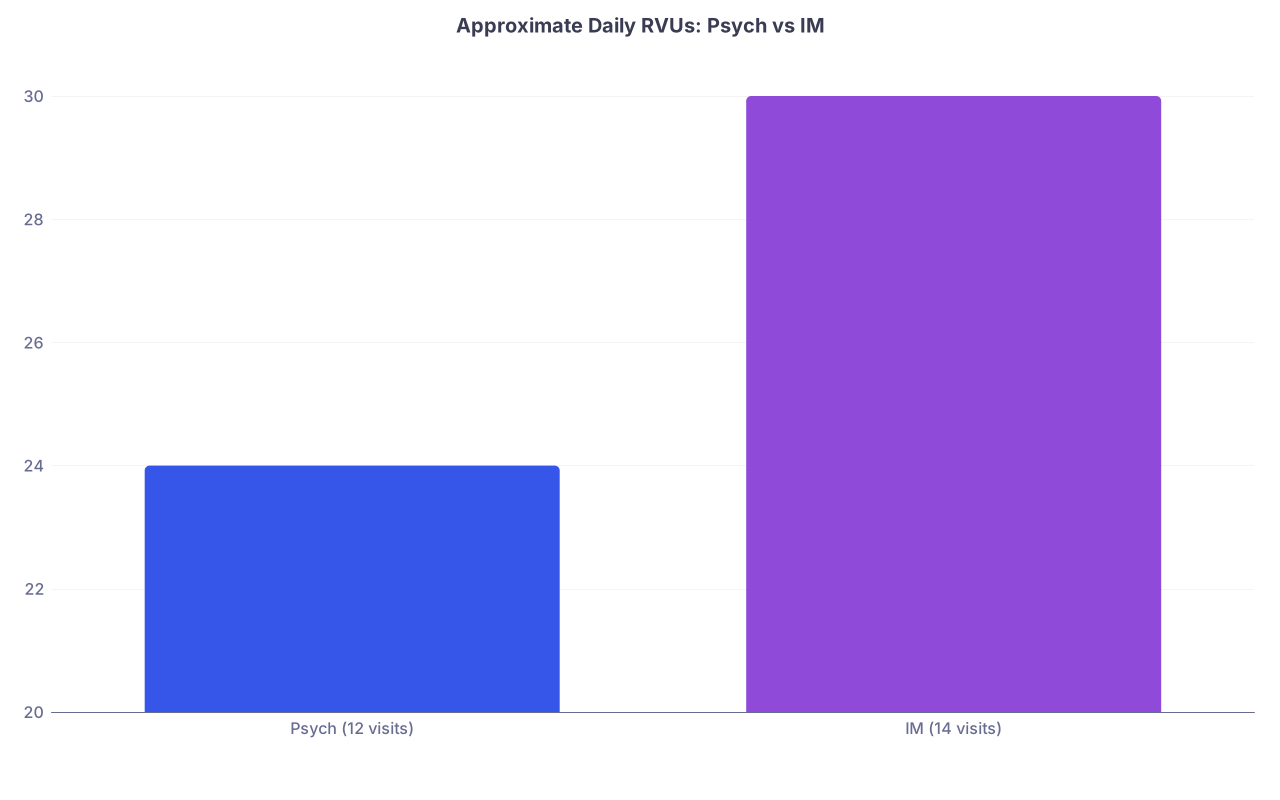
Here is a side-by-side comparison of daily RVU generation:
| Category | Value |
|---|---|
| Psych (12 visits) | 24 |
| IM (14 visits) | 30 |
The raw RVU targets are higher in IM, but the important detail is RVUs per visit:
- Psych example: 24.2 ÷ 12 ≈ 2.0 wRVUs/visit.
- IM example: 29.8 ÷ 14 ≈ 2.1 wRVUs/visit.
They look similar. But psych is taking longer per visit to get those wRVUs, and often doing more narrative documentation. IM is compressing more complexity into shorter slots.
5. Income implications (without turning this into a salary rant)
You are not asking directly about money, but panel size, visit length, and RVUs inevitably tie to income. So I will address the core relationship briefly, with numbers not fluff.
Broad national data (MGMA, Medscape, AMGA, etc.) tends to put:
- Median outpatient/combined Psychiatry compensation: roughly $270k–$350k, with wide regional variation.
- Median outpatient/combined Internal Medicine: roughly $260k–$320k, again with big spreads.
People obsess over the absolute numbers, but the more interesting ratio is:
Income per wRVU.
Typical compensation plans:
- Psychiatry: $45–$65 per wRVU (base + incentive blended).
- Internal medicine: $45–$65 per wRVU as well, sometimes slightly lower for pure primary care, slightly higher in RVU-heavy setups.
So the income gap is not only about “specialty value.” It is largely that IM physicians often produce more wRVUs per year under higher panel and visit-volume pressure. Psychiatry tends to hit somewhat lower absolute wRVU totals, but with fewer patients and longer visits.
If you want more money in either field, the systems push you in the same direction: shorter visits, more patients per day, higher panel.
The key distinction: psychiatry has more structural room to resist that pressure because the baseline visit lengths and panel norms are already lower.
6. Burnout vectors: what the numbers suggest about lived experience
Everyone asks about “lifestyle” in vague terms. Let us connect that directly to the data we have just walked through.
6.1. Cognitive load per day
Internal medicine outpatient visits pack multiple agenda items into 15–20 minutes:
- Diabetes, hypertension, CKD, obesity, depression, colon cancer screening, a new rash, plus 4 meds needing refills.
- And two MyChart messages that should have been visits.
Psychiatry visits are longer but more focused:
- Narrower problem list (though deep).
- Typically fewer acute organ-system emergencies.
- Lab and imaging management but at lower intensity and frequency than IM.
If you like juggling 6–10 chronic conditions simultaneously with strict preventive care metrics, IM will feel like a complex puzzle in fast motion. If you prefer deep work on fewer problems per visit, psychiatry is better aligned with that.
6.2. Responsibility footprint
Panel size is directly correlated with:
- Message volume.
- Refill requests.
- Lab results and imaging follow-up.
- Triage burden.
If your panel is 2,000 vs 600, you do not need a wellness committee to predict who is going to be buried in portal messages and after-hours work.
The data is clear: you are responsible for more people in IM. Each one might see you less frequently, but the absolute number of “lives on your roster” is much higher.
6.3. No-show and unpredictability
Psych has higher no-show rates, especially in community settings:
- 15–30% for some clinics is entirely real.
- That means more schedule volatility but also spontaneous breathing room.
IM no-show rates are lower, but double-booking and urgent add-ons often fill any “gaps” immediately.
If you hate unpredictability, the psych no-show chaos will frustrate you. If you hate relentless fully booked templates with no natural slack, you may find IM more draining.
7. Choosing between Psych vs IM specifically for outpatient practice
Let’s tie the numbers back to actual decision criteria.
You are numerically better aligned with Psychiatry if:
You want:
- Panel size under 1,000, ideally in the 400–800 range.
- Scheduled follow-ups at 20–30 minutes as a default, not a privilege you argue for.
- Higher time-per-patient even if that means slightly lower max income ceiling in some markets.
You can tolerate:
- High prevalence of chronic, relapsing disease.
- Meaningful suicide risk and liability concerns.
- Higher no-show rates and more emotionally intense encounters.
You like:
- Mainly cognitive work, longitudinal relationships.
- Less “we fixed it” and more “we manage it.”
- Less inbox volume per 100 patients and fewer organ-system emergencies.
You are numerically better aligned with Internal Medicine (outpatient) if:
You want:
- Broad medical complexity and problem diversity.
- The ability to incorporate procedures (joint injections, skin biopsies, point-of-care ultrasound, etc.) to boost RVUs.
- More flexibility to move between inpatient, outpatient, hospitalist, and subspecialty pathways.
You can tolerate:
- Panel sizes in the 1,500–2,200 range in many employed settings.
- 15–20 minute follow-ups as your default, sometimes double-booked.
- High inbox and portal message volume relative to visit time.
You like:
- Being the “quarterback” for complex multi-morbidity.
- Data-driven disease management and guideline application.
- Tight integration with the rest of the healthcare system.
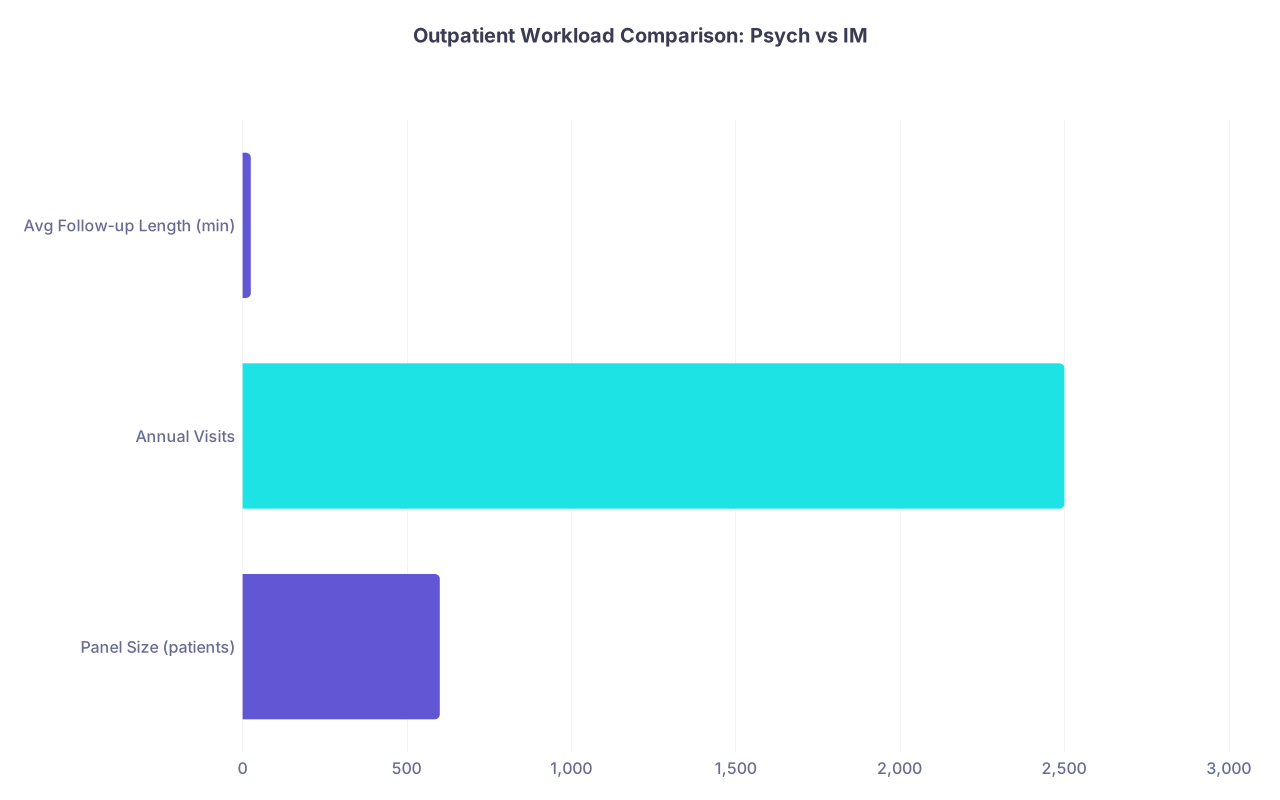
To visualize the trade-off triad (panel size, visit length, annual visits), look at it as a simple comparison:
| Category | Value |
|---|---|
| Panel Size (patients) | 600 |
| Annual Visits | 2500 |
| Avg Follow-up Length (min) | 25 |
That is “one bar” for a representative psych job. For IM, imagine those same categories roughly at [2000, 4300, 18]. Steeper panel, higher visit count, shorter time per visit. That is the real fork in the road.
8. How to sanity-check real job offers (or elective experiences)
Numbers on paper are useful, but every job and training environment cheats the average a bit. Use the data mindset on any specific outpatient setup you are considering.
Ask for:
- Average visits per clinic day for full-time clinicians.
- Standard visit lengths:
- New.
- Follow-up.
- Annuals (for IM).
- Average panel size for full-time clinicians in that clinic.
- wRVU expectations for full-time FTE.
Then do the math:
- Annual visits = visits/day × clinic days/week × weeks/year.
- Derived panel ≈ annual visits ÷ avg visits per active patient per year (use ~4 for psych, ~1.3–1.5 for IM).
- Daily RVU target = annual wRVU target ÷ (weeks × clinic days).
If someone says:
- “Our IM docs see 24–26 patients per day, mostly 15-minute visits, panels around 2,500, and annual wRVU target 8,000.”
Run the numbers. That is a very high volume environment. You will be moving.
If another clinic says:
- “Our psychiatrists see 10–12 patients per day, mostly 30-minute follow-ups, panels 450–650, wRVU target 4,800.”
That is a relatively sustainable pace for outpatient work, at least numerically.
The red flag is misalignment: low visit lengths, high panel, and high RVU target. In either specialty, that combination predicts fatigue.
You are not choosing between “mental health” and “medical complexity” in the abstract. You are choosing between very different workload structures measured in panel size, visit length, and RVU pressure.
Psychiatry gives you fewer patients, longer visits, lower inbox volume per capita, and a clinic day shaped around deep cognitive work. Internal medicine gives you many more patients, shorter visits, higher total throughput, and the intellectual satisfaction of managing multi-system disease across a huge panel.
If you can look at those numbers and viscerally feel which day would drain you and which day would energize you, you are already ahead of most applicants. The next step is to test your intuition in real clinics, with real schedules, and see if the lived experience matches what the data predicted. That is where your residency choices—and later, your job contracts—get very real.