Sleep medicine is not one field. It is three different cultures wearing the same lab coat.
If you build your career in sleep coming from neurology, psychiatry, or internal medicine, you will not practice, think, or feel like the same type of sleep doctor. The fellowship curriculum may look similar on paper, but the scaffolding under your brain is completely different.
Let me break this down the way program directors talk about it behind closed doors.
Big Picture: How Your “Parent” Residency Rewires You
Before we get into the weeds, you need a core reality: your core residency does three things to you that you never fully undo.
- It defines what “sick” looks like to you.
- It shapes what problems you see as “real doctor work.”
- It sets your default comfort zones: procedures, complexity, counseling, systems.
Sleep medicine then sits on top of that foundation. Same fellowship year, different internal OS.
Here is the quick-and-dirty comparison first.
| Feature | Neurology → Sleep | Psychiatry → Sleep | Internal Medicine → Sleep |
|---|---|---|---|
| Core mindset | Circuits & physiology | Mind, behavior, experience | Systems, organs, comorbidities |
| Typical inpatient comfort | Neuro ICU, stroke, EMU | Psych units, crisis work | MICU, wards, complex medicine |
| Strongest sleep niche | Narcolepsy, parasomnias | Insomnia, parasomnias, OSA+MH | OSA, obesity hypoventilation |
| Procedures | EEG, EMU, NCS background | Minimal; mostly none | Bronch, lines, ICU procedures |
| Fellow stereotype | “The neuro electrophys guru” | “The insomnia whisperer” | “The CPAP and comorbidity hawk” |
No one tells you this bluntly as an MS3. You just hear, “All three can do sleep.” Technically true. Functionally incomplete.
Path 1: Neurology → Sleep Medicine
If you like wires, waveforms, and weird nocturnal behaviors, neurology as your base is very hard to beat.
How Neurology Residency Shapes You
Three big habits neurology drills into you that matter for sleep:
You think in circuits and localization.
You see REM atonia loss and immediately think pons, medulla, alpha-synuclein. You see hypersomnia and your brain goes hypothalamus, orexin, thalamocortical loops, not “patient is lazy.”You become fluent in electrophysiology.
EEG, EMU, evoked potentials. Reading a polysomnogram with leg EMG, chin EMG, EKG, EEG channels is just another day in the lab. The signal noise, the artifacts, the subtle patterns—it feels familiar.You are comfortable with “unexplainable” but real phenomena.
PNES, functional disorders, migraine variants. So when someone has violent parasomnias with a normal neurologic exam, you do not immediately dismiss them or call it “just anxiety.” You know there is probably a circuit-level explanation that will be described in a paper five years from now.
A typical neurology resident considering sleep is the one who enjoyed neurophys lab, loved EMU rotations, liked complex but stable patients, and hated the full-time chaos of stroke call.
What Your Sleep Practice Looks Like with a Neuro Core
You end up naturally pulled toward:
- Narcolepsy and idiopathic hypersomnia.
- REM sleep behavior disorder (RBD), parasomnias, and nocturnal epilepsy.
- Sleep-related movement disorders (PLMD, RLS, periodic arm movements, bruxism).
- Overlap with neurodegenerative disease (Parkinson disease, DLB, MSA) and stroke.
Your referrals sound like this:
- “59-year-old man, punches wife at night, dream reenactment for 2 years.”
- “28-year-old woman, episodes of unresponsiveness at night, ruled out by cardiology, maybe seizures?”
- “43-year-old with severe daytime sleepiness, near-misses while driving, ESS 20, PSG inconclusive, MSLT borderline.”
You are the person other sleep docs call when they are staring at a PSG with odd behaviors and are not sure if it is nocturnal frontal lobe epilepsy, NREM parasomnia, or RBD with bizarre phenomenology.
In practice, you also tend to be the one most comfortable integrating:
- PSG with extended EEG montages.
- EMU data with overnight studies (especially at academic centers).
- Complex medication regimens (anti-epileptics, dopaminergics, clonazepam, melatonin, sodium oxybate) in neurologically fragile patients.
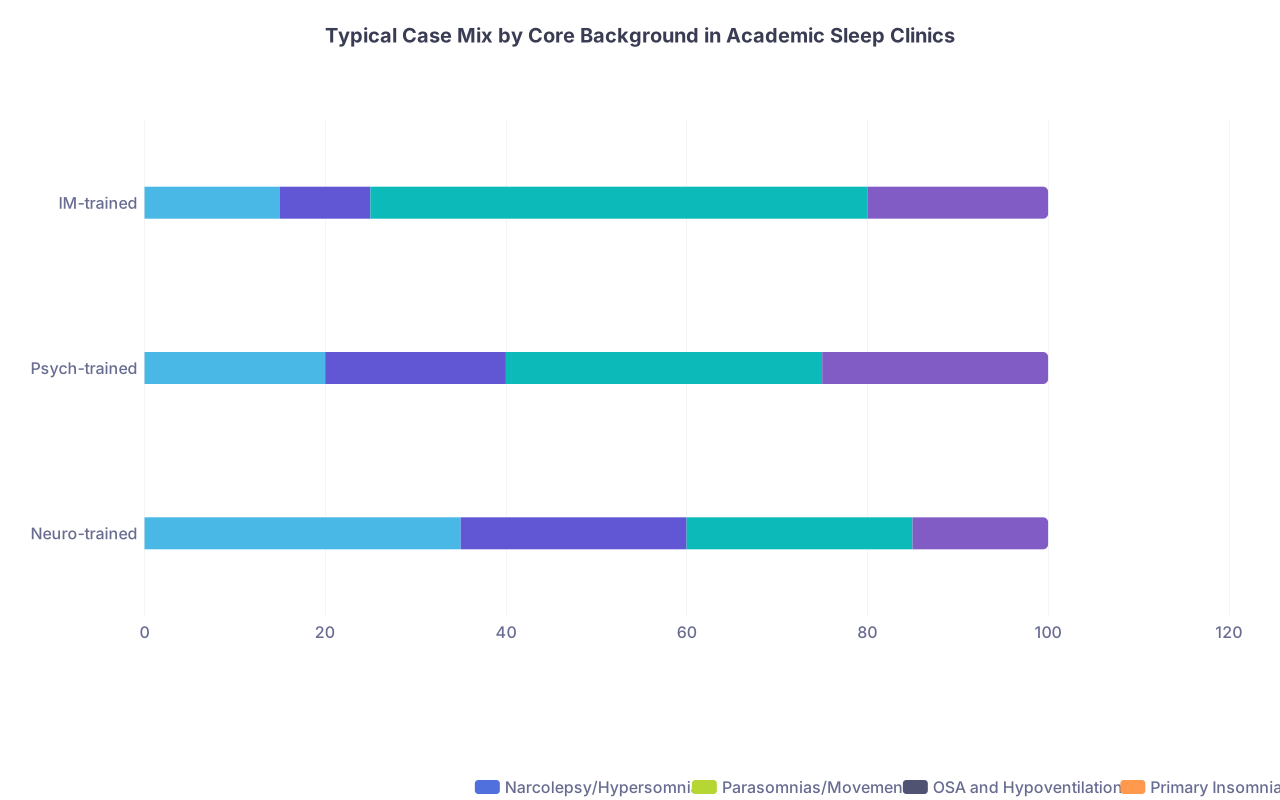
| Category | Narcolepsy/Hypersomnia | Parasomnias/Movement | OSA and Hypoventilation | Primary Insomnia |
|---|---|---|---|---|
| Neuro-trained | 35 | 25 | 25 | 15 |
| Psych-trained | 20 | 20 | 35 | 25 |
| IM-trained | 15 | 10 | 55 | 20 |
These numbers are not universal, but they reflect exactly what you see at big centers: neurology-trained sleep docs attract and retain the more neuro-heavy sleep pathology.
Strengths and Blind Spots of Neurology → Sleep
Strengths:
- You can own narcolepsy and parasomnias at a high level.
- You are naturally good at integrating imaging, electrophysiology, and neuropharmacology.
- You are taken seriously by other neurologists and often serve as the bridge between EMU and sleep lab.
Blind spots:
- Pure behavioral insomnia bores some neurology folks. They underinvest in CBT-I and overvalue meds.
- Complex metabolic sleep-breathing problems (obesity hypoventilation with severe HFpEF, pulmonary hypertension) may feel less intuitive without strong IM exposure.
- You may undervalue the psychiatric component in chronic insomnia, especially personality pathology and trauma.
Fit profile: Detail-oriented, enjoys waveforms, likes weird night behaviors, wants outpatient-heavy life but still appreciates complex pathophysiology.
Path 2: Psychiatry → Sleep Medicine
Psychiatry to sleep is underused and, frankly, underrated. If you care most about insomnia, circadian rhythm disorders, and the blowtorch interface with mental health, this path fits frighteningly well.
How Psychiatry Residency Shapes You
Three core rewires psychiatry does that matter in sleep:
You are trained to take real histories.
Not “bed at 11, up at 6.” You ask: “What do you actually do between 9 p.m. and midnight?”, “What is your phone usage?”, “What is the narrative running in your head at 3 a.m.?” Sleep is half behavior, half belief system; psychiatrists are taught to interrogate both.You become fluent in psychotropics and their sleep impact.
SSRIs and REM suppression. Mirtazapine and weight gain/OSA risk. Antipsychotics and RLS/PLMD. Benzos and SWS/REM alteration. You do not have to look those up every time—they are part of your daily work.You respect subjectivity without being gullible.
Insomnia severity, nightmare distress, sleep quality—the stuff you cannot “see” on PSG. Psychiatrists, when decent, know how to validate experience while still drawing boundaries.
This is exactly the skill set chronic insomnia needs and rarely gets from non-psych clinicians.
What Your Sleep Practice Looks Like with a Psych Core
Your clinical sweet spot naturally becomes:
- Chronic insomnia, especially refractory and comorbid with anxiety, depression, bipolar.
- Nightmare disorder and trauma-related sleep disturbances.
- Circadian rhythm disorders: delayed sleep phase, non-24, shift work problems.
- Parasomnias with strong emotional/psych overlays.
Patients that end up in your clinic:
- “34-year-old woman, insomnia for 10 years, on trazodone, zolpidem, clonazepam PRN, melatonin, still sleeping 3–4 hours.”
- “29-year-old ICU nurse, rotating shifts, ‘broken’ sleep schedule, significant anxiety, heavy caffeine use.”
- “40-year-old veteran with PTSD, nightly nightmares, refuses CPAP, on prazosin.”
Here you really shine because you are not afraid of 60-minute visits that are 80% conversation and 20% physiology. And you are better than almost anyone else at integrating:
- CBT-I in a real, non-cookie-cutter way.
- Trauma-informed approaches to bedtime and nighttime awakenings.
- Rational psychotropic strategies that do not destroy sleep architecture.

Strengths and Blind Spots of Psychiatry → Sleep
Strengths:
- You are the best positioned to deliver high-quality CBT-I and behavioral sleep medicine (BSM).
- You understand the incredible bidirectional relationship between mood disorders and sleep.
- You are comfortable deprescribing and re-structuring insane polypharmacy that wrecks sleep.
Blind spots:
- Purely physiologic sleep-breathing disorders may feel less intuitive at first. The pathophysiology of obesity hypoventilation, Cheyne–Stokes, end-stage COPD with OSA—these take more deliberate post-residency learning.
- You may initially feel less comfortable managing non-psychiatric comorbidities (complicated heart failure, ESRD) without a strong internal medicine foundation.
- Some academic pulmonary/IM-dominated sleep programs unconsciously bias against psych applicants or pigeonhole them into “the insomnia person.”
Fit profile: You like listening. You are fascinated by how people’s beliefs and histories shape their nights. You are willing to accept that most of your major wins are behavior- and systems-based, not “I prescribed the perfect pill.”
Path 3: Internal Medicine → Sleep Medicine
If you want to own the bread-and-butter of sleep that kills people—untreated OSA driving cardiovascular disease, obesity hypoventilation, complicated comorbidity—internal medicine is the most straightforward path.
How Internal Medicine Residency Shapes You
Three core frames IM hammers in that matter for sleep:
You think in organs and systems.
Sleep apnea is not just AHI. It is pulmonary pressures, right heart strain, blood pressure, atrial fibrillation, glucose control. You see the CHF patient with OSA and instantly think mortality curves, not just snoring.You are comfortable with complex comorbidity.
ESRD on dialysis with OSA and RLS. Morbid obesity with OHS, OSA, NAFLD, diabetes. COPD-OSA overlap. IM folks live in that complexity and are not afraid of a 12-med list.You know the hospital.
ICU, wards, post-op. You have seen what happens when nobody pays attention to a 70-year-old with severe OSA on high-dose opioids post-arthroplasty. You also know how to get things done in hospital systems—order sets, consults, RT coordination.
In reality, the majority of sleep medicine in many community settings is OSA and sleep-breathing disorders. IM is designed for that.
What Your Sleep Practice Looks Like with an IM Core
You naturally become the de facto expert for:
- Obstructive sleep apnea and upper airway resistance syndrome.
- Obesity hypoventilation syndrome and complex sleep apnea.
- Sleep-disordered breathing in heart failure, atrial fibrillation, pulmonary hypertension.
- Perioperative risk reduction related to OSA.
Your clinic slate tends to be full of:
- “55-year-old man, BMI 38, uncontrolled HTN on 3 meds, snores, witnessed apneas.”
- “63-year-old woman with HFpEF, pulmonary HTN, waking with gasping and morning headaches.”
- “45-year-old man on chronic opioids with suspected central sleep apnea.”
You are also much more comfortable running or working closely with:
- PAP adherence clinics, troubleshooting, DMEs.
- Integrated cardiology–sleep or pulmonary–sleep joint programs.
- Population health initiatives targeting OSA in diabetics or hypertensives.
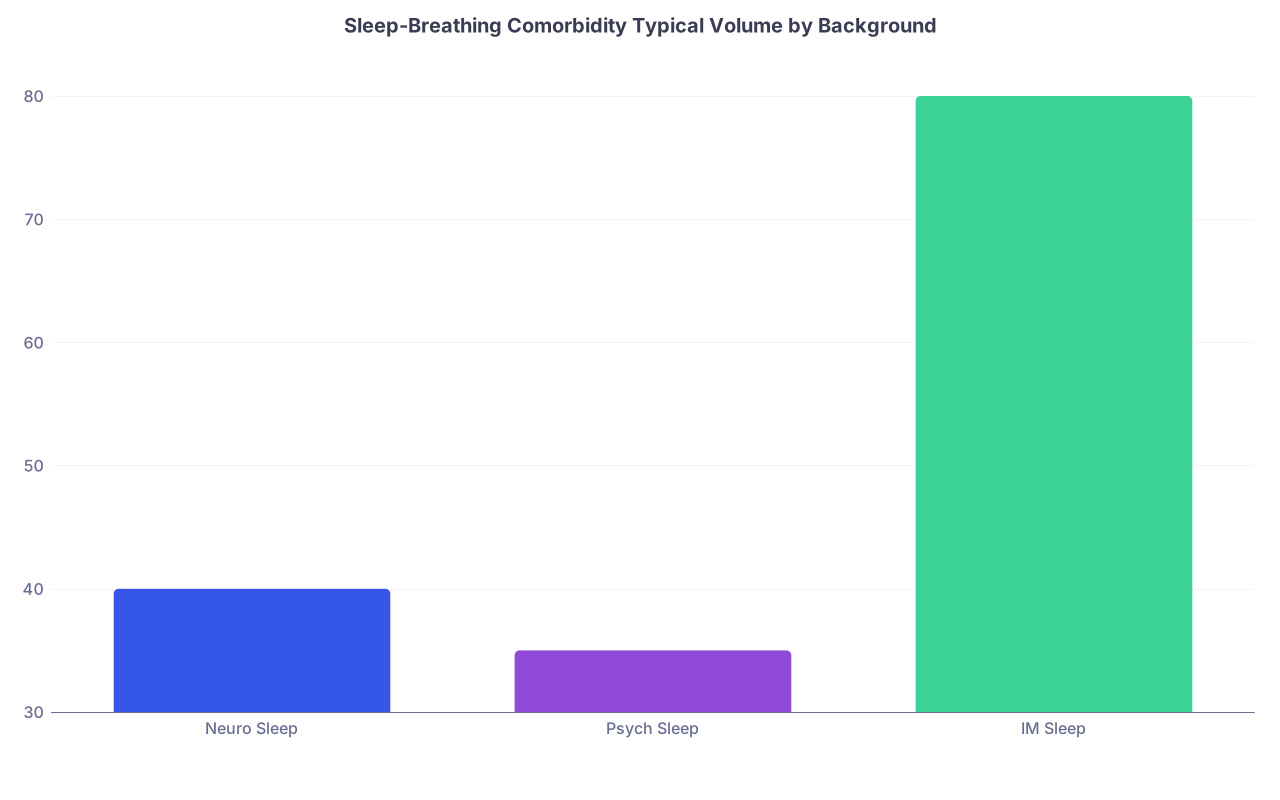
| Category | Value |
|---|---|
| Neuro Sleep | 40 |
| Psych Sleep | 35 |
| IM Sleep | 80 |
That is why many large centers’ sleep labs are physically nested in pulmonary or IM departments: most dollars and hospital metrics are tied to OSA and related conditions.
Strengths and Blind Spots of IM → Sleep
Strengths:
- You are excellent at integrating sleep management into chronic disease care.
- You speak the language of cardiology, endocrinology, pulmonary, primary care.
- You can justify PAP and other interventions with hard outcomes: BP control, AF recurrence, HF hospitalization.
Blind spots:
- You may undervalue the psychiatric dimensions of insomnia and parasomnias, defaulting to trazodone or zolpidem instead of CBT-I or trauma work.
- Narcolepsy and central hypersomnias may initially feel less intuitive; their neurobiology is not heavily emphasized in most IM programs.
- Without specific interest, you might underdevelop skills for complex parasomnias, where neuro and psych backgrounds are stronger.
Fit profile: You like systems. You like measurable outcomes and risk reduction. You want to work at the intersection of sleep and chronic disease, not spend most of your time in 60-minute behavioral visits.
Culture Shock: How Fellowship Feels Different by Background
Same fellowship. Totally different experience depending on where you came from.
What Each Background Struggles with Initially
I have seen this play out every July in sleep fellow cohorts.
Neurology-trained fellow:
Struggles most with: nuanced cardiopulmonary pathophysiology, ventilator modes, detailed ABG interpretation in chronic hypoventilation.
Overheard: “Wait, we are titrating bilevel this aggressively on someone with that much COPD and HF? Walk me through the hemodynamics again.”Psychiatry-trained fellow:
Struggles most with: interpreting raw PSG data initially, cardiac arrhythmias on overnight tracings, and respiratory physiology finer points (loop gain, arousal threshold).
Overheard: “I can manage three meds and a trauma history, but I need you to slow down and explain this Cheyne–Stokes breathing pattern one more time.”IM-trained fellow:
Struggles most with: complex parasomnias and seizure vs parasomnia distinctions, detailed staging on EEG, and recognizing subtle REM phenomena beyond apnea.
Overheard: “Is this REM without atonia, or just artifact from movement? And how exactly do we differentiate nocturnal frontal lobe epilepsy on PSG alone?”
Fellowship will cover these gaps somewhat, but your baseline determines how steep that ramp is.
Who Ends Up Dominating Which Part of the Field
In real-world practice:
- Academic narcolepsy/parasomnia centers: skew neuro and psych.
- Big OSA/CPAP factories and integrated cardiology-sleep clinics: skew IM and pulmonary.
- Behavioral sleep medicine centers: skew psych, some family med, a few IM with special interest.
- Mixed tertiary referral centers: you see all three backgrounds, each informally owning “their” niche.
So when you choose your core residency, you are quietly choosing which of those ecosystems will feel like “home.”
Lifestyle, Identity, and Long-Term Trajectory
You are not just choosing what diseases you see. You are choosing:
- Who you sit with at department meetings.
- Whose research language you speak.
- Which residents and fellows you will later teach.
Departmental Home and Power Structures
Neurology:
- Sleep may be a smaller division; you might be “the sleep person” in a mostly stroke and epilepsy department.
- Your influence is weighted in neurodegenerative clinics, EMU, movement disorders.
- Research tilt: neurophysiology, biomarkers, degenerative disease links (RBD to synucleinopathies).
Psychiatry:
- Sleep often lives at the edge of departmental priorities. Many psych departments still do not understand how powerful good sleep care is.
- But you can become the bridge that brings real sleep treatment into mood, psychosis, and trauma clinics.
- Research tilt: insomnia, CBT-I, trauma and sleep, chronotherapy, suicidality and sleep disturbance.
Internal Medicine (often via Pulmonary/Critical Care):
- Sleep is a financial and clinical workhorse—OSA brings volume, adherence metrics, device revenue. Departments care.
- You are at the center of chronic disease conversations, perioperative risk, quality initiatives.
- Research tilt: OSA and cardiovascular outcomes, CPAP adherence, population health.
Day-to-Day Work Reality
Across all three, outpatient-heavy lifestyles are the norm in sleep. But your mix varies.
A neurology-situated sleep doc might:
- Do 4 days of sleep clinic, 1 day of neuro clinic (e.g., headache or general neuro).
- Read PSGs, MSLTs, some EEGs.
- Take limited neuro call if they maintain some general neurology FTE.
A psychiatry-situated sleep doc might:
- Run an insomnia-focused sleep clinic, often co-located with general psych.
- Do formal CBT-I, group sessions, plus med management for mood/anxiety/PTSD.
- Rarely do inpatient call, or only low-intensity psych call.
An IM/pulm-situated sleep doc might:
- Split between pulmonary clinic and sleep clinic, or be full-time sleep.
- Read large volumes of PSGs and HSATs, run PAP adherence programs.
- Take pulmonary or ICU call, depending on contract.
Again: same board certification (Sleep Medicine), completely different daily life.
Training Reality: Competitiveness, Length, and Strategy
You also have to weigh the training pathway itself.
Length and Structure
Typical lengths:
- Neurology: 4 years (1 prelim + 3 neuro) in the U.S.
- Psychiatry: 4 years.
- Internal medicine: 3 years.
Sleep fellowship: 1 year for all.
So:
- Neuro → Sleep: ~5 years post-MD.
- Psych → Sleep: 5 years.
- IM → Sleep: 4 years.
That one year difference (IM) is not trivial if you are debt-heavy and fellowship-committed.
Competitiveness and Access
Sleep medicine fellowships are not dermatology. They are moderately competitive, highly variable by institution.
Things that matter more than they should:
- Whether your home institution has a sleep fellowship.
- Whether the sleep faculty there like you enough to advocate.
- Whether you have at least some sleep-related research or electives.
By background:
- IM and pulmonary are still the dominant feeder. More slots, more pipelines, especially at pulmonary-heavy places.
- Neurology is strong at centers with neuro-heavy sleep divisions.
- Psychiatry is variable—fantastic opportunities at some academic centers, almost invisible at others. The bias is real; some sleep divisions barely consider psych applicants seriously, others actively recruit them.
If you are psychiatry and serious about sleep, you need to signal early: electives in sleep, research with sleep attendings, and find mentors who will push back against institutional bias.
So Which Path Should You Choose?
Let me be direct. Choose your core residency based on the kind of patient complexity you actually like managing at 4 p.m. on a random Tuesday, not on a fantasy of your future “balanced” life.
Here is the distilled matching:
Choose Neurology → Sleep if:
You get a kick out of waveforms, you like strange episodic nocturnal events, you want to be the person other sleep docs call when something might be a seizure or an early neurodegenerative marker. You tolerate some degree of uncertainty and rarer diseases.Choose Psychiatry → Sleep if:
You are genuinely interested in stories, trauma, beliefs, and behavior. You do not mind that many of your biggest wins will be from structured therapy and medication strategy, not procedures. You want to own insomnia and circadian disorders at the highest level.Choose Internal Medicine → Sleep if:
You like integrating sleep into chronic disease care, enjoy talking about risk reduction and hard outcomes, and are comfortable managing complex comorbidity. You want to be at the center of OSA, obesity hypoventilation, and cardiorespiratory sleep disorders.
One more layer that residents ignore until it is too late: your second option if sleep vanished.
If for some reason you could not match sleep:
- As a neurologist, could you tolerate a career in general neuro, epilepsy, or movement?
- As a psychiatrist, could you live with outpatient mood/anxiety/trauma practice?
- As an internist, could you tolerate general IM, hospitalist work, or pulmonary?
Because that is the “insurance policy” you are actually buying when you pick your core field.

| Step | Description |
|---|---|
| Step 1 | Want Sleep Career |
| Step 2 | Neurology Residency |
| Step 3 | Psychiatry Residency |
| Step 4 | Internal Medicine Residency |
| Step 5 | Sleep Fellowship |
| Step 6 | What cases excite you most |
How to “Sleep-Optimize” Each Residency
Whichever path you choose, you can deliberately shape it toward sleep.
Neurology:
- Push for rotations/electives in EMU and sleep lab.
- Get comfortable reading full EEGs; it will pay off heavily with parasomnias and seizures.
- Find mentors in movement disorders and neurodegeneration; RBD lives there.
Psychiatry:
- Do a dedicated sleep elective early (PGY2 or PGY3).
- Learn CBT-I properly, not just as a half-baked handout. Consider formal BSM training.
- Track and write about the impact of psychotropic regimens on sleep in your own panel.
Internal Medicine:
- Spend time with pulmonary and ICU carefully; understand mechanical ventilation and chronic respiratory failure.
- Take extra interest in patients with obesity, HF, AF, and suspected OSA. Follow their sleep workup and outcomes longitudinally.
- Learn the business and systems side of PAP—DMEs, adherence programs, insurance rules.
Bottom Line
Three core points, then you can go back to your rotation:
- “Sleep medicine” is not one uniform career; your core residency (neuro, psych, or IM) hardwires how you think and what sleep problems you will dominate or struggle with.
- Neurology is king for narcolepsy and parasomnias, psychiatry for insomnia and circadian/trauma-related issues, internal medicine for OSA and cardiorespiratory sleep disorders embedded in chronic disease.
- Choose the path whose non-sleep work you can still respect, because your pre-sleep residency shapes not just your first job, but your clinical instincts for the rest of your career.