The old mantra that “general surgery keeps all doors open” is outdated. In 2026, it is closer to this: five years of general surgery keeps some doors open, slams others shut, and quietly locks a few behind your back while you are on call.
Let me be blunt. If you are choosing general surgery because “it’s the most flexible” or “I can always subspecialize later,” you are using a mental model from 20–30 years ago. Before duty-hour regulations, before the fellowship explosion, before fellowship spots started filtering applicants by Step scores, research years, and pedigree.
The modern question is not “Does general surgery keep doors open?”
It is “Which doors do you actually want, and does general surgery still get you through them without burning you out, bankrupting you, or making you unemployable in the community you think you will work in?”
Let’s walk through what the data and real trajectories actually show.
The Myth: “Do General Surgery, You Can Do Anything After”
This line gets thrown around constantly by older attendings, mid-career surgeons, and even program directors trying to fill categorical spots: “Do a 5-year general surgery residency and you can do anything – trauma, vascular, CT, surg onc, colorectal, MIS, breast, global surgery – you name it.”
That sentence used to be mostly true when:
- Many surgeons went straight into practice without fellowship.
- Fellowship training was optional prestige, not an informal requirement.
- Credentialing committees were looser and hospital bylaws less rigid.
- Case volumes were less sub-specialized and more “do-everything” generalists were needed.
Fast-forward to now: the majority of graduating general surgery residents go on to fellowship. Depending on the survey year, it is commonly 70–80% in many academic programs. Community programs are a bit lower, but the trend is clear: straight-to-practice general surgery as the default is fading, not growing.
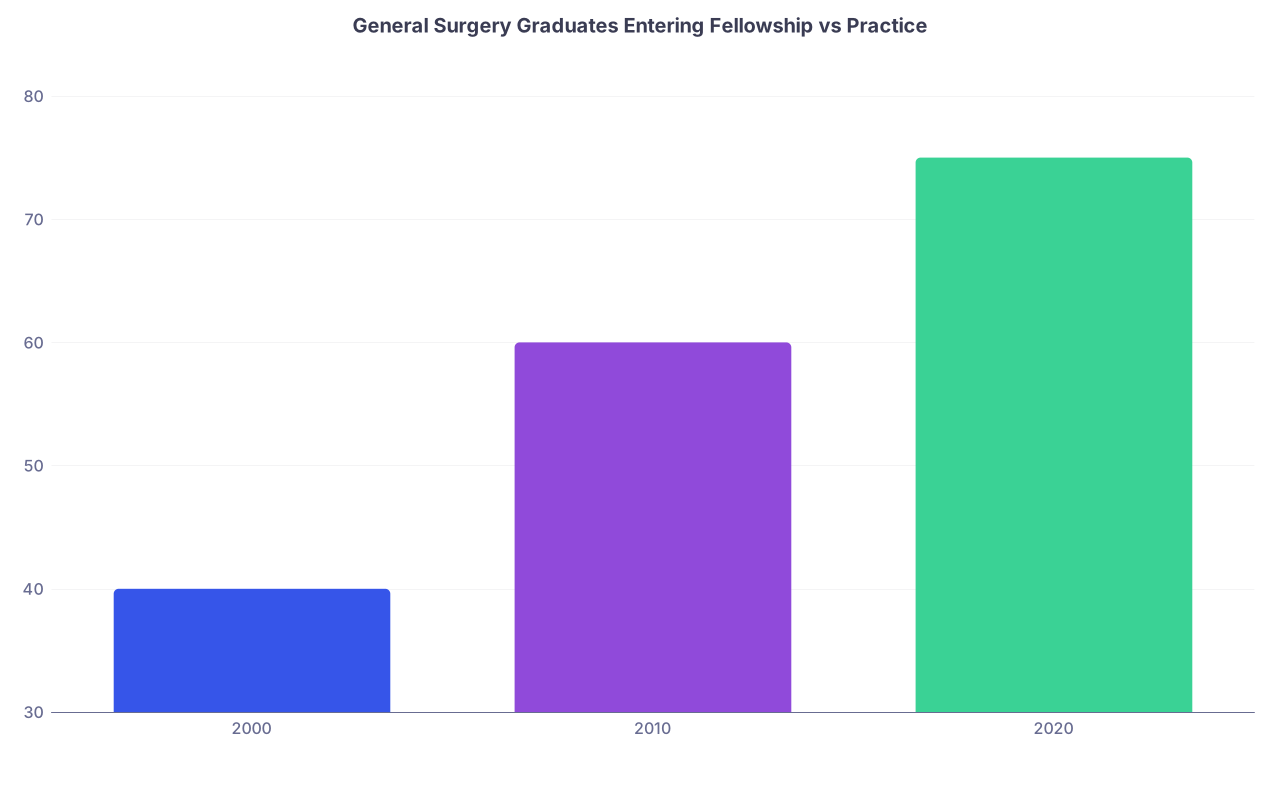
| Category | Value |
|---|---|
| 2000 | 40 |
| 2010 | 60 |
| 2020 | 75 |
Roughly:
- Around 2000: maybe 40% of graduates did fellowships.
- Around 2010: near 60%.
- Around 2020 and beyond: often 70–80%+ in academic-type programs.
So no, general surgery is not “five years and then endless freedom.” It is often five years plus 1–3 years of fellowship just to be competitive for the niche you thought was automatically yours.
What Doors Are Actually Open After 5 Years?
Let’s separate perception from reality.
There are three main “door types” after a standard 5-year general surgery residency:
- Independent practice as a general surgeon (no fellowship).
- Fellowship-driven subspecialties that expect a strong gen surg foundation.
- Fields where general surgery is now a suboptimal or even wrong route.
Door 1: Straight-to-Practice General Surgery
This door is still open, but it is not leading to the practice that older surgeons describe.
Typical reality in many non-urban areas:
- Heavy bread-and-butter: hernias, cholecystectomies, appendectomies, bowel resections, scopes if credentialed.
- A lot of call coverage: emergency general surgery, perforations, SBOs, abscesses, trauma consults depending on the hospital.
- Growing pressure from subspecialists: colorectal, HPB, vascular, plastics, ortho – each carving away historically “general” cases.
In a mid-size community setting, credentialing may still let you do a fair range if you have case logs and comfort. But in larger urban or competitive markets, hospitals increasingly prefer “fellowship-trained ___” for:
- Colorectal cancer surgery
- Complex bariatrics
- Advanced MIS/foregut
- Breast oncology in many systems
- Some endocrine cases
- Complex hernias with component separation
So yes, you can still practice as a general surgeon. But the “do everything from thyroid to AAA to Whipple” archetype is almost extinct outside of very specific, often rural, contexts.
If your fantasy is to be a broad, full-spectrum general surgeon in a smaller town? Still feasible. If your fantasy is to be a big-city powerhouse doing complex HPB and high-volume oncologic resections without fellowship? That door is not just closed; it was walled over.
Door 2: Subspecialties Where Gen Surg Still Matters – But Not Equally
This is where the “all doors open” myth really collapses. Because different subspecialties treat general surgery residency very differently.
Let’s map a few big ones.
| Subspecialty | Is 5-Year Gen Surg the Standard Entry? | Extra Training Typically Required |
|---|---|---|
| Trauma/CC | Yes | 1–2 yrs Surg Critical Care/Trauma |
| Surgical Oncology | Yes | 2–3 yrs Surg Onc fellowship |
| Colorectal | Yes | 1 yr Colorectal fellowship |
| Vascular | Sometimes (shrinking) | 2 yrs Vascular fellowship |
| CT (Adult Cardiac) | Yes, but integrated displacing | 2–3 yrs CT fellowship |
Trauma / Surgical Critical Care
Here the mantra is still mostly true. Trauma and SCC are built on general surgery training.
- Most ACS-verified Level I/II trauma centers want fellowship-trained trauma/critical care surgeons.
- But the entry route is standard: complete general surgery → SCC/trauma fellowship.
This door is open – if you match a decent gen surg program, do well in trauma/ICU rotations, and maybe tack on a research year if you want academic jobs. Trauma isn’t being replaced by an “integrated trauma” residency.
Surgical Oncology, Colorectal, MIS, Breast, HPB
Again: 5-year gen surg is the default pathway. But “keeps the door open” massively understates the competition.
For the top fellowships (MSKCC, MD Anderson, Cleveland Clinic, Mayo, etc.), they are not just taking “a general surgery grad.” They are taking:
- Chiefs with strong operative autonomy AND
- Multiple first-author publications, often in their field, AND
- Great letters from known faculty, often at name-brand institutions.
That is not an automatic outcome of “I did a 5-year gen surg residency.” That is a deliberate, multi-year strategy. And if you do your training in a small community program with limited research infrastructure? The door is not completely closed, but it is barely cracked.
In that sense, the residency brand and your portfolio – not just the fact that you did general surgery – determine which subspecialty doors really open.
Vascular Surgery
This is where the myth has already broken in front of everyone’s face.
Old pathway: 5+2 (general surgery + vascular fellowship).
Modern reality: 0+5 integrated vascular is increasingly dominant for the top programs and academic tracks.
Yes, you can still do 5+2 and practice vascular. Plenty of people do. But the most prestigious vascular programs often prioritize or preferentially recruit integrated residents they can internally shape from day one.
So if you, as an MS3, are already dead set on vascular, going through general surgery may be the less efficient, less competitive route now. Not the “keep all doors open” route.
Cardiothoracic Surgery
This door is the clearest example of general surgery no longer being the default.
Two main pathways:
- 0+6 Integrated CT training (straight from med school).
- 5+2 or 5+3 traditional fellowship after general surgery.
Most high-powered academic CT departments have thrown their weight behind the 0+6 model. The integrated residents are groomed early, get more CT time, and are often more competitive for elite jobs afterwards.
Can you still go gen surg → CT and have a great CT career? Absolutely. But if your primary dream is adult cardiac or congenital heart, general surgery is now a longer, less-tailored, often weaker route vs integrated.
So no, gen surg does not “keep the CT door open” in the way students imagine. The door is still there, but you will be competing with people who trained specifically for CT from day one while you were doing hemorrhoids and hernias and 2 am appendectomies.
Door 3: Fields Where General Surgery Is Now the Wrong Route
There are entire specialties where people still vaguely think “I’ll do general and then maybe pivot into ____ if I want,” and the reality is that door is basically shut.
Plastic Surgery
If you want plastics and you are still in med school, the most rational path is integrated plastic surgery. Period.
Is there still an independent plastics pathway after general surgery? Yes – but slots are few, the competition is brutal, and integrated residents have a much cleaner runway.
If plastics is even top-two for you, gambling on a generic gen surg spot and hoping to pivot later is reckless. You are choosing the longer, riskier, worse-positioned path.
ENT, Urology, Ortho, Neurosurgery
This should be obvious, but I still hear students mumble things like: “If I do not match ortho, I will just go into general and then do sports or hand or something.”
No. Those are built on their own categorical residencies. General surgery is not a backdoor into ortho, ENT, neurosurgery, or urology. Doing a gen surg prelim year might help you reapply, but that is different.
General surgery does not keep those doors open. They are separate buildings.
The Big Hidden Constraint: Timing and Burnout
Here is what almost no one says out loud when they recycle the “all doors open” line: time and fatigue change what you want.
A lot of MS4s say, “I’ll just do general, and if I want, I’ll tack on a 2-year fellowship.”
They say that before:
- Five years of 80-hour weeks.
- Multiple 24-hour calls per month.
- PGY-2 nights where you run a whole hospital’s worth of consults.
- Family realities: partners, kids, mortgages, aging parents.
By PGY-4, a big chunk of residents who thought they wanted multiple fellowships are suddenly very aware of their own limits.
You can theoretically still do trauma + SCC + burn + ECMO with a global surgery focus at age 36 after 8–9 years of postgraduate training. But will you still want to? That is the honest question.
The longer the road, the fewer doors genuinely remain attractive. They might be “open” on paper. Psychologically and practically? Not so much.
The Role of Reputation, Research, and Case Mix
Another inconvenient truth: not all 5-year gen surg residencies open the same doors.
If you think any categorical position automatically sets you up equally for HPB at MD Anderson or surg onc at MSKCC, you are kidding yourself.
Three big differentiators:
Program reputation and network.
Certain fellowships essentially recruit from a known circle: high-volume academic centers, often with NCI designation for onc programs. They know the PDs. They know the case logs. That matters.Research environment.
Surgical oncology, HPB, transplant, CT – they like residents with publications, often in their field. Programs that expect/reward 1–2 dedicated research years put you in a different tier than places where “research” is a single poster at ACS.Actual operative exposure in your area of interest.
Some general programs barely touch complex HPB because hepatobiliary is carved off to transplant or HPB specialists. Some have zero transplant exposure. Some have minimal vascular, minimal thoracic, no bariatrics. You cannot claim a door is “open” if you graduate with almost no credible exposure or case numbers in that area.
So, again: it is not “5 years of general surgery = all doors open.”
It is “the right 5 years, at the right place, with the right focus, puts you in position for certain doors if you strategically build for them.”
Where General Surgery Does Genuinely Keep Options
I will give general surgery its due. There are still areas where it remains the best or only rational staging ground.
- Rural / small community surgical practice with broad scope: you want to be the person the whole county calls when something in the abdomen goes wrong. Gen surg is your platform.
- Trauma and emergency general surgery at high-volume centers: still built on a general surgery chassis.
- Academic surgical oncology / colorectal / MIS / HPB: yes, you need gen surg, but you also need the right pedigree and productivity.
- Leadership roles like department chair, hospital CMO, or quality leadership in surgical departments: general surgeons still disproportionately occupy these roles because of their breadth of training and constant involvement in hospital systems.
For the student who genuinely likes “all of GI,” does not know if they prefer trauma vs colorectal vs MIS but wants a solid, broad surgical identity – general surgery still makes sense. It genuinely keeps some doors open, especially early in residency when you are rotating across services.
But the fantasy that you can aim vaguely at “surgery,” defer all real decisions to PGY-5, and then stroll into any subspecialty you feel like? That is dead.
How To Use This Reality To Make a Smarter Choice
Here is the test I use with students who float the “I’ll do general, keep options open” line.
Ask yourself three questions:
If gen surg were the only training I ever did, would I still be okay with the jobs I could realistically get?
Not imaginary, maximalist “top-of-the-top fellowship then dream job,” but actual general surgeon jobs in cities and towns that hire generalists.Is there a more direct integrated route to the thing I think I might want most?
If yes (plastics, CT, vascular), then you need to justify to yourself why you are choosing the longer, more uncertain path on purpose. Sometimes there is a good reason. Often there is not.Am I willing to do 7–8 years of training, with research, to access the rarefied fellowships?
Because those top HPB, surg onc, CT, and transplant spots are not 5-years-and-done. They are 5 + 2–3 + research years for most successful applicants.
If your honest answers are:
- “Yes, I would still be okay being a general surgeon,”
- “My top likely paths still run through gen surg,” and
- “I understand the years and still want it,”
then general surgery remains a powerful and flexible platform.
If instead your answers look more like:
- “I kind of hate big open abdominal cases but like plastics/ENT/ortho aesthetics,”
- “I really want CT/vascular but I’m just scared of not matching integrated,”
- “I assume I can always fellowship my way into what I want later,”
then you are using general surgery as a security blanket, not a strategy. And it will feel like a trap when the doors you imagined do not open as widely as promised.
General surgery is not the universal master key it used to be. It is a solid, demanding, sometimes brutal training platform that still opens a lot of doors – if you know which hallway you are walking down and you build toward it early.
Years from now, you will not remember the reassuring clichés people fed you on away rotations. You will remember whether you chose a path aligned with what you actually wanted, or a myth about endless options that never really existed.