It’s late evening. You just scrubbed out of another lap chole, your third of the day, and you’re scrolling through residency program websites on your phone in the call room. Half of them have the same line in their description: “Strong commitment to global health” or “robust international opportunities.”
You actually care about this. You’ve been to Rwanda on a med student trip. Or you grew up outside the US and know what “no CT scanner within 6 hours” really looks like. You’re not looking for an Instagram mission trip. You want real, longitudinal, ethical global surgery training.
But every program sounds the same on paper. The word “global” is slapped on everything. One picture of a resident in scrubs next to a palm tree and suddenly it’s a global health powerhouse.
Here’s what you’re actually up against: maybe 10–15% of US surgery programs have structured, protected, ethically grounded international surgery tracks. The rest have either:
- One attending who used to go to one site 8 years ago.
- A resident who did a self-arranged elective once.
- Or absolutely nothing, but a line on the website to sound progressive.
Your job now: separate the marketing from the truth. And pick places where you can actually grow as a global surgeon without blowing up your training or your visa status or your finances.
Let’s walk through how to do that like a grown-up, not a brochure reader.
Step 1: Be Honest About What “Global Surgery” Means to You
Before you even look at programs, get clear on your own goals. “I like global surgery” is way too vague. The kind of program you need depends heavily on what you mean by that.
Ask yourself, specifically:
- Do you want to spend months abroad during residency, or are you okay with 2–4 weeks per year?
- Do you care more about:
- Clinical work (operating, perioperative care)
- Research & policy (access to care, outcomes, health systems)
- Capacity building (training local surgeons, system development)
- Are you picturing:
- Low-resource hospitals
- Middle-income urban centers
- Disaster or conflict zones (very, very different pathway)
- Long-term, do you want to:
- Work full-time overseas?
- Split time between the US and one partner site?
- Mainly be a US-based academic doing research/short trips?
If you don’t know yet, that’s fine. But you need a direction. Because the program that’s best for:
- A future MSF / Doctors Without Borders type = not necessarily the same as
- Someone who wants a NIH-funded global surgery research career = not necessarily the same as
- Someone who wants to be a US academic surgeon with one trusted partner site they visit annually.
Write it down. Literally 3–4 bullet points in a notes app of what you want your global surgery life to roughly look like. You’re going to use those bullets to interrogate program websites and interviews.
Step 2: Learn What Real Overseas Opportunities Actually Look Like
Let me be blunt: “We support residents doing away rotations” is not a global surgery program. That’s called “you can use your vacation or elective block however you want if you can find coverage.”
You are looking for structure. Guardrails. Continuity. Not just vibes.
There are five concrete markers that a residency is serious about global surgery:
Formal, recurring partnerships with specific sites
- Example: “We send 2 PGY-4 residents every year for 2 months to Kijabe Hospital in Kenya as part of a long-standing partnership.”
- Red flag: “We have opportunities all over the world” with zero named institutions.
Protected time in the schedule
- Pre-built elective blocks for global surgery (often PGY-3 or 4).
- Not just “maybe you can go if your PD agrees and service coverage allows.”
Institutional support
- Funding: travel stipends, housing, or at least partial support.
- Legal/logistical: malpractice coverage abroad, MOUs with host institutions, visa help if needed.
Faculty who actually do this work
- Surgeons who travel regularly and publish or teach in global surgery.
- A defined “global surgery director” or track/ pathway director.
Ethical, bidirectional focus
- Not just “we go operate and leave.”
- Resident exchanges, local trainee involvement, joint research with local faculty, attention to sustainability.
If a program you’re considering can’t check at least 3 of those 5, it’s probably not a place you can reliably build real global surgery experience without a ton of self-driven chaos.
Step 3: Use Websites Strategically (But Don’t Believe Them Blindly)
Program websites are marketing tools, but they’re still useful if you know what to look for.
Go beyond the word “global.” You’re hunting for specifics.
Look for:
Named programs and sites
“Our residents rotate at:- Muhimbili National Hospital, Tanzania
- Tenwek Hospital, Kenya
- Hospital Nacional Dos de Mayo, Peru”
Formal tracks or pathways
“Global Surgery Track,” “Global Health Equity Pathway,” “International Surgery Fellowship Pipeline” attached to general surgery.Leadership and faculty
A page that says: “Global surgery faculty” listing specific names, with bios like “conducts research on surgical access in LMICs,” “co-directs partnership with XXX hospital.”Past resident projects and trips Alumni profiles, research titles, QI projects, dissertations centered on global surgery.
Here are some typical phrases and what they usually mean in real life:
| Website Phrase | Realistic Translation |
|---|---|
| "We support resident interest in global health" | You can maybe go abroad if you build it yourself. No structure. |
| "Residents have traveled to many countries including X, Y, Z" | One-off trips over many years. No consistent sites. |
| "Global health is a priority at our institution" | The med school has global health stuff. The surgery program may not. |
| "Dedicated global surgery rotation at [named hospital]" | This is real. Very good sign. Ask follow-up questions. |
| "Global health track with longitudinal curriculum and mentored projects" | There is actual structure. Still verify how much is surgery-specific. |
If a program site is vague, you do not cross it off yet. You just put it in the “requires deeper digging” pile.
Step 4: Email the Right People and Ask the Right Questions
You’re not going to figure this out just from ERAS and websites. You’ll need to email. Yes, now. As a student.
Target three groups:
- Global surgery faculty / track directors
- Current residents who have actually gone abroad
- Program coordinators / PD for logistics questions
Your email should be short and specific. Something like:
Dear Dr. X,
I’m a fourth-year medical student applying in general surgery with a strong interest in global surgery. I’m particularly interested in structured overseas rotations during residency and long-term partnerships with specific sites.I saw on your website that your residents have worked with [site or track name]. Would you be willing to share how this is currently structured for residents (duration, timing in training, funding, and how many residents participate each year)?
Thank you for your time,
[Name]
That wording tells them:
- You’re serious, not just “I like to travel.”
- You know what structure looks like.
- You expect details.
What you want answers to:
- How long is the overseas rotation? 2 weeks, 4 weeks, 2–3 months?
- When in residency does it happen? (PGY-3/4 is common.)
- How many residents go per year? All? One? Only if grant-funded?
- Is there guaranteed time or is it case-by-case?
- Who pays? Any travel/housing/malpractice coverage?
- Is it all elective / palliative, or do they actually operate? (Some places residents are mostly observing.)
- What has changed since COVID? Which partnerships are actually active now?
If their answers are incredibly vague (“it depends,” “we’re exploring,” “there’s lots of interest”), interpret that as: it rarely happens.
Step 5: Know the Programs That Actually Have a Track Record
You don’t need a pre-made list to do this right, but it helps to know the pattern. Over the last decade, certain institutions have consistently put out global surgery work and alumni:
Think programs (examples, not exhaustive; always confirm current status because leadership changes):
- Strong global surgery presence in the literature: places like Harvard-affiliated programs (MGH / BWH), UCSF, Duke, UT Southwestern, UW, Emory, Vanderbilt, U of Toronto, McGill, etc.
- Programs explicitly advertising Global Surgery Tracks or International Surgery Electives with names, sites, and schedules.
You’re not only aiming “top 10” here. There are mid-tier and even smaller programs with one or two powerhouse global surgeons doing fantastic work. I’ve seen a community program with a stronger, more honest single-site partnership than a big-name place with fifteen flags on their website and zero structure.
Your rule: follow people, not logos. If Dr. Global-Surgery is at a “meh” name hospital but sending residents annually to a single, well-partnered site, that may be a better training ground than a huge-name place that treats global health as a side hobby.
Step 6: During Interviews – Ask Questions That Expose Reality
Interview day is where you separate the serious from the fluff.
Do not ask:
“Does your program support global surgery?”
Everyone will say yes. It means nothing.
Ask questions that force numbers and specifics:
To PD or APD:
- “How many residents in the last 3–5 years did an overseas rotation, and for how long?”
- “Is there a formal elective block built into the schedule for global surgery? Which year?”
- “What are your active partner sites right now, and how long have those relationships been in place?”
To residents (especially senior ones):
- “Who in your class has gone abroad? How did they make it happen?”
- “Did you have to use vacation time? Did service coverage make it difficult?”
- “If I commit early to the global surgery track, how confident can I be that I’ll actually get a rotation out of the country?”
To global surgery faculty (if you meet them):
- “How do you prevent this from becoming one-off mission trips rather than sustained partnerships?”
- “What are the main skills you expect a graduate of your global surgery track to have that others might not?”
If their answers are hand-wavy, consider that the real answer is “this is not a core part of the program.”
Step 7: Factor in Training Quality, Not Just Passport Stamps
You can’t operate in any country if you’re a mediocre surgeon. Global surgery is not a shortcut around becoming technically excellent.
So, yes, you still have to care about:
- Case volume and complexity
- Operative autonomy
- Trauma exposure if that’s part of your global plan
- Bread-and-butter general surgery skills (hernia, bowel, biliary, basic urology/orthopedics in some settings)
Do not sacrifice your core operative training for the sake of a sexy-sounding global pathway with weak overall surgery training.
A simple mental check:
“If this program suddenly lost all of its overseas partnerships, would I still be happy training here as a pure domestic general surgeon?”
If the answer is “absolutely not,” be very careful. Partnerships can change. Visa policies change. Pandemics happen. You need your training to stand on its own.
Step 8: Understand the Time, Money, and Visa Realities
Let’s be practical.
Time
Most ACGME-compliant programs that do real overseas work use:
- One or two 4–8 week blocks
- Typically in PGY-3 or 4
- Sometimes with built-in research or QI time before/after
If you’re imagining 6–12 months abroad during a 5-year residency, that’s rare and usually only in:
- Dedicated research years with external grant funding
- Combined degree programs (like MPH or PhD with global focus)
You can’t just disappear for 6 months mid-PGY-2 and expect the ACGME to be happy.
Money
Travel is not cheap. Programs vary:
- Full coverage (flight, housing, some stipend): gold standard, not common
- Partial coverage (housing or flight only)
- “We support you getting grants”: means you’re hustling on your own
You need to ask exactly what’s covered so you’re not signing up to go into deeper debt.
Visa & citizenship issues
If you’re an international medical graduate or on a visa in the US:
- Some programs will not let you leave the US for rotations because of liability, visa, or HR policy.
- You must ask explicitly:
“As a resident on a J-1/H-1B, will I be allowed to participate fully in your overseas rotations?”
Do not assume yes. I’ve watched residents build their entire narrative around global surgery and then learn in PGY-2 they can’t leave the country while on their current visa.
Step 9: Avoid Common Global Surgery Traps
There are some recurring mistakes I see applicants make.
Trap 1: Confusing global surgery with short-term mission trips
If a program’s main pitch is “We do a yearly one-week mission to [country] with a big team,” that’s outreach. Maybe fine. It is not a substitute for:
- Longitudinal engagement
- Training local staff
- Working within local systems
If you’re serious about this field, you want continuity, not tourism.
Trap 2: Ignoring host-country perspectives
Real global surgery programs have:
- Local trainees embedded
- Co-authorship with local faculty on research
- Some version of “they come here, we go there,” not just one-directional movement
If no one can name local partners or how locals are involved in decision-making, that should bother you.
Trap 3: Thinking global = LMIC only
You can do legitimate global surgery training in:
- US border regions
- Native American reservations
- Underserved rural areas
- Territories like Puerto Rico, Guam, etc.
Some residents build strong equity and access-focused careers without leaving the US at all. Do not ignore these if your interest is more “surgical equity and access” than “stamps in a passport.”
Step 10: Build a Shortlist and Rank with a Clear Framework
You’re going to end up with programs in three buckets:
Robust, structured global surgery programs
- Named tracks, faculty, regular rotations, funding, clear numbers.
Moderate but real opportunities
- At least one consistent partner site, 1–2 residents go per year, some funding, but not a formal track.
Interest-only / maybe someday
- Good core training. Vague global language. Maybe could build something, but not there yet.
You then cross that with:
- How well they train you as a surgeon
- Location, support, culture, and your personal life needs
- How strongly you want global work as a core part of residency vs a nice add-on
A simple mental tool: think of percent weight. How much does “global surgery” matter for your happiness relative to everything else?
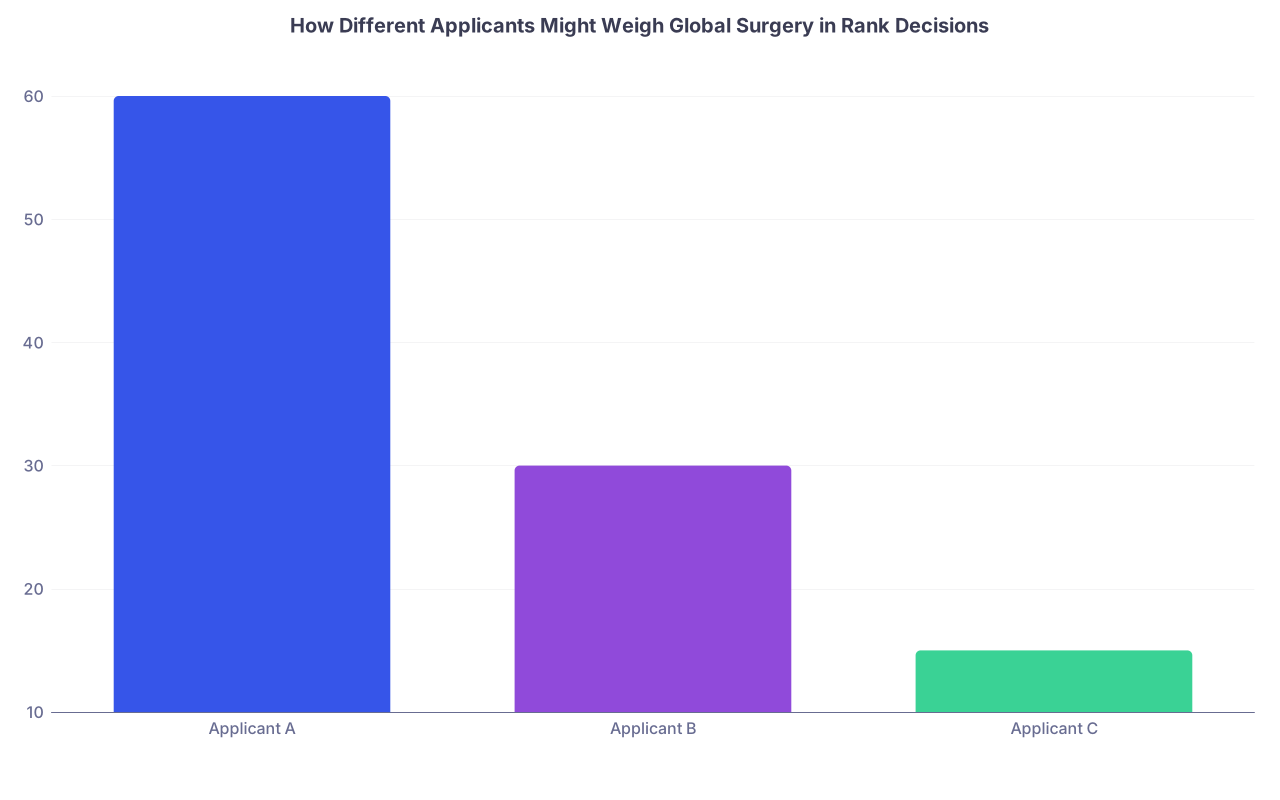
| Category | Value |
|---|---|
| Applicant A | 60 |
| Applicant B | 30 |
| Applicant C | 15 |
- Applicant A: Global surgery is 60% of their priority. They should probably only rank places from bucket 1 and the strongest in bucket 2 high.
- Applicant B: It’s 30%. They choose strong surgical training first, then pick among those with some global structure.
- Applicant C: It’s 15%. They should not contort their whole rank list around this.
Be brutally honest which one you are.
Step 11: If Your Home Program Is Weak in Global Surgery
One more scenario: you’re a student at a place with basically no global surgery presence. No track, no big-name faculty, maybe one vague partnership that’s mostly dead.
You still have options:
- Get involved with global surgery research remotely (health systems, policy, cost-effectiveness, etc.)
- Work with global health centers at your university that are medicine/peds-heavy and bring a surgical lens
- Attend virtual global surgery conferences (Bethune Round Table, G4 Alliance, Academic Surgical Congress global surgery sessions, etc.)
- Seek external mentors – email faculty at other institutions doing global surgery and ask for project involvement
This helps you:
- Clarify that your interest is real, not romanticized
- Build a track record you can discuss in interviews
- Find out which programs your mentors respect
Step 12: Your Very Next Step (Today)
Do this today. Not “later this month.”
Open a notes doc with three headings:
- “My global surgery goals”
- “Programs with real structure”
- “Questions to ask”
Under “My global surgery goals,” write 3–5 bullet points of what you actually want: time abroad, type of work, long-term vision.
Pick 3 residency programs you’re already considering. For each one, go to their website and try to answer:
- What sites do they partner with?
- How long are rotations?
- How many residents go, and when?
- Who are the named global surgery faculty?
If you can’t find that in 10 minutes, draft one email to the program’s global surgery or education contact asking directly.
That single pass will tell you more about how serious these places are than any glossy brochure ever will.