It’s 10:45 p.m. You’re on a surgery clerkship call night, sitting at a computer, and your intern just said, “You did engineering before med school, right? You should really think about ortho or CT. You guys love that gadget stuff.”
You laughed it off.
But you did notice something: the residents call you when the fluoroscope is acting weird; you’re the one who silently reorients the CT reformats; you actually enjoy reading about implant design and valve hemodynamics more than your classmates.
Now you’re staring at the list of surgical subspecialties, and two keep pulling at you:
- Orthopaedic surgery
- Cardiothoracic surgery (CT)
You’re wondering: does this engineering career I already lived actually move the needle? Or is it just a cute side note in your ERAS “previous career” box?
Short answer: it absolutely can matter. But only if you use it correctly.
Let’s lay out what you should actually do if you’re a former engineer aiming at ortho or CT.
Step 1: Decide If Your Engineering Background Really Fits Ortho or CT
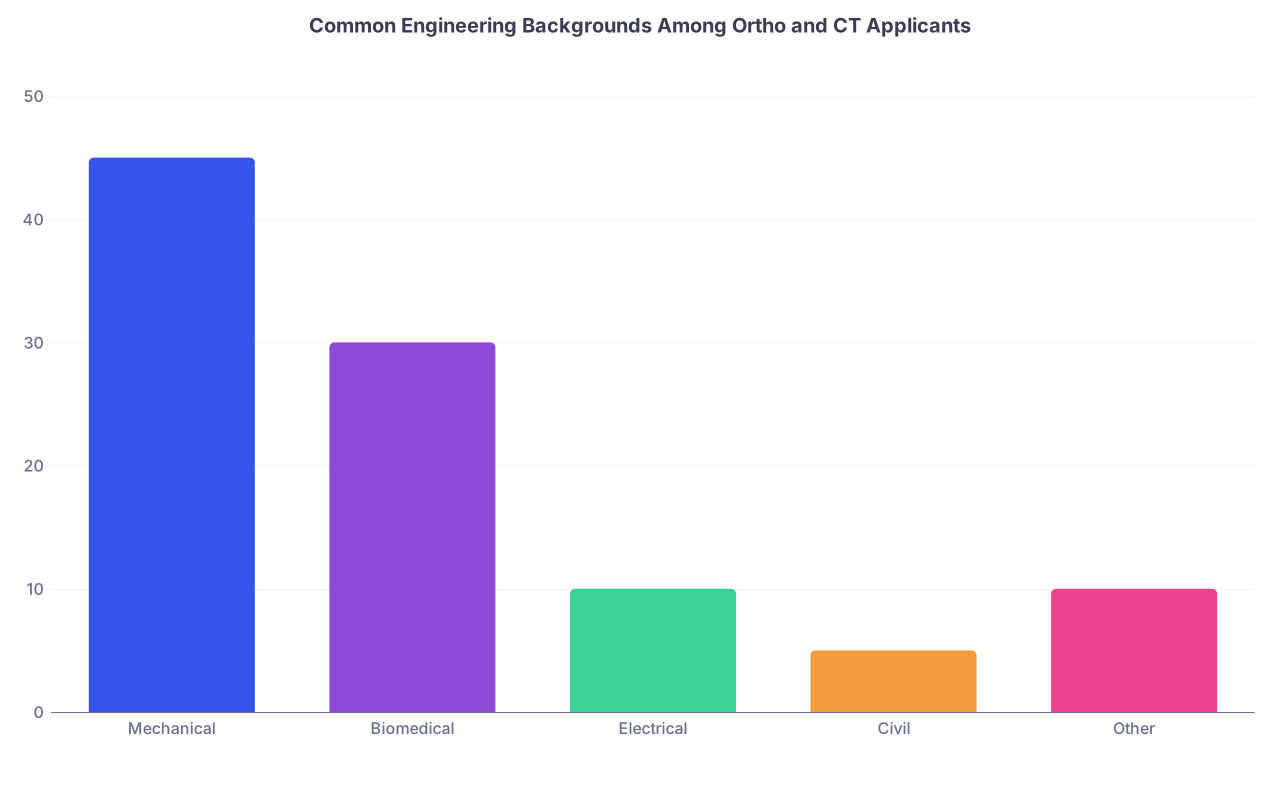
| Category | Value |
|---|---|
| Mechanical | 45 |
| Biomedical | 30 |
| Electrical | 10 |
| Civil | 5 |
| Other | 10 |
Both ortho and CT are very engineering-adjacent. But the way they use that mindset is different.
Orthopaedics:
- Mechanics of bone, joints, implants
- Loads, torque, material fatigue, wear
- Alignment, angles, deformity correction, biomechanics
Cardiothoracic:
- Fluid dynamics, pressures, resistance
- Pump systems (LVADs, ECMO, CPB circuits)
- Valve dynamics, conduit sizing, bypass flows, oxygen transfer
If your previous life was:
- Mechanical / biomedical / materials → Orthopaedics is an extremely natural fit.
- Mechanical / aerospace / systems / electrical → CT can be an excellent match, especially if you liked control systems, fluid dynamics, or thermodynamics.
Ask yourself some blunt questions:
When you’re in the OR, what do you instinctively focus on?
- Orthopaedics: angles, hardware, instrument design, screw trajectory, forces.
- CT: flows, pressures on the monitor, pump adjustments, valve or conduit geometry.
Do you find yourself thinking in free-body diagrams (ortho) or circuit diagrams (CT)?
What papers do you voluntarily read? Implant design? Biomechanics? LVAD optimization? Valve repair techniques?
If none of this resonates and the only thing you like is “cool big surgeries,” then your engineering past is just backstory, not a driver. That’s fine—but then don’t overplay it. Programs can smell pure branding.
Step 2: Translate Engineering into “Resident Who Will Be Good at This”

You are not applying to be “Resident Engineer.” You are applying to be “Resident Surgeon Who Happens to Have an Engineering Toolkit.”
Program directors care about one thing: Are you going to be safe, teachable, productive, and committed for 5–7 years?
Your engineering background helps if it signals:
- Strong problem-solving under constraint
- Comfort with complex systems
- Quantitative thinking about risk/benefit
- Ability to iterate and improve processes
- Technical hands-on aptitude
You need to connect the dots explicitly. Do not assume they’ll infer it.
For orthopaedics, you might frame it like this:
- “My mechanical engineering work on fatigue testing of composites maps directly to understanding why certain implants fail under repetitive load. It’s shaped how I think about fracture fixation choice and positioning.”
- “I’m very comfortable with angles, alignment, and vector forces; I found myself naturally understanding coronal and sagittal plane deformity and how that translates to osteotomy planning.”
For CT:
- “My background in fluid dynamics makes the hemodynamic consequences of valve lesions and conduit sizing honestly intuitive to me; during my CT elective, watching the TEE correlate with the physiology felt like jumping from equations to reality.”
- “Working on control systems in [industry] has made reading perfusion pump changes and anticipating hemodynamic shifts feel very natural.”
Make those sentences show up in:
- Your personal statement
- Your away rotation interactions
- How you discuss cases on rounds (“This reminds me of…” sparingly, not every 5 minutes)
Step 3: Build a Coherent Story, Not Just a Collection of Cool Facts
Your previous career needs to lead convincingly to this specialty. Not just to medicine in general.

| Step | Description |
|---|---|
| Step 1 | Engineering Career |
| Step 2 | Exposure to Medicine or Surgery |
| Step 3 | Specific Ortho or CT Moment |
| Step 4 | Clerkship Performance |
| Step 5 | Focused Research or Projects |
| Step 6 | Clear Specialty Commitment |
A solid narrative usually has this arc:
Past: What you did as an engineer, in concrete terms.
Example: “I worked 4 years as a mechanical engineer designing components for orthopedic external fixators and doing finite element analysis on load-bearing implants.”Spark: The transition moment.
“The turning point was sitting in on a cadaver lab with surgeons who used the hardware I helped design, realizing I wanted to be the person making the intraoperative decisions, not just the drawings.”Med school confirmation: How rotations proved this was the right move.
“During my ortho rotation, I recognized the same mechanical reasoning I used in failure analysis guiding decisions about fixation strategy and implant choice. It felt like the right match.”Current: What you have done to invest in this specialty.
Research, electives, mentorship in ortho or CT, leadership in a related group, QI projects, etc.Future: How your engineering lens will shape your career in that field.
“I want to integrate implant design and operative practice, ideally working with industry to improve outcomes for patients with complex joint deformities.”
Notice what’s missing: vague statements about “loving science” or “wanting to solve problems.” That’s background noise.
Step 4: Targeted Moves for Ortho vs CT
The backgrounds overlap, but how you deploy them is different.
For Orthopaedic Surgery
Orthopaedics loves:
- Biomechanics
- Hardware and implant nerds
- People who handle volume and intensity
- Residents who can be precise and efficient in the OR
Your engineering angle should hit:
Biomechanics and materials
Show you understand why certain constructs work.- During cases: talk appropriately about load-sharing vs load-bearing, why a plate is placed on the tension side, why dual plating is chosen.
- In your application: highlight any materials, fatigue, or CAD experience with specific tie-ins.
Spatial and manual skills
If you did CAD, machining, rapid prototyping, or lab bench work, that reads well:- “Experience with CAD and hands-on fabrication helped me quickly adapt to understanding spatial relationships in fluoroscopy and maintaining accurate screw trajectories.”
Research alignment
Push yourself toward:- Implant design / performance
- Biomechanics of fixation
- Outcomes of specific prostheses or techniques
If your school has a biomechanics lab, you should already know where it is and who runs it.
For Cardiothoracic Surgery
CT surgery selects for:
- People who can tolerate a long training path (integrated 6–8 years or gen surg + fellowship)
- Systems thinkers
- Those comfortable with complexity and high-stakes decisions
Your engineering value-add here:
Hemodynamics as systems
If you did fluids, control, or systems engineering:- Emphasize how pump flows, systemic resistance, venous return, and oxygen delivery feel like a familiar multi-variable system instead of voodoo.
- On rotations, show you can track what happens with specific changes in vasopressors, pump flows, vent settings.
Device-heavy domain
LVADs, ECMO, CPB, TAVR, TEVAR—this is your playground.- If you worked on pumps, turbines, sensor systems, or control loops, connect that to CT tech.
- Don’t pretend to be a perfusionist, but you can ask sharper questions and understand failure modes faster.
Research / innovation
Strong CT programs love applicants with:- Device development experience
- Computational modeling of flow or valve function
- Outcomes research on advanced heart failure or structural heart
You don’t need 10 pubs. But one or two well-aligned projects where your engineering skills clearly drove real work? Very attractive.
Step 5: Use Your Engineering Past to Get Real Mentorship
Do not just mention your degree and hope someone bites. You leverage it to start specific conversations.
Your email to a potential ortho or CT mentor should not be:
“I used to be an engineer and I’m interested in ortho/CT. Do you have any research?”
It should be:
“Before med school I worked three years as a mechanical engineer doing finite element analysis of load-bearing components and CAD design. I’m strongly considering orthopaedic surgery and I’m especially interested in biomechanics and implant performance. I saw you’re working on [project X]. I’d love to help with the modeling side or data analysis and get more exposure to the clinical decision-making that drives these designs.”
Now you’re offering value, not just asking for a favor.
Same for CT:
“My background includes graduate work in fluid dynamics and simulation, and I’m very interested in valvular disease and structural interventions. If you have ongoing work related to valve modeling, LVAD flows, or outcomes with ECMO, I’d like to see if there’s a way I can contribute.”
Your goal:
- Lock in 1–2 mentors who know both your engineering and clinical sides
- Get at least one substantial project in the target field
- Have someone who can write, “This student truly understands the mechanical/physiologic principles behind what we do and applies that reasoning in the OR and on the wards.”
Step 6: Be Smart About How You Talk in the OR
This is where engineers can blow it.
The temptation is to “explain” mechanics or fluid dynamics and sound clever. Bad move. You’re not there to teach; you’re there to learn and contribute.
Good uses of your background:
Asking pointed, concise questions:
“When you choose this plate over a locking plate, is it because you’re aiming for more load-sharing to stimulate callus?”
“Why do you favor this valve size when the annulus is borderline between two sizes?”Quietly helping with imaging or planning when asked:
“Do you want me to measure the mechanical axis on this film?”
“I can pull up the pre-op CT and scroll through the annulus measurements if that’s helpful.”
Bad uses:
- Mini-lectures about stress-strain curves in the middle of a fracture fixation
- Telling the perfusionist how pump systems work
- Correcting people on small technicalities just to feel smart
Residents and attendings will tolerate enthusiasm. They will not tolerate someone acting like an engineer who occasionally touches a scalpel.
Step 7: Make Your Application Materials Work Hard
You get three main written tools:
- Personal statement
- Experiences section
- Letters (influenced by how you frame yourself to writers)
Personal Statement
Anchor it with:
- A specific moment or case in ortho/CT where your engineering brain “clicked” with the clinical work
- Two or three concrete bridges from engineering to your chosen field (not just “problem-solving”)
- A forward-looking goal that sits clearly within that specialty
Not:
“My engineering background will make me a better surgeon.”
But:
“Years of modeling how implants fail under cyclic loading made me obsessed with how design and technique translate into real patient outcomes. Orthopaedics is where I can directly integrate biomechanical reasoning with hands-on surgical care, especially in complex trauma and deformity correction.”
Or for CT:
“Understanding fluid dynamics in theory was satisfying; understanding it while watching a patient’s pressures, flows, and oxygenation change during bypass was transformative. Cardiothoracic surgery lets me apply systems-level reasoning to some of the most complex physiologic problems in medicine.”
Experiences Section
Do not just list “Engineer at Company X.” Spell out:
- What you actually did (design, analysis, testing, project leadership)
- Skills that cleanly transfer to surgery: dealing with high stakes, deadlines, safety margins, multidisciplinary teams
Make at least one experience explicitly linked to ortho or CT:
- A biomechanics project
- A QI initiative on post-op outcomes
- A device/innovation project with a surgeon
Step 8: Ortho vs CT – How Your Engineering Tilt Might Push You
| Engineering Focus | More Natural Tilt | Why It Fits |
|---|---|---|
| Solid mechanics, FEA | Ortho | Implant, bone, joint loading |
| Materials / fatigue | Ortho | Hardware design and failure |
| CAD, machining, prototyping | Ortho | Instruments, jigs, custom implants |
| Fluid dynamics | CT | Hemodynamics, valves, bypass |
| Control systems | CT | Pump control, ECMO, ICU-level management |
| Biomedical devices (mixed) | Both | Implants, valves, assist devices |
If you’re stuck between the two, look at day-to-day reality and your temperament:
- Do you like bones, joints, mechanics, tangible hardware you can hold? You probably lean ortho.
- Do you like physiology, flows, ICU complexity, long cases, extremely sick patients? You probably lean CT.
Your engineering background might make you theoretically good at both. But you only get to live one life. Pick the environment you’d actually tolerate at 3 a.m. on day 23 of a call-heavy month.
Step 9: Common Pitfalls for Former Engineers
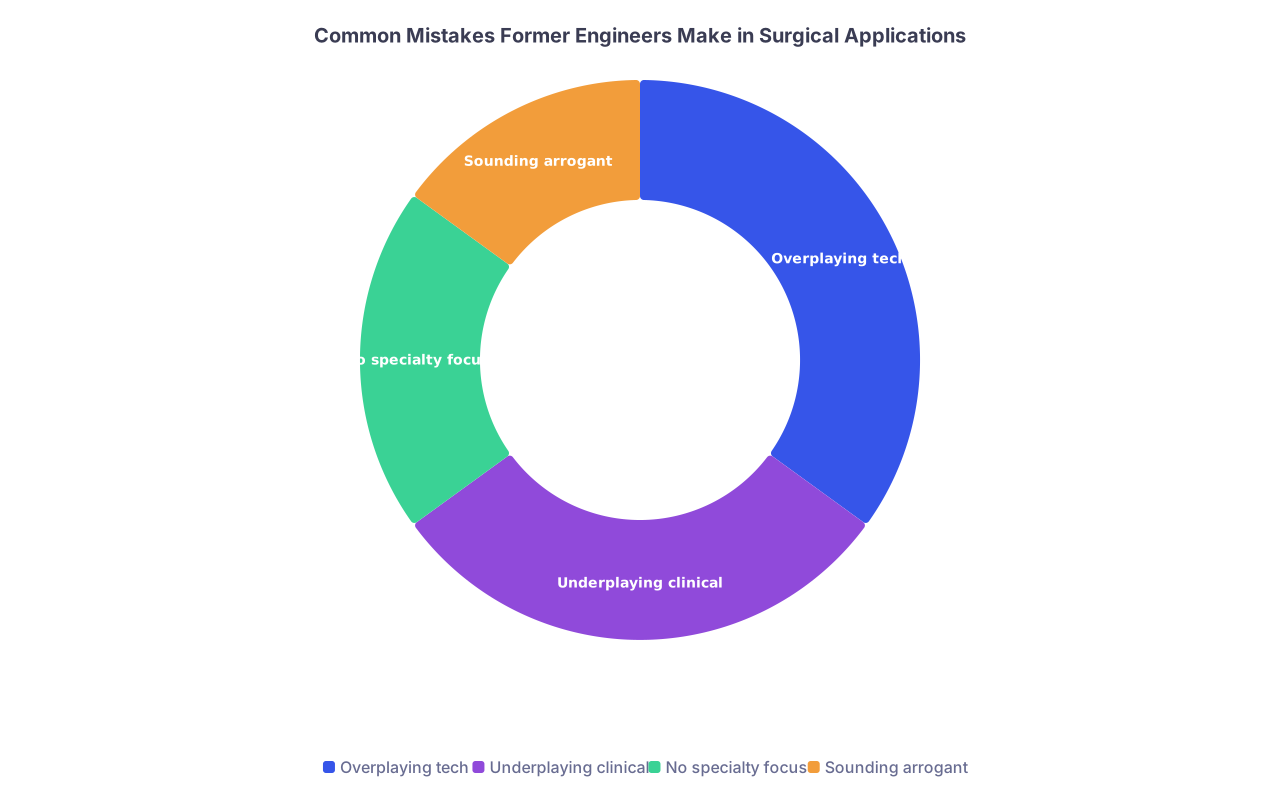
| Category | Value |
|---|---|
| Overplaying tech | 35 |
| Underplaying clinical | 30 |
| No specialty focus | 20 |
| Sounding arrogant | 15 |
I’ve seen the same errors over and over:
Overbranding as “the engineer”
If your whole identity is “engineer turned doctor,” you start looking like a novelty item, not a surgeon in training.Underdeveloped clinical side
Some applicants lean so hard on past accomplishments that their clinical narrative is thin. PDs want to know: can you take care of a post-op patient at 4 a.m.? Can you be trusted on call? Show clinical growth, not just intellectual.Vague specialty choice
“I’m interested in all specialties that use devices and tech.” Translation: I haven’t committed. That is a death sentence in competitive fields like ortho and CT.Talking down to people
Nothing will sink you faster than condescension, especially toward OR staff, perfusion, or anesthesia. If someone with a high school diploma has been running the pump safely for 15 years, you do not impress them by explaining Bernoulli.Not updating mentors about your actual goals
Your letter writers need to know you’re serious about this field, not “surgery in general.” You can’t pivot silently and hope they guess.
Step 10: Use Your Engineer Brain for the Application Strategy Itself

| Step | Description |
|---|---|
| Step 1 | Choose Specialty |
| Step 2 | Secure Mentors |
| Step 3 | Align Research Projects |
| Step 4 | Optimize Clinical Rotations |
| Step 5 | Craft Focused Application |
| Step 6 | Targeted Away Rotations |
| Step 7 | Interview Preparation |
You used to manage complex projects. Treat your specialty decision the same way.
Concrete timeline if you’re early MS3:
Next 1–2 months:
Decide whether your heart is more in ortho or CT. Shadow both with intention, not aimlessly.Following 3–6 months:
Lock a primary mentor in your chosen field. Start or join one project that uses your engineering strengths.Upcoming rotations:
Prioritize sub-I/away rotations in that specialty at 1–3 key programs. Show up as the grounded, humble former engineer who now thinks like a resident.
If you’re late and applying this cycle, compress it:
- Get at least one strong letter from your target specialty.
- Tune your personal statement to one field.
- Be ready to articulate: “Why ortho and not CT?” or vice versa, without sounding flaky.
What This Looks Like When It’s Done Well
To make this concrete, here are two composites pulled from people I’ve seen match:
Orthopaedics example:
- BS Mechanical Engineering, 3 years at a company designing spine instrumentation
- Med school: joined a spine biomechanics project with ortho faculty
- One first-author poster on screw pullout strength in osteoporotic models
- On rotation: was the student who could quickly understand reduction strategies and explain them succinctly
- Personal statement explicitly tied implant design experience to desire to manage complex deformity and trauma
- Matched at a strong academic ortho program, now doing exactly what they described
CT example:
- MS in Biomedical Engineering, thesis in LVAD flow modeling
- Started med school thinking IM/cardiology, but CT elective changed trajectory
- Worked on a project with CT and cardiology measuring outcomes in LVAD patients with specific flow parameters
- Comfortable discussing valve lesions, LVAD physiology, and CPB basics on interview day
- Integrated CT match, with plans for academic structural heart focus
Common thread: the engineering past wasn’t a gimmick. It was fuel.
You’re not just an ex-engineer trying to squeeze some value out of an old life. You’re someone who already learned to think about structure, load, flow, safety margins, failure modes. Ortho and CT are two of the few places in medicine where that mindset isn’t just cute—it’s central.
So your next steps are not abstract:
- Pick the world you actually want to live in: bones and hardware, or hearts and flows.
- Line up mentors in that world.
- Choose one or two substantial things (research, QI, OR performance) where your engineering brain is obviously an asset.
- Then present yourself not as “engineer who might be a surgeon,” but as “future orthopaedic/CT surgeon who already thinks like one, and used engineering to get here.”
Once that’s in place, you’re not just leveraging your past. You’re building a specialty-specific future that actually makes sense.
From here, the next big challenge is more tactical: picking programs, planning aways, and surviving interviews in these hyper-competitive fields. That’s its own battlefield—and we’ll tackle that another day.