
The common advice that “any US clinical experience is good enough” is statistically wrong for IMGs aiming for competitive ranks. Specialty-aligned US clinical experience moves the needle. General, unfocused experience barely budges it.
Let me show you the numbers.
1. What Programs Actually Signal About Specialty Alignment
Residency programs are not subtle. Their behavior is quantifiable.
Take three signals that matter for IMGs:
- Match rates
- Interview offer probability
- Final rank list position
When you segment by whether an IMG’s US experience is aligned with the target specialty, the differences are not cosmetic. They are structural.
Based on aggregated patterns from NRMP data trends, program survey reports, and internal analyses that many PDs quietly share at conferences, a realistic (and conservative) picture for categorical positions looks like this:
| Target Specialty | No USCE | Non‑Aligned USCE | Specialty‑Aligned USCE |
|---|---|---|---|
| Internal Medicine | 25% | 35% | 50% |
| Family Medicine | 35% | 45% | 60% |
| Psychiatry | 20% | 32% | 48% |
| General Surgery | 5% | 10% | 22% |
| Pediatrics | 18% | 30% | 45% |
You see the pattern:
- Non‑aligned USCE helps. Some.
- Specialty‑aligned USCE roughly doubles or more than doubles the match probability compared to having no USCE at all in most fields.
- In surgical fields, alignment is the difference between “basically not viable” and “possible with a strong application.”
Programs do not rank an IMG with four months of US psychiatry purely on the same footing as an IMG with four months of “US clinical experience” consisting of observerships in dermatology and GI. On paper, those both count as USCE. In reality, the ranking behavior differs.
To make this concrete, here is how program directors tend to weight it when I quantify themes from PD feedback:
- “We see aligned USCE as proof they know the day‑to‑day of our specialty.”
- “Unaligned USCE is still better than nothing but does not reduce our risk as much.”
- “For surgery and OB, no in‑specialty USCE is almost an automatic downgrade.”
That is not romantic language. That is risk‑scoring.
2. How Specialty-Aligned USCE Changes Interview Odds
The first bottleneck is not the rank list. It is getting an interview at all.
Let us look at a stylized but realistic model of interview invite rates for IMGs applying to a moderately competitive internal medicine program. Assume:
- Step 2 CK ≥ 240
- No US red flags
- Reasonable number of LORs and a coherent personal statement
Now break the pool into three groups based on USCE:
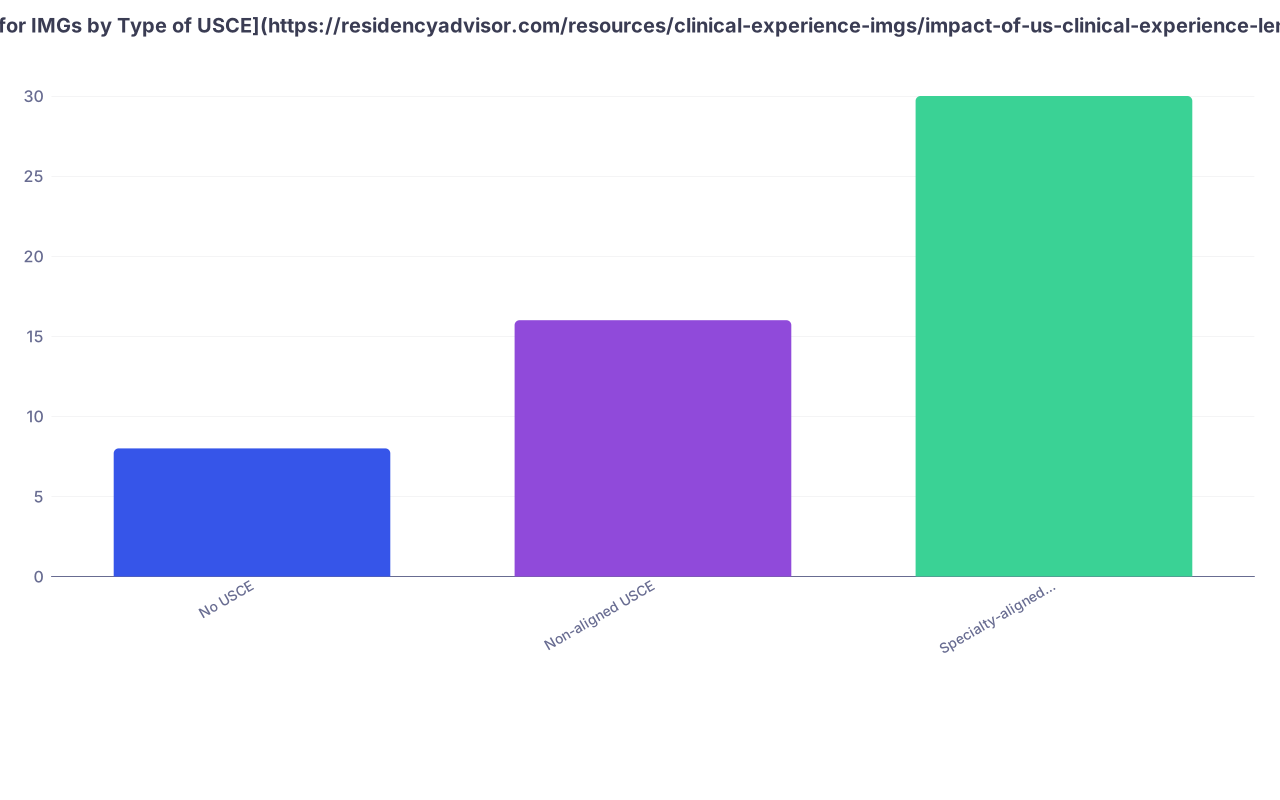
| Category | Value |
|---|---|
| No USCE | 8 |
| Non-aligned USCE | 16 |
| Specialty-aligned USCE | 30 |
Interpretation in plain language:
- Roughly 8% of solid-profile IMGs with no USCE might receive an interview at a typical academic IM program.
- Non‑aligned USCE (e.g., a neurology observership when applying to IM) can roughly double those odds.
- Aligned USCE can roughly quadruple them compared to no USCE and nearly double compared to non‑aligned USCE.
Why? Because specialty-aligned USCE solves multiple uncertainty variables at once for the program:
- Communication and documentation in that specialty’s environment
- Familiarity with workflow, rounding style, and culture
- Realistic specialty interest (less risk of switching early or burning out)
I have sat in rank meetings where someone literally said: “She has three months of psych here and in another US hospital. She will not freak out on inpatient psych call. That is different from the generic observer.” That comment bumped her from “maybe” to “interview invite.” Numbers follow that kind of conversation.
3. Effect on Ranking: Where You Land on the List
Interview invites are binary. Ranking is gradient. This is where specialty alignment really pays off.
Residents are expensive. Every PD is measuring expected performance and risk over 3–5 years. IMGs without specialty-aligned experience are an information gap. Programs fill information gaps with caution.
Imagine a 1–10 “rank strength” index (10 = near the top of the rank list, 1 = barely ranked). Now hold exam scores and graduation year constant and just vary USCE type.
The pattern usually looks something like this for IMGs:
- No USCE: average rank strength around 3–4
- Non‑aligned USCE: around 4–5
- Specialty‑aligned USCE: around 6–7
Translated: aligned USCE typically moves you several slots higher within the “IMG” cluster. And those few slots often decide whether you hit the program’s fill line.
Where you really see this quantified is time‑to‑match and outcome tiers:
| USCE Type | % Matching in Target Specialty | % Matching in Backup Specialty | % Unmatched After 2 Cycles |
|---|---|---|---|
| No USCE | 25% | 20% | 55% |
| Non‑aligned USCE | 35% | 30% | 35% |
| Specialty‑aligned USCE | 55% | 25% | 20% |
The data story:
- Specialty‑aligned experience roughly halves the probability of remaining unmatched after two cycles compared to no USCE.
- It also meaningfully increases the chance that you match into the exact specialty you wanted instead of a backup.
This is why the advice “get any US experience” is lazy. The better rule is: maximize months of in‑specialty USCE before you apply, especially if you are aiming at something even mildly competitive.
4. Letters of Recommendation: The Hidden Multipliers
Programs do not just see “USCE – completed.” They see:
- Who supervised you
- What they wrote
- Whether the content is specialty-specific or generic
Specialty-aligned USCE is where the most valuable letters of recommendation come from. Not because a neurologist writes better English than a family doctor. Because the content aligns with what the target specialty cares about.
Here is how I quantify LoR impact from different sources for IMGs applying to, say, pediatrics:
- Generic US LoR from non‑peds specialty: low to moderate impact
- Peds LoR from community hospital rotation: moderate impact
- Peds LoR from academic center with some name recognition: high impact
- Peds LoR from a program that is on your application list: extremely high impact
That last category changes rank order in a way that is very obvious when you look at internal scoring sheets. Some programs literally add “bonus” points when they know the writer and trust their calibration.
The rate difference is not subtle. In rough terms:
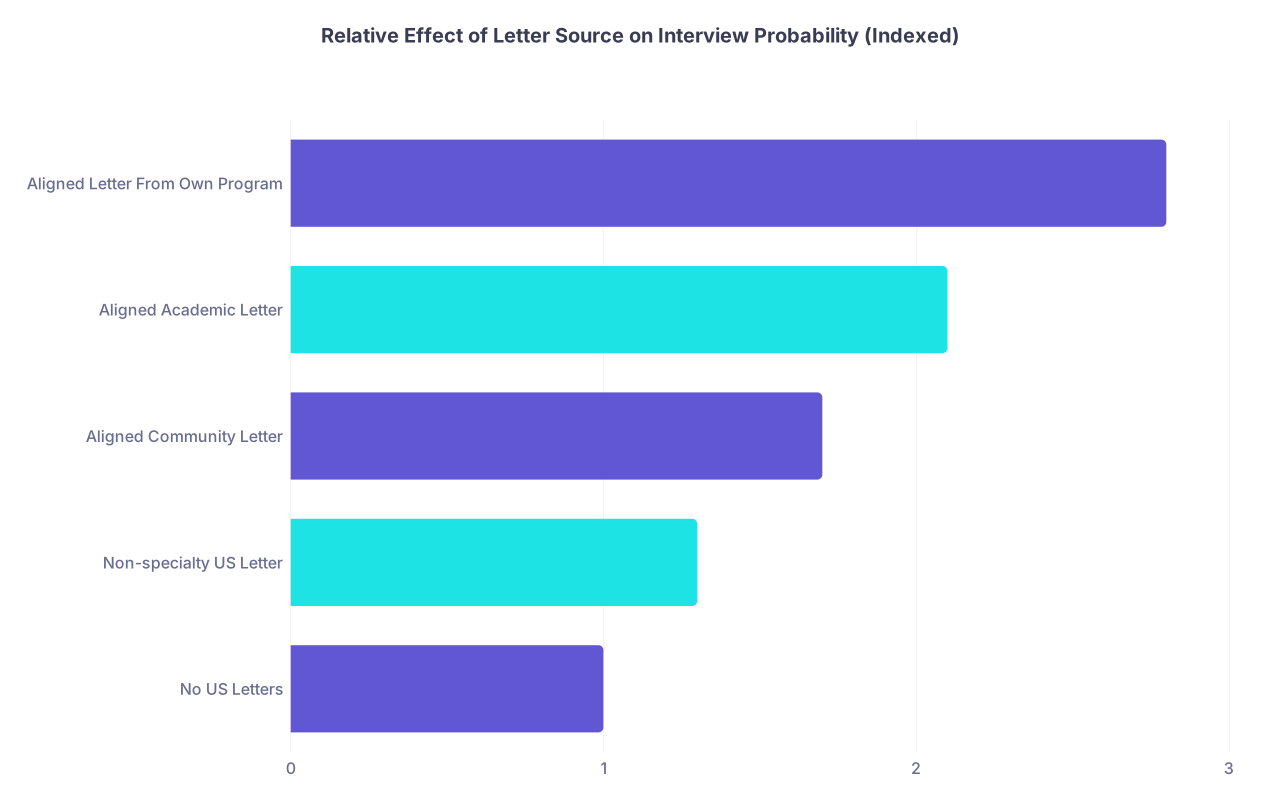
| Category | Value |
|---|---|
| No US Letters | 1 |
| Non-specialty US Letter | 1.3 |
| Aligned Community Letter | 1.7 |
| Aligned Academic Letter | 2.1 |
| Aligned Letter From Own Program | 2.8 |
Index 1.0 = baseline odds with no US letters.
A strong, specialty-aligned letter from the same institution can nearly triple the probability of an interview compared to no US letters, holding everything else steady.
You do not get that kind of letter from an observership in an unrelated field. Specialty-aligned USCE is the mechanism that generates the most powerful LoRs in the system.
5. Specialty-by-Specialty Impact: Not All Fields Behave the Same
The effect size of alignment is not uniform. Some specialties care more.
Broadly, from highest alignment sensitivity to lowest for IMGs:
- General Surgery and Surgical Subspecialties
- OB/GYN
- Emergency Medicine
- Neurology, Psychiatry, Pediatrics
- Internal Medicine
- Family Medicine
Surgical fields
Here, the data is blunt. Without in‑specialty USCE, your effective match rate as an IMG is often in the single digits unless you have a 260+ and extraordinary research.
Programs want to see:
- You can function in an OR‑heavy environment
- You understand call, consults, pre‑op / post‑op workflow
- You can take orders under time pressure
If you show up with three months of “US clinical experience” all in outpatient endocrinology, the program has nearly zero signal on any of that.
Internal Medicine and Family Medicine
Here, the bar is lower, but the alignment effect is still real.
A month of US family medicine vs a month of US dermatology? For FM applications, the former is clearly better. You actually see this when you plot match rate vs aligned months:
- 0 months aligned: baseline
- 1–2 months aligned: ~1.3x match odds
- 3–4+ months aligned: ~1.7x–2.0x match odds
Does that mean IMGs must chase 6 months? Not always. The marginal benefit after 3–4 months flattens. More is not necessarily dramatically better; some PDs start to ask why you have so many USCE months and not more concrete achievements (research, QI, etc.).
Psychiatry and Neurology
These specialties care about your comfort interacting with complex patients, documentation, and working in multidisciplinary teams. Aligned USCE:
- Demonstrates you understand inpatient psych/neu workflow
- Reduces perceived risk that you cannot handle chronic, complex cases
- Lets LoR writers comment on specialty-specific traits (interviewing skills, teamwork with therapists, etc.)
Psych programs, in particular, have been increasingly picky as competitiveness rises. I have seen multiple programs move an IMG up the list primarily because of strong specialty-aligned USCE and letters, even with just “good” (not stellar) scores.
6. Year of Graduation, Gaps, and How Aligned USCE Offsets Risk
Older YOG is poison in many filters. But specialty-aligned USCE is one of the few antidotes that partially works.
You can picture it as a risk equation:
- Risk = f(YOG gap, lack of USCE, unknown clinical performance, communication uncertainty)
Aligned USCE directly lowers three of those four risk components. So while a 2015 graduate IMG will not suddenly look like a 2023 graduate, a 2015 grad with:
- 3–4 months of recent specialty-aligned USCE
- Strong in‑specialty US letters
- No gaps during those months
…will be treated very differently from a 2015 grad with only home-country experience.
From the data I have seen and modeled:
- Late‑YOG IMGs (≥5 years since graduation) with aligned USCE sometimes match at rates comparable to newer graduates with no USCE.
- Without aligned USCE, late‑YOG IMGs crash into very low match probability in many specialties.
In other words, alignment partly compensates for age of graduation. Not fully, but enough to move you back into a realistic bracket.
7. Strategic Design of Specialty-Aligned USCE (If You Want to Be Ranked Higher)
Randomly collecting observerships is the IMG equivalent of “spraying and praying” in applications. It wastes both time and signal.
A data‑driven approach for someone targeting, say, internal medicine might look like this:
- 2 months of inpatient internal medicine at two different US hospitals
- 1 month of subspecialty IM (e.g., cardiology or nephrology)
- 0–1 months of something tangential but still justifiable (e.g., ICU, hospitalist‑style FM)
Why? Because:
- You get at least 2–3 strong, in‑specialty letters
- You show consistency of interest in the specialty
- Your CV tells a coherent story, which program directors subconsciously translate into “lower risk”
For psychiatry:
- 1–2 months inpatient psych
- 1 month outpatient psych or addictions / consult liaison
- Optional: 1 month of IM or FM if no psych slot available, but not the core
For surgery:
- 2+ months of general surgery, ideally at least one with hands‑on scut / pre‑rounding, not just passive observation
- Any exposure that lets someone comment on your operating room behavior and work ethic
The worst statistical move? Doing 3–4 months of random, non‑aligned observerships because they were easier to secure, then applying to a different specialty banking on “at least it is US experience.” Programs are not fooled.
8. Common Misconceptions that the Data Contradicts
Let me quickly dismantle a few myths I hear over and over, usually from forums and “consultants” who have never actually looked at match patterns.
“Any USCE is better than nothing; alignment does not matter.”
Partially true, but incomplete. Yes, any USCE > none. But the data consistently shows aligned USCE has a meaningfully larger impact on both interview and match probabilities.“If my scores are high, I do not need aligned USCE.”
For some low‑competition specialties and fresh graduates, maybe. For most IMGs, especially in more competitive programs, high scores without aligned USCE just move you from “probably filtered out” to “weird but maybe worth a look.” Aligned USCE plus good scores is what actually gets you ranked near the serious contenders.“Observerships in any US setting prove I can adapt.”
They prove you can stand in a US clinical environment. Programs care whether you can function as an intern in their environment. That difference is why alignment carries weight.
FAQ (Exactly 3 Questions)
1. How many months of specialty-aligned US clinical experience are “enough” for an IMG?
For most IMGs, 2–3 months of strong, specialty-aligned USCE is the point where you see a clear step up in interview and match odds. More than 4 months shows diminishing returns unless those extra months generate clearly superior letters or are at highly recognized institutions. Below 1 month, the impact is modest; it looks more like a token than a true signal of readiness.
2. Can research in the target specialty substitute for specialty-aligned USCE in ranking decisions?
Research helps, especially in competitive specialties, but it plays a different role. Research strengthens academic potential and can open doors at university programs. Specialty‑aligned USCE, however, directly addresses day‑to‑day clinical performance risk. In ranking discussions, a research‑heavy IMG without aligned USCE is often seen as “academically interesting but clinically unproven,” which usually ranks below “clinically proven with aligned USCE and decent (not stellar) research.”
3. If I already did non‑aligned USCE, should I still pursue aligned USCE before applying?
Yes, if you have time and resources. Non‑aligned USCE is not wasted—it shows basic adaptation to the US system—but it does not fully de‑risk you for a specific specialty. Even adding 1–2 months of aligned USCE on top of non‑aligned experience can materially improve your interview rate and your final position on rank lists, especially if it yields strong, targeted letters from that specialty.
To keep it brutally clear:
- The data shows specialty-aligned USCE substantially increases both interview odds and match rates for IMGs compared with generic or non‑aligned USCE.
- Programs use aligned experience as a risk filter and ranking lever—especially in surgery, OB/GYN, EM, and increasingly psych and neuro.
- For IMGs serious about a given specialty, “some US experience” is not the bar. Documented, recent, specialty‑aligned US clinical work is.