
The way most IMGs explain non-clinical gaps is killing otherwise solid applications.
If you treat a gap between U.S. clinical rotations as something to hide, you look evasive. If you overshare and ramble, you look disorganized. The win is right in the middle: clear, brief, and framed in a way that reassures programs you’re ready to function clinically on day one.
Let’s walk through exactly how to do that.
1. What Programs Actually Care About (Not What You Think)
Program directors aren’t sitting there obsessing over whether you had 3 months or 9 months of “perfectly continuous” U.S. experience.
They care about three core questions:
- Are your clinical skills current?
- Are you reliable and committed to medicine?
- Will you be safe and trainable on July 1?
Non-clinical gaps between U.S. rotations trigger concern when they suggest the answer to any of those might be “no.” Common red flags in their heads:
- “Did this person fail exams and vanish for a year?”
- “Were they unable to get more rotations because of poor performance?”
- “Have they been out of direct patient care too long to step into internship safely?”
- “Are they bouncing around without a plan?”
Your explanation has one job: calm those fears.
That means:
- Acknowledge the gap clearly (don’t dance around it).
- Show what you did with that time.
- Connect it back to you being a better, safer, more prepared intern.
2. Types of Non-Clinical Gaps IMGs Have (And How Risky They Look)
Not all gaps are equal. Some are almost non-issues if explained well; others need real strategy.
| Gap Type | Risk Level | Typical Length |
|---|---|---|
| Studying for USMLE | Low | 3–12 months |
| Research or MPH/MS | Low–Medium | 6–24 months |
| Visa / Administrative Delays | Medium | 3–12 months |
| Family / Health Issues | Medium–High | 1–12 months |
| Non-medical Job / Business | High | 6–24+ months |
Low risk: USMLE study or research
If the gap is mainly for:
- CK/CS (older grads) or Step 3 prep
- Dedicated research (with or without publications)
- A structured degree (MPH, MS, MBA)
These are easy to justify as long as:
- You don’t sound like you were drifting.
- You have something concrete to show (scores, abstracts, degree, poster, even just skills gained).
- You can still point to recent clinical contact (even if limited).
Medium–high risk: non-medical jobs, long inactivity, vague “personal reasons”
These require much tighter explanations because programs worry you’re rusty or not committed.
You need:
- A clear, short reason.
- Demonstrated consistent engagement with medicine (reading guidelines, online CME, observerships, telemedicine, free clinic, tutoring).
- A bridge showing why now you’re stable and ready to train.
If you have a 1–2 year non-clinical stretch and no attempt to keep medically active, that’s a problem. You can’t rewrite the past, but you absolutely can start changing the present now with:
- Volunteer clinical roles (free clinics, screening events)
- Shadowing primary care or hospitalists
- Online CME certificates
- Teaching or tutoring medical students for USMLE content
Even a few concrete items make your explanation more believable.
3. How to Structure Your Explanation (Template You Can Steal)
Here’s the basic formula you should use everywhere (ERAS, PS, interviews):
- One sentence: state the gap and timeframe plainly.
- 1–2 sentences: what you actually did with that time.
- 1–2 sentences: how it helped you and why you’re now ready for residency.
That’s it. No long stories. No drama.
Example 1: Gap for CK and research
“Between my internal medicine and family medicine U.S. rotations (Jan–Aug 2023), I focused on Step 2 CK preparation and joined a cardiology research group at [institution]. During this period I completed [X] projects leading to [poster/abstract/submission] and improved my CK from practice scores in the low 220s to a final score of 250. This time strengthened my clinical reasoning and evidence-based decision-making, which I’ve since applied in my most recent U.S. rotation.”
Example 2: Visa and family issues, high risk if vague
“After completing my first U.S. rotation in March 2022, I had an 11‑month non-clinical period while resolving visa processing and caring for a critically ill family member. During this time I stayed engaged with medicine through weekly journal clubs with colleagues overseas, completing online CME in internal medicine, and volunteering at community blood pressure screening events. Those experiences reinforced my commitment to internal medicine, and in my most recent U.S. rotation in 2023 my attending commented on my clinical maturity and up‑to‑date knowledge.”
Notice what’s not there: details about the embassy, emotional backstory, or long justifications. Program directors want to know you’re stable and clinically ready, not your full autobiography.
4. Where to Explain the Gap: ERAS vs Personal Statement vs Interview
You shouldn’t be telling five slightly different gap stories across your application. Keep it consistent.
ERAS application
Use the “Experience” and “Education” entries strategically.
- For exam prep: You can list it as “Independent USMLE Preparation” under “Experience” if it was a substantial, structured period (full time 4–12 months).
- For research: Definitely list each research position with clear dates.
- For degrees: MPH, MS, etc. go under Education with dates that naturally fill the gap.
Short explanation in each entry field is enough. Don’t write an essay there.
Personal statement
Only bring the gap into the personal statement if:
- It’s longer than ~6–9 months, AND
- It meaningfully shaped your pathway or skills.
If yes, give it 2–4 sentences max in the body, not the opening or closing. It’s supporting context, not your headline.
Bad move: starting your PS with “After my mother died, I…”
Better move: “During a planned gap between U.S. rotations, I faced significant family responsibilities that required me to be back home. Balancing those responsibilities while staying academically active taught me to manage stress, prioritize tasks, and lean on team support — skills I now bring into patient care.”
If your gap is ≤6 months and for something clean (exam prep, research), you can skip it in the PS completely and let ERAS + interview handle it.
Interview
You will be asked: “Tell me about this gap” or “What were you doing between these rotations?”
Use the same three-part formula, then stop talking.
Don’t:
- Become defensive (“In my country it’s normal…” as your main defense).
- Over-explain.
- Ask the interviewer if this is a problem.
Do:
- Speak confidently and neutrally.
- Emphasize what you learned and how it improved your preparation.
- Pivot back to your recent clinical work.
Example pivot: “That period actually pushed me to be extremely disciplined with self-study. In my most recent U.S. rotation at [hospital], I was able to… [brief concrete example].”
5. The Biggest Mistakes IMGs Make Explaining Gaps
I’ve seen the same self-sabotaging patterns over and over.
Mistake 1: Hiding the gap
You can’t “sneak” this past a PD. They see your graduation year, US rotations dates, and Step scores. If something doesn’t add up, their trust drops.
Every significant non-clinical gap over about 3 months should have at least a one-line explanation somewhere obvious.
Mistake 2: Over-sharing personal drama
You’re not in therapy. They’re assessing risk.
If it involves:
- Divorce
- Financial collapse
- Legal issues
- Major mental health struggles
You can usually generalize: “family responsibilities,” “health issue requiring short-term treatment,” “financial responsibilities requiring temporary non-medical work.” You’re allowed to protect your privacy and still be honest.
Programs want to know:
- Are you stable now?
- Did you grow from it?
- Is it likely to disrupt residency?
If you can’t answer those confidently, that’s where you focus your energy now — not on crafting a more emotional story.
Mistake 3: Making the gap sound like a vacation
“During this time I traveled and reflected on my goals” sounds like you took a gap year for vibes. Bad look.
If you did travel, fine, but pair it with concrete professional activity:
- Online courses
- Research collaboration
- Telemedicine, if applicable
- Teaching/tutoring
Mistake 4: Not backing it up with recent clinical proof
Words aren’t enough if your last real hands-on patient contact was two years ago.
Programs love seeing:
- A very recent U.S. rotation (within 12 months of start date)
- Strong letters talking about your current clinical performance
- Step 3 during a long non-clinical period (shows ongoing engagement)
If your gap is big, your #1 job is to get something clinically relevant and recent on that CV.
6. How Long Is “Too Long” Between Rotations?
There’s no magic number, but here’s reality.
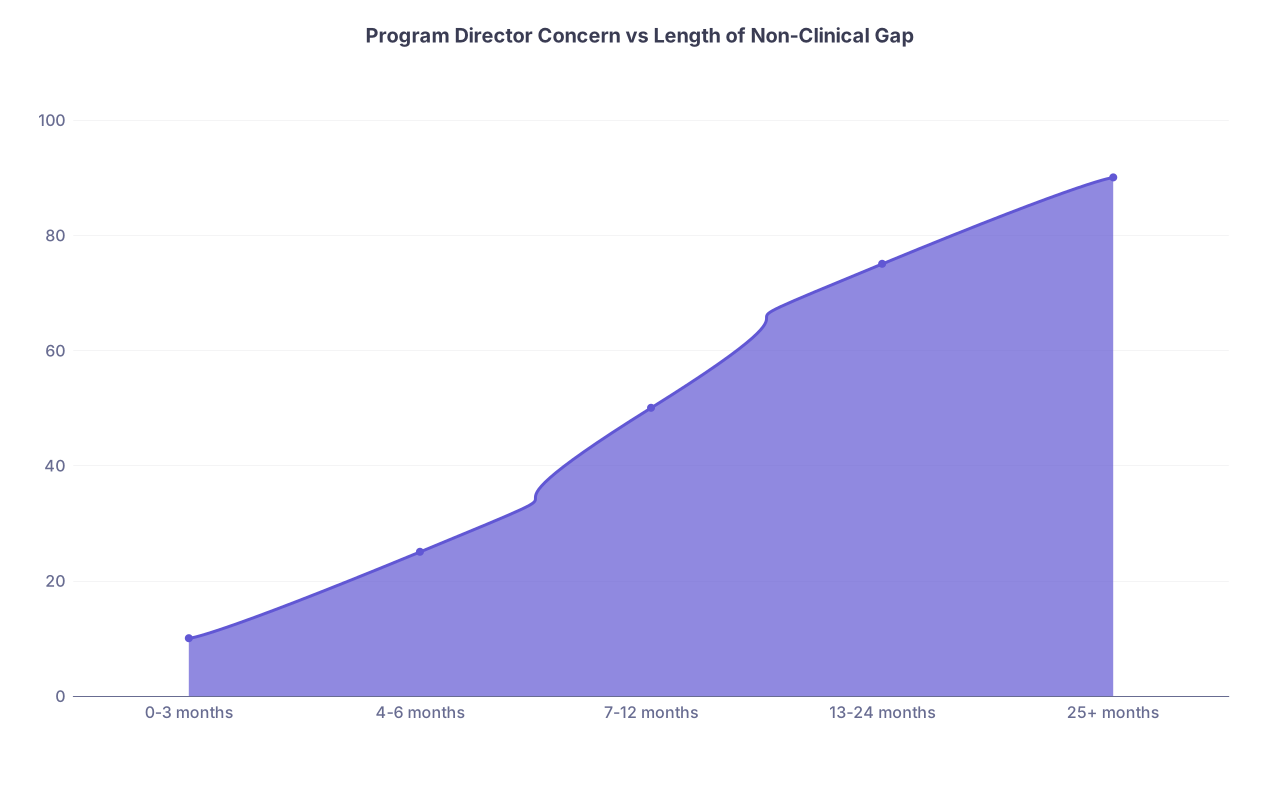
| Category | Value |
|---|---|
| 0-3 months | 10 |
| 4-6 months | 25 |
| 7-12 months | 50 |
| 13-24 months | 75 |
| 25+ months | 90 |
- 0–3 months: Basically normal. No one cares much, especially if it lines up with exam timing or logistics.
- 4–6 months: Mild curiosity. Fine with a straightforward explanation.
- 7–12 months: Now you need a structured story and evidence you stayed clinically/academically engaged.
- 13–24 months: High concern unless filled with training, research, or formal education.
- 25+ months: Major red flag unless you have a strong, well-documented arc back into clinical work.
If you’re in the high-risk range, the question isn’t “How do I hide this?” It’s “What can I do in the next 3–6 months to show I’m back in the game?”
That often means prioritizing:
- A fresh U.S. rotation (even observership if that’s all you can get)
- Step 3
- A structured research or clinical fellowship
- Consistent volunteer clinical work
7. Sample Phrases You Can Adapt (By Scenario)
Use these as starting points and make them specific to your dates and activities.
For exam-focused gaps
“From [month/year] to [month/year], I dedicated myself full-time to Step 2 CK preparation and completed a structured study schedule of approximately [X] hours per week. This allowed me to strengthen my clinical reasoning and achieve a score of [score], which reflects my current knowledge level entering residency.”
For research-heavy gaps
“Between my U.S. rotations, I worked as a research fellow in [specialty] at [institution] from [month/year] to [month/year]. I contributed to [X] projects, including [brief example], and presented at [meeting if applicable]. This experience sharpened my critical appraisal skills and reinforced my interest in [specialty or IM/FM/psych, etc.].”
For family/health-related gaps
“From [month/year] to [month/year], I had to step back from clinical work to manage significant family responsibilities. During that period I remained connected to medicine through [online CME, journal clubs, teaching, volunteer work]. Those responsibilities have now resolved, and my recent U.S. rotation in [year] confirmed my readiness to return to full-time clinical training.”
For non-medical work
“Due to financial obligations, I worked outside of medicine from [month/year] to [month/year]. While this role was non-clinical, it strengthened skills I now use daily in patient care, including [communication, time management, teamwork]. At the same time, I maintained my medical knowledge through [self-study, CME, shadowing], and in [year] I returned to hands-on clinical activity during my U.S. rotation at [hospital].”
Pick one of these patterns, tighten it up, and repeat the same core version in ERAS, PS (if needed), and interview.

| Step | Description |
|---|---|
| Step 1 | Non clinical gap between US rotations |
| Step 2 | Brief note in ERAS only |
| Step 3 | Explain in ERAS and be ready for interview |
| Step 4 | Explain in ERAS, PS, and interview |
| Step 5 | Highlight study, research, CME, volunteer |
| Step 6 | Start current clinical or academic activity now |
| Step 7 | Length of gap |
| Step 8 | Stayed engaged with medicine? |
FAQ: IMGs Explaining Non-Clinical Gaps Between U.S. Rotations
Do I have to explain a 3–4 month gap between U.S. rotations?
If it lines up with exam prep, visa processing, or logistics, a brief ERAS note or a clear entry (e.g., “USMLE Step 2 CK preparation”) is enough. You don’t need a long narrative or PS paragraph for a short, reasonable gap.Should I list exam preparation as an “experience” on ERAS?
Yes, if it was a substantial, structured period (e.g., 4–12 months of full-time study). Keep the description short and professional: focused study hours, question banks completed, improvement demonstrated by final score. Don’t pretend it was a job; just show it was organized, not drifting.My gap was for family or health reasons. How honest should I be?
Be honest but not overly detailed. It’s enough to say “family responsibilities” or “health issue that is now fully resolved.” Programs care more that your situation is stable and that you maintained some connection to medicine than about the exact diagnosis or family drama.Is a non-medical job during my gap fatal to my application?
Not necessarily, but it’s high risk if it looks like you walked away from medicine. You need to show you stayed engaged (CME, self-study, limited volunteer or shadowing) and that the situation is now resolved. Emphasize transferable skills and your recent return to clinical work.Do I need to discuss every gap in my personal statement?
No. The PS is not your gap report. Only address longer (>6–9 month) gaps that shaped your path or might raise questions, and even then, keep it to a few sentences. Use ERAS entries and interviews to handle the rest.How do I answer “Your last clinical experience was two years ago” in an interview?
Acknowledge the gap, briefly explain why, then focus hard on what you’ve done to keep your knowledge and skills current (CME, research, teaching, Step 3, new observerships). Programs want to hear a clear bridge from “then” to “I’m ready now,” backed by something recent and concrete.Is it better to do a low-quality observership now or have no recent U.S. activity?
A legitimate observership with real patient exposure (even if observational) is almost always better than nothing. It shows initiative and gives you updated U.S.-based context. Just don’t oversell it as “full hands-on responsibility” if it wasn’t; programs can smell exaggeration.
Bottom line: Don’t hide your gaps, don’t turn them into a soap opera, and don’t leave them unexplained. State the reason, show how you stayed engaged with medicine, and prove you’re clinically ready now with recent activity and strong letters. That’s what reassures residency programs—and that’s what gets you taken seriously as an IMG with a non-linear path.