

What if the one attending who saw you at your absolute worst is the one who ends up on the program’s selection committee? And that’s the rotation sitting in your ERAS as “first US clinical experience” forever?
That’s exactly the kind of thought that kept me up at 3 a.m. after my first US rotation went… let’s just say “not Instagram-worthy.”
Let me just say it out loud so you don’t have to:
I messed up my first US clinical rotation. I was slow. I missed some questions. I felt in the way. I had at least one attending who I’m pretty sure didn’t like me. And every night I lay in bed thinking:
“Did I just destroy my chances as an IMG?”
What “Struggling” Actually Looks Like (You’re Not Specially Terrible)
We both know there’s “I could have done better” and then there’s “I want to delete myself from ERAS.” If you’re reading this, you probably feel closer to the second one.
Here’s what I’ve seen (and done myself) in that first US rotation:
- Standing there on rounds, having no idea what “can you pull the H&P from yesterday’s admission” actually means in their system.
- Pre-rounding taking you 2 hours longer than everyone else because the EMR feels like a video game with no tutorial.
- Getting pimped on a question you definitely knew… until the moment your attending said your name and your brain just shut down.
- Writing a note that gets completely rewritten by the resident with that passive-aggressive “next time…” feedback.
- Being told, “You need to be more proactive,” when you already feel like you’re annoying everyone by existing.
So your mind goes:
US rotations are critical for IMGs.
I messed mine up.
Therefore my chances are gone.
The anxiety math checks out in your head.
Reality doesn’t work that cleanly.
How Much Does One Bad (or Mediocre) Rotation Actually Matter?
Let me be brutally honest: clinical experience does matter a lot for IMGs. Programs want to see that you can work in the US system, talk to patients, function on a team, and not implode under pressure.
But. A single rotation doesn’t usually make or break you unless:
- It’s your only US rotation
- You got an outright terrible evaluation / professionalism concern
- Or you somehow made it into hospital folklore in a really bad way
Most programs are looking for a pattern. A story. Not one episode.
Think of your application like this:
| Component | Relative Weight |
|---|---|
| USMLE scores | High |
| Recent US clinical exp | High |
| Letters of rec | High |
| Medical school grades | Medium |
| Research | Medium |
| One specific rotation | Low–Medium |
So yeah, your US rotations matter. But your first rotation? That’s usually the one where everyone expects you to be the most lost.
What actually gets noticed is the trend:
- First rotation: average, shaky, “still adjusting”
- Later rotations: better evaluations, stronger letters, more responsibility
Programs care a lot more about “this person improved and can take feedback” than “this person was perfect from day one.” Perfect from day one usually just reads as “maybe they had a very easy attending” anyway.
The Fear: “This Attending Won’t Write Me a Strong LOR”
This is the big one, right?
You’re not just mourning the rotation. You’re panicking about the letter that won’t come from it.
Maybe you had:
- An attending who barely knew your name by week 4
- A senior resident who liked you but isn’t the official letter-writer
- That one piece of lukewarm feedback you keep replaying instead of everything else
So your brain says: “No strong LOR from this first US rotation = my application is dead.”
Here’s what I’ve seen actually happen:
Most attendings are not out to destroy you.
They might say “still developing” or “average” or “performed at expected level.” That doesn’t kill you. It just doesn’t give you a superstar letter. And that’s survivable.You are not required to get a letter from every rotation.
You can just… not ask. If you think the letter will be weak, skip it. Programs don’t assume, “Where is the letter from that very specific community hospital in Ohio?” They don’t track that way.One strong letter > three generic ones.
A single detailed, enthusiastic letter from a later rotation is worth more than some obligatory, “This student was fine” from your first.
So if your first rotation was shaky, your goal is simple:
Don’t chase a letter there unless you’re sure someone liked your work and knows you well.
Instead: plan to win later rotations.
The Ugly Question: What If I Actually Got a Bad Eval?
Not just “meh.” I mean you got:
- Written feedback that was clearly negative
- Comments like “needs significant improvement in clinical reasoning”
- Anything hinting at professionalism concerns, poor reliability, or attitude issues
That’s when things get more serious.
Not hopeless. But serious.
Here’s what you can do if you know one eval was bad:
Contain the damage.
That eval usually stays in the hospital records and maybe your school’s file. It doesn’t automatically get faxed to every program in the country. The real danger is if:- It’s from your home school
- Or it’s part of an official transcript-like evaluation that programs receive
Overcompensate with future rotations.
Aim for:- Consistent “above expectations” or “outstanding” comments later
- Strong letters from attendings who can explicitly say you took feedback and improved
If it’s going to show up, control the narrative.
You don’t lead your personal statement with, “I was terrible in my first rotation.”
But if there’s a visible bad mark, you can briefly frame it as:- You were adjusting to a new system
- You got specific feedback
- You deliberately worked on it and later evaluations reflect that
Programs don’t like unexplained red flags.
They’re much softer on “early bump that clearly got fixed.”
The Part No One Says: Everyone Knows You’re Lost in Your First US Rotation
Here’s the thing I wish someone had told me before I walked into my first hospital in the US:
They know you’re going to be awkward.
You’re dealing with:
- New system (US healthcare is its own weird universe)
- New culture
- New EMR
- New hierarchy and unspoken rules
- Possibly a new language or accent-related communication challenges
The expectation isn’t “function like a PGY-2.”
It’s: show up, be prepared as best you can, care about your patients, try to get better.
I’ve heard attendings literally say in workrooms:
- “It’s their first US rotation, give them a week.”
- “They’re an IMG, they’re still adjusting to the EMR.”
- “Yeah, they’re quiet, but they’re working hard.”
Nobody is sitting there tracking your every mistake and building a case file.
They notice things like:
- Did you show up on time?
- Did you seem to actually care?
- Did you try to improve after feedback?
- Were you decent to nurses/staff?
If you can honestly say “yes” to those, you’re not doomed.
OK, But What If This Was My Only US Clinical Experience?
This is where the anxiety isn’t irrational. If you only have 1 US rotation and it was average or bad, that does hurt more.
Programs want recent US clinical experience and evidence you can function here. If that one shot was weak, your brain says: game over.
Here’s what I’d do in that situation:
Fight hard to get at least one more US rotation.
Even if it’s:- Observership
- Community hospital
- Ambulatory clinic
Anything. You need something to show growth and more recent exposure.
Prioritize a rotation where you can get to know attendings.
You want:- Smaller teams
- More face time
- Less chaos than huge tertiary centers where med students disappear in the crowd
Treat that next rotation like it’s your re-try button.
Show up ridiculously prepared. Ask for feedback in week 1, not week 4. Tell the senior/resident, “This rotation is very important to me, I’d really appreciate any tips to improve.”
If your first rotation was a mess, your second one needs to be your redemption arc.
How Programs Actually Look at IMGs’ US Clinical Work
Let me strip this down. When an IMG file hits a PD’s desk, they’re basically asking:
- Can this person function safely and reasonably in our system?
- Do they have at least one or two people in the US who are willing to vouch for them?
- Is there any sign of being a nightmare (unprofessional, lazy, arrogant)?
They are not saying:
- “Their first US rotation wasn’t described as ‘outstanding’ so into the reject pile.”
If you have:
- Decent scores (for the specialty and year)
- Solid, recent US clinical experience (even if not perfect)
- 2–3 honest, supportive letters
- No glaring professionalism disasters
You’re in the running. Not guaranteed. But you’re not out.
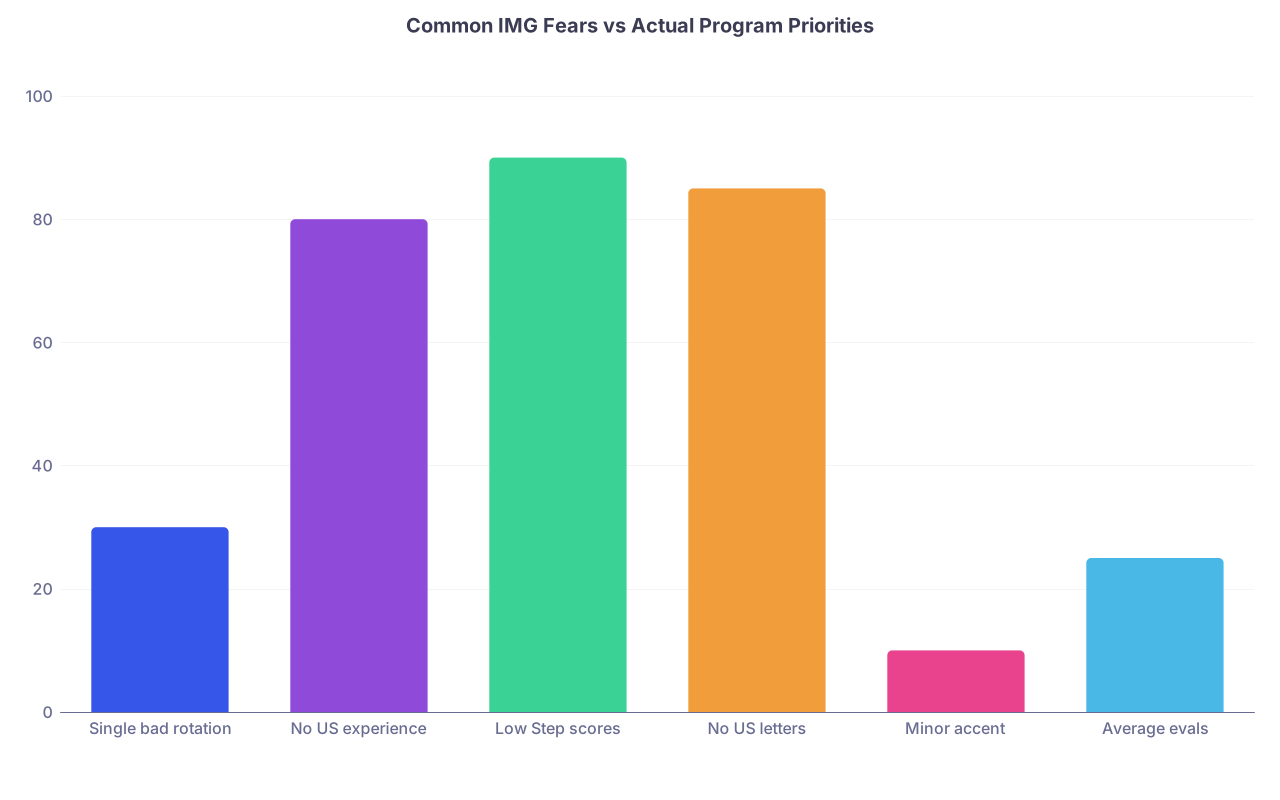
| Category | Value |
|---|---|
| Single bad rotation | 30 |
| No US experience | 80 |
| Low Step scores | 90 |
| No US letters | 85 |
| Minor accent | 10 |
| Average evals | 25 |
Left side is how much you fear it.
Right side is how much programs actually care.
Notice how “single bad rotation” and “average evals” look very different from “no US experience” or “low scores.”
What You Can Still Do Now If That Rotation Haunts You
You can’t rewrite what happened on that rotation. But you’re not powerless.
Here’s what I’d actually do, step by step:
Be brutally honest with yourself for 20 minutes.
Ask:- Was I late?
- Did I seem uninterested?
- Did I ignore feedback?
- Was I defensive?
If yes to any, that’s your homework for future rotations.
Email one person who seemed neutral-to-positive.
Something simple: thank them for teaching, mention one specific thing you learned. No “please write me a letter” yet. Just keep a human connection alive. You might circle back later if you realize the eval wasn’t as bad as you thought.Plan your next rotation more strategically.
Don’t just “hope it goes better.” Walk in with:- A plan for pre-rounding
- A system for notes
- A list of common scenarios in that specialty to read about
- A decision that you’ll ask for mid-rotation feedback even if it terrifies you
Be ready to talk about improvement, not perfection.
In interviews, if it comes up, you don’t say, “I struggled, but now I’m amazing.”
You say: “I was overwhelmed in my first US rotation learning the system, but I got clear feedback about X and Y. I worked on those specifically, and in my later rotations my evaluations reflected that progress.”
That sentence shows self-awareness, maturity, and growth. Programs like that.
The Thing Behind All of This: You’re Terrified This Was Your Only Chance
Underneath all the analysis and strategy, it’s really this, right?
“That was my one shot. I blew it. Everyone else is ahead. I’m done.”
Residency applications for IMGs already feel like you’re starting the race 100 meters behind. So messing up any piece of it feels fatal.
Here’s the ugly truth that helped me breathe a bit:
Most of us don’t match because of one single disaster. We match—or don’t—because of an overall pattern.
One shaky rotation doesn’t define that pattern.
What you do after it has more weight than what you did in week 1 of your first US hospital.
Is it harder now? Maybe.
Impossible? No.
You’re allowed to be upset about how it went. You’re allowed to feel sick every time you remember that one comment the attending made in front of everyone. I still remember one resident saying, “Why didn’t you think of that?” in a tone that basically translated to “Are you clueless?” I replayed that one sentence for months.
But here’s what finally got me out of the spiral: realizing that obsessing over that rotation wasn’t fixing it. It was just draining the energy I needed to actually do better on the next one.
You haven’t ruined your IMG chances. You’ve just used up your fantasy of having a perfectly clean, flawless US clinical record.
Welcome to being like… everyone else.
FAQ (Exactly 6 Questions)
1. Should I still ask for a letter from a rotation where I struggled?
Only if at least one attending or senior clearly liked your work and actually saw you improve. If the vibe was neutral and you got nonspecific feedback, the letter will probably be generic at best. A generic letter doesn’t kill you, but if you have or expect stronger letters from other rotations, prioritize those instead. You are not obligated to get a letter from every single US experience.
2. Will programs see my actual evaluation comments from that rotation?
Usually not directly. They’ll see what your school or the rotation provider sends officially: transcripts, MSPE, or standardized eval forms. If this rotation isn’t part of your official transcript or MSPE, it often only shows up if you submit a letter from there. That’s why you need to know how bad it actually was. A mediocre eval that lives in some hospital system’s internal record is not the end of your match chances.
3. Do I need to explain a bad rotation in my personal statement?
Most of the time, no. Don’t drag attention to something programs may never notice. If it’s not a major, visible red flag (like failing a core clerkship or getting written up for professionalism), let it go and focus on your strengths and growth. If it is visible, you can mention it briefly and frame it as early adjustment plus clear improvement later, not as a confession speech.
4. How many strong US letters do I need as an IMG to stay competitive?
For most IMGs, 2 solid US letters is the bare minimum; 3 is safer. They don’t all have to be from big-name institutions, but they need to be specific and clearly positive. A good letter talks about how you think, how you interact with patients and teams, and how dependable you are. A rotation where you were invisible will rarely give you that. That’s why you should really fight to shine in your later rotations.
5. If my first US rotation was bad, should I avoid listing it on ERAS?
If it was an actual hands-on clinical elective, you usually want it listed under experiences, because programs do like to see clinical exposure. What you can avoid is using that rotation for a letter if you expect it to be weak. Flat-out hiding legitimate clinical work can look strange if it comes up later, but downplaying it (no letter, no big emphasis) is fine.
6. Did I pick the wrong specialty if I struggled in my first rotation in it?
Not automatically. Sometimes you struggle because of the team, the hospital chaos, or the transition to the US system—not because the specialty is wrong for you. Before you panic-switch fields, see how you feel in another rotation in the same specialty with a different team. If over multiple experiences you consistently hate the day-to-day or feel drained by the core work, then it’s worth rethinking. One bad or overwhelming first attempt shouldn’t decide your entire career.
Key points?
You didn’t ruin everything with one rough US rotation. Programs care about trends, not isolated bad days. Your job now is to make sure your next rotations—and your letters—tell a story of growth, not perfection.


