

The age of your US clinical experience matters a lot less than how you explain the gap in your story.
You’re not actually asking, “Is my USCE too old?”
You’re asking, “Are program directors secretly rolling their eyes at my file thinking: ‘This person is out of practice, risky, and not worth interviewing?’”
Let’s talk about that honestly. Because I’ve watched people with “ancient” USCE match. And I’ve watched people with recent USCE get ignored. Age wasn’t the real problem in either case.
How PDs Really Look at “Old” USCE (Not the Fantasy Version in Our Heads)
You’re probably imagining something like this:
PD opens ERAS.
Sees: “USCE = 2019.”
Instant thought: “Rusty. Reject.”
That’s not how this works.
Program directors are asking three questions when they see older US clinical experience:
- Can you function safely and efficiently in the hospital now?
- Who has seen you work recently and is willing to vouch for you?
- Does your timeline make sense, or does it look like you’ve been drifting?
The date by itself isn’t the enemy. The context around that date is.
What actually scares them:
- No recent clinical activity at all (anywhere in the world)
- No recent letters from people who’ve seen you with patients
- Big unexplained gaps that sound like “I just didn’t match and sat there”
- Poor Step performance that, combined with old USCE, looks like decline, not growth
What reassures them:
- You’ve stayed clinically active (even if outside the US)
- You can explain the years clearly and calmly without sounding defensive
- You have at least one reasonably recent clinical recommender
- You show ongoing effort: exams, research, observerships, courses, QI, something
So no, the date alone is not an auto-reject. But the date plus silence? That’s what kills people.
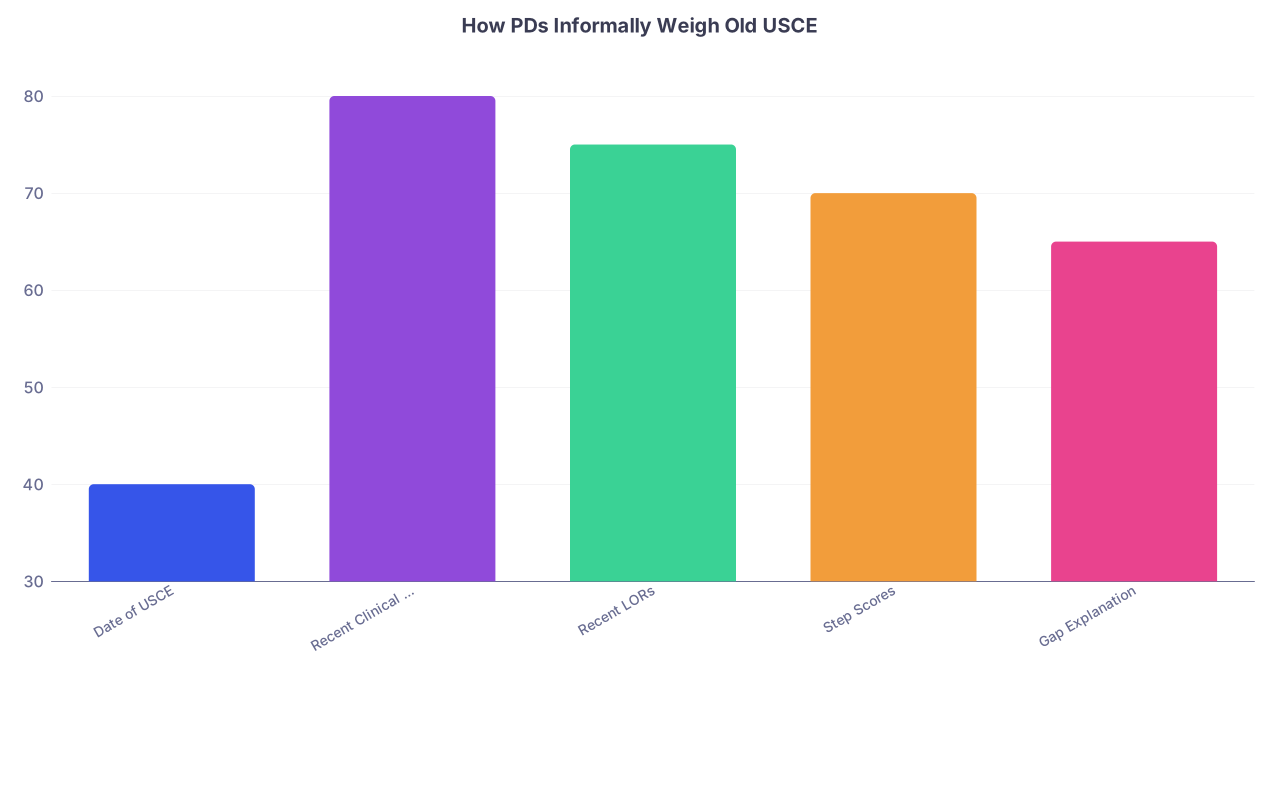
| Category | Value |
|---|---|
| Date of USCE | 40 |
| Recent Clinical Activity | 80 |
| Recent LORs | 75 |
| Step Scores | 70 |
| Gap Explanation | 65 |
How “Old” Is Actually “Old” for US Clinical Experience?
Let me be blunt: there’s no magical universal cutoff. Different programs treat this differently, and nobody writes it clearly on their website.
But there are patterns.
| Age of Clinical Experience | How It’s Commonly Perceived |
|---|---|
| 0–1 years old | Ideal / fresh |
| 2–3 years old | Acceptable with context |
| 4–5 years old | Questioned but salvageable |
| 6+ years old | Needs a very strong story |
I’ve seen IMGs match with:
- USCE from 2017, matching in 2024
- A single 4-week observership from 2019 and otherwise only home-country work
- No “formal” USCE at all, but very strong recent home-country clinical and stellar letters
What they had in common wasn’t magic. It was:
- Clinical continuity (not disappearing completely)
- Evidence of growth (new exams, new roles, more responsibility)
- Personal statements that owned the timeline instead of hiding it
Your fear is: “My USCE is from 2019; I’m doomed.”
The actual question is: “What have I done from 2020–2026 that proves I’m sharper now than I was back then?”
The “Rusty Skills” Fear: What PDs Worry About vs What You’re Imagining
In your head, “rusty” means:
- They think you forgot how to take a history
- They think you don’t remember antibiotics
- They think you’re going to freeze in front of a patient and forget how to speak
That’s not really it.
Program directors worry about:
- You not being used to the pace of US hospitals
- You not being familiar with US documentation, EMR, notes, orders, handoffs
- You not understanding team structure, expectations, communication norms
- You struggling with recent guidelines and updated management
They’re not imagining you blanking on “what is COPD.” They’re imagining you being slow, inefficient, or needing a lot of hand-holding to adjust.
Good news: you can counter all of that without magically time-traveling to get newer USCE.
Here’s what helps:
- Recent anywhere-clinical work: hospital, clinic, telemedicine, even rural practice
- Courses or certificates in updated guidelines, ACLS/BLS renewal, etc.
- US-oriented online CME, webinars, virtual clerkships
- Recent Step 2 CK or OET/IELTS success showing your brain still works under pressure
You want your file to scream: “I’m active. I’m learning. I didn’t sit and rot for three years.”

| Step | Description |
|---|---|
| Step 1 | See USCE Date |
| Step 2 | Move on - No concern |
| Step 3 | Check Recent Clinical Work |
| Step 4 | Less worried about rust |
| Step 5 | Concern about readiness |
| Step 6 | Check Recent LORs |
| Step 7 | Someone vouches today |
| Step 8 | No current proof |
| Step 9 | May lower on rank or reject |
| Step 10 | Older than 3 years |
| Step 11 | Recent activity? |
| Step 12 | Recent letters? |
How to Make Old USCE Look Like a Strength Instead of Dead Weight
You can’t change the date. So stop trying to “hide” it and start reframing it.
1. Own the Story in Your Personal Statement
Bad version (what many people do):
- Never mention the big gap
- Just list achievements and hope no one notices
- Sound vague about recent years: “I was dedicated to personal growth and family responsibilities”
Good version:
- One clean, direct paragraph that answers:
- Why the gap exists
- How you stayed clinically or academically engaged
- What you learned and how you’re better now than you were back then
Example structure:
- “In 2019, I completed observerships at X and Y, which sparked my interest in [specialty].
- After returning to [country], I worked as [position] from 2020–2024, managing [types of patients].
- During this period, I took responsibility for [concrete tasks], completed [courses/exams], and maintained my clinical skills through [specific activities].
- These experiences have kept me clinically active and reinforced my desire to return to the US system to train in [specialty].”
Short. Honest. Not whiny. Not defensive.
2. Get Something Recent — Even If It’s Small
I know, you might be thinking:
“But I can’t just fly to the US for a month. Money. Visa. Time. It’s not that easy.”
I get it. So think in layers instead of all-or-nothing:
- Ideal: A fresh US externship, observership, or hands-on position
- If that’s impossible:
- Recent home-country hospital work with strong letters
- Online US-based clinical courses or tele-rotations
- Evidence of learning: CME, conferences, guidelines updates
Even a 2–4 week recent experience in some clinical setting looks better than just: “Last time I touched a patient was 2020.”
3. Make Your Letters Work Overtime
Big PD question: “Who has seen this person work recently?”
If all your strong letters are from 2019, red flag.
You want at least one — ideally two — letters from the last 12–18 months.
If they’re not US-based, that’s still much better than nothing. You want them to say things like:
- “Dr. X has maintained strong clinical reasoning and up-to-date knowledge.”
- “They manage complex patients independently while knowing when to escalate.”
- “They are ready to transition to residency-level responsibilities.”
That knocks straight into the “rusty skills” fear and pushes it down.

What If My Last Real Clinical Work Was Years Ago?
This is the nightmare scenario in your head:
“My last actual patient contact was, like, 4–5 years ago. I studied for exams, I worked non-clinical jobs, I helped family, but I wasn’t in a hospital.”
Here’s the hard truth:
Yes, that’s a problem.
No, it’s not necessarily a permanent death sentence, but you can’t “spin” your way out of it. You have to do something.
If you’re clinically inactive for years, PDs think:
- You’ll be overwhelmed stepping into an intern role
- You’ll take longer to get up to speed
- You might not actually like clinical work anymore
You fight that not with words, but with actions:
- Take some clinically adjacent role: assistant physician, clinic helper, telehealth, nursing home, anything supervised
- Enroll in skills refreshers: ACLS/BLS recertification, up-to-date life support, CME on guidelines
- Try to get at least one recent LOR that says: “I saw them work with patients.”
This might mean delaying your application cycle by a year to rebuild your story. Painful? Yes. But sometimes it’s actually smarter than burning money on a weak cycle.
How Old USCE Plays with Other Parts of Your Application
Old USCE doesn’t live in isolation. PDs look at patterns.
Imagine these combos:
| Profile Snapshot | How It Often Looks to PDs |
|---|---|
| Old USCE + high, recent Step 2 + recent home-country clinical | Risky but promising; skills likely not too rusty |
| Old USCE + low or old Steps + no recent clinical | Very concerning; likely no interview |
| Old USCE + strong recent research + recent LORs | Possible in academic programs, especially IM/Neuro |
| Old USCE + strong US mentor advocating | Can override age concerns at some places |
So if you’re panicking about the age of your USCE, zoom out.
What else in your file says: “I am current, teachable, and safe?”
- Recent Step 2 or Step 3? Great.
- Recent clinical? Even better.
- Recent LORs? Critical.
Your job is to build a coherent narrative where the old USCE is just the starting point of a long, continuous arc, not a lonely island in 2019 with nothing after it.
FAQ: Old USCE and “Rusty Skills” Anxiety
Is US clinical experience from 4–5 years ago basically useless now?
No, it’s not useless. But on its own, it doesn’t carry the weight it did when it was fresh. Instead of thinking “useless,” think “needs support.” You need something recent — exams, clinical work, updated letters — to prove you’re not the same person you were 5 years ago, you’re a better version.Will programs reject me automatically because my USCE is old?
Some very competitive programs probably will quietly filter you out, especially if you also have older exams or no recent clinical work. Many community and mid-tier academic programs won’t auto-reject purely based on date. They’ll look at the full picture: recency of clinical work anywhere, exam timeline, and letters. Your goal is to make sure everything else is as current and strong as you can make it.Should I skip applying this year and only apply after I get new USCE?
If your last real clinical contact was >3–4 years ago and you have no recent LORs, honestly, it might be smarter to spend a year rebuilding: get clinical exposure (even home-country), update exams, and secure new letters. If, however, you’ve been clinically active at home and just lack US-recent experience, you may still be competitive for some programs this year while you try to pick up even a short new observership or tele-rotation.Do home-country clinical jobs actually help with the “rusty skills” concern?
Yes. PDs care way more about whether you’ve been seeing patients than whether every single experience was in the US. A current hospitalist job in your home country with a strong letter looks much better than being completely non-clinical for two years but having one old US observership. Obviously USCE is ideal, but continuous patient care anywhere beats nothing.How do I talk about my old USCE in interviews without sounding defensive?
Be straightforward and forward-looking. Example: “My US observerships were in 2019 at X and Y, where I first learned the structure of US inpatient teams. Since then, I’ve been working in [current role], managing [types of patients], and keeping up with guidelines through [CME, courses, etc.]. I feel more prepared now than I did then, and I’m excited to bring that experience into residency.” Short, calm, no oversharing, no panic.
Open your CV or ERAS right now and write a single, honest, three-sentence explanation of what you’ve done clinically since your last USCE. If you can’t do that confidently, that’s your signal: don’t just worry your skills look rusty — start doing one concrete thing this month to sharpen them.


