

If Your US Clinical Experience Was Cut Short Unexpectedly—Next Steps
Your attending suddenly ended the rotation. The visa start date got pushed. The hospital canceled your observership halfway through. Now what do you actually put on your ERAS application—and how do you keep this from hurting your Match chances?
Let’s walk through exactly what to do if your US clinical experience (USCE) was cut short, canceled, or blown up in some other annoying way.
I’m going to assume:
- You’re an IMG (or FMG)
- You’re in or near an application cycle
- You’re worried this looks bad, and you’re not wrong to worry
You can still come out of this okay—but only if you move fast and handle the story correctly.
Step 1: Get Clear on What Actually Happened (And Get It in Writing)
Do this before you do anything else.
You need a clean, concrete explanation that:
- Is fact-based
- Is short
- Does not make you look unprofessional or unstable
Common situations I’ve seen:
- Site lost funding or changed policy on observers
- Attending left the institution or went on unexpected leave
- Hospital changed rules about IMGs / externs / observers
- Visa delays cut your planned 3 months down to 2 or 1
- COVID or other institutional “safety” policy changes
- Administrative screw-up with onboarding, credentialing, or EMR access
If you do not have an email or message documenting the reason, politely ask.
Something like:
Dear Dr. Smith,
Thank you again for the opportunity to observe in your clinic. I understand the service is no longer able to host visiting observers starting this month. For my records and to accurately reflect this in my residency applications, would you be able to confirm that my observership ended early due to the department policy change and not due to any performance concerns on my part?
I am very grateful for the time I did spend on your service.
Sincerely,
[Your Name]
You want:
- Confirmation the early end was not performance-related
- A clear external reason you can reference later
Save that email. Screenshot it. Back it up. If anyone ever questions you, that’s your safety net.
Step 2: Decide How to List It on ERAS
You have to answer three questions:
- Do you list this at all?
- If yes, how do you list the dates?
- How do you describe it so it doesn’t look like you were kicked out?
1. Do you list it?
General rule:
If you completed at least 2 full weeks and actually did something meaningful (saw patients, attended rounds, had teaching):
→ Yes, list it.If you did only a few days and barely got oriented, no real exposure, no responsibilities:
→ Usually do not list it. It reads as filler and raises questions.If you were supposed to do 3 months but ended up with 1 solid month:
→ List it as 1 month. That’s still real clinical experience.
Programs care more about:
- Total months of USCE
- Strength of your engagement
- Quality of letters
Not whether you originally intended it to be longer.
2. How to list the dates
Do not fake dates. Ever. Programs can and do verify.
List the actual dates:
- Start: when you actually started seeing or observing patients
- End: last day you participated
Example ERAS entry:
- Experience type: Clinical – Observership
- Organization: ABC Internal Medicine Associates
- Location: Brooklyn, NY
- Start date: 06/2024
- End date: 07/2024
- Description: (we’ll cover this in a second)
If you were scheduled June–September but only did June–July, you still only put June–July. ERAS is not asking what was planned. It’s asking what actually happened.
3. How to describe it
You don’t need to turn your experience section into a trauma confession.
Focus on:
- What you DID
- What you LEARNED
- One short line acknowledging the shorter duration (only if it’s unusually short or likely to be asked about)
Example description for a 4-week rotation that was meant to be 8–12 weeks:
Completed a 4-week outpatient internal medicine observership in a high-volume primary care clinic. Observed patient encounters, participated in case discussions, and presented literature reviews on hypertension and diabetes management. Planned extension of rotation was canceled due to institutional changes in visiting observer policy.
That’s it. No drama. No self-blame. Clear reason. External cause.
If it was a 2–3 week experience (very short), I’d add a similar line:
This was a 3-week experience limited by new departmental restrictions on visiting observers.
Better that you say it once, clearly, than leave everyone guessing.
Step 3: Salvage a Letter of Recommendation (If Possible)
Even a short rotation can yield a decent letter if you handled yourself well.
But you must be realistic:
A 1–2 week observership letter is weaker than a 4–12 week one. Program directors know how long it takes to really know someone.
Still, some letter is often better than none, especially from US-based faculty.
Approach the attending like this:
Dear Dr. Smith,
Although my time on your service was shorter than anticipated, I found it extremely valuable. I learned a lot from observing your approach to complex internal medicine patients and appreciated your feedback on my case presentations and literature reviews.
I am applying to internal medicine residency this fall. If you feel you know my clinical skills and professionalism well enough, would you be willing to write a letter of recommendation commenting on the time we did work together? I understand the rotation was limited in length and completely respect your decision either way.
Thank you again for the opportunity.
Best regards,
[Your Name]
Key points:
- Acknowledge the short duration (shows insight and honesty)
- Emphasize what you did
- Give them an out if they don’t feel comfortable
If they say yes, help them:
- Share your CV
- Share your personal statement
- Send a bullet-point list of specific patient encounters or tasks you handled
- Remind them of any feedback they gave you that could be included
You are not “manipulating” them. You’re jogging their memory. They’re busy.
Step 4: Fill the Gap Fast – Replace, Don’t Just Explain
Programs are much more forgiving of a canceled or short USCE if they see that:
- You responded by finding alternatives
- You’re not just sitting at home re-watching UWorld explanations
Your priority: new, concrete clinical involvement—US if possible, but structured home-country work is better than nothing.
Here’s a simple comparison of what helps most:
| Option | Strength for Match |
|---|---|
| New supervised US hands-on externship | Very strong |
| New US observership with active teaching | Strong |
| Tele-rotations with US programs | Moderate |
| Home-country supervised clinical work (recent) | Moderate |
| Purely online courses / CME only | Weak |
You want something you can point to on ERAS that says:
“I didn’t just lose this rotation and stop. I pivoted.”
Example actions you can take within 2–8 weeks:
- Book a 4-week US externship (yes, it’s expensive; yes, it might be necessary)
- Join a tele-rotation with a US faculty member who can observe your thinking and maybe write a letter
- Take on extra supervised clinical responsibilities at your home institution
- Start a small, focused quality improvement project or case series tied to that specialty
Then you can write in your personal statement or interviews:
One of my planned US rotations was cut short when the hospital abruptly ended its observer program. I used that unexpected gap to obtain a new supervised experience at [X clinic] and to complete a tele-rotation in [Y specialty], where I was able to [specific things].
That kind of pivot looks mature and resilient.
Step 5: Decide Where (and Whether) to Explain It Explicitly
You have four possible places to address the shortened experience:
- Experience description (we already did that briefly)
- Personal statement
- Supplemental application / meaningful experiences section
- Interview answers
You do not need to explain it fully in every place. That looks defensive.
When to use the personal statement
Use it if:
- This was your only USCE that got cut short
- Or you have a pattern of interrupted experiences that might worry people
Then you might write 2–3 sentences, not a paragraph.
Example:
My first planned US clinical rotation was unexpectedly cut short after four weeks due to an institutional decision to discontinue visiting observers. While disappointing, this pushed me to quickly secure a new supervised externship at [Program/Clinic Name], where I was able to continue adapting to the US healthcare system and solidify my interest in [specialty].
Calm. Responsible. Forward-looking.
If you have plenty of other solid USCE and this is just one shortened experience, I’d skip it in the personal statement. No need to magnify it.
Step 6: Know Exactly What to Say in Interviews
You will likely get something like:
- “I see you had only one month at [Hospital X]. What happened there?”
- “You mentioned a canceled rotation in your application—can you tell me more?”
Your response needs three elements:
- Brief explanation
- Clear statement that it was not due to performance
- How you responded constructively
Example answer:
That rotation was originally scheduled as a three-month observership, but after my first month the department decided to stop hosting visiting observers because of changes in their policy. It was disappointing, but I did receive positive feedback on my professionalism and engagement while I was there, and I stayed in touch with my attending. I then arranged a new rotation at [other site], which ultimately gave me more hands-on exposure and confirmed that internal medicine in the US is the right path for me.
If the truth is something like COVID restrictions, visa delay, or institutional restructuring, say that directly.
What you do not do:
- Blame individuals by name
- Sound bitter or victimized
- Over-explain timelines and immigration paperwork so they get lost
Keep it clean.
Step 7: Protect Yourself Against the “Red Flag” Assumption
Every time something is “cut short,” some program will wonder if:
- You were unprofessional
- You had complaints filed
- You weren’t showing up
- There was misconduct
That’s just reality.
So you need to build a counter-narrative using other evidence:
- Strong letters of recommendation from uninterrupted rotations
- Consistent clinical engagement with no long unexplained gaps
- Clear, specific examples of professionalism, teamwork, and reliability in your experiences section and interviews
If you have at least one US faculty letter that says something like:
“Dr. [Name] was punctual, professional, and well-prepared every day on our service…”
That single sentence does more to kill suspicion than any long explanation from you.
If you’re really worried programs may contact the site that cut you short, you can pre-emptively ask your prior attending:
I understand the rotation ended due to institutional reasons. If residency programs contact the clinic to verify my experience, would you be comfortable confirming that there were no performance concerns during the time I was there?
Again, get that in writing if possible.
Step 8: Adjust Your Overall Application Strategy
A shortened USCE usually means one or more of these is also true:
- Fewer US letters
- Fewer months of USCE than planned
- Less “recent” US experience
So you compensate strategically.
If you have ≤ 1 month of USCE total
You should:
- Apply more broadly and heavily to:
- Community programs
- University-affiliated community programs
- IMG-friendly programs with historical acceptance of limited USCE
- Be realistic about highly competitive university programs; many want 2–3+ months of USCE and stronger letters
If you have 2–3 months total but one was shortened
You’re in better shape. Focus on:
- Highlighting the stronger, uninterrupted experiences more heavily
- Using the short one as “extra” rather than your main pillar
If your USCE is older (2+ years ago) and this recent one was cut
Then prioritize:
- Any way to get recent clinical involvement, even if outside the US
- Tele-rotations or structured remote work with US programs
- Emphasizing ongoing clinical work in your home country to show you’re not clinically rusty
Here is a simple way to visualize priorities if your USCE was disrupted:
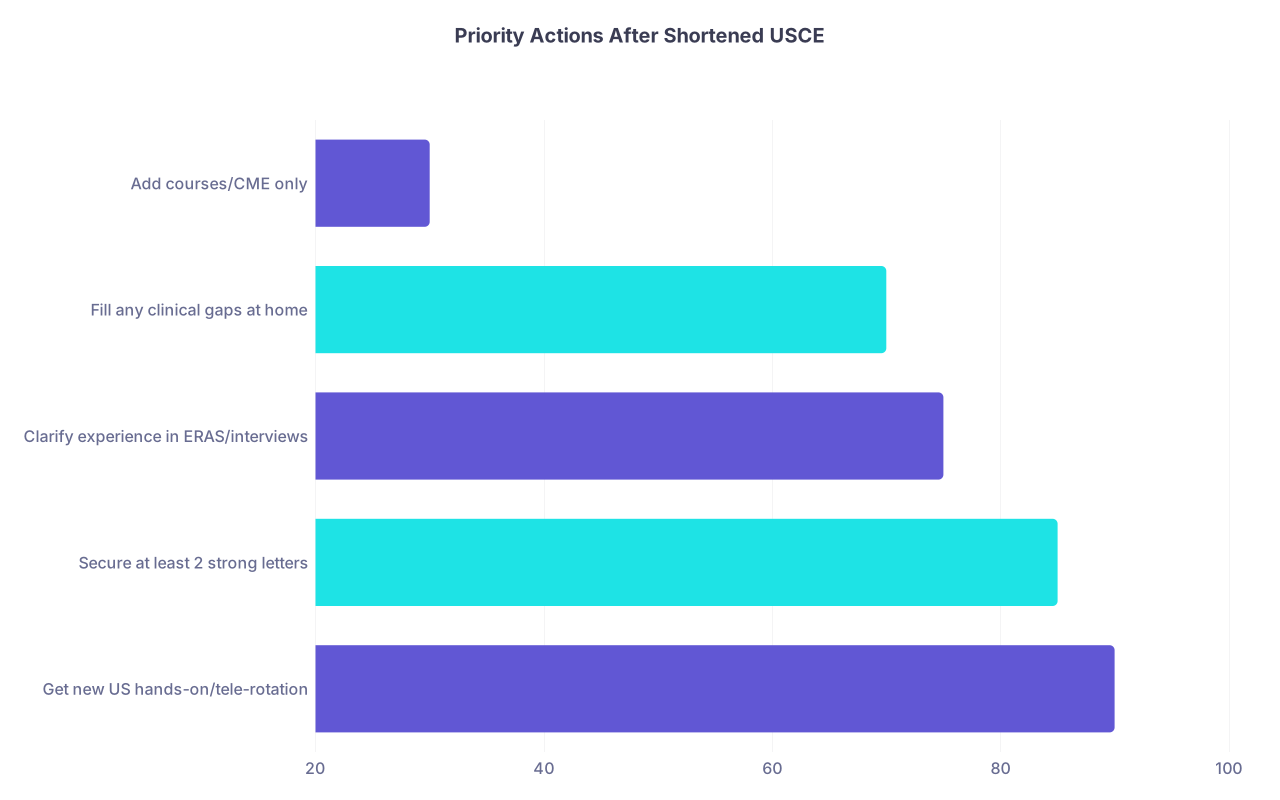
| Category | Value |
|---|---|
| Get new US hands-on/tele-rotation | 90 |
| Secure at least 2 strong letters | 85 |
| Clarify experience in ERAS/interviews | 75 |
| Fill any clinical gaps at home | 70 |
| Add courses/CME only | 30 |
The point: replacing clinical time and securing letters matters more than obsessing over the lost weeks.
Step 9: Clean Up the Story So It’s Consistent Everywhere
By the time you’re done, four things must align:
- Dates in ERAS
- Descriptions in ERAS
- What any letter writers might say if contacted
- What you say in your personal statement / interviews
If one place says “2 months” and another looks like “1 month,” or your letter vaguely implies a longer relationship than dates suggest, it can look sloppy or dishonest.
Before you submit:
- Re-read each experience entry
- Re-read your personal statement
- Check any email where attendings discussed your role/dates
- Make sure the same basic story appears everywhere
If something changed after you submitted (e.g., a site closed, your extension got canceled after you already listed the plan), that’s different. In that case:
Update during interviews:
“At the time of submission I expected to continue through December, but the institution later stopped accepting observers, so my time ended in October.”If the change is big and affects many programs, you can mention it in future communication, but don’t panic-modify everything mid-cycle unless a program explicitly asks.
Step 10: Emotionally, Don’t Let This Derail You
I’ve seen this specific thing wreck people’s confidence more than it should.
You planned this rotation for months. You paid for housing. You felt like you finally got a chance in the US system. And then—email from GME: “We are discontinuing the program…”
Frustrating? Yes. A fatal blow to your application? Usually not.
Programs care more about:
- Total application strength
- Step scores / OET / ECFMG status
- Pattern of professionalism and growth
- Clinical readiness
A single shortened rotation is a small variable in that equation.
Your job is to:
- Tell the truth briefly
- Show you adapted
- Prove your value through what you did next
Not to relive the cancellation in every paragraph of your application.
Two Things to Remember
One shortened or canceled US clinical experience is not the end of your Match chances unless you let it define your story. List it honestly, explain it briefly, and move on to what you did next.
The strongest response is action: secure alternative clinical work, salvage a letter if you can, and make sure the rest of your application screams reliability and maturity so no one assumes the worst from one disrupted rotation.


