
It’s 11:47 p.m. You’re scrolling through your ERAS application for the twentieth time, trying to calm your brain before interview season. And then your stomach drops.
You stop on an “Experience.” Or a publication. Or a role you… let’s say “framed generously.” Maybe you bumped “volunteer” to “lead,” or stretched 4 months into “1 year,” or counted an “in preparation” case report that quietly died 18 months ago. Whatever it is, you suddenly know: this isn’t just positive framing. It’s misleading.
Now you’re asking the real question:
Did I just lie on my residency application? And if yes, what do I do now?
Let’s walk through this like an adult, not like a panicked M3 on Reddit. I’ll break it into concrete scenarios and very specific actions.
Step 1: Get Brutally Clear on What You Actually Did
Before you spiral, you need to classify the problem. Not all “padding” is created equal. Some is just sloppy wording. Some is truly dishonest. Programs treat them differently, and you should too.
Here’s a simple breakdown.
| Type of Padding | Severity | Example |
|---|---|---|
| Spin/Over-selling | Low | Saying “assisted with project development” when you just attended meetings |
| Exaggeration | Moderate | Listing 100+ hours of volunteering when you did 30–40 |
| Mislabeling role | Moderate–High | Calling yourself “co-author” on a paper where you only collected data and aren’t on the manuscript |
| Factual inaccuracy | High | Reporting a paper as “published” that was rejected and abandoned |
| Complete fabrication | Critical | Entirely made-up project, position, or award |
If you’re unsure where yours lands, do this quick test:
- Could another person (PI, faculty, coordinator) reasonably disagree with what you wrote?
- Could an interviewer ask a follow-up that you literally can’t answer without lying further?
- If your dean read that line out loud in front of you and your PD, would you feel sick?
If yes to any of those, you have a real problem, not a “creative phrasing” issue.
You cannot fix this if you keep lying to yourself about the severity. So be honest on paper: write down exactly what you wrote in ERAS, and then under it, write exactly what the truth is. No spin.
Step 2: Figure Out Where You Are in the Timeline
What you should do depends heavily on when you notice the padding.

| Step | Description |
|---|---|
| Step 1 | Notice padding on CV/ERAS |
| Step 2 | Before ERAS submission |
| Step 3 | After submission, before interviews |
| Step 4 | During interview season |
| Step 5 | After ranking/Match |
| Step 6 | Edit and correct directly |
| Step 7 | Correct via updates/communications |
| Step 8 | Address in interviews + updates |
| Step 9 | Consult dean/legal, consider disclosure |
| Step 10 | Stage of cycle? |
Scenario A: You Haven’t Submitted ERAS Yet
This is the easiest. Stop overthinking.
- Go back into every padded entry and correct it to be strictly true.
- Remove anything that’s fabricated or cannot be defended with documentation.
- Change “published” to “submitted,” “in revision,” or “unpublished project” — and only if that’s true.
- Fix hours, titles, and roles to match reality.
If an advisor told you “everyone rounds up a little,” understand this: programs don’t throw people out for modest, honest applications. They absolutely will for dishonesty if it surfaces.
If you correct it before submission, you’re done. Learn from the impulse and move on.
Scenario B: You Already Submitted ERAS, No Interviews Yet
Now we’re in cleanup mode.
You can’t change the submitted ERAS, but you can change what programs eventually see or hear.
Your options:
Correct it in future versions of your CV
If you upload an updated CV (for emails, away rotations, or program updates), that document must be clean. No padding. No fiction.Use an ERAS update (if allowed) or direct email to programs
If the error is significant (fabricated article, wrong role, wildly exaggerated leadership), you should consider sending a brief correction. Yes, that’s uncomfortable. It’s still better than being caught.Template you can adapt:
Subject: Application Update and Clarification – [Your Name, AAMC ID]
Dear Program Director and Selection Committee,
I am writing to provide a clarification regarding my ERAS application. In the [Experience/Publication/Research] section, I listed [briefly identify the item, e.g., “a manuscript titled X as ‘published’”].
On review, I realized this description is inaccurate. The correct status is [e.g., “unpublished project that was submitted but not accepted” / “abstract accepted but manuscript not submitted” / “I participated as a volunteer, not as a formal coordinator”].
I apologize for the error and want to ensure your program has an accurate representation of my experiences.
Sincerely,
[Name, AAMC ID]You don’t write a full confession letter. You correct the record succinctly and move on.
Talk to your dean’s office before sending mass corrections
Especially if the misrepresentation is big. They’ve seen this before. They can help you craft language that is honest but not career-suicide.
Scenario C: You’re Getting / Attending Interviews
This is where it gets tricky, but also where people overreact out of guilt.
Crucial distinction:
There’s a difference between:
- an outright fabricated position/publication, and
- a slightly overblown description that’s directionally true but overstated.
For each padded item, ask:
- Can I give a detailed, concrete account of what I did if asked?
- Would my description, spoken out loud, basically match what a supervisor would say?
If the answer is “no” or “absolutely not,” then:
Prepare an honest, non-dramatic correction for interviews
Example:
- “I noticed after submitting ERAS that I’d initially listed that project as ‘published.’ It was actually submitted but ultimately not accepted. My current CV reflects that.”
- “I originally put ‘lead coordinator’ for that clinic. Realistically, I should have called myself a regular volunteer who occasionally helped organize sessions. That was my mistake.”
You do not need to start interviews with a monologue of repentance. But if they ask, you answer straight.
Update your CV before interviews
If you send programs an updated CV or bring one to interviews, fix everything. Don’t keep propagating the padded version.
If the padding is egregious (fabricated role/publication)
Then you have to decide: proactively disclose, or wait and react?
My stance: if there’s a clear, documentable lie (fictional publication, fake job, fake leadership), you should strongly consider contacting programs and your dean’s office. Because if it comes out later, you’re done. And I’ve seen residencies terminate people for this.
Step 3: Understand How Bad the Consequences Can Be
You’re not just worrying about “will they think less of me.” You should be worrying about:
- Being ranked lower or not at all if they sense dishonesty
- Being reported back to your school
- Match violations investigation in extreme cases
- Contract termination if discovered post-Match or as a resident
Here’s the ugly reality laid out:
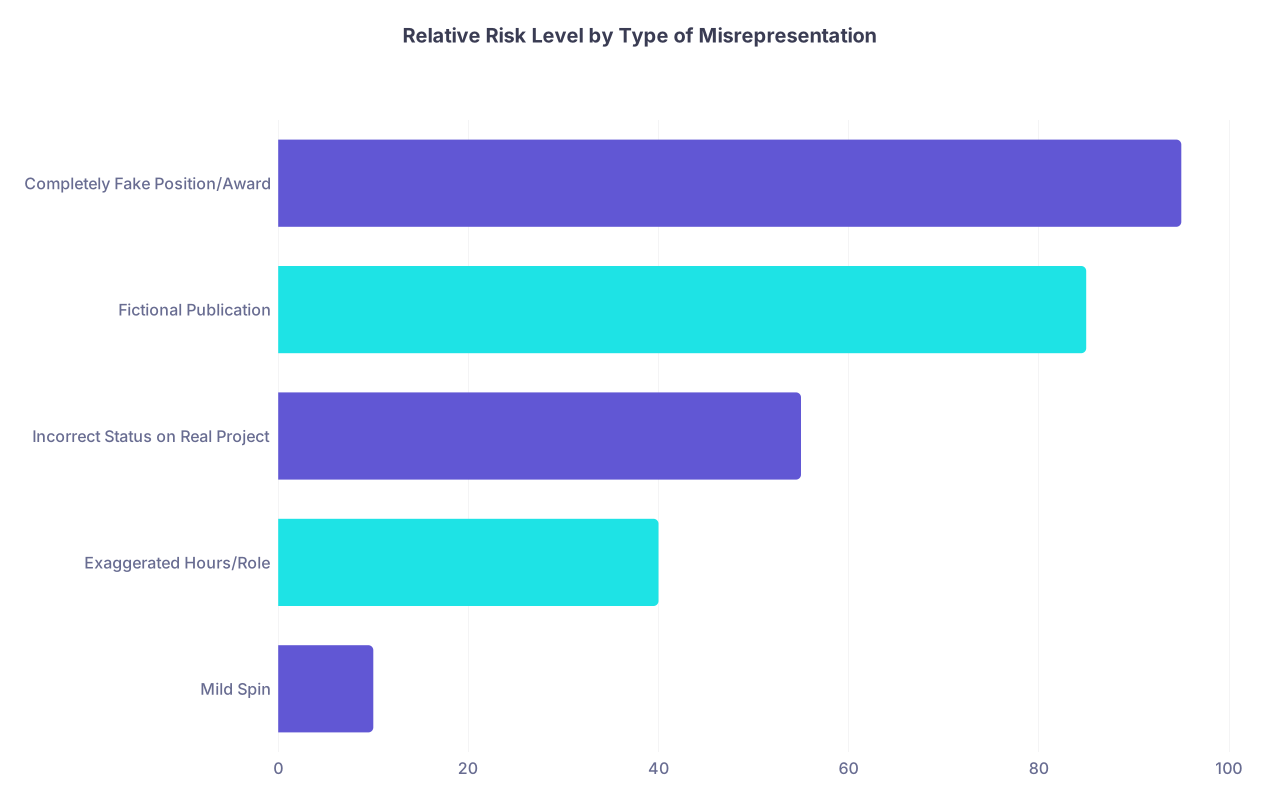
| Category | Value |
|---|---|
| Mild Spin | 10 |
| Exaggerated Hours/Role | 40 |
| Incorrect Status on Real Project | 55 |
| Fictional Publication | 85 |
| Completely Fake Position/Award | 95 |
Those numbers aren’t from a formal study; they’re a realistic sense of how often I’ve seen each type lead to real trouble.
Mild spin rarely blows up. Pure fabrication eventually does. Someone catches it. A co-applicant asks your “PI” about you. A PD emails your school. A co-resident looks up your “JAMA paper” and finds nothing.
If you’re in the top two categories (mild spin, minor exaggeration), the correction is mostly about your own integrity and being ready to speak accurately. If you’re in the bottom two (fiction or near-fiction), you need to treat this like an ethical emergency.
Step 4: How to Actually Fix Specific Types of Padding
Let’s get practical.
1. “Published” vs “Submitted” vs “Nothing Happened”
Misrepresentation: You marked a paper as “published” or “accepted” when it’s not.
What to do:
If ERAS not submitted: fix the status precisely.
If already submitted:
Change all future CVs to show correct status.
In interviews, be very clear:
“That manuscript was ultimately not accepted; my ERAS status was incorrect, and I’ve corrected it on my current CV.”
If truly nothing ever happened with the project, list it as “Research experience” with a description, not as a publication.
2. Inflated Hours or Duration
Misrepresentation: You said 300 hours of free clinic when you did maybe 60.
Here’s the thing: programs don’t care if it’s 60 vs 80 vs 120 nearly as much as they care that you’re honest.
What to do:
On your updated CV, list a range or approximate but truthful number.
If asked:
“I realized after submission that my hours estimate was too high. I went back, checked my actual schedule and emails, and a more accurate range is 50–75 hours over that year.”
That answer shows maturity and corrective effort.
3. Title Inflation (“Coordinator,” “Lead,” “Director”)
Misrepresentation: You upgraded “volunteer” to a leadership title you were never officially given.
Fix:
On updated CVs: change to the formal role. Volunteer, tutor, committee member, etc.
If asked:
“Looking back, I overstated my role by using ‘coordinator.’ I was a regular volunteer who sometimes helped organize sessions, but I didn’t hold a formal leadership title.”
Programs can live with a corrected ego trip. They care that you’re able to own it.
4. Ghost Publications or Fake Projects
Misrepresentation: You listed a paper, abstract, or project that does not exist. Or you claimed co-authorship with no real involvement.
This is the danger zone.
Here’s what you do if you’re serious about salvaging your career:
Immediately stop repeating the lie
Fix every future document. Do not double down.Talk to your dean’s office or advisor you trust
Spell it out:- Exactly what you claimed
- What the reality is
- Whether anyone else can corroborate or contradict you
Decide if you will disclose pro-actively to programs
If the fictional thing is central to your application (e.g., “first-author RCT in NEJM” that doesn’t exist), and you matched heavily based on that, it may be safer, ethically and practically, to own it before Match or even consider withdrawing.
Brutal? Yes. But I’ve seen people lose entire careers because they let one big lie ride.
Step 5: If You’ve Already Matched or Started Residency
This is the worst timing but also the most important ethically.
You matched. Or you’re already an intern. And only now you realize, “My application wasn’t clean.”
Three main paths:
Minor spin only, no outright lies
Fix your CV going forward. Drop the inflation. Don’t repeat the error. If no one is harmed and nothing is fabricated, I wouldn’t go dig this up with your PD just to self-flagellate. But make sure your future self isn’t still selling the old version.Significant but not central misrepresentation
Example: you exaggerated your role in one research project, but everything else is accurate and your performance as a resident is solid.In this zone, I’d speak quietly with:
- A trusted faculty mentor, or
- The PD if you have a decent relationship and can be direct.
You do not need a melodramatic meeting. Just:
“There’s a thing on my ERAS I’ve been thinking a lot about. I overstated my role on X. I’ve corrected my CV and I want to be transparent about it rather than pretend it didn’t happen.”
Odds are they’ll respect the honesty and move on after a conversation.
Central fabricated experiences or publications
This is now a legal/contract issue as much as an ethical one.
Actions:
- Talk to your dean’s office first, even as a graduate. They may refer you to GME leadership or legal.
- Consider consulting legal counsel privately if the misrepresentation is severe.
- Know that the program may:
- Place you on remediation/probation
- Report to institutional leadership
- In extreme cases, terminate your contract
Does that mean you should stay quiet? I’d argue no. Because if someone else exposes it, you lose the only leverage you had: self-initiated correction and evidence you understand the seriousness.
Step 6: How to Talk About This Without Digging a Deeper Hole
You’ll be tempted to over-explain, over-apologize, or dramatize. Don’t.
When you address it (in writing or speaking), follow this structure:
Name the specific issue.
“I listed X as Y.” No vague “I may have slightly misrepresented things.”State the correct version in one sentence.
“In reality, the manuscript was submitted but never accepted.”Take responsibility, but don’t self-immolate.
“That was my mistake. I should have verified before listing it that way.”Show what you’ve done to correct it.
“I’ve updated my current CV and will describe the experience accurately moving forward.”
That’s it. No essay on your childhood, no crying in the PD’s office, no blaming “advisors” who said everyone pads.
Step 7: How to Not Repeat This in Future Applications
You will apply again. Fellowships. Jobs. Faculty positions. The pattern matters.
Here’s a simple rule set I actually recommend people print and stick above their desk during application season:

- If you’d be embarrassed to explain it line-by-line to your PD and your PI in the same room, don’t write it that way.
- If you can’t produce some form of proof (email, draft, schedule) that the experience happened as described, rewrite it more conservatively.
- If the status of a project is uncertain, describe it as uncertain. “Unpublished project,” “data collection completed,” “manuscript in progress if still true.”
- If you’re guessing hours, estimate low, not high.
- Review your application with one no-nonsense person (not your best friend) and give them permission to say, “This sounds like BS.”
You do not need a “maxed-out” ERAS to match. You do need a reputation for being trustworthy, because programs are betting 3–7 years of patient care and team function on you.
Quick Visual: When You Must Absolutely Take Action
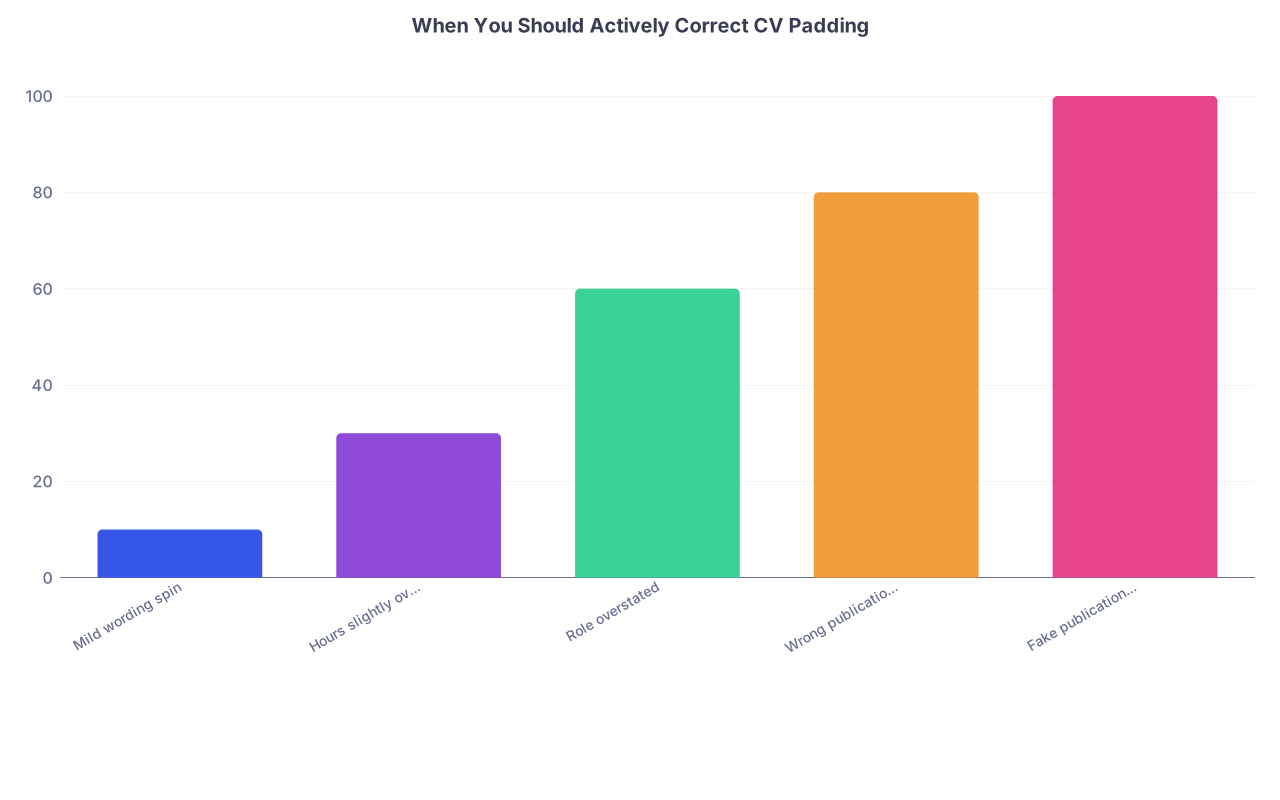
| Category | Value |
|---|---|
| Mild wording spin | 10 |
| Hours slightly overestimated | 30 |
| Role overstated | 60 |
| Wrong publication status | 80 |
| Fake publication/position | 100 |
- Under ~30: correct quietly on future CVs, be honest if asked.
- 60–80: consider proactive clarification, especially pre-interview.
- 100: you fix it, disclose if needed, and accept there may be fallout.
FAQ – Exactly 5 Questions
1. Will programs actually check if my publications and experiences are real?
Sometimes yes, sometimes no. But you should act like they will. Faculty google things. PDs email PIs. Co-applicants mention your name in passing. The more impressive or central an item is (especially first-author pubs, major leadership roles, awards), the more likely someone casually verifies it. You don’t want to be the story that gets told at the next selection committee meeting as “the applicant who invented a paper.”
2. If I correct a mistake after submitting ERAS, will that automatically tank my chances?
No, not automatically. A brief, factual correction usually lands much better than silence followed by discovery. Many PDs will read, think “ok, they fixed it,” and move on—especially for honest mistakes or moderate exaggerations. What really tanks people is a pattern of dishonesty or a single egregious fabrication that looks deliberate.
3. What if my “padding” was encouraged by an advisor who told me it was normal?
You’re still the one signing your name. “My advisor said it was fine” will not protect you if it blows up. That said, if you were genuinely misled, you can absolutely mention that to your dean or PD when you’re correcting things—but as context, not as an excuse. Going forward, default to the most conservative, strictly-true wording you can defend.
4. Should I bring this up in every interview even if they don’t ask?
Usually no. If the issue is moderate (hours, title inflation, status confusion) and you’ve corrected it on your CV, I’d answer honestly if asked, but I wouldn’t start each interview with a confession speech. If the misrepresentation is serious and central (fake publication, fake role), talk with your dean first about whether proactive disclosure in some form makes sense.
5. Is this a career-ender, or can I recover from padding my CV?
Most of the time, you can recover—if you stop compounding the problem. Correct the record where you can. Be scrupulously honest in every future document. Own it if questioned, without dramatics. I’ve seen people who made poor choices on a first ERAS cycle go on to be excellent residents because they recognized the line they crossed and never went near it again. The real career-ender is refusing to learn from it and letting dishonesty become your default.
Bottom line, in three points:
- Figure out exactly what you did—spin, exaggeration, or full fabrication—and stop lying to yourself about it.
- Correct what you can, as soon as you can, in a calm, factual way; don’t wait for someone else to expose it.
- Treat this as a hard boundary lesson: your future applications and CVs must be boringly accurate, even if that means looking a little less impressive on paper.