Two weeks after your MS2 spring finals, you’re still waking up at 3 a.m. replaying the grades in your head. That anatomy shelf you barely passed. The remediation you had to explain to your advisor. The unspoken “Are you okay?” looks from classmates who suddenly pulled ahead.
Now you’re staring at specialty competitiveness charts, seeing words like “plastic surgery,” “dermatology,” “orthopedics,” “ENT,” and you’re thinking: “Did I just nuke my chances before I even hit the wards?”
Let me be blunt: you can come back from a rough MS1–MS2 and still match into a competitive specialty. I’ve watched people do it. But it’s not automatic, and it’s not “just work hard and it’ll be fine.” There’s a pattern to who actually makes it from “rocky pre-clinical” to “competitive match,” and who just keeps spiraling and gives up.
You’re here because you’re afraid you’re in that first group. Or worse, the second. So let’s talk about what’s actually salvageable, what isn’t, and what you need to do starting now.
First: How Bad Was “Bad”?
Here’s the part nobody wants to say out loud: not all “rough MS1–MS2” stories are equal.
There’s a difference between:
- A couple of low passes and one remediation
vs. - Multiple course failures, professionalism issues, and a Step 2 CK barely passing
You need a reality check, not vague reassurance.
Let’s roughly map where you might fall.
| Situation | Competitiveness Outlook |
|---|---|
| Mostly passes, 1–2 low grades, no repeats | Very recoverable |
| 1 course remediation, average shelves | Recoverable with strong clinical years |
| Multiple repeats, academic probation once | Possible but uphill, needs a standout story |
| Repeated year, multiple failures, professionalism issues | Tough; competitive specialties unlikely |
| Major professionalism violation | Severely limiting; focus may need to shift specialties |
If your “rough MS1–MS2” is mostly: “I didn’t honor, I’m not at the top of my class, I had one bad block”… that’s not doom. That’s basically half the class.
If it’s: “I failed two courses and had to remediate, but now I’m back on track”… that’s serious but still salvageable, if the rest of your record becomes rock solid.
If you had:
- Repeated year
- Ongoing professionalism issues
- Major unexplained gaps
Then yeah, matching into derm or plastics is honestly a long shot. Could it happen in some fluke scenario? Maybe. But I wouldn’t build your entire future on that 1% outcome.
But if you’re in the “some failures/remediation/mediocre pre-clinical record” group? That’s the territory this article is really about. Because that’s where you still have leverage.
What Competitive Programs Actually Care About (Beyond the Panic)
You’re probably obsessing over the wrong things. Programs don’t just stare at your MS1 transcript like it’s a death sentence.
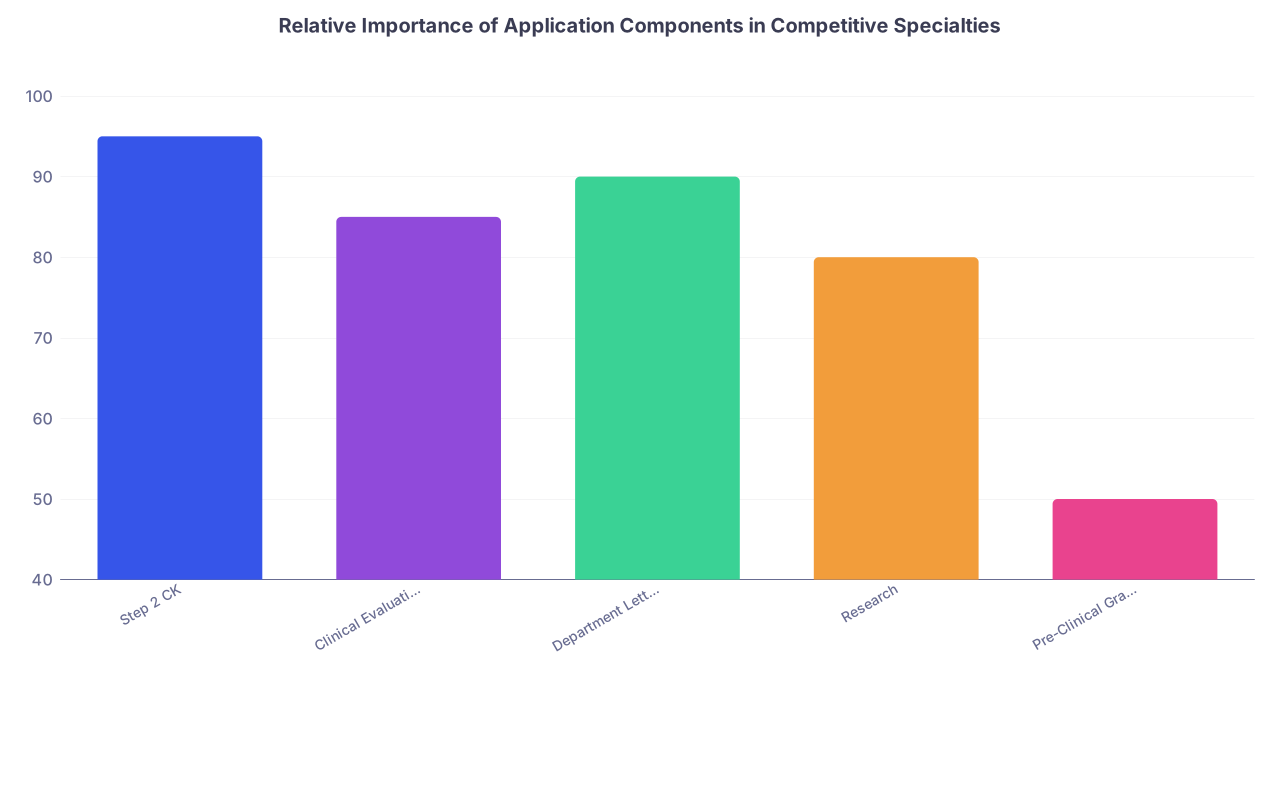
For competitive fields (ortho, derm, ENT, plastics, neurosurgery, etc.), here’s what consistently moves the needle more than “you weren’t a star MS1”:
| Category | Value |
|---|---|
| Step 2 CK | 95 |
| Clinical Evaluations | 85 |
| Department Letters | 90 |
| Research | 80 |
| Pre-Clinical Grades | 50 |
Yes, this is approximate. No, it’s not perfectly scientific. But it’s directionally right.
Programs care a lot about:
- Step 2 CK (since Step 1 went pass/fail)
- MS3 clinical grades and narrative comments
- Letters from people they trust (especially in their specialty)
- Whether you look like you actually want their field, not just prestige
- Research, especially in academic or hyper-competitive programs
Pre-clinical grades? They matter, but not as much as you think—unless you never recovered.
The story that kills you is:
- Weak pre-clinical
- Mediocre/bad clinical
- No clear upward trajectory
- No one strongly vouching for you
The story that competitive programs will still entertain:
- Rough MS1–MS2
- Clear turning point
- Strong MS3 performance
- Step 2 CK that proves you’re not your early grades
- Well-known faculty saying, “Trust me, this student is the real deal now”
Your job is to make that second story true.
Can You Still Aim for a Competitive Specialty?
Here’s the question that sits like a rock in your stomach: “Can I still go for ortho/derm/whatever… or do I need to give up now?”
Let’s separate fantasy from plausible comeback.
| Specialty Type | Rough MS1–MS2 + Strong Recovery | Chances |
|---|---|---|
| Hyper-competitive (Derm, Plastics, Ortho, ENT, Neurosurg) | Needs near-flawless MS3+, high Step 2 CK, strong connections | Possible but tight |
| Moderately competitive (EM, Anesthesia, Radiology, GI track through IM) | Very realistic with strong turnaround | Good |
| Less competitive (FM, Psych, Peds, IM community-focused) | Rough MS1–MS2 rarely fatal | Very good |
For the hyper-competitive ones, the bar after a rough start is high:
- Step 2 CK well above average for that field
- Honors (or equivalent) in core rotations
- At least one seriously strong home department letter
- Evidence you’re now consistent, reliable, not a chronic struggler
Does that mean you can’t get in if you’re not perfect? No. But the margin for error shrinks. You don’t get the luxury of coasting or “figuring it out later.”
And honestly? Some people realize halfway through this process that what they thought was “I love ortho” was actually “I like the idea of being an ortho surgeon.” Which is not the same thing.
You might discover:
- You like EM because you hate clinic follow-ups
- You love IM subspecialties because you like puzzles
- You’re happier in fields where one rough semester isn’t dissected under a microscope
That’s not “settling.” That’s adjusting your plan based on real data: your performance, your stress tolerance, your actual day-to-day happiness, not your ego.
The MS1–MS2 Recovery Blueprint: What Actually Changes Your Trajectory
You’re probably thinking, “Okay, but how do I prove I’m not the same student who tanked those early exams?”
Huge hint: the narrative they care about is trajectory. Not perfection.
Here’s what that looks like in reality:
1. Make MS3 Your Redemption Arc
MS3 is where programs stop guessing and start seeing who you really are on the wards.
You need:
- Strong evaluations that repeatedly say versions of: “Hardworking, prepared, improved quickly, great with patients, reliable.”
- Shelf scores that aren’t garbage anymore. Ideally at or above your school’s average.
- At least a couple of honors (if your school gives them), especially in rotations linked to your target specialty.
This is not about impressing everyone. It is about not giving anyone a reason to doubt your turnaround.
2. Step 2 CK Becomes Your Proof-of-Concept
Pre-clinical grades were rough? Fine. Then Step 2 CK has to say, loudly: “I get the material now.”
Rough guideline:
- Competitive specialties often like Step 2 scores significantly above national average for matched applicants in that field.
- If your early grades were bad, you don’t want a barely passing CK. You want a number that makes them pause and go, “Huh. Okay. This person figured it out.”
So your mindset for Step 2 CK prep can’t be:
- “I just need to pass.”
It has to be: - “I need a score that rewrites how people view my academic ability.”
That’s a heavy lift. It’s also doable. I’ve watched students jump 20–30 points beyond what anyone predicted based on their early performance—but only when they took it brutally seriously.

The “Rough Start” Narrative: How You Explain It (Without Sounding Like Excuses)
Program directors don’t want your tragic backstory. They want to know: if they take you, will you handle residency or collapse under pressure?
So when you talk about your rough MS1–MS2, your story has to sound like growth, not damage control.
Bad narrative:
- “I had personal issues and the curriculum was hard, but I’ve always wanted derm and I worked really hard.”
That sounds vague and excuse-y. Everyone “worked really hard.” So what?
Better narrative:
- “During my early pre-clinical years, I struggled with time management and overcommitting outside of coursework, which led to [specific outcome—e.g., one remediation]. After that semester, I changed how I studied—using active questions, getting earlier help from faculty, and reducing outside commitments. Since then, I’ve had [consistent passes/honors, strong clinical evaluations, solid Step 2]. The experience made me much more disciplined, and my attendings now consistently describe me as prepared and reliable.”
See the difference? Same rough start. Completely different implication.
You’re answering three unspoken PD questions:
- Did you figure out what went wrong?
- Did you do something specific to fix it?
- Is there evidence that fix actually worked?
If your story can check all three boxes, your MS1–MS2 mess becomes a character development chapter, not the whole book.
Where Specialty Competitiveness Hits You Hardest (And Where It Doesn’t)
You’re probably seeing charts with “# of applications,” “Step scores,” and scaring yourself to death.
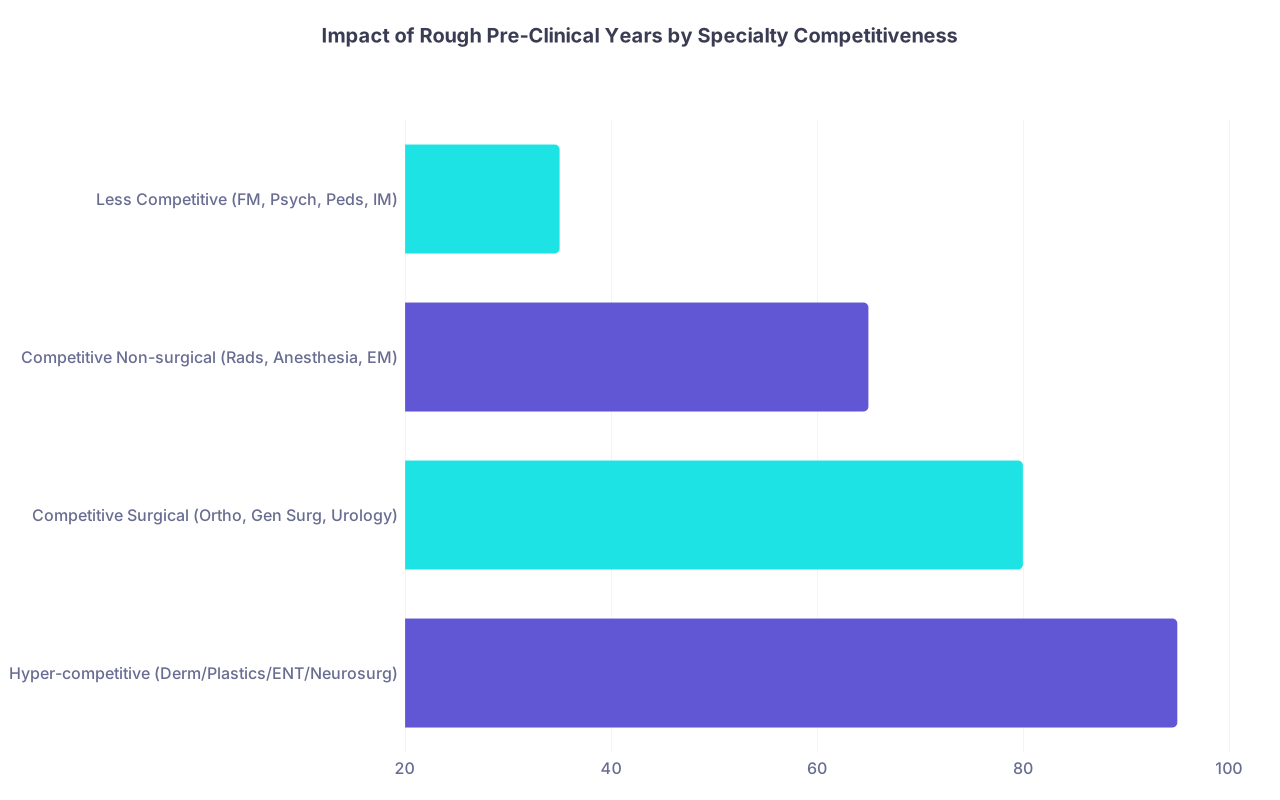
Let’s simplify how your rough start intersects with different specialties.
| Category | Value |
|---|---|
| Hyper-competitive (Derm/Plastics/ENT/Neurosurg) | 95 |
| Competitive Surgical (Ortho, Gen Surg, Urology) | 80 |
| Competitive Non-surgical (Rads, Anesthesia, EM) | 65 |
| Less Competitive (FM, Psych, Peds, IM) | 35 |
Higher number = more your past will be scrutinized and held against you unless you’ve clearly outgrown it.
Hyper-competitive:
- Every weakness matters
- You need people in that specialty to personally advocate for you
- You can’t just be “okay” clinically—you need to stand out
Competitive surgical:
- They’ll care a lot about work ethic, team fit, willingness to grind
- If your pre-clinical story is “I was immature but then I got serious and now I crush rotations,” they might respect that
Competitive non-surgical:
- Step 2 CK and letters matter a lot
- A rough MS1–MS2 is a smaller problem if everything after that is strong
Less competitive:
- One bad year rarely sinks you
- Being solid, reliable, and a good human being often matters more than being a perfect test-taker
So yes—the more competitive the field, the more your rough start is a liability. But your trajectory and current performance always matter more than a single bad year.
What You Should Do Right Now (Not Next Month)
This is the part where people usually procrastinate, then panic six months later.
Don’t.
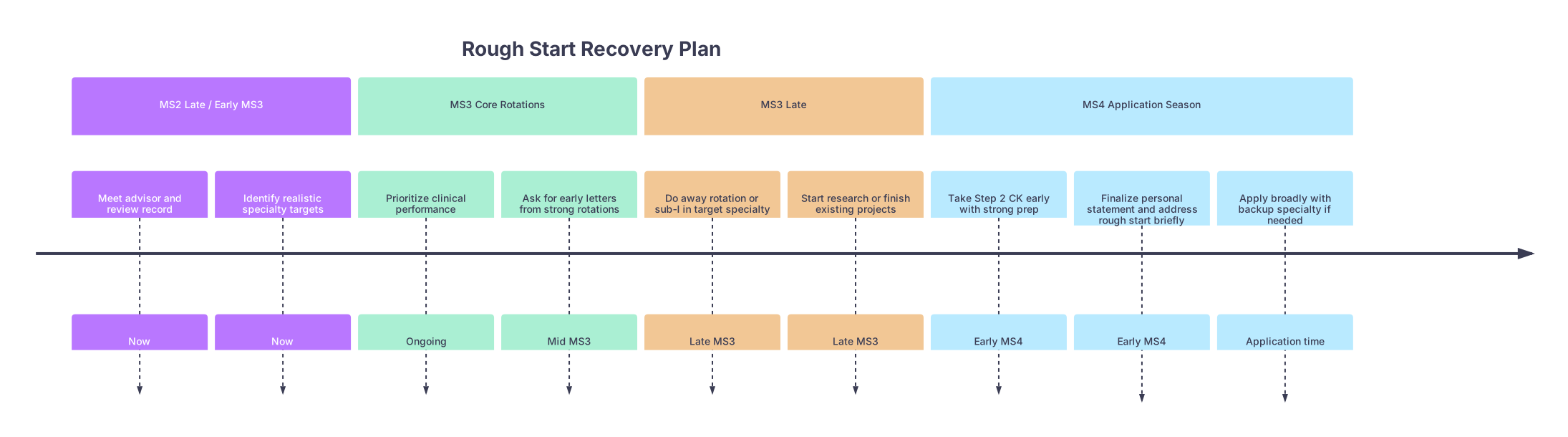
Here’s how I’d triage if I were in your shoes:
1. Get a Brutally Honest Read From Someone Who Knows
Not your class group chat. Not Reddit.
A real person who:
- Sits on your school’s promotions or residency advising committee
- Or a trusted specialty advisor in the field you’re thinking about
Ask them explicitly:
- “With my record so far, and assuming I significantly improve from MS3 onward, which specialties are realistically still on the table for me?”
- “If I want to aim for [X field], what would I need to achieve going forward (Step 2 CK range, rotations, research) to be taken seriously?”
Then don’t argue with the answer. Use it as data.
2. Decide on Two Tracks: Dream + Safe
Not “derm or bust.” That’s how you end up unmatched and wrecked.
Think:
- Track A: The competitive field you’re still reasonably aiming for
- Track B: A solid backup field you can genuinely see yourself tolerating (or even liking)
Then act like both are real. Not as a last-minute scramble.
| Period | Event |
|---|---|
| MS2 Late / Early MS3 - Meet advisor and review record | Now |
| MS2 Late / Early MS3 - Identify realistic specialty targets | Now |
| MS3 Core Rotations - Prioritize clinical performance | Ongoing |
| MS3 Core Rotations - Ask for early letters from strong rotations | Mid MS3 |
| MS3 Late - Do away rotation or sub-I in target specialty | Late MS3 |
| MS3 Late - Start research or finish existing projects | Late MS3 |
| MS4 Application Season - Take Step 2 CK early with strong prep | Early MS4 |
| MS4 Application Season - Finalize personal statement and address rough start briefly | Early MS4 |
| MS4 Application Season - Apply broadly with backup specialty if needed | Application time |
3. Treat Every Clinical Rotation Like an Audition
You don’t have the luxury of a “throwaway” rotation.
What I’ve seen from successful “comeback stories”:
- They pre-read on every patient the night before
- They show up early, leave late (without being performative about it)
- They ask: “Is there anything I can do better?” and then actually change
- Their interns start saying, “Oh yeah, I’d want you on my team again.”
Your goal isn’t to impress every attending. It’s to leave a breadcrumb trail of people who’d say, “Yeah, that student turned it around.”

4. Fix the Underlying Problem, Not Just the Optics
Harsh truth: if you barely limped through MS1–MS2 because of untreated ADHD, depression, test anxiety, or terrible study habits—and you don’t fix those—you will drag the same issues into Step 2 and residency.
Nobody says this enough.
If any of this sounds uncomfortably familiar:
- Chronic procrastination non-stop
- Panic attacks before exams
- Zero focus without crisis-level pressure
- Studying for 8 hours and remembering nothing
Then part of your “competitiveness plan” has to be:
- Getting evaluated for learning differences or mental health issues
- Actually using accommodations if you qualify
- Completely changing how you study (question-based, spaced repetition, active recall—not just passive reading)
This is not about being “weak.” It’s about not pretending you can brute-force your way through a broken system using a brain that’s on fire.
So… Can You Still Match Well After a Rough Start?
Yes. Many people do.
People who:
- Had to remediate but then honored their key MS3 rotations
- Started with mediocre scores and ended up with a strong Step 2 CK
- Wrote a clean, honest, non-dramatic explanation of their early struggles
- Collected a few powerful letters that said, “This student is not their first-year transcript”
And no, it’s not guaranteed. You can do everything right and still not match your dream subspecialty at your dream institution.
But here’s something I wish someone had told me earlier:
Years from now, you won’t judge your career by whether you erased every early mistake. You’ll judge it by whether you actually built a life you can stand living—day after day, call night after call night.
So don’t just ask, “Can my rough MS1–MS2 still lead to a competitive match?”
Ask: “Can I use this rough start to become the kind of physician who learns from failure, adapts, and still shows up for patients anyway?”
Because that version of you? Programs will take a chance on them a lot more often than you think.

And weirdly, the day you realize your worth as a future doctor isn’t defined by those first two years—that’s the day this whole mess stops feeling like a permanent stain and starts feeling like just one hard chapter in a much longer story.