What if you’re…just okay on paper, but the only things that excite you are the most competitive specialties?
Welcome to the nightmare loop: you love derm or ortho, but every time you look at match stats, you feel like you’re basically signing up to lose.
Let’s walk through this without sugarcoating it—but also without the fatalistic “your life is over if you’re not a 260 + AOA + 12 papers” nonsense.
First: What Does “Average” Actually Mean?
This is where the panic usually starts. You see “average matched applicant” stats for derm/ortho and think: I’m dead.
For context, here’s roughly what we’re talking about (numbers vary slightly year to year):
| Category | Dermatology (Matched US MD) | Orthopedics (Matched US MD) | Many Worried Students |
|---|---|---|---|
| Step 2 CK | ~255+ | ~250+ | 230–245 |
| Research items | 10–20+ | 5–15 | 0–5 |
| Class rank | Often top quartile | Often top half+ | Middle of the pack |
| AOA | Common | Helpful but not required | Usually not |
Now pair that with something ugly:
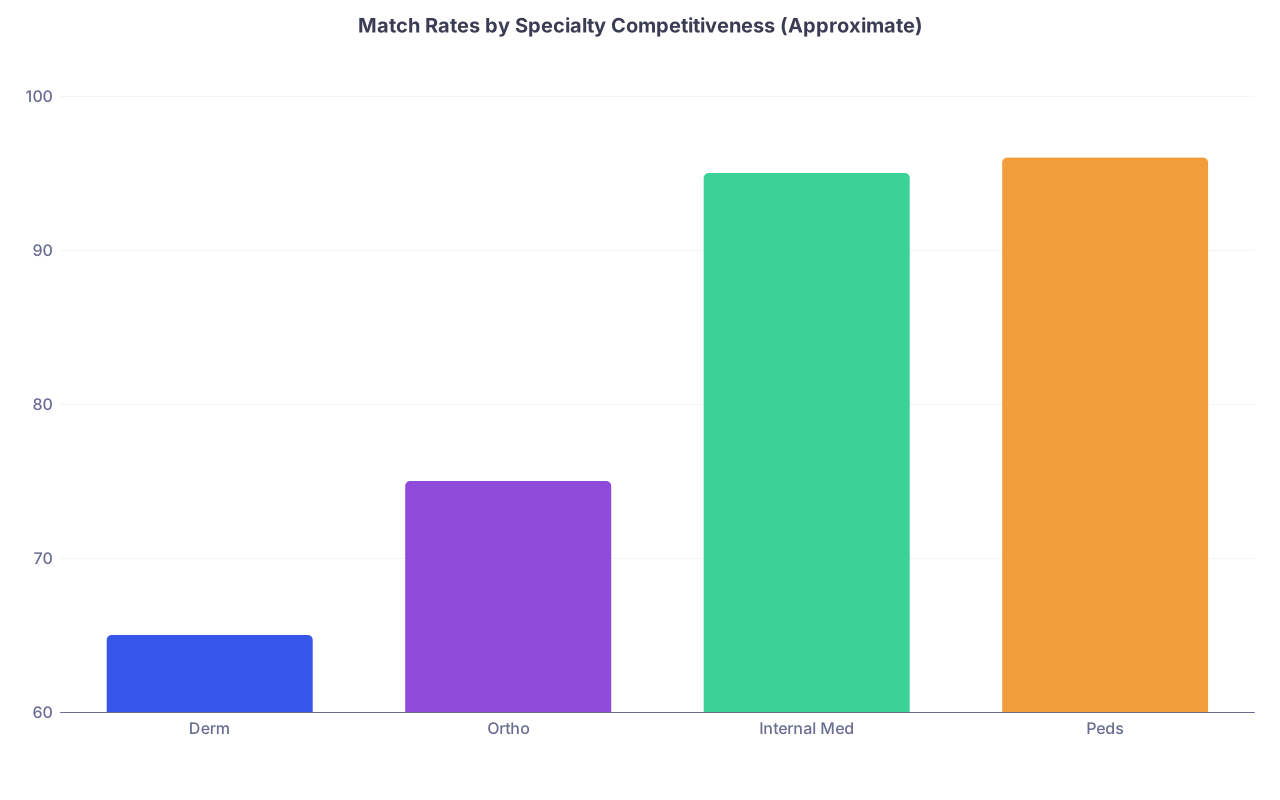
| Category | Value |
|---|---|
| Derm | 65 |
| Ortho | 75 |
| Internal Med | 95 |
| Peds | 96 |
Derm and ortho don’t just attract strong applicants. They attract people who’ve been building this story for years: early research, home-advantage departments that know them, mentors pushing for them.
So if by “average” you mean:
- Step 2 CK in the low 230s–240s
- No AOA
- A couple posters or maybe one publication, nothing derm/ortho-specific
- Mid-class rank
- From a mid-tier or lower-tier school, maybe with weak home specialty departments
Then yeah. On paper, you’re below the typical matched profile for derm and ortho.
But that’s not the same as “impossible.” It just means this: if you want derm or ortho, you don’t get to be casual about any part of your application. And you need to be brutally honest about risk.
How Bad Are the Odds Really?
Let me be straight: for a truly average US MD student with average scores, no strong research, and no big connections, derm and ortho are long-shot plays.
Not zero. But not in the “if I work hard it’ll definitely happen” category either.
Where people get messed up is this: they treat “hard but possible” as “definitely if I just believe.” That’s how you end up unmatched and scrambling.
There are three big levers that change your odds:
- How “average” you really are
- How late you started caring about this specialty
- How much risk you’re actually willing to take
If:
- Step 2 is 230–235
- No specialty-specific research
- No home derm/ortho department or weak one
- You decided you love derm/ortho at the end of M3
Then the honest truth: you’re trying to jump onto a moving train that left two years ago with everyone else already on board.
You can still sprint. But you’re chasing, not cruising.
The Harsh Reality vs The Real, Messy Middle
The online narrative goes like this:
- “If you don’t have a 260 and 20 pubs, forget derm.”
- “If you’re not AOA, ortho is closed”
That’s overblown. I’ve seen:
- Derm matches with 240s but stacked research, glowing LORs, and a very strong mentor going to bat
- Ortho matches with 240s where the applicant was insanely well-known by the home program and did multiple aways that loved them
But there’s always a hook. Something that compensates for being “average” on one axis.
Nobody average in every dimension waltzes into derm or ortho. That’s the brutal part people don’t admit.
If You’re Average and Still Want Derm/Ortho: What Has to Happen?
Let’s assume you’re not ready to give up the dream yet. OK. Then the question becomes:
What would it actually take to make this reasonable—not fantasy?
1. You need something you’re exceptional at
One of these has to be well above average:
- Research in the specialty (multiple abstracts, posters, ideally at least one publication with a known faculty member)
- Relationships / mentorship (a PD or big name who genuinely knows you and is willing to advocate)
- Clinical performance in that specialty (honors, insane letters from rotations, strong aways)
If all three are “fine” but not great? That’s how you end up in the unmatched spreadsheet.
2. You can’t miss on Step 2 CK
At this point, Step 2 is your last standardized measure. If you’ve got a mediocre Step 1 (or pass/fail with no halo of “this student is a rock star”), Step 2 is your shot to say: I can hang.
- Below ~240: dystopian for derm, shaky for ortho unless something else is stellar
- 240–250: you’re not out, but you need serious compensating strengths
- 250+: now you have at least one thing working strongly in your favor
I hate the score culture, but pretending it doesn’t matter for these two is delusional.
3. You need specialty-specific receipts
Generic research doesn’t move the needle the same way.
If you show up with:
- 3 posters in nephrology
- A random QI project in hospital medicine
- No derm/ortho anything
Programs will assume you picked this specialty kind of late or superficially.
Even 1–2 derm or ortho projects, especially with faculty who are known in the field, changes the story from “wandering” to “committed but late.”

Timing: When Are You Already in the Danger Zone?
A lot of people don’t realize they’re behind until it’s almost too late.
Here’s a rough mental map:
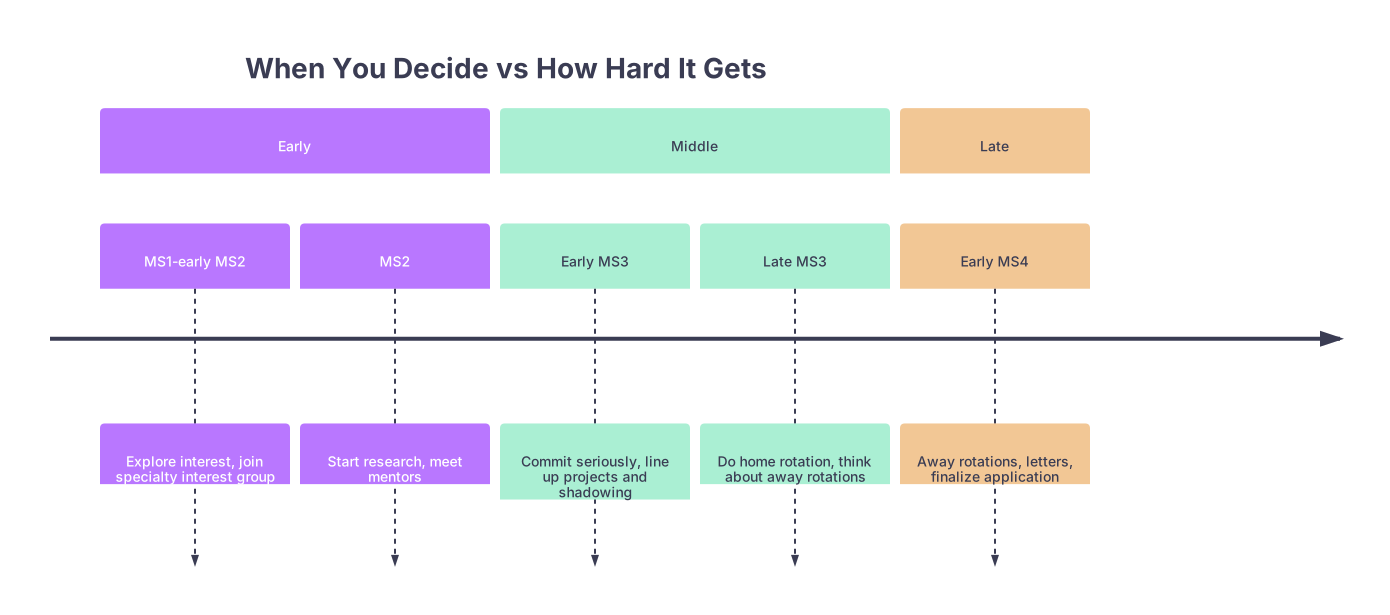
| Period | Event |
|---|---|
| Early - MS1-early MS2 | Explore interest, join specialty interest group |
| Early - MS2 | Start research, meet mentors |
| Middle - Early MS3 | Commit seriously, line up projects and shadowing |
| Middle - Late MS3 | Do home rotation, think about away rotations |
| Late - Early MS4 | Away rotations, letters, finalize application |
If you’re:
- End of MS3 and just realizing you might love derm or ortho
- With no specialty research and no mentor in the field
You’re in the “high-risk, all-in, scramble” territory.
Can something still be done? Yes. But you’re compressing work that others spread over 2–3 years into like 6–9 months.
And here’s the part no one likes to hear: sometimes, you can’t realistically catch up. That’s not a character flaw. That’s just how stacked the field is.
Backup Plans That Don’t Feel Like “Giving Up on Life”
The worst advice I see is binary thinking: either chase derm/ortho with no backup or give up completely and do something you’re meh about forever.
There’s a middle path, but it requires swallowing your pride and being strategic instead of romantic.
Here are three common pathways I’ve seen that aren’t doom:
Path 1: Dual-apply strategically
You apply to derm/ortho but also to a less competitive specialty you could be OK with long-term.
Common combos:
- Ortho + General Surgery
- Ortho + PM&R
- Derm + Internal Medicine (with plan for rheum, allergy, or hospitalist lifestyle)
- Derm + Family Medicine (with special interest in procedures, aesthetics later)
Is it emotionally brutal to prepare two personal statements and two sets of letters because you don’t fully trust yourself to match your dream? Yes. Feels like “I already think I’ll fail.”
But being “all in” and ending up unmatched is a lot more brutal. I’ve watched it wreck people for years.
Path 2: Play the long game with a transitional or prelim year
Some people:
- Do a prelim or transitional year
- Crush it clinically
- Add research, make stronger connections, then reapply derm/ortho
This is very program and person dependent. It’s not a guaranteed fix. But for some, that extra year is what makes them competitive enough.
The catch? You have to be psychologically OK with potentially doing that year and still not getting in. If just reading that makes your stomach flip, remember: that’s the actual risk profile.
Path 3: Pivot specialties but preserve the parts you love
Break down what you actually like about derm/ortho.
Is it:
- Procedures? (cuts, sutures, scopes, injections)
- Short visits and outpatient focus?
- Visual pattern recognition?
- Lifestyle and income?
There are alternatives that hit parts of that:
| What You Love | Derm Adjacent | Ortho Adjacent |
|---|---|---|
| Procedures | Derm → FM with procedures, EM | Ortho → PM&R, Sports Med |
| Outpatient | Derm → Allergy, Rheum | Ortho → Sports Med clinic-heavy |
| Visual/Pattern | Derm → Pathology, Rheum | Ortho → Radiology, PM&R MSK focus |
| Lifestyle | Derm → Allergy, Endo | Ortho → Anesthesia, PM&R |
Are these perfect replacements? No. If you love derm, FM won’t magically feel the same. But this isn’t all-or-nothing.
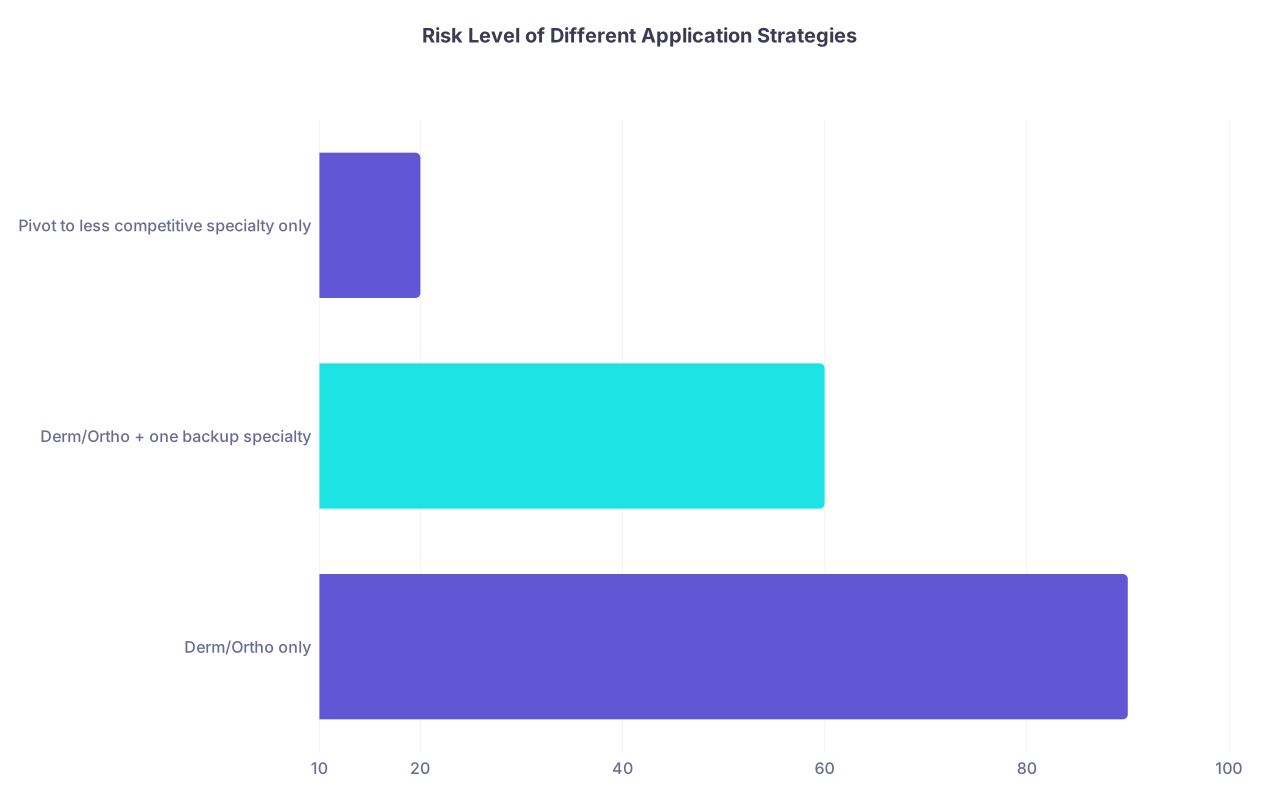
| Category | Value |
|---|---|
| Derm/Ortho only | 90 |
| Derm/Ortho + one backup specialty | 60 |
| Pivot to less competitive specialty only | 20 |
(Think of those numbers as “stress level / risk of being unmatched,” not exact percentages.)
The Emotional Spiral: “If I Don’t Match Derm/Ortho, I Wasted Everything”
This one’s vicious. Once you fall in love with a specialty, it feels like you’ve attached your entire worth to it.
The stories in your head sound like:
- “If I don’t match, everyone will know I wasn’t good enough.”
- “I’ll spend the rest of my career regretting this.”
- “My classmates will think I overreached.”
Here’s what actually happens in real life that no one posts on Reddit:
- People who dual-apply, match their “backup,” and 6 months into residency…are actually OK. Not thrilled the dream didn’t work, but not destroyed. Busy, learning, forming new identities.
- People who unmatched and had zero backup? They disappear for a while. Research years, SOAP dramas, endless anxiety. Some come back stronger. Some…don’t. It’s rough.
There’s one thing I’ve never seen: someone who matched their backup and was worse off than if they’d gone unmatched just to preserve pride.
You do not owe your 3rd-year self a life-long adherence to their fantasy section of UpToDate. You owe your future self a job, stability, and at least a decent shot at happiness.
What I’d Do If I Were You (Average, Dreaming Big, Not Delusional)
If I were sitting exactly where you are—mid-class, okay Step score, no flashy CV—but derm/ortho still lit me up, here’s the uncomfortable-but-honest plan:
Have a brutally honest talk with a real mentor in that specialty
Not a resident on Reddit. An attending or PD who’s seen dozens of match cycles. Ask them straight: “Given my stats and timeline, what are my realistic odds?” If they wince, that means something.If they say it’s not impossible, decide if you can tolerate a high-risk year
High risk means:- You might end up unmatched
- You might need to do research / prelim year
- You might end up in your backup anyway
If you go for it, you go all in and still dual-apply
- Do the research, the rotations, the letters
- Simultaneously build a strong application in a backup you can live with
This isn’t weakness. It’s actual adult risk management.
If they tell you the door is essentially closed
You’re allowed to grieve that. Really grieve it. Then get curious:- What exactly about derm/ortho made you excited?
- Which other fields overlap with those features?
And don’t do the thing where you sabotage those options out of spite because they’re not your original dream.
FAQ (Exactly 4 Questions)
1. My Step 2 is 235. Is derm or ortho automatically off the table?
Not automatically, but the bar for everything else becomes sky-high. You’d need very strong specialty-specific research, big-name mentors, and outstanding clinical performance and letters. For derm, 235 puts you at a serious disadvantage unless you have a truly exceptional story somewhere else. For ortho, it’s not game over, but you’ll be fighting uphill. You should at least strongly consider dual-applying.
2. Is it better to try for derm/ortho and risk being unmatched, or just pick a safer specialty now?
If we’re being honest: ending up unmatched is worse than matching a “less sexy” but still decent specialty. You can’t build a career on vibes alone—you need a residency position. If your mentors are telling you your odds are very low, it’s usually smarter to pick a more realistic field where you can be solidly competitive than to YOLO your entire future on “maybe I’ll be the exception.”
3. Will I regret it forever if I don’t at least try for my dream specialty?
Some people do regret not trying. But a lot of people who “tried” with no backup regret ending up unmatched more. The version of “trying” that makes the most sense is: pursue the dream in a structured way (research, rotations, mentors) while building a strong backup. That way you won’t look back and feel like you never gave yourself a shot, but you also won’t blow up your entire career if it doesn’t work.
4. Is it possible to switch into derm or ortho later if I match something else first?
It’s possible, but rare and difficult. People sometimes transition into derm or ortho from prelim years, research years, or even after starting another residency, but it usually requires strong research, powerful connections, and a lot of persistence. You should not count on this as your main plan. Think of it as a long-shot backup to your backup—not your primary strategy.
Key points:
- Being “average” and wanting derm/ortho isn’t stupid, but pretending the odds are normal is.
- Your best move is a mix of honest mentorship, realistic risk tolerance, and a serious backup you can live with.
- Matching something that respects your skills and keeps you employable will always beat romanticizing an unmatched fantasy.