
The idea that you can’t become competitive if you decide your specialty at the end of MS3 is garbage.
It’s not ideal. It’s not easy. But “too late”? That’s just something people say when they’re scared or when they only see the golden-path applicants who knew they wanted ortho at age 12.
You and I both know what this really feels like.
You’re halfway through clerkships, drowning in notes, and suddenly you realize:
“Oh no. I actually like ___… and I haven’t done anything for it.”
Fill in the blank: derm, ortho, EM, rads, anesthesia, psych, gen surg, whatever.
And then the spiral starts:
- “Everyone else in this specialty has 5 pubs already.”
- “I haven’t even joined the interest group.”
- “I’ll never get a good letter. It’s already over.”
Let me walk through what’s actually true here—by specialty competitiveness, by timeline, and by what you can still salvage if you only decide at the end of MS3.
Because you’re not as doomed as your 2 a.m. brain thinks you are. But you can absolutely screw this up if you don’t move fast and strategically.
The Hard Truth: Timing Matters… but Not How You Think
You’re not late on some spiritual “figuring out my life” timeline. You’re late on logistics.
Residency planning is annoyingly front-loaded. Programs want:
- Strong Step 2 / Level 2 scores
- Specialty-specific letters
- Some kind of signal you didn’t pick this field last Tuesday
If you decide at the end of MS3, you’re crunched on:
- Time for aways
- Time for research
- Time for meaningful mentorship
- Time for audition rotations in that specialty before ERAS locks
But here’s the trick: you don’t need everything. You need enough checkboxes that your story is believable and your app doesn’t scream “panic pivot.”
Let’s talk specialties, because that’s what’s really haunting you.
Which Specialties Punish Late Deciders the Most?
Some specialties are more forgiving if you show up late but focused. Others… not so much.
| Specialty | Late-Decider Friendly? | Main Fixable Weakness Late | Main Hard-to-Fix Weakness |
|---|---|---|---|
| Internal Med | Very | Letters, Step 2 | Super-elite research |
| Family Med | Very | Clinical narrative | None major |
| Psych | High | LORs, interest story | Niche research |
| Gen Surg | Moderate | Letters, aways | Early research/mentors |
| EM | Moderate | SLOEs, aways | Long-term EM exposure |
| Ortho/Derm/Plast | Low | Step 2, away performance | Years of research/network |
That table is brutally simplified, but you get the idea.
Least forgiving: the ultra-competitive fields
I’m not going to sugarcoat this. If at the end of MS3 you suddenly decide:
- Dermatology
- Plastic surgery
- Orthopedic surgery
- ENT
- Neurosurgery
…and you have:
- Average board scores
- Zero research
- No existing relationships in the field
Then yes, that’s a problem. Not “impossible,” but you are not playing on easy mode.
These fields often expect:
- Multiple research projects (often started MS1–2)
- Strong specialty letters from big names
- Aways at key programs
- Solid Step 2 (especially in the Step 1 pass/fail era)
Can you still jump in late? Yes, but:
- You’ll probably need a research year or
- A less competitive backup specialty or
- A very geographically broad, realistic list
If someone tells you: “No, you’re 100% doomed, don’t even try,” that’s lazy advice. But if someone says: “You can totally match derm from scratch starting late MS3 with no research,” that’s lying.
Moderately forgiving: surgery, EM, rads, anesthesia
These are in the “doable but you need to move now” category:
- General surgery
- EM
- Radiology
- Anesthesiology
- OB/GYN
If you decide end of MS3:
- You can still get strong specialty letters if you arrange rotations fast
- You can still do an away or two (EM especially lives on SLOEs)
- You might squeeze in small projects, QI, case reports
The big risk here is running out of calendar. ERAS doesn’t care that you realized your passion in June. Letters, aways, and Step 2 all collide in this awful bottleneck.
Most forgiving: IM, FM, peds, psych, neurology, PM&R
If you’re leaning:
- Internal medicine
- Family medicine
- Pediatrics
- Psychiatry
- Neurology
- PM&R
You’re in much safer territory as a late decider.
These fields:
- Don’t usually require long research histories
- Care a lot about fit, letters, and consistent interest
- Are used to people discovering them later in MS3
You still benefit massively from being intentional, but you’re not stepping onto a battlefield where everyone else has a tank and you’re holding a spoon.
The Calendar Reality: What “End of MS3” Actually Means
Let’s pin down what “end of MS3” usually looks like.
ERAS opens for editing around June.
Applications can be submitted mid-September (timeline shifts slightly each year).
If by “end of MS3” you mean:
- Early April–May: you’ve got a small window but it’s workable
- June–July: you’re in sprint mode, but still not dead
- August: you’re in “hail Mary / maybe delay a year” territory
Here’s what late deciders panic about and what’s actually possible.
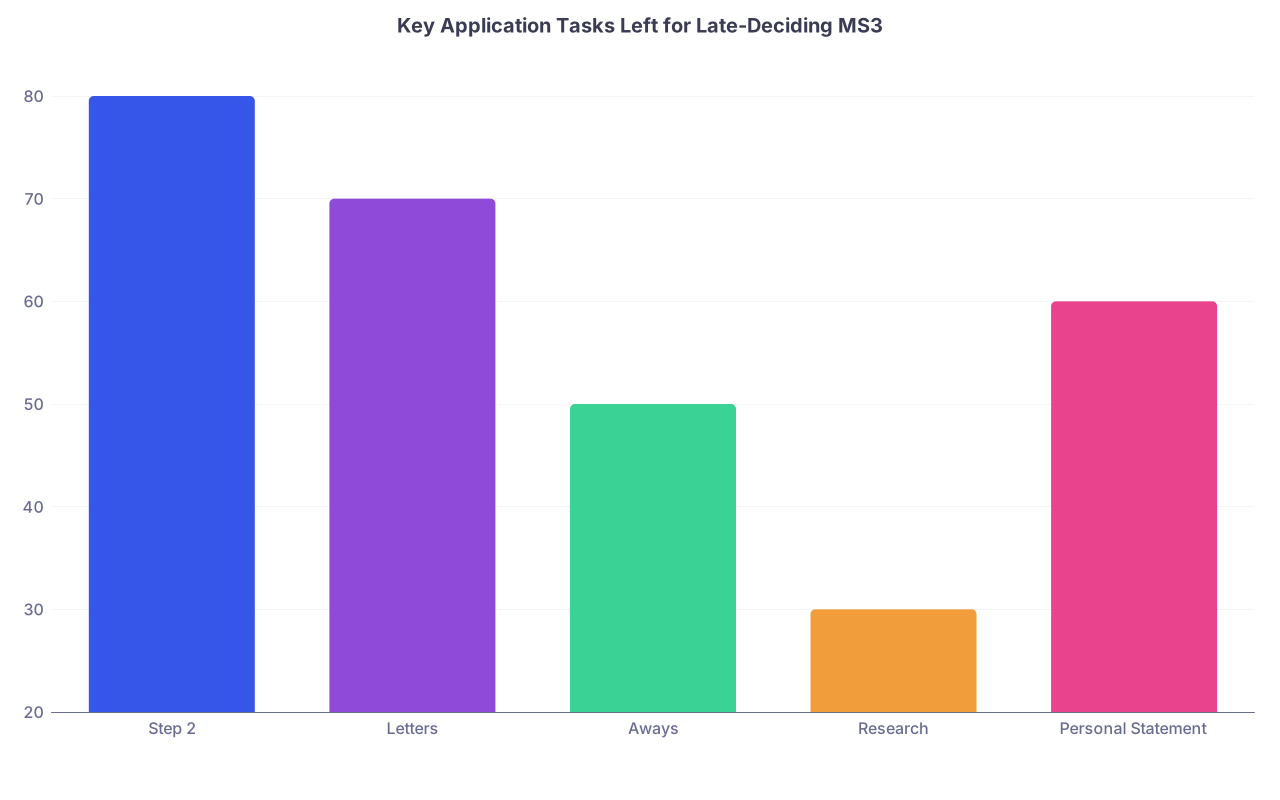
| Category | Value |
|---|---|
| Step 2 | 80 |
| Letters | 70 |
| Aways | 50 |
| Research | 30 |
| Personal Statement | 60 |
(I’m assigning percentages as “how much control you still realistically have” if you wake up at the end of MS3.)
- Step 2: you can still crush this with a dedicated block. Programs lean harder on Step 2 now.
- Letters: you can still get very strong ones if you choose rotations strategically and tell attendings your plans.
- Aways: some will be full, some will have waitlists. EM/surg especially can be tight.
- Research: full original projects are unlikely; small stuff is still very doable.
- Personal statement: completely under your control, and most people leave it to the last second anyway.
You’re late. You’re not powerless.
What You Can Still Do — By Competitiveness Level
Let’s walk through some concrete scenarios. Because I promise you’re thinking like this:
“I’m end of MS3, 240/245-ish Step 2 equivalent, mid-tier school, minimal research, and I just realized I want _____. Do I even have a shot?”
If you’re targeting a highly competitive specialty
Example: You realize in May you want derm or ortho. You have:
- Step 1 pass, no crazy red flags
- No significant research in that field
- No specialty mentors
Your realistic paths:
Fast-track mentorship and exposure.
You go directly to:- The specialty program director
- Any faculty even remotely connected to you
And say (out loud, not in your head):
“I know I’m deciding late. I’m serious about this field. What can I still do in the next 6–12 months to build a credible application?”
You need honesty. Not coddling.
Brace for the “consider a research year” talk.
If they say: “You really should do a research year if you want to be competitive,”
that’s not them crushing your dreams. That’s them telling you the unwritten rules.You then choose:
- Yes: delay graduation or take a formal research year, stack pubs, get embedded in the department
- No: apply anyway, but also apply to a more forgiving backup you could be happy in
Small wins still matter.
Even if you do a research year:- Case reports
- Retrospective chart reviews
- QI projects
- Presentations at regional/national meetings
These are all still on the table if you start now. You’re not rewriting your whole CV in 4 months, but you can make it a lot less empty.
If you’re dead-set on an ultra-competitive field and absolutely refuse a research year or backup, you’re gambling hard. People match like that sometimes. People also don’t. And they end up reapplying or switching fields later.
If you’re targeting a moderately competitive specialty
Example: You realize you want EM in May.
You’re behind on:
- SLOEs from EM rotations
- EM-specific mentorship
- Aways planning
The fix, if you move quickly:
- Grab every EM rotation slot you can at home or nearby institutions
- Prioritize rotations that can generate SLOEs before apps are due
- Email EM advisors early and say: “I’m late to this. I want to maximize my SLOE opportunities this summer. What can we rearrange?”
Same for general surgery, anesthesia, rads:
You front-load rotations in that field this summer, not in January. You need letters early.
You may need to:
- Swap electives
- Drop some random subspecialty rotations
- Take Step 2 slightly earlier or later depending on your prep
None of this is comfortable. But it’s doable if you accept this is no longer a chill summer.
If you’re targeting a more forgiving specialty
Example: End of MS3, you suddenly love psych. Or IM. Or peds.
You’re actually okay. Really.
Here’s what to do:
- Make sure you have at least one strong letter from that specialty (two is better)
- Adjust your 4th year schedule so you have early rotations in that field
- Tell your attendings flat out: “I’m planning to apply in psych/IM/peds. I’d really appreciate feedback on how I’m doing and whether I’d be competitive for a strong letter.”
For these fields, what often matters more is:
- Are you someone they want to work with?
- Do you have a coherent story that explains your interest?
- Are you not a disaster on wards?
You can absolutely build that story in a few months.
The Step 2 Panic: Is It All on This Test Now?
Short answer you already know in your gut: Step 2 has become a bigger deal.
If you’re deciding late, it feels like this is the only thing you can still control.
Two traps I see people fall into:
Pushing Step 2 too early just to “get it in”
You end up with a mediocre score because you rushed to pad your app. That hurts, especially if you’re jumping into a competitive field.Delaying Step 2 too far
Now programs don’t see it before interview decisions. They’re nervous about the unknown.
The sweet spot depends on:
- Your practice scores
- Your specialty competitiveness
- Your current rotation schedule
If you’re late-deciding and your Step 1 was average, I’d focus heavily on Step 2. One really strong test score can compensate for a late-interest narrative far better than another half-baked shadowing experience.
Aways, Acting Internships, and the Crushing Realization You Didn’t Plan Anything
This one stings. Everyone around you has been talking about away rotations since like January. You… did not.
For some specialties (surgery, EM, ortho), aways are a giant part of your application:
- They’re auditions
- They produce key letters
- They’re how programs “see you in the wild”
If you’re late:
- Some slots are still open
- Waitlists move
- Programs sometimes add extra spots
What I’d do:
- Meet with your dean’s office or specialty advisor ASAP
- Say: “I’m late. Here’s my target field. Where can I still get aways that will actually help this year?”
- Apply to more than one place. Do not bank on one “dream” away.
If you truly can’t get meaningful aways this cycle for a highly competitive field, that’s when a research year or delayed graduation becomes a serious, rational consideration, not a failure.
You’re Not Behind on Everything (Even If It Feels That Way)
One thing you’re forgetting: a lot of your classmates who “decided early” still have messy apps.
They might:
- Hate the field they’ve been pretending to love
- Have mediocre evaluations despite tons of research
- Be awkward or disengaged on wards
- Have no idea how to talk about their interest without sounding scripted
You, the so-called late decider, might:
- Actually like patients in this specialty
- Have solid clinical comments on rotations
- Be more mature in interviews because you’ve actually thought this through
Late interest is not a character flaw. It just means you now have a compressed timeframe and need to be surgical about your choices.
What I’d Do First, If I Were You
If you’re in that “end of MS3 and freaking out” place, I’d do three things this month:
Pick a likely tier of competitiveness and be honest about it.
Stop saying “maybe derm or FM or surgery or EM.” That’s fantasy-land. You can’t optimize for all of them at once. Choose:- Ultra-competitive and probably research year territory
- Mid-competitive and sprint for aways/letters/Step 2
- More forgiving and focus on being an outstanding, consistent applicant
Talk to a real human advisor in that specialty.
Not Reddit. Not random SDN threads from 2016.
A faculty member who matches people in that field regularly. Ask:- “If I apply this year, what are my odds roughly?”
- “What can I realistically improve between now and September?”
- “If I waited a year or did a research year, how would that change things?”
Rebuild your 4th-year schedule as if this specialty is already your path.
Put your target specialty early.
Line up letters.
Protect your Step 2 study block.
You can’t fix being late, but you can stop compounding the problem.
Quick Reality Check Before You Spiral Again Tonight
You’re not the first person to decide late. You will not be the last.
People match every year who:
- Didn’t join the interest group until MS4
- Didn’t touch research until right before ERAS
- Switched fields mentally three times before committing
The system is rigid, but it’s not completely blind. Programs can tell when someone is genuinely interested and capable, even if their timeline isn’t Instagram-perfect.
If you remember nothing else, keep these in your head:
- “Too late” is usually code for “this will be harder and may require tradeoffs,” not “impossible.”
- Your biggest levers now are Step 2, targeted rotations, and honest mentorship, not magically inventing a fake 3-year passion.
- You have to pick a lane. You can’t stay in indecision and hope an amazing specialty match materializes out of nowhere.
You’re allowed to be late. You just don’t get to be passive anymore.