

You are sitting in your hospital office at 7:45 p.m. The last clinic patient left an hour ago. You finally opened that email from your subspecialty board: “YOUR CERTIFICATION EXPIRES IN 12 MONTHS.” The portal says you are “not yet meeting requirements.” You have 135 CME credits logged, you go to at least one national meeting every year, and somehow you are still at risk of losing subspecialty certification.
You click deeper and find phrases like “self‑assessment,” “MOC Part II,” “Practice Assessment,” “topic-specific CME,” and a cryptic note that certain credits “must be earned within the last 2–3 years of the cycle.” This is where most people get burned. Not the raw number of CME hours. The hidden clauses.
Let me break this down specifically.
1. The Big Picture: CME vs MOC vs Subspecialty Certificates
First distinction most people blur: CME is not the same as Maintenance of Certification (MOC) or Continuous Certification.
CME is the currency. MOC is the rules of the game. Subspecialty boards decide what kind of “currency” they accept.
For subspecialty certification (cardiology, GI, critical care, heme/onc, clinical neurophys, any of the alphabet soup), you are usually dealing with three overlapping layers:
- State medical board CME requirements
- Primary specialty board requirements (ABIM, ABP, ABEM, ABS, ABR, etc.)
- Subspecialty‑specific clauses layered on top of your primary board’s rules
Where people miscalculate: they meet the state requirement (e.g., 50 credits every 2 years) and assume that equals “safe.” It usually does not. Your subspecialty board may require:
- Higher volume of CME
- Specific types (self‑assessment, performance improvement, etc.)
- Specific content areas (e.g., pediatric cardiology, interventional pain)
- Specific recency (credits must be in the last X years of the cycle)
To make this concrete, look at how different the patterns can be:
| Board/Subspecialty | Cycle Length | Annual/Total CME | Special Types Required |
|---|---|---|---|
| ABIM – Cardiology | 10 years | 1 MOC activity/yr + exam or pathway | Medical Knowledge, Practice Assessment |
| ABEM – Emergency Medicine | 10 years | ~150 CME/10 yrs | LLSA, MyEMCert modules |
| ABR – Neuroradiology | 10 years | 75 SA-CME/10 yrs | Self-Assessment CME mandatory |
| ABA – Pain Medicine | 10 years | 250 CME/10 yrs | Pain-specific CME, PPA |
| ABP – Pediatric Critical Care | 5–10 years | MOC Part 2 and 4 | Subspecialty-relevant modules |
Those “special types” are where the traps live.
2. Categories of CME That Actually Matter for Subspecialists
The number of hours is the least interesting part. Boards care about categories. If you treat all CME as interchangeable, you will eventually discover that a chunk of your hours are basically useless for your subspecialty certification.
Let’s break the buckets:
2.1. Category 1 vs Category 2 (and Why Category 2 Won’t Save You)
Most US boards:
- Accept only AMA PRA Category 1 (or equivalent) for MOC / maintenance of subspecialty certification.
- Category 2 (self‑directed reading, journal club without credit designation, precepting) may count for state license renewal but often does nothing for your board.
Hidden clause: “Credits must be AMA PRA Category 1 or AOA Category 1-A, ACCME-accredited, and designated as such.”
Translation: The random “education hour” committee meeting you logged for your state board? Probably worthless for your subspecialty certificate.
2.2. Self‑Assessment CME (SA‑CME, MOC Part II, LLSA etc.)
Boards love self‑assessment. Why? Because you have to answer questions, and they can track “engagement.”
Different names, same concept:
- SA‑CME (ABR)
- MOC Part II (ABIM, ABP, etc.)
- LLSA (Lifelong Learning and Self‑Assessment for EM)
- MyEMCert (ABEM modules)
- SAMs (Self‑assessment modules in radiology, path, etc.)
Hidden clause 1: A minimum subset of your CME must be self‑assessment. 20, 40, 75 credits – varies by board.
Hidden clause 2: Some boards demand the self‑assessment credits spread across the cycle, not all at the end. Example pattern:
- “At least 1 MOC activity every 2 years”
- “Complete X LLSA articles by year 8”
If you binge all your SA‑CME in year 9 of a 10‑year cycle, you may technically meet the numbers but still fail the “participation” or “annual requirement” rule.
2.3. Practice Assessment / Quality Improvement CME (Part IV)
This is where good clinicians get blindsided. These are the “chart audit / PDSA cycle / registry participation / QI project” credits.
- Often required as a discrete element of MOC (Part IV).
- Sometimes explicitly required to be subspecialty‑relevant.
Hidden clause: Many boards will not accept generic “QI leadership” CME for your subspecialty. They want:
- Procedural metrics for procedural subspecialties
- Disease‑specific metrics (heart failure outcomes in cardiology, ventilator days in critical care, etc.)
- Participation in approved registries (e.g., cath lab registries, stroke registries)
You can easily spend hours on a hospital QI project that will never get recognized by your board because you did not enroll it through an approved MOC/QI pathway.
2.4. Subspecialty‑Relevant Content
A subtle but critical line in many policies:
“Credits must be relevant to the physician’s subspecialty area of practice.”
Most of the time nobody polices this proactively. Until they do.
I have seen:
- A pain medicine physician whose board questioned why half of his logged CME was general addiction medicine without any interventional content.
- A pediatric cardiologist flagged for a 5‑year cycle dominated by general pediatrics CME, with almost no advanced imaging or electrophysiology content.
They were not de‑certified. But they were made to produce extra documentation and scramble for targeted CME before the deadline.
Key point: National meetings and board‑review courses specific to your subspecialty are your safest core. Generic “primary care update” courses are not.
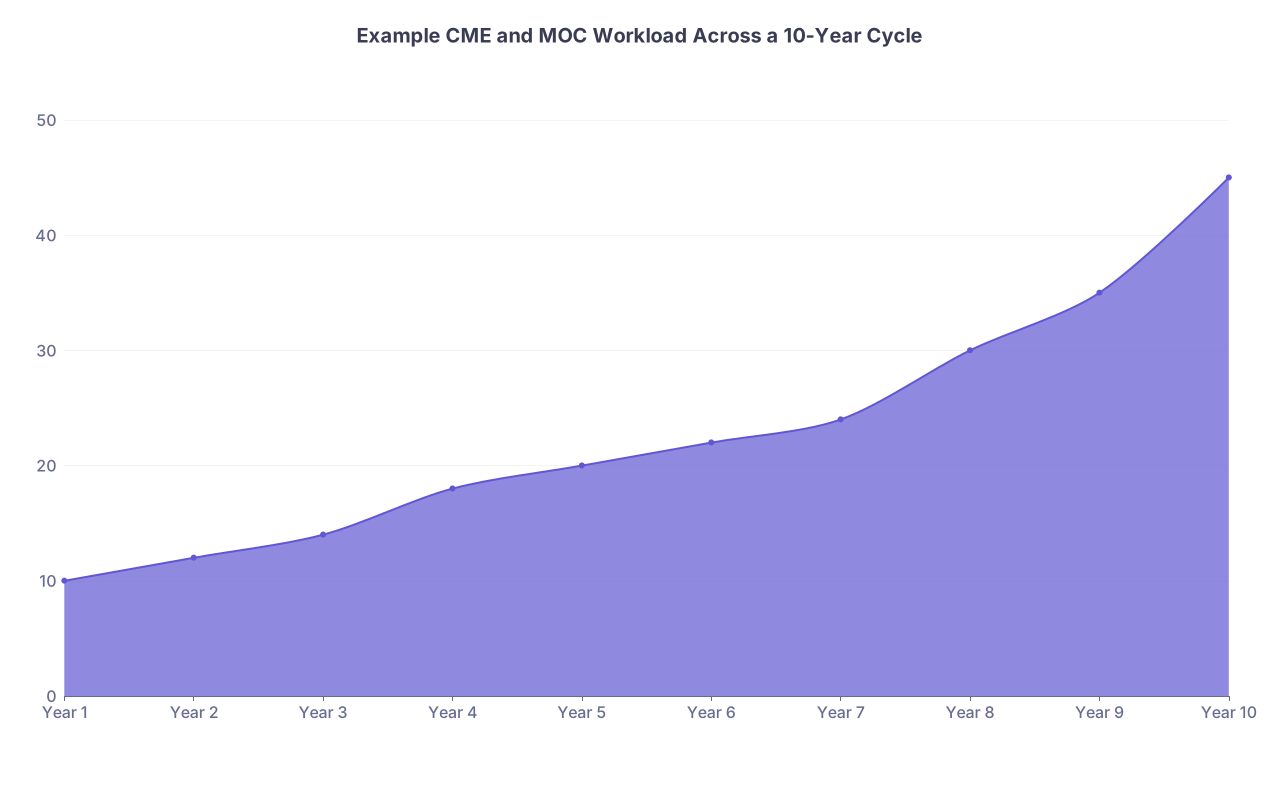
3. Cycle Mechanics: Timing Traps That Catch Busy Subspecialists
Reading only the “total credits per cycle” line is how people get into trouble. The timing rules are where the board gets you.
| Category | Value |
|---|---|
| Year 1 | 10 |
| Year 2 | 12 |
| Year 3 | 14 |
| Year 4 | 18 |
| Year 5 | 20 |
| Year 6 | 22 |
| Year 7 | 24 |
| Year 8 | 30 |
| Year 9 | 35 |
| Year 10 | 45 |
Actual boards use patterns like these:
3.1. Annual or Biennial Participation Requirements
Embedded clauses you will see on ABMS boards:
- “At least one MOC activity every 2 years.”
- “Meet your annual MOC points requirement by December 31 each year.”
- “Participate in continuous certification every year to remain listed as ‘Certified – Meeting Requirements.’”
Translation:
You can no longer ignore MOC for 8 years, then crash-study and binge 200 CME + a board review course in year 9.
Some hospital credentialing committees now look explicitly at your board status wording:
- “Certified” vs
- “Certified – Not Meeting Requirements” vs
- “Lapsed”
If you are technically still within your 10‑year certificate but flagged as “not meeting continuous requirements,” you may have fun explaining that to your credentials committee.
3.2. Recency Windows
Hidden but important language like:
- “Of the 100 CME required in the 10‑year cycle, at least 40 must be earned in the last 3 years”
- “Practice assessment activities must be completed within 36 months of application for recertification”
- “At least X credits must be in the last 24 months”
This kills people who front‑load CME during fellowship or early practice then coast.
Scenario I have actually seen:
- Interventional cardiologist attending his academy’s big meeting 3 years in a row.
- Logs 120 subspecialty‑specific CME in years 1–3, relatively little in years 4–8, then a busy stretch with minimal time for conferences.
- In year 9, discovers that most of his earlier CME is outside the “recent” window the board uses for certain requirements.
- Scrambles to buy expensive online packages to meet “last 2–3 years” criteria.
3.3. Exam vs Longitudinal Pathways
Many boards now offer two tracks:
- Traditional 10‑year high‑stakes exam
- Longitudinal assessment (quarterly or yearly questions, e.g., ABIM LKA, ABR OLA, ABEM MyEMCert modules)
Hidden clause: Some longitudinal pathways double‑count as both assessment and CME, but only if you hit completion thresholds or do them on schedule.
Missed windows, skipped quarters, or incomplete modules can mean:
- You do not get promised CME credits.
- You are kicked back into the exam pathway.
- You are listed as “not meeting requirements,” even though you answered “some” questions.
4. Subspecialty‑Specific Landmines: Concrete Examples
Let us look at how the hidden clauses play out in real subspecialties. These are not abstract.
4.1. Cardiology (ABIM)
Typical structure:
- Internal Medicine board + Cardiovascular Disease subspecialty certificate
- Continuous certification system with annual “MOC points” expectation
- Longitudinal assessment (LKA) or exam option
Key hidden clauses:
- You need a minimum number of MOC points in each 5‑year period. Not just by year 10.
- Some points must be from medical knowledge activities. Others from practice improvement.
- If you hold multiple certificates (e.g., Cardiology + Interventional + EP), you often need to show activity relevant to each area, or you risk one of them lapsing while the others survive.
Common failure pattern:
- Busy interventionalist focuses on general cardiology CME, does no distinct interventional-specific practice assessment or self‑assessment.
- Near the end of cycle, discovers the interventional cardiology certificate is tagged as “not meeting MOC requirements,” even while general cardiology is fine.
4.2. Emergency Medicine (ABEM)
EM boards have a reputation for being very explicit, but people still miss details.
Elements:
- CME credit requirement over a 10‑year period
- LLSA (or newer MyEMCert modules) each cycle
- Practice improvement component
Hidden clauses:
- LLSA / MyEMCert modules are time‑bounded. You cannot simply complete all 10 years’ worth in year 9. Some must be completed within specific windows.
- Certain modules require passing scores on questions to claim both CME and MOC. Just “opening” the module is not sufficient.
- EM subspecialties (toxicology, EMS, pediatric EM) may bolt on their own content expectations.
I have seen EM physicians who completed all necessary hours by going to ACEP every year but neglected the LLSA modules. They thought “conference CME” was the whole story. It is not.
4.3. Radiology / Neuroradiology (ABR)
Radiology is a master class in hidden CME clauses.
- General requirement for CME over the cycle.
- Explicit requirement for SA‑CME (self‑assessment CME), often with a specific number like “75 SA‑CME credits in 10 years.”
- Subspecialty certificates layered on top of general diagnostic radiology.
Hidden clause:
- Watching generic lecture recordings is not automatically SA‑CME. Lectures need integrated questions and accredited self‑assessment designation. Many radiologists discover too late that half their “meeting CME” did not include an SA‑CME component.
- Subspecialty recertification (neuroradiology, IR) may require a fixed number of CME hours specifically labeled relevant to that subspecialty.
4.4. Anesthesiology / Pain Medicine (ABA)
Pain subspecialty is notorious for content‑specific language.
Common patterns:
- 250 CME credits in 10 years, with X% in pain medicine.
- Practice performance assessment (PPA) activities specific to pain treatments or outcomes.
Hidden clauses:
- “Pain‑specific CME” often means the course itself must be accredited and tagged as pain medicine, not just “anesthesiology update.”
- Some boards will not count industry‑sponsored dinner talks for subspecialty-specific requirements, even if they qualify as Category 1 for your state license.
5. The Non‑Obvious Clauses Buried in Fine Print
You will not see these on the front page of your board’s website. They sit in FAQs and policy PDFs nobody reads until there is a problem.
5.1. Limits on Certain CME Sources
Examples of subtle restrictions:
- Caps on simulation-based credit.
- Caps on “teaching” credit or precepting residents / fellows.
- Caps on “journal-based CME” vs live or enduring activities.
- Exclusion of non‑ACCME providers even if they are high quality.
So yes, you might have 40 hours of simulation faculty time or 60 hours of journal club, and your state loves it. Your subspecialty board may count only a fraction or none of it toward MOC.
5.2. Content Restrictions
Some boards discourage or disallow:
- Excessive practice management or billing / coding courses.
- Generic leadership training unless clearly tied to clinical outcomes.
- CME outside your scope (e.g., a pediatric nephrologist with 60 hours in cosmetic dermatology).
The language usually looks like: “CME must be clinically relevant to the diplomate’s area of practice.” The enforcement is sporadic, but if you are ever audited or challenged, this is where you will be forced to justify your choices.
5.3. Double‑Counting and Non‑Counting
Places people assume double‑dipping is allowed when it may not be:
- Using the same QI project for hospital OPPE, system QI recognition, and MOC Part IV can be fine if pre‑approved, but some boards require explicit registration before or during the project.
- Some longitudinal assessments give CME only if you achieve a specific performance threshold or complete a minimum number of questions.
If you are leaning on those programs to meet your CME totals, you need to verify the credit mechanics, not guess.
6. Practical Strategy: How to Not Get Burned by Hidden Clauses
Let us get tactical. How do you stay certified without spending your weekends in a panic clicking through low‑quality slide decks?
6.1. Reverse‑Engineer Your Board’s Rules Once
You need one focused 60–90 minute session where you behave like an adult and read the policies.
Steps I recommend:

| Step | Description |
|---|---|
| Step 1 | Log in to Board Portal |
| Step 2 | Download CME and MOC Policy PDF |
| Step 3 | Identify Cycle Dates and Deadlines |
| Step 4 | List Required CME Types |
| Step 5 | Map Existing Credits to Requirements |
| Step 6 | Identify Gaps and Deadlines |
| Step 7 | Plan Targeted CME Activities |
What you want to know specifically:
- Exact cycle start and end dates
- Total CME required
- Required subcategories (self‑assessment, practice improvement, subspecialty‑specific)
- Any annual or biennial participation expectations
- Rules for longitudinal assessment vs exam pathways
- How they treat multiple subspecialty certificates
Write it on one page. Screenshot it. Whatever. But do it once.
6.2. Build a Minimal, High‑Yield CME Plan
You do not need 14 different platforms. You need 2–3 that are:
- Board‑aligned for your subspecialty
- ACCME‑accredited
- Explicitly labeled for MOC and/or Part IV where relevant
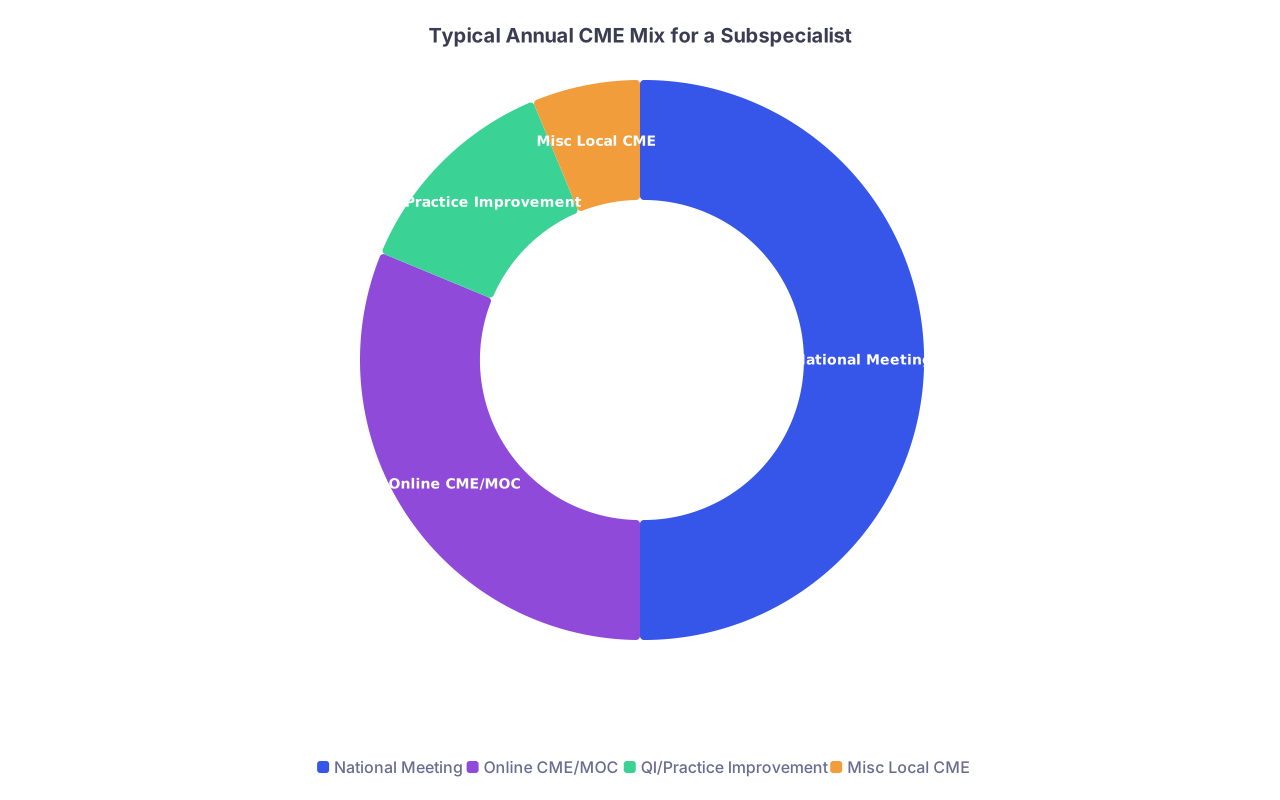
Typical efficient combo:
- Your main subspecialty society’s annual meeting (e.g., ACC, ASN, AASLD, SCCM)
- One high‑quality online CME/MOC provider with board‑specific modules
- An approved QI / registry program that gives Part IV or equivalent
| Category | Value |
|---|---|
| National Meeting | 40 |
| Online CME/MOC | 25 |
| QI/Practice Improvement | 10 |
| Misc Local CME | 5 |
If you hit something like that each year, you are unlikely to find yourself short on any category by the end of your cycle.
6.3. Track the Right Details (Not Just the Hours)
Your spreadsheet or tracking system needs these columns, at minimum:
| Field | Why It Matters |
|---|---|
| Date completed | Valid within cycle and recency windows |
| Provider / sponsor | Confirm ACCME / board approval |
| Subspecialty relevance | Justify content if audited |
| Type (SA, PI, general) | Map to board categories |
| Credits earned | Obvious, but segment by type |
| MOC / Part II / Part IV? | Distinguish for board requirements |
Do not rely solely on hospital CME transcripts. They almost never categorize things by MOC type in a way that matches your subspecialty board.
6.4. Watch Your Board Status Annually
Most boards now show a near‑real‑time dashboard:
- “Certified – Meeting MOC Requirements”
- “Certified – Not Meeting Requirements”
- “Lapsed”
Check it once a year, not once a decade. That way, if you see “not meeting,” you have 11 months to fix it, not 11 days.
7. High‑Risk Profiles: Who Gets Burned Most Often
I see the same types of physicians tripped by hidden CME clauses over and over.
7.1. Multi‑Certified Subspecialists
Examples:
- Cardiologist + Interventional + EP
- Anesthesiologist + Critical Care + Pain
- Internist + Heme/Onc + Palliative Care
Risk:
Assuming that “one big pile” of generic internal medicine CME automatically satisfies all their certificates. Very often, subspecialty certificates expect:
- Explicit practice‑relevant CME
- At least some MOC activity tagged specifically for that subspecialty
7.2. Academic Faculty Who “Teach Instead of Learn”
Academic clinicians often say:
“I teach at national conferences, I run journal clubs, I mentor QI projects – I’m surrounded by education, so I’m fine.”
Not necessarily.
Teaching can count for some state boards. For subspecialty certification, your board usually wants:
- Documented, accredited CME as a learner.
- QI projects that are formally registered and approved for MOC credit.
I have seen distinguished professors scramble for basic CME hours because 20 years of lecturing did not translate into board‑acceptable credits.
7.3. Late‑Cycle Bingers
Physicians who ignore the portal for 7–8 years, then:
- Sign up for a crash review course
- Try to complete 100–150 CME in 6 months
- Discover that self‑assessment and practice improvement components were supposed to happen earlier in the cycle
Yes, you can sometimes get CME credit retroactively tagged for MOC if the provider allows it. But not always. And not all activity types can be “back‑dated” for participation rules.
8. Quick Reality Check: CME Is Now Part of Your Professional Risk Profile
This is not just paperwork. There are real downstream consequences if you miss the hidden clauses.
Potential consequences:
- Loss or lapse of subspecialty certification
- Hospital privileges restricted to general specialty only
- Inability to bill as a subspecialist (e.g., certain payors or networks)
- Credentialing problems when changing jobs or states
- Reputation hit when your online listing changes from “Certified” to “Lapsed”
You do not need to be paranoid. You just need to treat subspecialty CME requirements the same way you treat malpractice coverage or DEA registration: one of the structural things you cannot afford to ignore.
FAQ (Exactly 4 Questions)
1. Can I use fellowship CME or board review course credits toward my first subspecialty recertification cycle?
Sometimes, but not as much as you think. Most boards start counting CME from your initial certification date, not during fellowship. Any CME claimed before your certificate’s start date may not count for that first cycle. Board review courses shortly after initial certification usually count, but always confirm the activity date against your cycle start.
2. Do online question banks or longitudinal assessments automatically count as CME?
No. Some do, some do not. Even within the same platform, certain modules may have CME/MOC designation and others might be “practice only.” You must check for explicit AMA PRA Category 1 designation and, if relevant, MOC Part II / SA credit. And many assessment programs only grant CME if you complete a minimum number of questions or achieve a passing performance.
3. If I am double‑boarded in internal medicine and a subspecialty, can the same CME credits satisfy both sets of requirements?
Yes, often they can, but with nuance. A cardiology board‑review course, for example, may satisfy both general IM and cardiology requirements as long as it is ACCME‑accredited and tagged for your board’s MOC program. However, certain required activities (like subspecialty‑specific practice assessment or QI projects) may be recognized only for the subspecialty certificate. You cannot assume automatic double‑counting; you must check the board’s cross‑credit policies.
4. How do I know if a QI project or registry participation will count for my subspecialty MOC Part IV or practice assessment?
You cannot guess. You need either: (a) a project listed in your board’s directory of approved activities, or (b) pre‑approval through your institution’s MOC portfolio program or your board’s submission process. If you only discover this after the project is finished, you might be able to submit retroactively, but that depends entirely on board policy. Safer move: confirm alignment before you start or at least early in the project, not after the fact.
Key points, without sugarcoating:
- Raw CME hours are not your problem; category‑specific and timing rules are.
- Subspecialty boards hide critical clauses in fine print about self‑assessment, practice improvement, subspecialty relevance, and recency.
- One serious review of your board’s rules, plus a simple tracking system and 2–3 high‑yield CME sources, is usually enough to keep you far away from the panic zone.


