

What actually happens to your CME obligations when you cut your FTE in half—but your license renewal clock doesn’t care?
You’re not the first to get burned here. I’ve seen people drop to 0.6 FTE for family or burnout reasons, assume “less work = less CME,” then get ambushed at license renewal because the board or hospital staff office does not care about their schedule. They care about numbers.
Let’s walk through this like you’re sitting in my office saying, “I’m going 0.5 FTE next quarter; what do I need to change so I don’t screw myself later?”
Step 1: Figure Out Who Actually Cares About Your CME (And What They Want)
You do not have “one” CME requirement. You have multiple overlapping ones. That’s where people get confused.
There are usually four (sometimes five) entities that care:
- State medical board (license)
- Specialty board (MOC/continuing certification)
- Hospital/health system (credentialing/privileges)
- Malpractice carrier (discounts, risk requirements)
- Possibly employer (if different from hospital)
Your FTE change affects each of these differently.
A. State license CME: usually FTE-blind
Most states do not adjust CME hours for part-time status. You’re either licensed or you’re not.
Typical pattern:
- 20–50 CME hours per renewal cycle (often 2 years)
- Some require specific topics (opioids, ethics, HIV, cultural competency, etc.)
- Many accept AMA PRA Category 1 Credits as the standard
Whether you’re 1.0 FTE, 0.5 FTE, or working two shifts a year, they probably want the same number.
Action items:
- Go to your state medical board website.
- Find “Continuing Medical Education Requirements.”
- Look explicitly for any phrase like “exemption,” “reduction,” “retired,” or “inactive.” Most boards that reduce CME do it only for fully retired or “voluntary inactive” status, not part-time.
- Screenshot or print requirements and keep in a “CME master file.”
B. Specialty board (MOC/CC): sometimes flexible, usually not for standard part-time
ABIM, ABFM, ABS, ABA, etc. have their own CME/MOC structures. They care more about certification status than FTE.
Most boards:
- Expect you to meet MOC points over a set cycle (e.g., 100 points over 5 years, plus exam or LKA).
- Don’t reduce requirements just because you went 0.6 FTE.
- Do have pathways for “clinically inactive” or retired status, but that’s different from part-time.
So if you’re still practicing clinically—even 1–2 days per week—assume full MOC requirements apply.
Action items:
- Log into your specialty board portal.
- Look for:
- Current cycle dates.
- Points required.
- Required activities (QI, patient safety modules, exam or LKA, etc.).
- Note what’s due in the next 24 months—this is the window you must plan around if you’re shifting FTE.
C. Hospital/health system: this is where FTE might actually matter
Hospitals sometimes:
- Require a minimum number of CME hours per credentialing cycle (often 2 years).
- Tie certain CME topics to privileges (e.g., sedation, moderate procedural privileges).
- Have internal or risk-management mandated modules.
Some hospitals treat part-time staff the same as full-time. Others have separate “courtesy staff,” “affiliate staff,” or “limited privileges” with looser CME expectations—but also potentially restricted practice.
Do not assume this. Ask.
Action items:
- Email or call Medical Staff Services: “I’m moving to 0.X FTE in [month]. Does that change my CME or privileging requirements?”
- Ask for:
- Written policy or bylaws section around CME.
- Any separate category (per diem, limited, courtesy) with different requirements, if you’re shifting into that.
- Clarify: “Are CME hours prorated for part-time?”
D. Malpractice carrier and employer policy
Malpractice carriers sometimes:
- Offer premium discounts linked to risk-focused CME completion.
- Require certain CME for high-risk procedures or OB, anesthesia, etc.
Employers:
- Often fund CME (stipend + days) based on FTE.
- Rarely reduce required CME, but almost always reduce funded CME when you drop FTE.
So ironically, when you go part-time:
- Requirements stay the same (state, board).
- Money and time to complete CME usually shrink.
That’s the trap.
Step 2: Map Your New Reality – Requirements vs. Resources
You need a one-page snapshot of: “What’s required of me over the next X years” vs. “What time/money I actually have now that I’m part-time.”
Make a grid. Nothing fancy.
| Source | Cycle Length | Hours/Points Required | Adjusts for FTE? | Notes |
|---|---|---|---|---|
| State License | 2 years | 40 hours | No | 2-hour opioid requirement |
| Specialty Board | 5 years | 100 MOC points | No | 1 QI project, 1 LKA track |
| Hospital Privs | 2 years | 25 hours | Maybe | Must show CME in specialty |
| Employer Funding | Annual | $1,500 + 3 days | Yes (pro-rated) | Dropping to 0.6 FTE |
Then ask yourself the uncomfortable question: with my new FTE and life, is this doable with my current approach?
Step 3: Decide Your Actual Practice Identity
Going part-time is not just about hours. It’s about scope.
You can’t maintain every niche you had as a 1.0 FTE and expect part-time life to feel lighter. That includes CME.
You need to make a decision: “What kind of clinician am I now?”
Examples:
Hospitalist going from 14 to 7 shifts/month:
- Maybe you drop procedures (no central lines/LPs) → you no longer need procedural CME.
- Focus CME on core IM updates, sepsis, hospital guidelines.
Outpatient FP going 0.5 FTE to be home more:
- You might stop doing in-office procedures and prenatal care.
- CME then centers on chronic disease management, preventive care, mental health, telehealth.
EM physician dropping to 0.6 FTE at community ED:
- Keep trauma but maybe drop peds sedation if you rarely see it now.
- Shift CME to bread-and-butter EM plus high-risk complaints.
Why this matters: your CME should track your real scope. When you try to maintain full-time complexity on part-time exposure, risk skyrockets. And you waste CME time on skills you no longer use.
Action:
- List what you actively want to keep doing for the next 3–5 years.
- Cross out everything that’s nice for ego but not realistic for your FTE and life.
- Use that list to drive your CME topic priorities.
Step 4: Build a Part-Time-Realistic CME Plan
Now, how to actually get the credits and education without burning the little time you’ve reclaimed.
A. Switch from “event-based” to “workflow-based” CME
As a full-timer, conference-based CME sometimes works: fly to a big meeting, burn 20–25 CME hours in a week.
As a part-timer with less funded time and often less income, the model changes. You don’t want to spend your few free days sitting in windowless ballrooms unless you really love it.
You want:
- CME that can be done in shorter segments.
- CME that fits into low-yield time you already have (e.g., evenings, call downtime, commute if audio-based).
- CME that doubles as board prep or quality improvement, not just check-box hours.
Look for:
- High-yield online CME platforms with:
- 15–60 minute modules.
- Question-based learning.
- MOC integration if needed.
- Podcasts and audio CME you can knock out while driving or walking.
- Hospital grand rounds that offer CME credit (often free and virtual now).
B. Calendar it like a bill, not a hobby
Part-time life fills up. Caregiving, second jobs, side gigs, or just trying to rest. CME will slide to the bottom unless you treat it as non-negotiable.
Practical setup:
- Take your total CME hours required per cycle.
- Divide by cycle length in months.
- Add 25–50% buffer for missed months.
Example:
- Need 40 CME hours in 24 months for your state.
- 40/24 ≈ 1.7 hours per month.
- Round to 2–2.5 hours per month as your goal.
Then:
- Pick 1–2 fixed CME slots a month (e.g., first Tuesday 8–9 p.m., third Saturday morning one hour).
- Put them on your calendar like a shift. Protected.
To keep yourself honest, track progress visually.
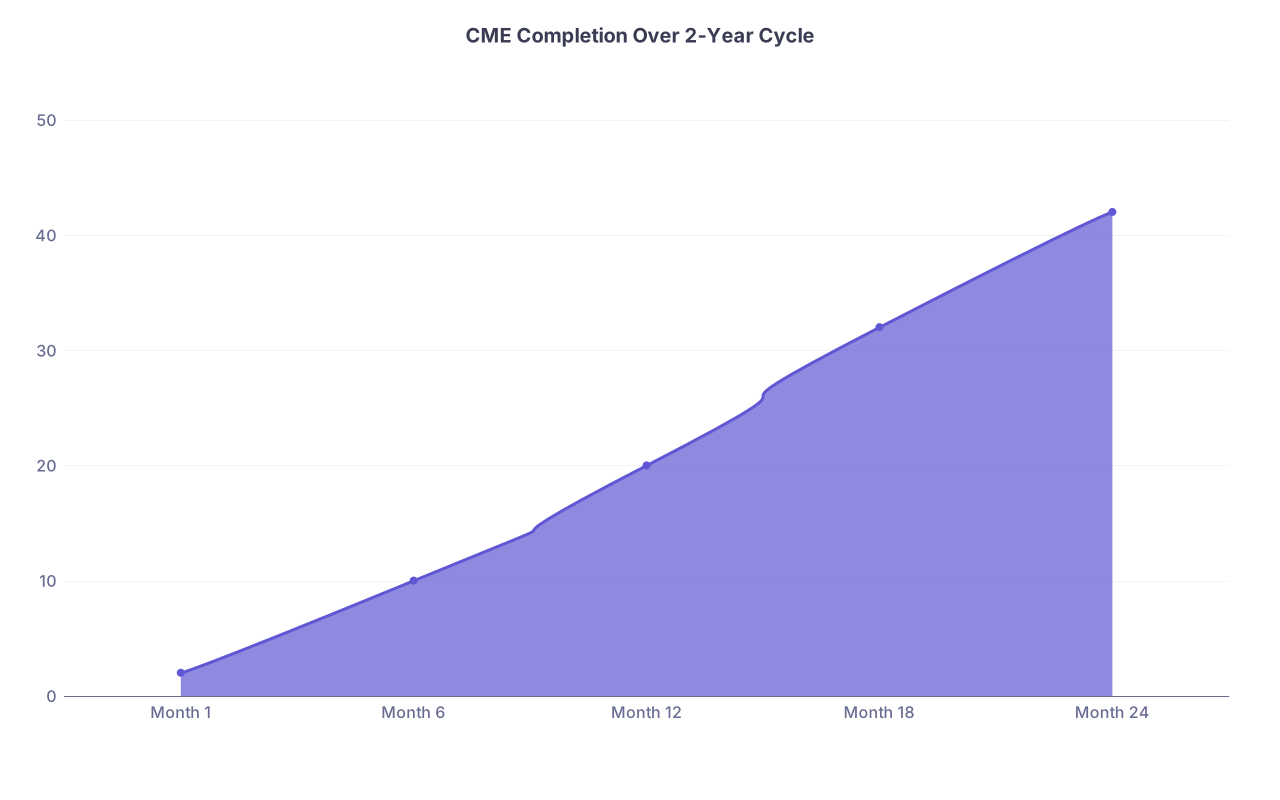
| Category | Value |
|---|---|
| Month 1 | 2 |
| Month 6 | 10 |
| Month 12 | 20 |
| Month 18 | 32 |
| Month 24 | 42 |
You don’t want to be that person cramming 30 credits the month before renewal. That’s when you pick garbage CME “to get hours” and learn nothing.
C. Use your reduced FTE to choose better CME, not just cheaper
One hidden advantage of going part-time: you can be more selective.
As full-time, you may have just clicked through whatever your hospital or employer provided. Part-time, your time is worth more. So prioritize CME that:
- Directly upgrades how you care for patients you actually see.
- Counts for multiple buckets:
- CME hours
- MOC points
- Required topics (opioids, ethics, prescribing)
- QI/practice improvement
If you have a CME stipend that’s been pro-rated but still exists, you might be better off buying one excellent, comprehensive course per year instead of scattering money on random modules.
Examples:
- For IM/hospitalists: annual update courses (ACP, SHM, CoreIM-style platforms).
- For EM: high-risk EM CME, lawsuit case reviews, board-style Q&A.
- For primary care: diabetes intensives, psych in primary care, contraception updates.
Step 5: Don’t Forget the Administrative Landmines
The education is one thing. The paperwork is another—and people mess this part up all the time.
A. Document everything centrally
Physicians love to lose certificates. Different portals. Random PDFs. That’s how you end up panicking at credentialing renewals.
You need a single CME vault. Options:
- A dedicated folder in your cloud drive (Google Drive/OneDrive/Dropbox) with subfolders by year.
- A basic spreadsheet with:
- Date
- Activity name
- Provider
- Credits
- Type (Category 1, MOC, opioid, etc.)
- Notes (which requirement it helps fulfill)
Most boards and hospitals accept self-reported CME with documentation available on request. But when they ask, they often want it fast.
B. Clarify your “part-time” status in writing with everyone
Don’t rely on hallway conversations. You want this nailed down in email or contract addendum.
What you confirm:
- Employer:
- New FTE.
- New CME stipend.
- CME days (if any).
- Any expectations around conference attendance or academic duties.
- Hospital:
- Your medical staff category.
- CME expectations for that category.
- Any special CME tied to privileges you’re keeping.
If a credentialing committee later questions your hours, you want to be able to say: “Here’s the policy, here’s my category, here’s what I did.”
C. Watch the timeline transitions
The trickiest period is the 6–12 months after you change FTE, while old and new cycles overlap.
You might be:
- Finishing an MOC cycle.
- Renewing a license.
- Renewing hospital privileges. All while adjusting to a new schedule and possibly lower pay.
So before your FTE change goes live:
- Pull all your current CME logs and see where you stand.
- If you’re significantly behind in any cycle, consider front-loading some CME before your pay drops and schedule changes.
- After you switch, re-check early—at 3–6 months—to make sure your new CME rhythm actually covers what you need.
Step 6: If You’re Going Very Part-Time or Per Diem
Different scenario: you’re dropping to 0.2–0.3 FTE, or just picking up shifts occasionally.
Then you need to ask a harder question: should I still maintain full certification and privileges?
Sometimes the honest answer is no.
Options people actually take (I’ve seen all three):
Maintain full license and full board certification
- Costs: same CME load, same MOC, same exam/LKA, same costs.
- Use when: you want to keep doors wide open for ramping back up within a few years.
Maintain license, loosen board/cert requirements
- Some boards let you go “not participating in MOC” while keeping a valid license and hospital practice (depends heavily on specialty and institution tolerance).
- May restrict some jobs later (academic centers, competitive groups).
Shift to inactive/retired status for license or board
- Drastically lowers or eliminates CME/U requirements.
- You cannot practice clinically while on inactive in many states.
- Good when you’re functionally retired or doing only non-clinical work and do not intend to go back.
If you’re not sure, default to maintaining full status for 1–2 cycles while you see whether your “short-term part-time” becomes permanent.
Step 7: Make Your CME Match Your New Life, Not Your Old Guilt
Last piece: a bit of mindset.
A lot of physicians going part-time carry guilt. “I’m not pulling my weight.” “I owe it to my patients to stay at full academic speed.” That guilt will push you to overload your CME and try to be a super-subspecialized expert on a 0.5 FTE exposure.
That’s dangerous.
Here’s the better frame:
- You owe your patients competent, current care in the scope you actually practice now.
- You do not owe them mastery of procedures or subspecialty niches you no longer perform.
- You owe yourself a CME strategy that doesn’t recreate burnout in a new form.
So when you evaluate CME opportunities, keep three filters:
- Does this match my actual current scope?
- Does this help fulfill a real requirement (state, board, hospital)?
- Does this fit my new schedule and energy, or will it wreck my week?
If it fails two out of three, skip it.

| Step | Description |
|---|---|
| Step 1 | Decide to go part-time |
| Step 2 | Identify all CME requirements |
| Step 3 | Clarify new FTE and CME funding |
| Step 4 | Define new practice scope |
| Step 5 | Choose CME formats and topics |
| Step 6 | Create monthly CME schedule |
| Step 7 | Track and store documentation |
| Step 8 | Reassess at 6-12 months |
FAQs
1. I’m going from 1.0 to 0.6 FTE. Can I ask my state board to reduce my CME requirement?
Usually no. Most state boards don’t care about FTE; they care whether you hold an active license. They may reduce requirements only for fully retired, inactive, or limited licenses. Check your board’s site, but I would plan on fulfilling the full requirement unless you formally change your license category.
2. My employer cut my CME stipend when I went part-time. How do I do this on a tighter budget?
You prioritize. Drop the big in-person conferences unless they’re doing triple duty (education, networking, certification). Lean on:
- Free hospital grand rounds with CME.
- Free or low-cost online CME from societies.
- Bundled online CME subscriptions that give a lot of hours for a fixed fee.
Also, calendar CME regularly so you’re not paying last-minute premium prices for “emergency credits.”
3. I’m per diem with no formal FTE. Do I still need CME?
If you hold an active license: yes. If you want to keep board certification: yes. Hospital? Usually yes, if you’re on the medical staff. Per diem is not a loophole. The only way out is transitioning to inactive/retired license or board status, in which case your clinical work usually stops.
4. Can I use the same CME activities for state license, board MOC, and hospital privileges?
Often yes. Many activities provide AMA PRA Category 1 Credit and MOC points simultaneously. You may need to claim MOC separately through your board account. For hospitals, any CME that’s relevant to your specialty and documented usually counts. Keep the certificates and log the activity once; just reuse it for the different entities.
5. I’m behind on CME and switching to part-time soon. Should I cram before or after I change schedule?
If you’re significantly behind, front-load while you still have the larger income and possibly more CME funding from your current FTE. Use the months before your FTE cut to catch up on any looming deadlines (license or MOC cycle end). Then, once part-time, shift into a sustainable, small-monthly-dose CME routine instead of swings of panic studying.
Key points:
- Going part-time rarely reduces your formal CME requirements; it mostly reduces your time and money to meet them.
- Redefine your clinical scope and build a CME plan that matches your actual practice and new life, not your previous full-time identity.
- Treat CME like a non-negotiable monthly bill, document it ruthlessly, and check early how your new rhythm lines up with your renewal deadlines.


